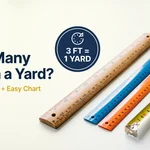
There are exactly 3 feet in a yard. That is also 36 inches, or 0.9144 meters. To turn feet into yards, divide by 3. To go the other way, multiply by 3.
You might be pricing carpet, buying fabric, following a football broadcast, or staring at a fence quote that switches between units. Below you’ll find a chart, the formula, worked examples, and a few mistakes that trip people up.
Quick answer: 1 yard = 3 feet = 36 inches.
Feet → yards: ÷ 3 | Yards → feet: × 3
By [Author name, credentials] · Last updated [date]
Feet in a Yard: Conversion Chart
| Unit | Equals 1 yard |
| Feet | 3 ft |
| Inches | 36 in |
| Centimeters | 91.44 cm |
| Millimeters | 914.4 mm |
| Meters | 0.9144 m |
The metric figures are exact, not rounded. Since the international yard and pound agreement of 1959, the yard has been defined as precisely 0.9144 meters, and NIST publishes the same value. The foot is one third of that, or 0.3048 meters.
How to Convert Feet to Yards
Divide the number of feet by 3.
- 9 feet ÷ 3 = 3 yards
- 14 feet ÷ 3 = ≈ 4.67 yards, or 4 yards and 2 feet
- 30 feet ÷ 3 = 10 yards
Say you’re buying 14 feet of garden edging and the store sells it by the yard. You need about 4.67 yards, so you’d round up to 5 to leave room for cuts. Rounding up is nearly always the safer choice when you’re buying material.
How to Convert Yards to Feet
Multiply the number of yards by 3.
- 2 yards × 3 = 6 feet
- 8 yards × 3 = 24 feet
- 25 yards × 3 = 75 feet
If a sewing pattern calls for 8 yards of fabric, that’s 24 feet of cloth. It sounds like a lot, and a reminder that yards add up faster than most people expect.
Quick Reference: Feet to Yards
| Feet | Yards |
| 3 | 1 |
| 6 | 2 |
| 10 | ≈ 3.33 |
| 12 | 4 |
| 15 | 5 |
| 20 | ≈ 6.67 |
| 30 | 10 |
| 60 | 20 |
| 150 | 50 |
| 300 | 100 |
Multiples of 3 land on whole numbers, which is why 3, 6, 9, and 12 feel tidy. Anything else gives you a decimal, and 0.33 or 0.67 of a yard is just 1 or 2 spare feet.
What Does a Yard Actually Look Like?
Numbers on a page don’t help much when you’re standing in a hardware store without a tape measure. These everyday things come close to 36 inches, so they make good mental rulers:
- A yardstick is the obvious one, exactly 36 inches, usually marked at each foot.
- A standard US kitchen counter is typically about 36 inches tall. Stand next to yours and you’re looking at one yard, floor to surface.
- A 36-inch exterior door is a common size, though 32 inches is also common, so check yours. If it’s 36, that’s a yard of clear width.
- An adult baseball bat runs roughly 31 to 34 inches, and a golf putter roughly 33 to 35, so both fall a little short of a yard.
- Three standard 12-inch rulers laid end to end make exactly one yard.
- Your own stride may be close to a yard. Test it once: pace out 30 feet, count your steps, and divide 30 by that count to get your average step length in feet.
Product sizes vary by brand, so treat these as estimates and confirm with a tape when it matters. If you happen to hold a meter stick, a yard is about 3.4 inches shorter.
Yard vs. Meter
A meter is 39.37 inches. A yard is 36. So a yard is about 8.6% shorter than a meter, and one meter is roughly 1.09 yards. For casual estimates, about the same is fine. For ordering material or cutting lumber, the difference of a few inches matters, so keep the units straight.
Where You’ll See Yards in Everyday Life
- American football: The field is 100 yards between the goal lines, or 300 feet, plus a 10-yard end zone at each end.
- Golf: Distances to the pin are given in yards in the US and many other countries.
- Fabric: Cloth is sold by the yard, and that cut is 36 inches along the length of the bolt. The width depends on the fabric, and many bolts run somewhere from 44 to 60 inches.
- Landscaping and construction: Soil, mulch, gravel, and concrete are sold by the cubic yard.
- Carpet and flooring: Some sellers still price by the square yard, though square feet are common too.
Square Yards and Cubic Yards
This is where most conversion errors happen. Because a yard is 3 feet on every side:
- 1 square yard = 9 square feet (3 × 3)
- 1 cubic yard = 27 cubic feet (3 × 3 × 3)
Don’t multiply by 3 and call it done. If a room is 90 square feet, that’s 10 square yards, not 30. A practical example: a common 2-cubic-foot bag of mulch means you’d need about 13.5 bags to make one cubic yard.
Common Mistakes to Avoid
- Multiplying when you should divide. Going from feet to yards makes the number smaller. If your answer got bigger, flip the operation.
- Using 3 for area or volume. Use 9 for square units and 27 for cubic units.
- Forgetting the fabric width. A yard of fabric describes length only. Two yards of a narrow cloth cover less area than two yards of a wide one.
- Not rounding up. When you buy by the yard, a fraction is usually charged as a full yard, and you’ll want the extra anyway.
A Short Note on the Units
The foot and yard grew out of older, less exact measures, and different countries once defined them slightly differently. The 1959 agreement between the US and several Commonwealth countries fixed the yard at 0.9144 meters and settled the question. One small footnote for surveyors: the older US survey foot differs from the international foot by about two parts per million, and NIST retired it at the end of 2022. For everyday use, the international foot is the one you want.
FAQ
How many feet are in a yard?
Three. One yard equals 3 feet, or 36 inches.
How many yards are in a foot?
One foot is one third of a yard, about 0.33 yards.
How many feet are in 100 yards?
300 feet. That’s the length of an American football field between the goal lines.
Is a yard longer than a meter?
No. A yard is 0.9144 meters, so a meter is about 3.4 inches longer.
How many feet are in a square yard?
A square yard holds 9 square feet, since it measures 3 feet by 3 feet.
Final Thoughts
One yard is exactly 3 feet, or 36 inches, so the whole job comes down to two moves: divide by 3 to go from feet to yards, multiply by 3 to go back. That covers the fence quote, the fabric order, and the game-day distance.
When you’re working with area or volume, remember the bigger factors: 9 square feet per square yard and 27 cubic feet per cubic yard. Pick one or two reference points you can see at home, such as a 36-inch counter or three rulers in a row, and you’ll be able to sanity-check most measurements without reaching for a calculator.
Sources: NIST guidance on the international yard and pound agreement of 1959 and on the retirement of the US survey foot.
Discover More!
How Long Is a Yard? 📏 Exact Answer + Real-Life Examples
Yards in a Mile 📏 1,760 (Plus 15 Things That Match It)
Feet to Yards Conversion: Formula, Chart & Example

I’m Marcus Kane, a measurement content specialist at MeasuresIt.com. I write clear, accurate, and practical articles about measurements, dimensions, conversions, and everyday size comparisons, making complex topics simple and easy to understand.