You’re holding a phone case, a picture frame or a scrap of fabric. The listing says 5 inches, and there’s no ruler in sight.
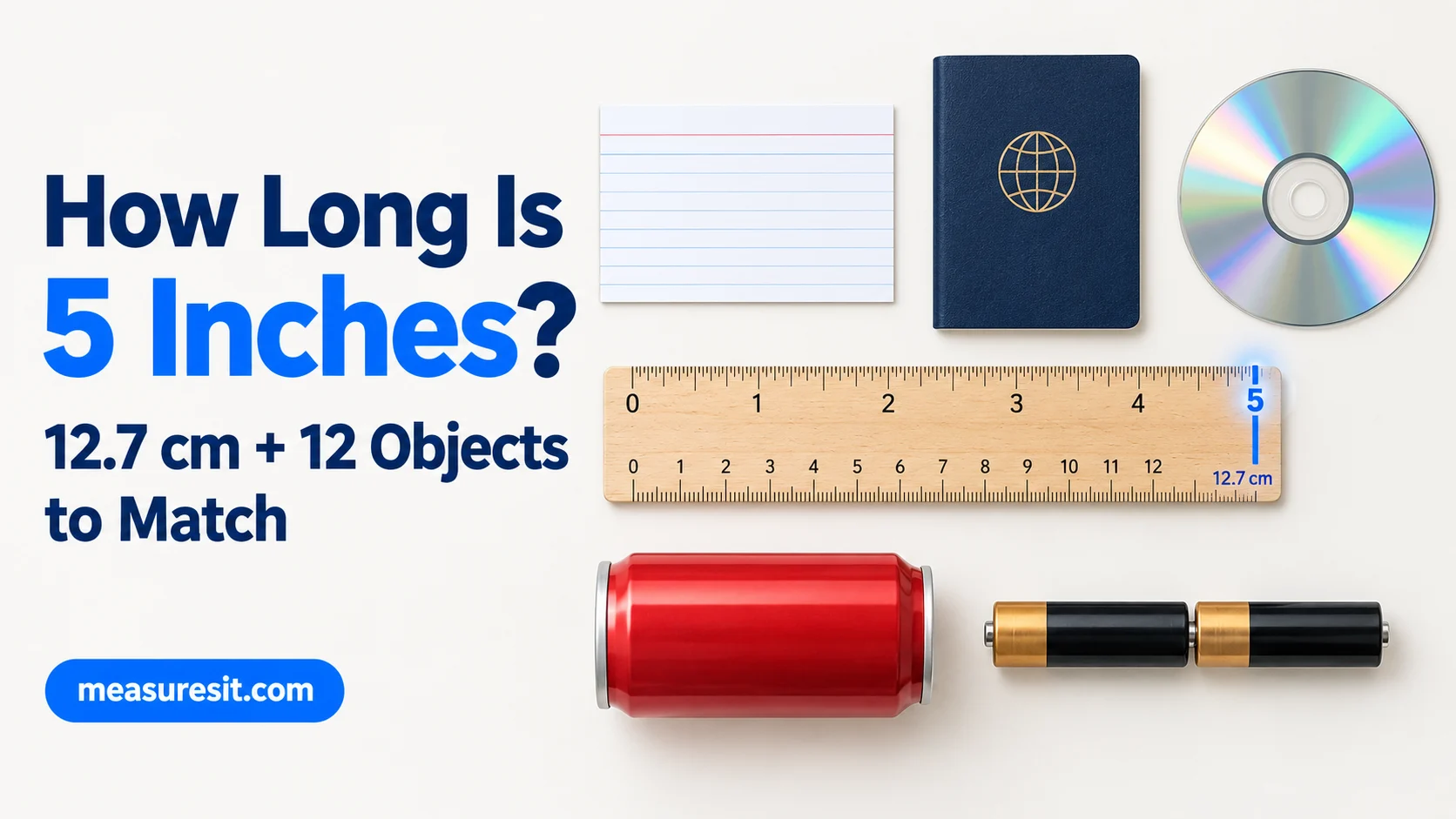
Five inches is 12.7 centimeters (127 millimeters), or about 0.42 of a foot. That is a little less than half of a standard 12-inch ruler, or roughly one and a half credit cards laid end to end.
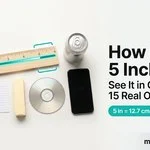
You can check the size with things already in your pocket, drawer or gym bag. Below you’ll find a conversion chart, a plain-English feel for the length, tape measure tips, and 12 everyday objects at or very near 5 inches, each with its published size. That’s handy for online shopping, paper and fabric cuts, packing, or deciding If something fits in a drawer.
Quick facts
- 5 inches = 12.7 cm = 127 mm
- 5 inches ≈ 0.42 feet ≈ 0.14 yards
- Easiest match: the long edge of a 3×5 index card
- On a metric ruler: 7 mm past the 12 cm line
5 Inches in Other Units
Since 1959, the inch has been defined as exactly 25.4 millimeters, so converting is plain multiplication. Multiply inches by 2.54 to get centimeters.
| Unit | Converted Value |
| Inches | 5 in |
| Feet | ≈ 0.42 ft |
| Yards | ≈ 0.14 yd |
| Millimeters | 127 mm |
| Centimeters | 12.7 cm |
| Meters | 0.127 m |
Miles and kilometers are left out because the numbers would be too small to mean anything.
Measurements are rarely a clean 5, so here are the values on either side, including the fractions you’ll find on a tape measure.
| Inches | Centimeters |
| 4 | 10.16 |
| 4½ | 11.43 |
| 4¾ | 12.07 |
| 5 | 12.7 |
| 5¼ | 13.34 |
| 5½ | 13.97 |
| 6 | 15.24 |
Going the other way, 12 cm is 4.72 inches, 13 cm is 5.12 inches, and 15 cm is 5.91 inches.
How Long Is 5 Inches, Really?
Five inches is short enough to fit across your palm, yet long enough that guessing it by eye often goes wrong. Anchors help. A credit card is about 3.4 inches long (85.6 mm), so 5 inches is one card plus about half of another. A US dollar bill runs about 6.1 inches, which makes 5 inches roughly an inch shorter than a bill. Half a foot is 6 inches, and 4 inches is 10.2 cm, so 5 inches sits right in the middle of that range.
Don’t confuse it with 5 centimeters. Five centimeters is only 1.97 inches, so 5 inches is more than two and a half times longer. It’s an easy slip when a product page lists both units.
You can also train your own hand. Spread your thumb and index finger until the gap feels like 5 inches, then check it against a ruler or an index card. Repeat that a couple of times and your hand starts to remember. Hand sizes vary a lot, so calibrate yours instead of borrowing someone else’s rule of thumb.
Reading 5 Inches on a Tape Measure
On the imperial side, every inch is divided into 16 parts, and the long numbered marks are whole inches. Find the number 5 and you’re there. On the metric edge, the same point lands at 12.7 cm, seven millimeters past the 12 cm line.
If the tip of your tape is bent or worn, start at the 1-inch mark and subtract an inch from your reading. The small metal hook at the end is also meant to slide a little. That slack matches the hook’s own thickness, so leave it alone.
When 5 Inches Has to Be Exact
Estimating is fine for shopping, but cutting is different. Three details cause most errors.
Mark with a sharp pencil or a fine knife line, since a thick pencil line can hide an eighth of an inch. Allow for what the cut removes. A typical saw blade takes out about an eighth of an inch of wood, so measure from the side you’re keeping. In sewing, a finished 5-inch square with quarter-inch seams needs to be cut at 5½ inches. Then measure twice, starting from the same point on the tape both times.
12 Everyday Things That Are About 5 Inches
Every size below comes from a published standard or a rule manufacturers follow, so it won’t change much from brand to brand. Sponges, bagels and paper cups are missing on purpose, because a reference that shifts from product to product isn’t much of a reference.
| Object | Which dimension | Approximate length |
| 3×5 index card | Long side | 5 in (12.7 cm) |
| 5×7 photo print | Short side | 5 in (12.7 cm) |
| Two poker-size playing cards | Side by side | ≈ 5 in (12.7 cm) |
| Passport | Height | ≈ 4.9 in (12.5 cm) |
| CD or DVD | Diameter | ≈ 4.7 in (12 cm) |
| US 12-oz soda can | Height | ≈ 4.8 in (12.3 cm) |
| Two D batteries | End to end | ≈ 4.8 in (12.3 cm) |
| Three AAA batteries | End to end | ≈ 5.3 in (13.4 cm) |
| Five US quarters | In a row | ≈ 4.8 in (12.1 cm) |
| Three golf balls | In a row | ≈ 5 in (12.8 cm) |
| Two tennis balls | Stacked | ≈ 5.2 to 5.4 in (13.1 to 13.7 cm) |
| First-generation iPhone SE | Height | ≈ 4.9 in (12.4 cm) |
Not all of these are equally precise. The index card and photo print are exactly 5 inches on the listed side, and the golf balls and playing cards come within a hair. The passport, CD, can, D batteries and quarters run slightly short. The AAA trio and tennis balls run slightly long. If you’re checking that a space is big enough, use a reference that runs long. If you’re checking that an object is small enough, use one that runs short.
Paper, cards and documents
The 3×5 index card is the closest thing to a free 5-inch ruler. The long edge is 5 inches, it turns up in desk drawers and recipe boxes, and it’s stiff enough to hold flat against a shelf or a gap. If you only remember one item from this page, make it this one.
A 5×7 photo print or frame gives you the same 5 inches on its short side, while the 7-inch side shows what a bit longer looks like. Outside the US the same print is sold as 13×18 cm, which is 5.1 × 7.1 inches, close enough to treat as identical.
Poker-size playing cards are 2.5 inches wide, so two lying side by side make 5 inches. Bridge-size cards are narrower at about 2.25 inches, so this trick only works with the standard poker size.
Passports follow an international standard of 125 × 88 mm, so yours is about 4.9 inches tall no matter which country issued it. That’s fine for a packing decision but not for cutting anything.
From the junk drawer
A CD or DVD is 120 mm across, about 4.7 inches. Because it’s round, it’s better for judging lids, small plates and circular crafts than for lengths. Picture a thin extra slice, around a quarter inch, and you have 5 inches.
A US 12-ounce soda can stands about 4.8 inches tall. Many other countries sell 330 ml cans, which are shorter at around 4.5 inches, so check which kind you have.
A D battery is about 2.4 inches (61.5 mm) tall, so two end to end reach roughly 4.8 inches. That’s a quick test for a battery compartment or a gap under a shelf.
Three AAA batteries laid end to end come to about 5.3 inches, since each is close to 1.75 inches long. They overshoot slightly, which makes them useful when you need to confirm that something is at least 5 inches.
A US quarter is 0.955 inches (24.26 mm) across, so five in a row measure about 4.8 inches. Coins are flat and uniform, so they line up neatly against small items. Any coin works if you know its diameter. Seven dimes, for example, make about 4.9 inches.
Sports gear and pocket tech
Golf rules set the minimum ball diameter at 1.68 inches (42.67 mm), and almost every ball sits right at that size. Three golf balls in a row come to about 5 inches, which makes them the most exact reference here after the index card.
Regulation tennis balls are 6.54 to 6.86 cm across, roughly 2.6 to 2.7 inches, so two stacked reach about 5.2 to 5.4 inches. They help you picture 5 inches in three dimensions, like the height of a small jar or vase.
Older compact phones such as the first-generation iPhone SE and the iPhone 5 are about 4.9 inches tall (123.8 mm). Current phones are much longer, so this only works with the old compact models.
Where You’ll Run Into 5 Inches
Screens are the most common source of confusion. A phone with a 5-inch screen measures 5 inches diagonally across the display only, so the device itself is taller and wider than that number suggests.
In quilting, 5-inch squares are a standard precut size, sold as charm packs. If a pattern calls for them, cutting your own from larger fabric means measuring 5 inches carefully, plus seam allowance if the pieces will be sewn.
In footwear, a 5-inch heel is in stiletto territory. Most everyday heels are far lower, so it’s a useful number to picture before you order shoes online.
FAQ
Is 5 inches bigger than 12 cm?
Yes, slightly. Five inches is 12.7 cm, so it’s 7 mm longer than 12 cm.
Is 5 inches half a foot?
No. Half a foot is 6 inches. Five inches is about 42 percent of a foot.
What’s the easiest way to measure 5 inches without a ruler?
Use the long edge of a 3×5 index card. Without one, three golf balls in a row or two poker-size playing cards side by side both come to about 5 inches.
Does a 5-inch phone screen mean the phone is 5 inches tall?
No. Screen size is measured on the diagonal, corner to corner, on the display only. The phone is taller than the number in the listing.
Final Thoughts
Five inches is a modest length that’s surprisingly hard to judge by eye, but you don’t need a ruler to get it right. Remember 12.7 cm, remember that it’s a little under half a foot, and keep one dependable reference within reach: the long edge of a 3×5 index card. Without a card, three golf balls, two poker-size cards or two D batteries all get you within about a quarter inch.
Use these matches as a fast guide for shopping listings, craft cuts and packing decisions. When a fit is tight or a cut is permanent, confirm it with a real tape measure. A quarter inch is easy to miss and expensive to fix.
Keep in mind
- 5 in = 12.7 cm = 127 mm
- Best quick reference: the long side of a 3×5 card
- Slightly short: passport, CD, quarters. Slightly long: AAA trio, tennis balls
- Confirm with a tape measure whenever precision matters
Discover More About!
- How Tall Is 59 Inches? Everyday Objects That Show You Exactly
- How Tall Is 70 Inches? See It in Feet, CM & Real-Life Objects
- Inches in a Yard: The Fast, Foolproof Conversion Guide

I’m Elena Cross, a content writer at MeasuresIt.com, where I turn complex measures, units, and mathematical concepts into clear, accurate, and easy-to-read articles. I’m passionate about precision in numbers and in words and I write to help readers actually understand measurements, not just memorize them.