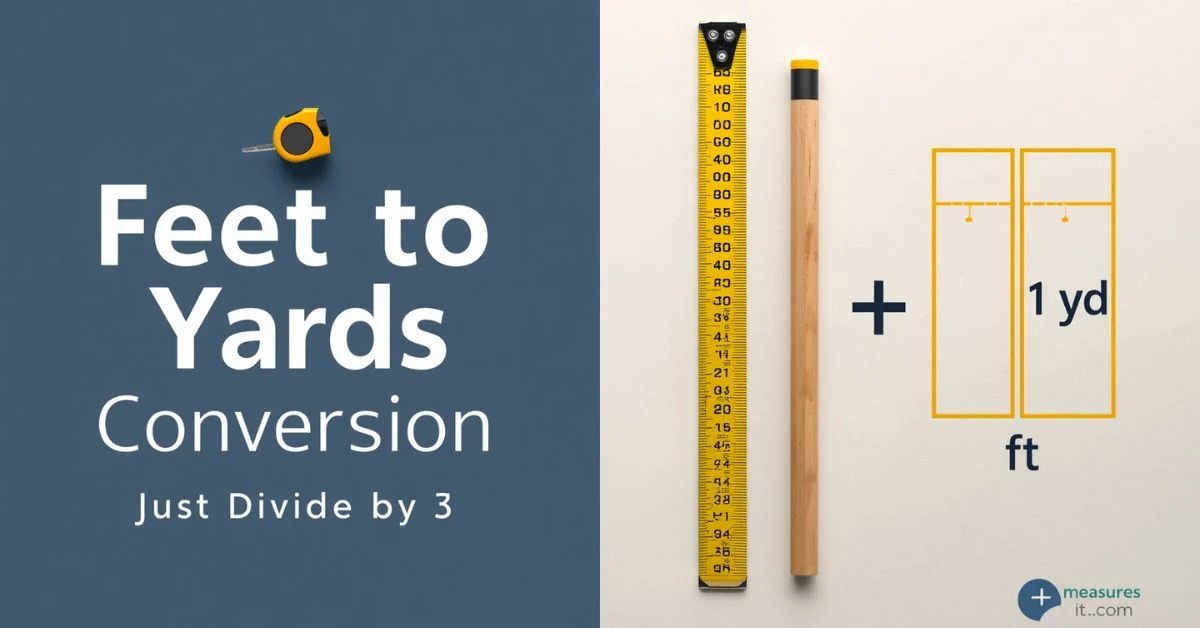
You’ve got a tape measure reading 45 feet, and the store sells by the yard. Before you order, you need the number in yards.
Quick answer: Divide the feet by 3. One yard is exactly 3 feet, so 45 feet is 15 yards.
Going the other way, multiply yards by 3. Ten yards is 30 feet.
That single rule is all you need for fabric, garden edging, rope, or the distance to the end zone. It gets trickier with area and volume, where a yard is not 3 units, and that’s where most buying mistakes happen. This guide covers the formula, a chart you can scan in seconds, and a few real jobs worked through step by step.
The Formula
yards = feet ÷ 3
Some numbers divide evenly. Most don’t, and you have two ways to say the answer:
- 18 feet ÷ 3 = 6 yards
- 25 feet ÷ 3 = 8.33 yards, or 8 yards 1 foot
- 47 feet ÷ 3 = 15.67 yards, or 15 yards 2 feet
The yards and feet form is often easier on a job site, since you can read it straight off a tape. Use the decimal when you’re typing it into an order form.
If your measurement includes inches, turn the inches into a fraction of a foot first. A wall that’s 10 feet 6 inches is 10.5 feet (6 inches is half a foot). Then 10.5 ÷ 3 = 3.5 yards.
Why 3? The yard is defined as 36 inches, and a foot is 12 inches. Since 1959, the US and other English-speaking countries have used the international yard, which is exactly 0.9144 meters. NIST publishes the official definitions if you want to check.
Feet to Yards Chart
| Feet | Yards |
| 1 | ≈ 0.33 |
| 2 | ≈ 0.67 |
| 3 | 1 |
| 5 | ≈ 1.67 |
| 6 | 2 |
| 9 | 3 |
| 10 | ≈ 3.33 |
| 12 | 4 |
| 15 | 5 |
| 20 | ≈ 6.67 |
| 30 | 10 |
| 50 | ≈ 16.67 |
| 100 | ≈ 33.33 |
| 300 | 100 |
| 1,000 | ≈ 333.33 |
| 5,280 (1 mile) | 1,760 |
And the reverse, for when you’re starting from yards:
| Yards | Feet |
| 1 | 3 |
| 2 | 6 |
| 5 | 15 |
| 10 | 30 |
| 25 | 75 |
| 50 | 150 |
| 100 | 300 |
Three Jobs, Worked Through
A formula is easy. Applying it to a real project is where people slip, so here are three common ones.
Garden edging sold by the yard. Your bed runs 60 feet around. 60 ÷ 3 = 20 yards. Buy a little extra for cuts and corners.
Carpet for a room. Carpet is priced by the square yard. A room that’s 12 feet by 15 feet is 180 square feet. One square yard is 3 ft × 3 ft = 9 square feet, so 180 ÷ 9 = 20 square yards. Installers add extra for seams and waste, so treat 20 as your minimum.
Concrete or mulch by the cubic yard. These are sold by volume, and one cubic yard is 3 ft × 3 ft × 3 ft = 27 cubic feet.
- A slab 10 feet by 12 feet and 4 inches thick (that’s ⅓ of a foot) holds 40 cubic feet. 40 ÷ 27 ≈ 1.48 cubic yards.
- A mulch bed 20 feet by 5 feet at 3 inches deep (¼ foot) holds 25 cubic feet, or about 0.93 cubic yards. One yard covers it.
Mistakes That Cost People Money
- Dividing by 3 when the unit is squared or cubed. For square yards you divide square feet by 9. For cubic yards you divide cubic feet by 27. Dividing by 3 would leave you with three to nine times too much material.
- Mixing inches into a decimal. 10 feet 6 inches is 10.5 feet, not 10.6. Convert inches by dividing by 12.
- Rounding down. For anything you’ll cut, trim or pour, round up. Running short by a foot usually costs more than an extra yard.
- Confusing a yard with a meter. They’re close but not equal: a meter is about 1.09 yards. It matters on a big order.
What a Yard Looks Like
If you’re away from a tape measure, these common things land close to 3 feet:
- A kitchen counter. Standard US counters are about 36 inches high, which is exactly a yard.
- A doorknob. They’re often mounted around 36 inches up, though building codes allow some variation.
- An adult baseball bat. Usually 32 to 34 inches, so add a hand’s width.
- A full-size skateboard. About 31 to 33 inches long.
- A two-year-old. Many are around 34 inches tall, though children vary a lot.
- A yardstick. Exactly 36 inches. It’s the one to keep in the drawer.
For big distances, the reference is a football field: 100 yards between the goal lines, which is 300 feet.
Related Conversions
| Unit | Equals |
| 1 yard | 3 feet |
| 1 yard | 36 inches |
| 1 yard | 0.9144 meters (91.44 cm) |
| 1 foot | 0.3048 meters |
| 1 meter | ≈ 1.0936 yards |
| 1 mile | 1,760 yards (5,280 feet) |
| 1 square yard | 9 square feet |
| 1 cubic yard | 27 cubic feet |
FAQ
How do you convert feet to yards?
Divide the number of feet by 3. For example, 21 feet ÷ 3 = 7 yards.
How many feet are in a yard?
Exactly 3 feet.
How many yards are in 100 feet?
About 33.33 yards, or 33 yards and 1 foot.
Is a yard longer than a meter?
No, a meter is slightly longer. A yard is 0.9144 meters, so a meter is about 1.09 yards.
How do I convert square feet to square yards?
Divide by 9. A 180-square-foot room is 20 square yards.
Final Thoughts
Every feet to yards conversion comes down to one move.
Divide feet by 3 to get yards. Multiply yards by 3 to get feet.
For area, divide by 9. For volume, divide by 27.
Get those three numbers right and you can handle almost any project. Measure carefully, convert once, and round up before you order. When a number doesn’t divide evenly, 8 yards 1 foot is a perfectly good answer.
Discover More!
- How Tall Is a Monster Can? Exact Height & Size Guide
- Red Bull Can Dimensions: Height, Width & Size Guide
- How to Convert Measurements: Units & Charts Guide

I’m Elena Cross, a content writer at MeasuresIt.com, where I turn complex measures, units, and mathematical concepts into clear, accurate, and easy-to-read articles. I’m passionate about precision in numbers and in words and I write to help readers actually understand measurements, not just memorize them.








1 thought on “Feet to Yards Conversion: Formula, Chart & Example”