You are checking a running route, and the map says 0.5 miles while your coach talks in yards. Or a homework sheet asks you to convert miles to yards and the numbers look strange.
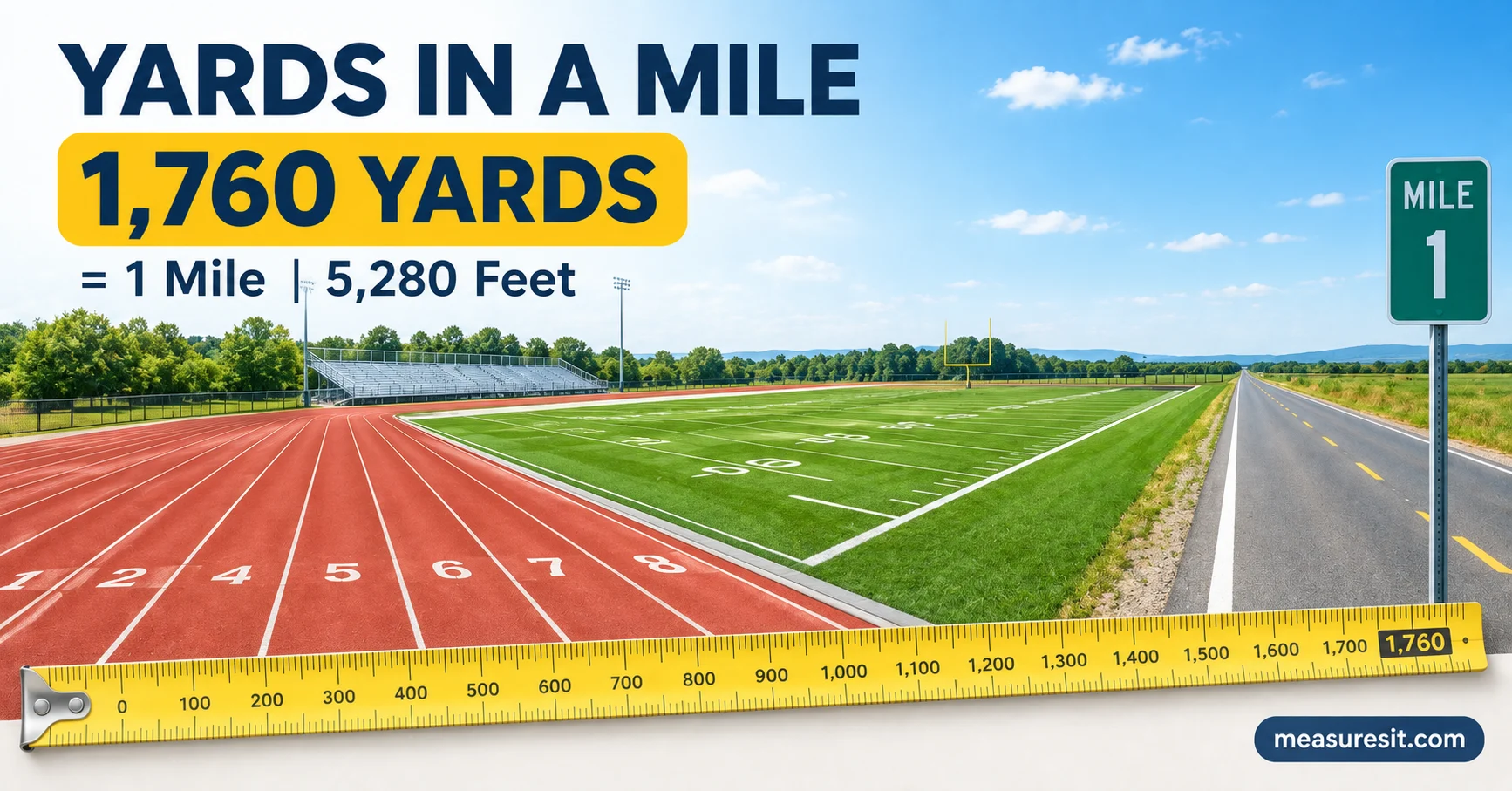
There are 1,760 yards in a mile, and since each yard is 3 feet, a mile is also 5,280 feet. That answers how many yards are in a mile, and the number is the same in the US and the UK.
Knowing the yards in a mile helps with track workouts, golf yardage, fence and land measuring, and school math.
This guide gives you a quick chart, a simple formula, and 15 everyday things that are about a mile long, so the distance feels real and not just like a number on a page.
Yards in a Mile: Quick Conversion Chart
Here is what one mile equals in other units. To convert any number of miles to yards, multiply by 1,760. To go the other way, divide yards by 1,760.
| Unit | Converted Value |
| Yards | 1,760 yd |
| Feet | 5,280 ft |
| Inches | 63,360 in |
| Meters | ≈ 1,609.34 m |
| Kilometers | ≈ 1.61 km |
| Furlongs | 8 |
| Chains | 80 |
| Nautical miles | ≈ 0.87 |
15 Common Things That Are About a Mile Long
Common Things That Are About a Mile (1,760 Yards)
| Item | Approximate Length |
| Four laps of a running track (400 m) | ≈ 1,750 yd |
| 17.6 football fields end to end | 1,760 yd |
| Eight furlongs at the racetrack | 1,760 yd |
| 80 cricket pitches | 1,760 yd |
| 70 lengths of a 25-yard pool | ≈ 1,750 yd |
| Eight Chicago city blocks | ≈ 1,760 yd |
| 20 Manhattan blocks (north–south) | ≈ 1,760 yd |
| Denver’s elevation | 5,280 ft (1,760 yd) up |
More Everyday Items Around a Mile
| Item | Approximate Length |
| Highway mile markers | 1,760 yd apart |
| One minute at 60 mph | 1,760 yd |
| A brisk walk (15–20 minutes) | ≈ 1,760 yd |
| Home-run trots (about 15) | ≈ 1,760 yd |
| Two Burj Khalifas stacked | ≈ 1,811 yd |
| About 23 Boeing 747s nose to tail | ≈ 1,760 yd |
| The Brooklyn Bridge | ≈ 2,000 yd |
How Long Is a Mile in Yards?
A mile is 1,760 yards long, which is about 1.61 kilometers. For most adults, that is a 15 to 20 minute walk. Half a mile is 880 yards, a quarter mile is 440 yards, and a tenth of a mile is 176 yards.
A kilometer is a shorter reference at about 1,094 yards, so a mile is roughly 60 percent longer. Going the other way, a 5K race is about 3.1 miles, or around 5,468 yards. That makes one mile close to a third of a 5K.
Easy ways to estimate a mile in everyday life
- Count laps: On a standard 400-meter track, four laps get you very close to a mile.
- Use football fields: Each one is 100 yards between the goal lines, and about 17.6 make a mile.
- Watch the clock: A brisk walk takes 15 to 20 minutes, and a car at 60 mph covers a mile every minute.
- Check the odometer: Most car odometers show tenths of a mile, and each tenth is 176 yards.
- Use a map app or fitness tracker: They report miles, so multiply by 1,760 to get yards.
- Count city blocks: In a grid city, eight blocks in Chicago or about 20 short blocks in Manhattan make a mile.
1. Four Laps Around a Running Track
A standard outdoor track is 400 meters around, so four laps add up to 1,600 meters, or about 1,750 yards. That falls just short of a mile. Race officials add roughly 9 meters to make it exact, which is why a mile race starts a few steps behind the usual line. If you have ever jogged four laps at a school field, you have covered almost a full mile. After four laps, you have only about 10 yards left to go.
2. Seventeen and a Half Football Fields
Between the goal lines, an American football field measures 100 yards. Stack 17.6 of them end to end and you reach 1,760 yards. Most people can picture a stadium from TV, so this comparison is easy to hold in your head. Each field is a little over 5 percent of a mile. If you count the end zones, each field grows to 120 yards, and the count drops to about 14.7 fields.
3. Eight Furlongs at the Racetrack
A furlong is 220 yards, exactly one-eighth of a mile. The word comes from an old farming measure, the length of a furrow in a plowed field. Horse racing still uses it, and a one-mile race is simply eight furlongs. When a commentator says the horses have a furlong to go, they are about 220 yards from the finish. That is two football fields plus 20 yards.
4. Eighty Cricket Pitches
The strip between the wickets in cricket is 22 yards long. Land surveyors once used a measuring chain of the same length, and that unit is still called a chain. Eighty of them make a mile, since 80 × 22 equals 1,760. This one works well if you know the game, because a cricket pitch keeps the same length wherever it is played. Picture a line of 80 pitches and you have your mile.
5. Seventy Lengths of a 25-Yard Pool
Many US school and club pools are 25 yards long. Divide 1,760 by 25 and you get 70.4 lengths, or 35 trips down and back. Swimmers call the 1,650-yard freestyle “the mile,” but it is only 66 lengths, which stops 110 yards short of a true mile. So when a swimmer says they did a mile in the pool, the yards tell the real story.
6. Eight Chicago City Blocks
Chicago’s street grid makes distance easy. Its address numbers run in hundreds, and eight city blocks equal about one mile. That puts a typical block at roughly 220 yards, the same as a furlong. Locals often give directions in blocks and know that an eight-block walk is a mile. The same trick works in any city with a regular grid, but check the block length first.
7. Twenty Manhattan Blocks
In Manhattan, the short blocks between cross streets run about 264 feet, or 88 yards. Twenty of them make a mile. The longer blocks between avenues are much bigger, so this only works when you walk uptown or downtown. It is a handy rule for visitors, because street numbers give you a running count. Walking from 20th Street to 40th Street covers about a mile.
8. Denver’s Mile-High Elevation
Denver is called the Mile High City because its elevation is about 5,280 feet above sea level. That is 1,760 yards straight up. A marker on the steps of the Colorado State Capitol shows the exact mile height. Instead of a flat distance, this reference gives you a vertical one. Picture 17 and a half football fields stacked on end, and you get a sense of how high that is.
9. Highway Mile Markers
The small green signs along highways count miles, and each one sits a mile from the next. They are the easiest reference you will ever find, because the road hands you the number. Drivers use them to report a breakdown or to work out how far away an exit is. In many places the numbers rise as you travel, so subtracting one from another tells you the distance. Two markers passing by equal 1,760 yards.
10. One Minute at 60 mph
A car traveling at 60 miles per hour covers exactly one mile every minute. That works out to 88 feet per second, or about 29 yards. Driving at 30 mph takes two minutes for the same distance. This reference suits road trips, since the dashboard clock tells you how far you have gone. Time a steady highway stretch and check it yourself.
11. A Brisk Walk of 15 to 20 Minutes
Many adults walk a mile in about 15 to 20 minutes at a steady pace. A relaxed stroll can take longer. Step counts change with height and stride, but roughly 2,000 to 2,500 steps cover a mile. Fitness trackers lean on this kind of math all day. If you walk to the shops and back in half an hour, you have probably covered somewhere between a mile and a half and two miles.
12. About 15 Home-Run Trots
On a regulation baseball diamond, the bases are 90 feet apart. A trip around all four is 360 feet, or 120 yards. Divide 1,760 by 120 and you get about 14.7 trips. So a mile is roughly 15 home-run trots in a row. Each trip feels short, which is exactly why a mile turns out to be longer than most people expect. This comparison fits full-size fields, since youth diamonds use shorter bases.
13. Two Burj Khalifas Stacked
The Burj Khalifa in Dubai stands about 828 meters, or roughly 906 yards, tall. Two of them stacked reach 1,656 meters, or about 1,811 yards. That is just over a mile, about 1.03 miles. It is a bold way to picture a mile going straight up, and it also shows how tall the Burj Khalifa really is when you measure it against something you already know.
14. About 23 Boeing 747s Nose to Tail
A Boeing 747-400 jumbo jet is roughly 231 feet long, which is about 77 yards. Line up 23 of them nose to tail and you have a mile. If you have ever watched a jumbo jet roll down a runway, remember that a mile is 23 of those in a row. It is a big-scale comparison, and it works well for anyone who has spent time around airports.
15. The Brooklyn Bridge
The Brooklyn Bridge, including its approaches, is about 5,989 feet long, or roughly 1.1 miles. In yards, that is close to 2,000. It runs a little longer than a mile, so use it as an upper marker. Walkers and cyclists cross it every day, which makes it a familiar comparison for anyone who has visited New York City and strolled across.
FAQ
How many yards are in half a mile?
Half a mile is 880 yards. A quarter mile is 440 yards, and a tenth of a mile is 176 yards.
How many football fields make a mile?
About 17.6 football fields, counting 100 yards per field between the goal lines.
Is a nautical mile the same as a regular mile?
No. A nautical mile is 1,852 meters, or about 2,025 yards, so it is longer than a standard mile of 1,760 yards. Ships and aircraft use it.
How do I convert miles to yards?
Multiply the number of miles by 1,760. For example, 3 miles × 1,760 = 5,280 yards. To go the other way, divide yards by 1,760.
Final Thoughts
The yards in a mile come down to one number: 1,760. Once you know it, the other conversions follow, from 880 yards in half a mile to 5,280 feet in a full one. You do not need a measuring wheel to feel that distance.
Four laps around a track, seventeen and a half football fields, a minute at highway speed, or a brisk walk of 15 minutes all land close to a mile. Use whichever fits the moment. Runners can check a track workout, golfers can make sense of yardage, and anyone planning a fence line, a hike or a road trip can turn miles into yards without a calculator.
Keep two or three of these pictures handy, and the next time someone asks how far a mile is, you will have a real answer.
Discover More!
- How Tall Is a Monster Can? Exact Height & Size Guide
- What Is a Yard? 📏 Simple Answer + 15 Everyday Examples
- How Long Is a Yard? 📏 Exact Answer + Real-Life Examples

I’m Marcus Kane, a measurement content specialist at MeasuresIt.com. I write clear, accurate, and practical articles about measurements, dimensions, conversions, and everyday size comparisons, making complex topics simple and easy to understand.










2 thoughts on “Yards in a Mile 📏 1,760 (Plus 15 Things That Match It)”