You’re halfway through ordering sleeves, and the listing says “fits standard-size cards.” Standard compared to what?
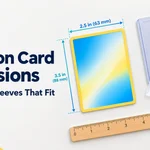
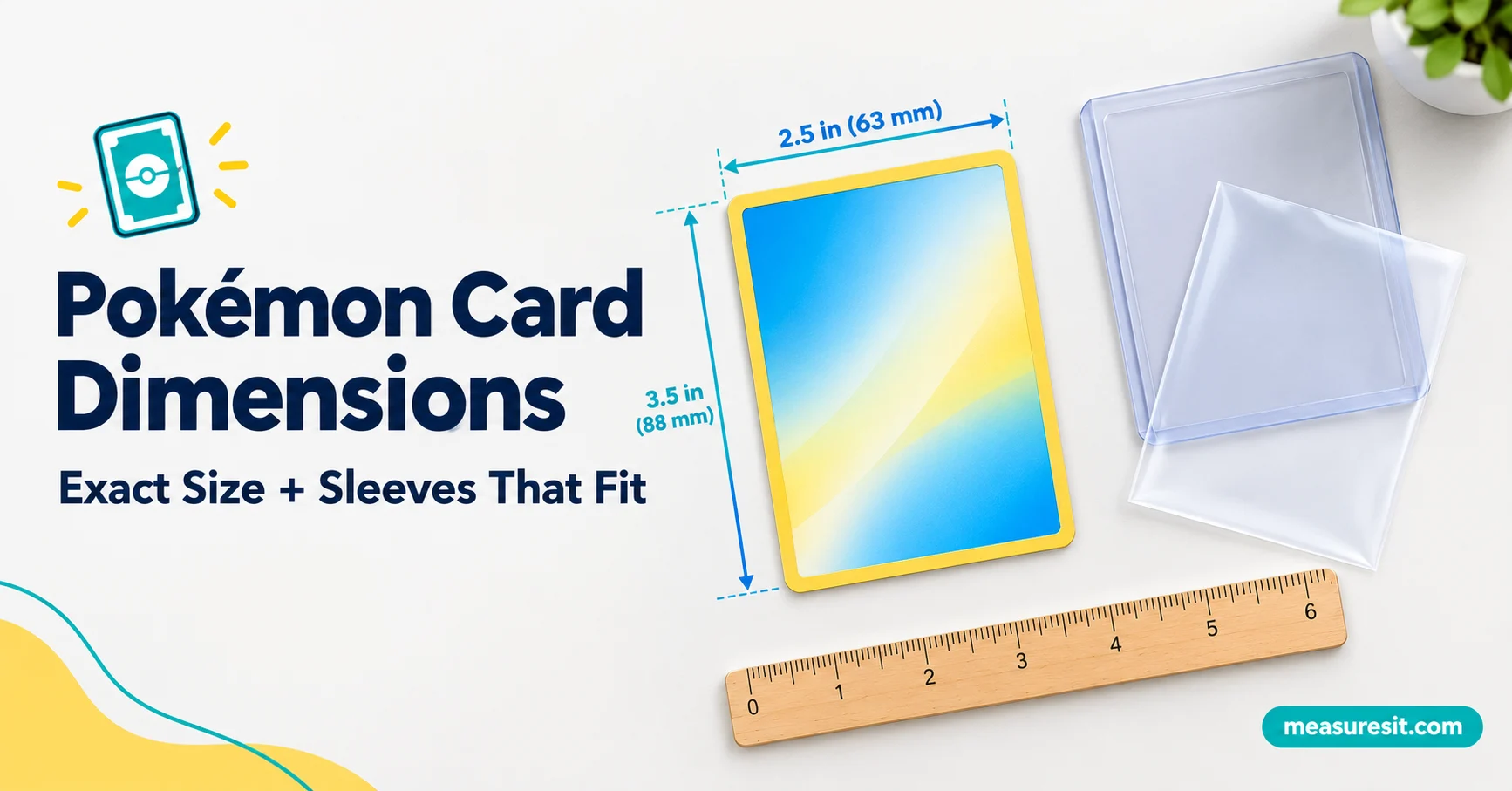
A standard Pokémon card is 2.5 inches wide by 3.5 inches tall (63 × 88 mm, or 6.3 × 8.8 cm) and roughly 0.3 mm thick. English and Japanese cards share that size, and so do Magic: The Gathering cards, poker playing cards, and most sports cards. That overlap is why so much card gear works across games, and why Yu-Gi-Oh! gear, which is cut smaller, usually doesn’t.
Below you’ll find the full measurements, how the card compares with others, which sleeves and holders fit, the odd sizes like jumbo promos, and a simple way to measure your own.
Quick answer
- Size: 2.5 × 3.5 in (63 × 88 mm)
- Thickness: about 0.3 mm
- Same size as: poker cards, Magic cards, standard sports cards
- Not the same as: Yu-Gi-Oh! cards (smaller) and jumbo promos (larger)
- Sleeve to buy: one labeled for standard-size cards
Pokémon Card Dimensions at a Glance
| Measurement | Inches | Metric |
| Width | 2.5 in | 63 mm (6.3 cm) |
| Height | 3.5 in | 88 mm (8.8 cm) |
| Thickness | about 0.012 in | about 0.3 mm |
| Surface area (one side) | 8.75 sq in | about 55 sq cm |
The width-to-height ratio is close to 5:7, and the corners are rounded. A single card weighs only a couple of grams, so size and weight rarely matter for shipping until you add holders and mailers.
How a Pokémon Card Compares With Other Cards
If you already own another card game, you have a free size reference. A poker-size playing card, a Magic card, and a regular sports card match a Pokémon card so closely that you can’t tell them apart by outline.
| Card | Size | Compared with a Pokémon card |
| Poker playing card | 2.5 × 3.5 in | Same |
| Magic: The Gathering | 63 × 88 mm | Same |
| Standard sports card | 2.5 × 3.5 in | Same |
| Wallet-size photo | 2.5 × 3.5 in | Same |
| Yu-Gi-Oh! card | about 59 × 86 mm | A few mm smaller each way |
| Bridge playing card | about 57 × 89 mm | Same height, about 6 mm narrower |
| Credit card (held upright) | about 54 × 86 mm | About 9 mm narrower, 2 mm shorter |
| Tarot cards | Varies by deck | Usually taller and a little wider |
Two near misses are worth remembering. Yu-Gi-Oh! cards are small enough that a Pokémon card won’t slide into Yu-Gi-Oh! sleeves without bending. Bridge-size cards match the height but come up noticeably narrower, which you can feel when you hold them side by side.
Sleeves, Toploaders, and Binders: What Actually Fits
Sleeve listings are where the size question starts costing money. Here is what each common product is built for.
| Product | Typical size | Best for |
| Penny sleeve | about 2.6 × 3.6 in | A thin first layer, loose fit |
| Perfect-fit (inner) sleeve | Made to hug a standard card | Going inside a standard sleeve for double sleeving |
| Standard deck sleeve | about 66 × 91 mm | Snug protection for standard-size cards |
| Toploader | about 3 × 4 in outside | A rigid holder for one card |
| 9-pocket binder page | Pockets for standard-size cards | Checking whether a sleeved card still fits |
Sizes vary by brand by a millimeter or two, so read the stated card size on the product page rather than trusting the category name. Graded slabs are bigger than toploaders, and each grading company has its own dimensions, so confirm them before you buy a display case.
Jumbo, Mini, Japanese, and Digital Cards
- Japanese cards use the same 63 × 88 mm size as English ones. The confusion comes from sleeves: products sold as “Japanese size” are usually cut for smaller cards, such as Yu-Gi-Oh!, and won’t fit.
- Jumbo cards are oversized promos. Sizes vary by release, and some have several times the area of a standard card, so check the product listing before buying a holder.
- Mini cards are smaller than standard and often come in tins. Their sizes vary by product.
- Pokémon TCG Pocket is digital, so there is no physical card size to worry about.
How to Measure Your Own Card
Measuring takes a minute and settles most doubts, especially if a card feels off.
- Take the card out of any sleeve and lay it on a flat surface.
- Line one edge up with the ruler’s zero mark. Many rulers start a few millimeters in from the physical end, so don’t use the end itself. Read the width in millimeters, then the height.
- Expect tiny differences. Cutting isn’t perfect, so two cards from the same pack can differ by a fraction of a millimeter. A gap of a millimeter or more suggests a different product, a trimmed card, or damage.
- For thickness, a caliper works best. Without one, stack ten cards, measure the stack, and divide by ten. You should land near 3 mm.
If you’re thinking about grading, also compare the border widths on opposite sides of the card. Graders look at how evenly the artwork sits inside the card. Each company sets its own standards, so check theirs instead of relying on a rule of thumb.
Estimating the Size Without a Ruler
- Credit card: Stand it upright. The Pokémon card is a bit wider and just slightly taller.
- US quarters: A quarter is close to an inch across, so a card is roughly two and a half quarters wide and three and a half tall.
- A playing card: Any card from a poker-size deck is your answer.
- A 3 × 3 inch sticky note: It is half an inch wider than the card and half an inch shorter.
Sizing for Printing and Templates
If you’re designing binder labels, display cards, or custom art, a 63 × 88 mm canvas at 300 DPI is about 744 × 1,039 pixels. Add bleed around the edge if your printer asks for it, and check their template specs first.
FAQ
What size is a Pokémon card in cm and inches?
A standard card is 6.3 × 8.8 cm, which is 2.5 × 3.5 inches (63 × 88 mm).
Are Japanese Pokémon cards the same size as English ones?
Yes. Both use the same standard size. Just avoid sleeves sold as “Japanese size,” which are usually made for smaller cards.
Can I use Yu-Gi-Oh! sleeves for Pokémon cards?
No. They are cut for cards about 59 × 86 mm, so a Pokémon card won’t go in without bending.
Do Magic or poker-size sleeves fit Pokémon cards?
Usually yes, since the cards are nearly identical. Sleeves labeled for standard-size cards are the safest choice, and poker-size sleeves may fit slightly looser.
How thick is a Pokémon card?
Roughly 0.3 mm (about 0.012 in). It can vary a little between printings.
Final Thoughts
Pokémon card dimensions come down to one number worth remembering: 2.5 × 3.5 inches (63 × 88 mm). Once you know it, sleeve listings, binder pages, and display cases get much easier to judge, because you can check the stated size against the card instead of guessing.
Key takeaways
- A standard card is 63 × 88 mm, the same as Magic, poker, and most sports cards.
- English and Japanese cards match. Watch for sleeves labeled “Japanese size,” which fit smaller cards.
- Yu-Gi-Oh! gear is too small, and jumbo promos are larger, so check the product listing.
- Measure yours from the zero mark of a ruler, outside any sleeve, and expect only fractions of a millimeter of difference.
Discover More Posts!
Yards in a Mile 📏 1,760 (Plus 15 Things That Match It)
Feet to Yards Conversion: Formula, Chart & Example
How Many Feet in a Yard? 📏 Exact Answer + Easy Chart

I’m Elena Cross, a content writer at MeasuresIt.com, where I turn complex measures, units, and mathematical concepts into clear, accurate, and easy-to-read articles. I’m passionate about precision in numbers and in words and I write to help readers actually understand measurements, not just memorize them.