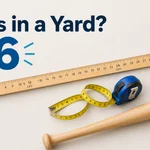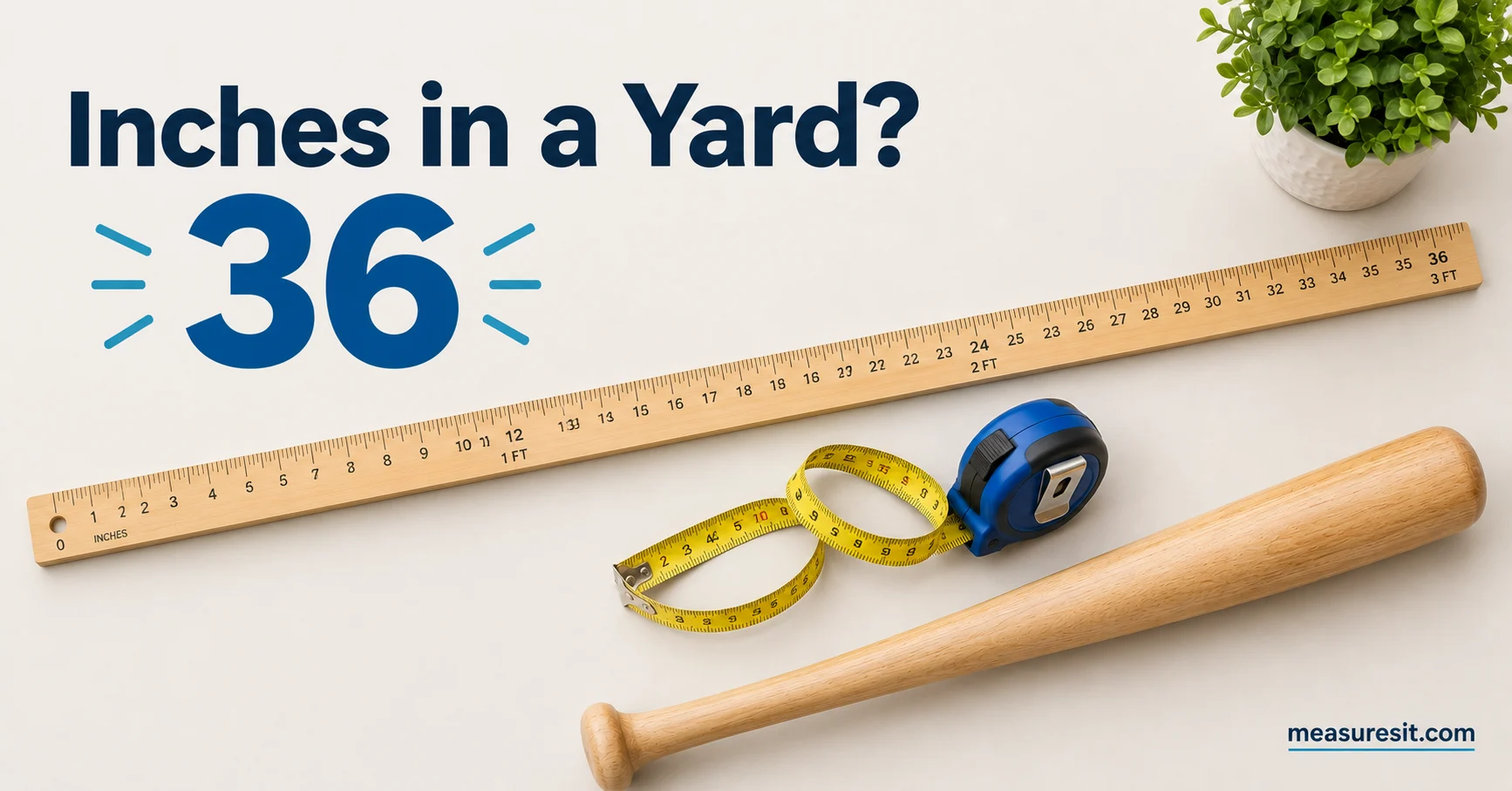
A yard equals exactly 36 inches. That’s the whole answer, and it comes from a fixed relationship that doesn’t change: a yard is 3 feet, a foot is 12 inches, and 3 × 12 gets you there.
It’s a conversion that turns up more often than people expect buying fabric by the yard, ordering mulch or gravel by the cubic yard, measuring a football field, or eyeballing If a piece of furniture will clear a doorway.
Once the number 36 is locked in, most of those situations stop requiring a calculator at all.
Conversion Chart
A yard is officially defined as 0.9144 meters, that’s the exact figure the U.S. National Institute of Standards and Technology (NIST) uses to anchor U.S. customary units to the metric system. Everything below follows from that one fixed number.
| Unit | Value |
| Inches | 36 in |
| Feet | 3 ft |
| Yards | 1 yd |
| Miles | ≈ 0.00057 mi |
| Millimeters | 914.4 mm |
| Centimeters | 91.44 cm |
| Meters | 0.9144 m |
Inches, feet, and miles are exact conversions, not rounded estimates; a yard really is 36.000 inches, not 35.9 or 36.1. If you regularly convert other lengths too, a [feet-to-yards converter] or [centimeters-to-inches converter] can save you the mental math on numbers that aren’t round.
Objects That Are About a Yard Long
Numbers alone don’t stick in memory the way objects do. Below are eight common items that land close to 36 inches, gathered from things you’d genuinely encounter, not obscure trivia.
| Object | Approximate Length |
| Yardstick | 36 in |
| Standard exterior door (width) | 36 in |
| Kitchen countertop (height) | 36 in |
| Baseball bat | ~34 in |
| Golf putter | ~34–35 in |
| Push broom (handle) | ~36–40 in |
| Acoustic guitar | ~40 in |
| Average height of a 3-year-old | ~37–38 in |
More Everyday Yard-Length Comparisons
These seven don’t overlap with the list above and lean toward situations yard work, sports, shopping where a rough yard-length estimate is genuinely useful.
| Object | Approximate Length |
| Push lawnmower handle (height) | ~34–38 in |
| Beach towel (length) | ~35–40 in |
| A long adult stride | ~36 in |
| Golf umbrella (closed) | ~34–38 in |
| Skateboard (deck length) | ~31–32 in |
| Shopping cart handle (height) | ~36–40 in |
| Violin case (length) | ~30–32 in |
Getting a Feel for How Long a Yard Actually Is
A yard sits in an easy spot on the measuring tape: clearly longer than a foot, which is roughly the length of a standard sheet of printer paper, and clearly shorter than the width of most sedans, which run close to two yards bumper to bumper. If you’ve ever helped someone move a couch through a doorway, you’ve already made this comparison without naming it checking If the couch’s width would clear a 36-inch opening.
Fabric and craft stores lean on the yard as their default unit for a practical reason: it’s long enough to be useful for garments and quilts, but short enough that a shopper can hold one end and stretch an arm to guess the length before a clerk even measures it. That’s not a coincidence; it’s why the unit survived while other old measurements (the ell, the span) fell out of everyday use.
A few low-tech ways to estimate a yard without a tape measure:
- Stretch your arms out. For most adults, fingertip to fingertip with arms spread wide is close to a yard sometimes a bit more, depending on height.
- Take one deliberately long step. A normal walking stride runs shorter, but a stretched-out giant step lands close to 36 inches.
- Picture a baseball bat standing on end. It’s a couple of inches short of a yard, which makes it useful just under reference.
- Think of your front door’s width. Most exterior doors are exactly a yard wide, and it’s a measurement nearly everyone interacts with daily.
- Use three note-sized rulers end to end. Twelve inches, three times over, is the most literal way to rebuild a yard from scratch.
1. Yardstick
This one is almost too obvious to include, except that it’s the most accurate reference on the list by definition rather than approximation. A yardstick is milled to exactly 36 inches, which makes it the tool of choice whenever precision actually matters: marking a cut line on plywood, checking If a rug will fit a room, or squaring up a garden bed.
Most garages or closets have one gathering dust in a corner. If yours doesn’t, a tape measure pulled to the 36-inch mark does the same job.
2. A Standard Exterior Door
Front doors in the U.S. are typically built to 36 inches wide, a figure shaped in part by accessibility requirements in the building code. Interior doors usually run narrower closer to 30 or 32 inches so it’s worth specifying that this comparison is about the main entry, not a bedroom or closet door.
Because everyone passes through a door like this daily, it doubles as an instant, no-tools way to size up If a piece of furniture or appliance will fit through an opening elsewhere in the house.
3. Kitchen Countertop Height
Cabinet-industry standards put most kitchen counters at 36 inches off the floor, a height chosen so that chopping, kneading, and prep work don’t strain an average-height adult’s back. It’s one of the few yard-length comparisons that runs vertical instead of horizontal.
If you’ve ever leaned against a counter while waiting for water to boil, you’ve stood at yard height without noticing. That makes counters a handy gut-check for railing heights, shelf placement, or how tall a new piece of furniture will actually feel once it’s in the room.
4. Baseball Bat
Adult bats vary by league rules, but a common length is around 34 inches close to a yard, though a couple of inches shy of it. Anyone who’s played or even just half-watched a Little League game has a rough sense of that scale.
Its rigid, unbending shape makes it a cleaner visual than something floppy like rope or fabric. It’s good just under a yard marker when you’re trying to guess if a box, shelf, or fence post falls short of the full measurement.
5. Golf Putter
Putters typically measure 33 to 35 inches, landing them just below a yard as well. Golfers rest a hand on this length constantly during a round, which makes it a familiar object even to people who’ve never picked up a club themselves; most people have at least seen one leaning against a golf bag.
Its narrow, rigid build makes it useful for estimating shelf depth or the width of a narrow hallway closet.
6. Push Broom
A push broom’s handle usually runs 36 to 40 inches, putting it at or just past a full yard. Nearly every garage, shed, or utility closet has one propped in a corner somewhere.
Because it stands upright on its own, it works almost like an improvised yardstick when the real thing isn’t handy. Sweeping out a garage already puts that exact length in your hands.
7. Acoustic Guitar
A full-size acoustic guitar runs close to 40 inches from headstock to base a bit longer than a yard, but near enough to serve as a mental anchor. Musicians handle this length constantly, If it’s tucked in a case or resting in a stand.
Its distinctive shape makes it easier to picture than a plain measurement would be. When you’re trying to judge If a piece of luggage or a garden trellis is roughly yard-sized, about guitar-length is a quick shortcut.
8. Average Height of a Three-Year-Old
Growth charts published by the Centers for Disease Control and Prevention put the average height of a 3-year-old at roughly 37 to 38 inches just over a yard. Parents tracking milestones on a doorframe see this number more often than they might realize.
It’s a comparison that sticks for a different reason than the others: most people have a concrete memory of standing a small child against a wall to mark their height, and that image alone communicates the scale better than a number on its own would.
9. Push Lawnmower Handle
The handlebar height on a standard push mower typically sits between 34 and 38 inches, close to yard height, so the person mowing doesn’t have to hunch over. Anyone who’s mowed a lawn on a Saturday afternoon has gripped roughly this length without ever thinking of it as a measurement.
It’s a useful comparison specifically for yard work checking If a fence height, garden stake, or trellis post falls in the same range as equipment you already own.
10. Beach Towel
Large beach towels generally run 35 to 40 inches long, depending on the brand, which makes this one a looser but still familiar comparison. Most households have at least one tucked in a closet or car trunk for summer trips.
Unlike the rigid objects on this list, a towel gives a sense of the measurement in something soft and foldable, a useful mental shift when you’re picturing fabric, blankets, or curtains rather than boards and poles.
11. A Long Adult Stride
A deliberately exaggerated step, not a normal walking pace, but a stretched-out stride covers close to 36 inches for most adults. Surveyors and gardeners have used stride-counting as a rough distance check for centuries, long before tape measures were something you carried in a pocket.
It costs nothing and requires no tools: pacing off a garden bed or a room’s width in long strides and multiplying by roughly a yard each gets you in the right range fast, even if it’s not precise enough for a construction project.
12. Golf Umbrella
Closed golf umbrellas typically measure 34 to 38 inches, noticeably longer than a standard compact umbrella, which is part of why they’re sold specifically as golf umbrellas rather than everyday ones. Golfers and anyone who’s been caught in a serious downpour tend to own one.
Its long, narrow shape when closed makes it a decent stand-in for estimating poles, rods, or anything else slender and close to a yard.
13. Skateboard
A standard skateboard deck measures around 31 to 32 inches, a few inches short of a full yard. It’s a familiar sight on sidewalks and at skateparks even to people who’ve never ridden one.
Because it falls consistently under 36 inches rather than around it, it works well as a definitely shorter than a yard reference point useful when you’re trying to judge If something is just under or comfortably over the mark.
14. Shopping Cart Handle
The handlebar on a standard grocery cart usually sits 36 to 40 inches off the ground. Most adults push one at close to that height on every trip to the store without registering it as a measurement at all.
Since it’s a height rather than a length, it’s a particularly good comparison for railings, counters, or anything mounted vertically rather than laid flat.
15. Violin Case
A full-size violin case runs about 30 to 32 inches long, a bit short of a yard but still in the same general range. Musicians and students carrying one to lessons handle this length regularly.
It rounds out this list as another just under a yard comparison helpful alongside the baseball bat and skateboard entries when you’re trying to sense the difference between something that’s close to 36 inches and something that only looks close.
Frequently Asked Questions
Is a yard longer than a meter?
No a meter is slightly longer. A meter equals about 39.37 inches, compared to a yard’s 36 inches, so the difference is a little over 3 inches.
What’s the single most reliable way to picture a yard?
A yardstick, by definition, since nothing else on this list is exactly 36 inches. A standard exterior door’s width is the closest real-world runner-up.
How many yards are in a mile?
A mile contains 1,760 yards, which also works out to 63,360 inches.
Does fabric always get sold in exact one-yard cuts?
Not necessarily most fabric stores cut to whatever length a customer asks for, though patterns are commonly written in whole or half-yard amounts because that’s a convenient unit to shop by.
The Bottom Line
A yard is 36 inches, full stop, a fixed conversion, not an estimate, and one that’s worth committing to memory rather than looking up every time it comes up. What makes it easy to hold onto, though, isn’t the number by itself. It’s tying it to something physical: a yardstick lying flat, a front door’s width, the height of the counter you lean against every morning.
Once one of those images is locked in, converting between inches and yards stops being a calculation and just becomes something you know on sight.
If you’re cutting fabric, pacing off a garden bed, or figuring out if the new bookshelf is actually going to fit.
Discover More Posts!
How Big Is 5 cm? Easy Size Comparisons & Chart
How Big Is 8 cm? 15 Easy Everyday Comparisons
What Is 50 cm in Inches? Fast Answer

I’m Marcus Kane, a measurement content specialist at MeasuresIt.com. I write clear, accurate, and practical articles about measurements, dimensions, conversions, and everyday size comparisons, making complex topics simple and easy to understand.