I once spent twenty minutes in a hardware store parking lot trying to figure out if a 2.4-meter shelving unit would fit against a wall I’d measured in feet. It shouldn’t have taken that long.
The fastest way to convert between measurement systems is to memorize a few anchor points 1 inch ≈ 2.54 cm, 1 kilogram ≈ 2.2 lb, 1 liter ≈ 1.06 quarts and build from there instead of trying to remember exact formulas.
Once those anchors are in your head, most everyday conversions become quick mental math instead of a search-and-scroll exercise.
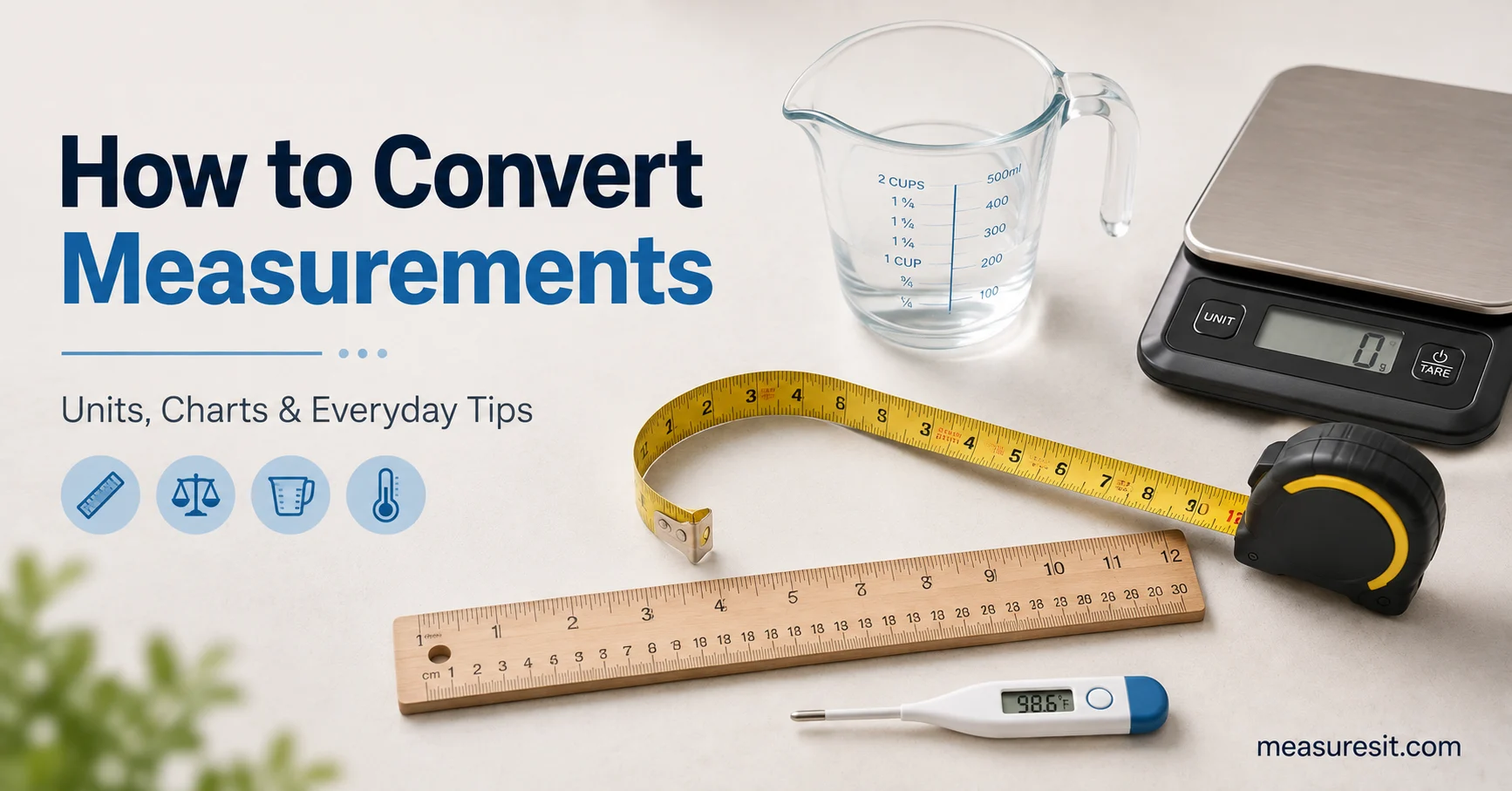
This guide covers the difference between the metric and imperial systems, gives you conversion charts for length, weight, volume, area, and temperature, and walks through ways to estimate a measurement when you don’t have a tape measure or scale on hand. It’s written for the moments that actually trip people up: reading a European clothing tag, following a recipe from another country, or figuring out if furniture will clear a doorway.
Why Two Measurement Systems Still Exist
The metric system runs on units of ten, which is why scientists, doctors, and most of the world default to it; there’s no fumbling with fractions when everything scales by 10, 100, or 1,000. A milliliter is a thousandth of a liter, a kilometer is a thousand meters, and the pattern holds for every unit in the system. The United States is one of only a handful of countries alongside Liberia and Myanmar that hasn’t fully adopted it for everyday use, according to the U.S. Metric Association.
The imperial system, still standard in American households, grew out of older English units tied to human-scale references: a foot approximated an actual foot length, an acre was roughly what one person could plow in a day. That history is part of why it still feels intuitive for quick estimates, even though the math gets messier there’s no clean way to turn 5 feet 8 inches into a decimal without a calculator.
Neither system is more correct. NIST, the U.S. agency that maintains national measurement standards, has actually defined U.S. customary units in terms of metric ones since 1893 so even the inch is technically metric under the hood. The real difference is just which set of numbers feels natural to work with.
The Six Types of Measurement You’ll Actually Use
Most measuring tasks fall into one of six categories, and knowing which one you’re dealing with is half the battle when converting.
Length covers distance: a hallway, a hem, a hiking trail. Weight (technically mass, though the terms get used interchangeably outside a physics classroom) tells you how heavy something is, from a suitcase at check-in to a bag of dog food. Volume measures how much space a liquid or loose material fills, which is why it dominates recipes and grocery shopping.
Area describes two-dimensional space: the square footage of an apartment or a garden bed. Then there’s temperature, which measures heat rather than size, and time, which rarely gets grouped with the others but is technically a measurement too. Nearly every practical conversion you’ll ever need to make lives in one of these six buckets.
Length and Height Conversion Chart
| Unit | Converted Value (from 1 meter) |
| Millimeters (mm) | 1,000 mm |
| Centimeters (cm) | 100 cm |
| Inches (in) | ≈ 39.37 in |
| Feet (ft) | ≈ 3.28 ft |
| Yards (yd) | ≈ 1.09 yd |
| Meters (m) | 1 m |
| Miles (mi) | ≈ 0.00062 mi |
Weight and Mass Conversion Chart
| Unit | Converted Value (from 1 kilogram) |
| Grams (g) | 1,000 g |
| Ounces (oz) | ≈ 35.27 oz |
| Pounds (lb) | ≈ 2.20 lb |
| Kilograms (kg) | 1 kg |
| Stone (UK) | ≈ 0.16 stone |
Volume Conversion Chart
| Unit | Converted Value (from 1 liter) |
| Teaspoons (tsp) | ≈ 202.88 tsp |
| Tablespoons (tbsp) | ≈ 67.63 tbsp |
| Fluid ounces (fl oz) | ≈ 33.81 fl oz |
| Cups | ≈ 4.23 cups |
| Pints | ≈ 2.11 pints |
| Quarts | ≈ 1.06 quarts |
| Gallons | ≈ 0.26 gallons |
| Milliliters (ml) | 1,000 ml |
| Liters (l) | 1 l |
Area Conversion Chart
| Unit | Converted Value (from 1 square meter) |
| Square inches | ≈ 1,550 sq in |
| Square feet | ≈ 10.76 sq ft |
| Square yards | ≈ 1.20 sq yd |
| Square centimeters | 10,000 sq cm |
| Square meters | 1 sq m |
| Acres | ≈ 0.000247 acres |
Temperature Conversion
Temperature doesn’t scale the way length or weight does; there’s no single multiplier, just a formula. To convert Celsius to Fahrenheit, multiply by 9/5 and add 32; to go the other direction, subtract 32 first and then multiply by 5/9.
A useful anchor: 20°C, a fairly typical indoor room temperature, works out to 68°F. Keep that pair in mind and most other conversions are just a short mental hop away.
Choosing the Right Tool for the Job
The right tool depends less on what you’re measuring and more on how precise you need to be.
- Ruler best for small, exact measurements like a photo frame or a piece of paper.
- Tape measures the standard for furniture, doorways, and room dimensions.
- Digital kitchen or bathroom scale reliable for ingredients, produce, or luggage weight.
- Measuring cups and spoons is the default for volume in cooking and baking.
- The thermometer reads heat, If it’s an oven, the outdoors, or a fever.
- Calipers used when tolerances matter, like woodworking joints or machine parts.
A tape measure will get you through 90% of home projects; the rest of the list covers the situations where a tape measure won’t help.
Estimating a Measurement With No Tools at All
Sometimes you just need a ballpark number, not precision. These reference points work because they’re things most people already carry or can picture.
- An adult hand span, thumb to pinky fully stretched, tends to land close to 9 inches, and a closed fist is roughly 4 inches. Good for quick length checks on the fly.
- A dollar bill a U.S. bill measures 6.14 inches long by federal specification, which makes it a surprisingly accurate pocket ruler.
- A walking stride, a relaxed adult step, covers roughly 2.5 feet, useful for rough-pacing a room or backyard.
- A liter of water weighs almost exactly 1 kilogram, a dependable mental anchor for weight since water’s density is close to 1 g/ml at room temperature.
- Credit card standard cards are 3.37 by 2.13 inches under the ISO/IEC 7810 standard, handy for estimating small objects.
- Your phone’s built-in tools and most modern smartphones include a camera-based measuring app that’s accurate enough for rough furniture or wall measurements.
None of these replace an actual tape measure when precision matters, but they’re enough to settle will this fit questions without leaving the room.
Common Conversion Mistakes Worth Avoiding
A few errors show up constantly, even among people who convert measurements regularly.
Rounding too early is the biggest one if you round 1 inch to 2.5 cm and then multiply that rounded number several times over, the error compounds fast across a longer measurement. It’s better to carry the more precise 2.54 cm through your math and round only at the end.
Confusing weight and volume trips people up in the kitchen especially. A cup of flour and a cup of water don’t weigh the same amount, so recipes that mix cups with metric weight measurements (grams) need to specify which ingredient you’re measuring, not just the unit.
Mixing systems mid-calculation is another common slip measuring a room in feet, then converting furniture dimensions listed in centimeters without converting both to the same system first. Pick one system, convert everything into it, and do the comparison from there.
FAQ
Is the metric system more accurate than imperial?
No. Accuracy comes from the measuring tool and technique, not the system itself. Metric is easier to calculate with because it scales by ten, not because it’s inherently more precise.
What’s the fastest way to convert between metric and imperial in my head?
Round to these anchors: 1 inch ≈ 2.5 cm, 1 kilogram ≈ 2.2 lb, 1 liter ≈ 1 quart. They’re close enough for everyday decisions and easy to remember.
Why does the U.S. still use the imperial system?
Mostly historical momentum. The U.S. adopted these units early, and shifting an entire country’s infrastructure, education system, and manufacturing base to metric would be an enormous undertaking; several federal attempts to switch have stalled since the 1970s.
Do scientists in the U.S. use imperial units?
Rarely, for research purposes. Nearly all scientific work, including in the U.S., runs on the metric system’s SI units so results stay consistent across international studies.
Final Thoughts
Most people don’t think about measurements until they’re standing in a store aisle or a kitchen, stuck between two systems that don’t line up.
Knowing how to convert measurements even just a few reliable anchor points like 1 inch to 2.54 cm or 1 kilogram to 2.2 pounds turns that stuck moment into a five-second calculation.
Combine that with a couple of no-tool tricks, like using a dollar bill or your own stride as a rough ruler, and you can handle the recipe swap, the furniture measurement, or the clothing size conversion without opening a separate app. The charts above cover the rest for anything more precise.
Read Other Posts!
How Tall Is a Monster Can? Exact Height & Size Guide
Red Bull Can Dimensions: Height, Width & Size Guide

Hi, I’m Vera Lindqvist, a content writer at MeasuresIt.com, where I turn measurement standards, unit conversions, and precision tools into clear, practical guides. I care about getting the details right so you don’t have to second-guess them.
2 thoughts on “How to Convert Measurements: Units & Charts Guide”