Fahrenheit to Celsius Conversion: Formula & Chart
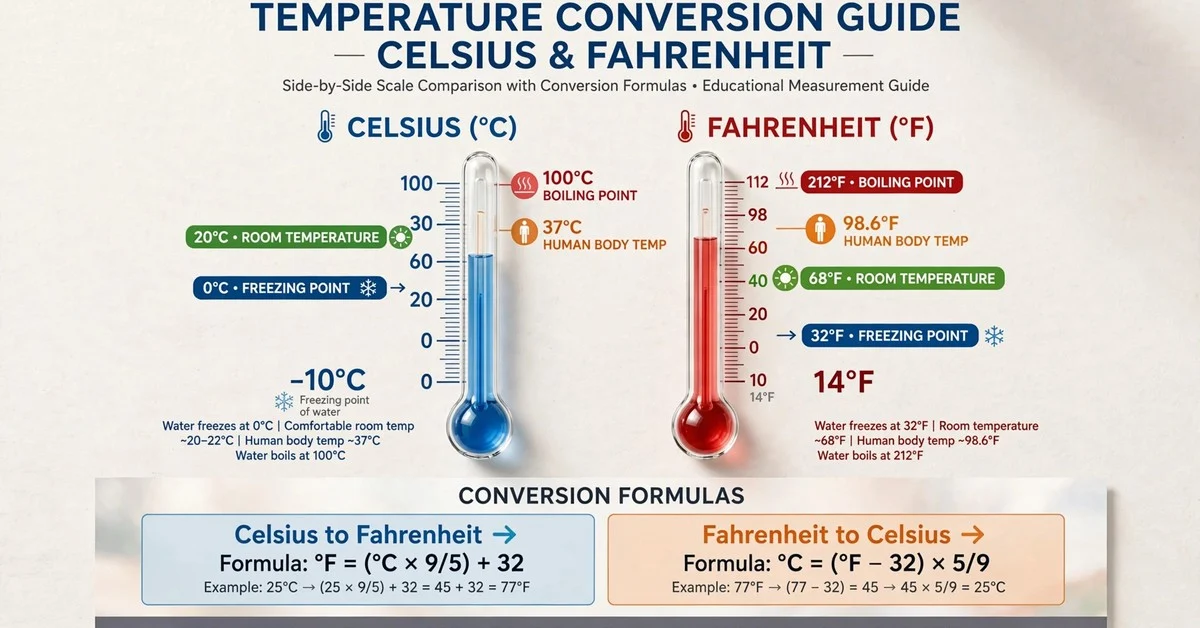
To convert Fahrenheit to Celsius, subtract 32 from the Fahrenheit temperature and multiply the result by 5/9 — that is the whole formula, written as °C = (°F − 32) × 5/9. It works for every temperature, from a −40°F deep freeze to a 212°F boiling pot.
Fahrenheit is still the everyday scale in the United States, while most of the world reads the weather, sets ovens, and takes temperatures in Celsius. Whether you are following a recipe, reading a thermostat, or checking a fever, this guide gives you the formula, a full conversion chart from −40 to 212°F, worked examples, and mental-math shortcuts you can use without a calculator.
Fahrenheit to Celsius Conversion Chart
| °F | °C | °F | °C |
|---|---|---|---|
| −40 | −40 | 86 | 30 |
| −20 | −28.9 | 98.6 | 37 |
| 0 | −17.8 | 104 | 40 |
| 20 | −6.7 | 122 | 50 |
| 32 | 0 | 140 | 60 |
| 50 | 10 | 158 | 70 |
| 68 | 20 | 176 | 80 |
| 72 | 22.2 | 194 | 90 |
| 77 | 25 | 212 | 100 |
8 Key Temperature Conversions
| # | Fahrenheit | Celsius | What It Is |
|---|---|---|---|
| 1 | −40°F | −40°C | Scales meet here |
| 2 | 0°F | −17.8°C | Very cold winter day |
| 3 | 32°F | 0°C | Water freezes |
| 4 | 68°F | 20°C | Comfortable room temperature |
| 5 | 98.6°F | 37°C | Normal body temperature |
| 6 | 140°F | 60°C | Hot tap water limit |
| 7 | 212°F | 100°C | Water boils (sea level) |
| 8 | 451°F | 232.8°C | The “Fahrenheit 451” reference |
7 Everyday Reference Points
| # | Everyday Situation | Fahrenheit | Celsius |
|---|---|---|---|
| 1 | Home freezer | 0°F | −18°C |
| 2 | Refrigerator | 38°F | 3.3°C |
| 3 | Mild spring day | 60°F | 15.6°C |
| 4 | Hot tub / spa | 104°F | 40°C |
| 5 | Moderate oven | 350°F | 176.7°C |
| 6 | Hot oven | 425°F | 218.3°C |
| 7 | Pizza oven | 500°F | 260°C |
1. The Official Conversion Formula
The formula for converting Fahrenheit to Celsius is °C = (°F − 32) × 5/9. The subtraction of 32 accounts for the offset between the two scales’ zero points — Fahrenheit’s freezing point of water sits at 32 degrees while Celsius puts it at 0. The multiplication by 5/9 accounts for the different degree sizes: there are 180 Fahrenheit degrees between water’s freezing and boiling points but only 100 Celsius degrees, and 100/180 simplifies to 5/9. Apply the steps in order — subtract first, then multiply — because reversing them gives a wrong answer. This formula is exact, not an approximation, and it is the same one used in every calculator, weather app, and scientific reference.
2. Worked Example: 32°F to Celsius
The freezing point of water is the cleanest example. Start with 32°F and subtract 32, which gives 0. Multiply 0 by 5/9, which gives 0. So 32°F equals exactly 0°C. This example doubles as a sanity check for the formula: if you ever convert a temperature and 32°F does not land on 0°C, you made an arithmetic slip. It also shows why the formula’s first step matters — the “minus 32” is doing all the work of shifting Fahrenheit’s zero down to Celsius’s zero. Every other conversion follows the same two-step rhythm, just with messier numbers.
3. Worked Example: 212°F to Celsius
Water’s boiling point at sea level gives the second anchor. Subtract 32 from 212 to get 180. Multiply 180 by 5/9: first multiply 180 by 5 to get 900, then divide by 9 to get 100. So 212°F equals exactly 100°C. Notice how the formula’s fraction cancels neatly here — 180 is divisible by 9, which is no coincidence, since the two scales were historically tied together through these very points. Together with the freezing point, this example shows the formula mapping Fahrenheit’s 180-degree span onto Celsius’s 100-degree span, which is exactly what the 5/9 factor means.
4. Worked Example: Body Temperature 98.6°F
Normal human body temperature, 98.6°F, is the conversion most people actually need. Subtract 32 from 98.6 to get 66.6. Multiply 66.6 by 5/9: 66.6 × 5 = 333, divided by 9 = 37. So 98.6°F equals 37°C. This is worth memorizing, because thermometers and medical guidance switch between scales constantly — a fever threshold of 100.4°F is 38°C, and knowing the 37°C baseline helps you interpret either reading instantly. In practice, most people round body-temperature conversions to the nearest whole degree, which is fine for health decisions but not for lab work.
5. Worked Example: Room Temperature 68°F
A comfortable room temperature of 68°F converts as follows: subtract 32 to get 36, then multiply 36 by 5/9. Thirty-six times 5 is 180, divided by 9 is 20. So 68°F equals exactly 20°C — another clean landing, and the reason 20°C is the textbook “room temperature” in metric countries. This one is handy when reading thermostats, HVAC manuals, or hotel air-conditioning panels abroad, where the display may show 20°C and you want to confirm it matches the 68°F you expect at home. Like the freezing and boiling points, it is a good anchor to keep in memory.
6. The Quick Mental-Math Trick
When you do not have a calculator, use the shortcut: subtract 30 from the Fahrenheit temperature and divide by 2. For 68°F, that gives (68 − 30) ÷ 2 = 19, which is close to the true 20°C. For 86°F, you get (86 − 30) ÷ 2 = 28, versus the exact 30°C. The trick works because 30 is close to 32 and 1/2 is close to 5/9, so the error stays small near everyday temperatures — usually within 1 to 2 degrees. It breaks down at extremes, though: at −40°F it gives −35 instead of −40. Use it for weather and cooking estimates, never for medicine, science, or engineering.
7. The Reverse Formula: Celsius to Fahrenheit
Going the other direction uses °F = (°C × 9/5) + 32. Multiply the Celsius temperature by 9/5 (which is 1.8), then add 32. For 20°C: 20 × 1.8 = 36, plus 32 = 68°F. For 100°C: 100 × 1.8 = 180, plus 32 = 212°F. Notice this is the exact algebraic inverse of the forward formula — the multiplication and addition undo the forward subtraction and multiplication. The mental shortcut reverses too: double the Celsius temperature and add 30. Twenty degrees doubled is 40, plus 30 gives 70, close to the true 68°F.
8. Minus 40: Where Both Scales Meet
At −40 degrees, Fahrenheit and Celsius read the same: −40°F equals −40°C. You can verify it with the formula: (−40 − 32) × 5/9 = −72 × 5/9 = −40. This is the only temperature where the two scales agree, and it happens because the conversion is a straight line — two straight lines cross exactly once. Meteorologists in cold climates know this point well, since −40 is a realistic winter temperature in places like northern Canada and Siberia, and at that extreme the scale on the thermometer genuinely stops mattering.
9. The Freezing Point: 32°F = 0°C
The freezing point of water anchors the bottom of the familiar range: 32°F equals 0°C. Below this, water freezes; above it, ice melts. Weather forecasts in the US revolve around this number — a forecast of 31°F means icy roads, while 33°F means rain. In Celsius countries the same line is simply 0°C, which is arguably easier to remember. Note that this is the freezing point of pure water at standard pressure; salt water and other liquids freeze at different temperatures, which is why roads are salted. For everyday conversions, though, 32°F = 0°C is the single most useful fact to memorize.
10. The Boiling Point: 212°F = 100°C
Water boils at 212°F, which is 100°C, at sea level. The Celsius scale was literally built around this: 0 for freezing, 100 for boiling, with 100 equal steps between. Altitude changes the picture — at 5,000 feet, water boils around 203°F (95°C) because of lower air pressure — so recipes adjusted for high altitude are really adjusting for a lower boiling point. Pressure cookers exploit the same physics in reverse, raising the boiling point to cook food faster. For conversion purposes, 212°F = 100°C is exact at sea level and close enough everywhere else for kitchen math.
11. Common Weather Temperatures
Weather is where most people meet this conversion. Roughly: 32°F is 0°C (freezing), 50°F is 10°C (cool), 68°F is 20°C (pleasant), 86°F is 30°C (hot), and 104°F is 40°C (dangerous heat). Memorizing this 0–10–20–30–40 ladder on the Celsius side with its 32–50–68–86–104 Fahrenheit partners covers nearly every forecast you will ever read. When traveling, it pays to learn the Celsius ladder directly rather than converting every reading — after a day or two, 25°C simply feels like “warm” without any math. The mental-math trick from section 6 is accurate enough for dressing decisions.
12. Common Oven Temperatures
Oven dials are a classic conversion trap because American recipes use Fahrenheit and much of the world bakes in Celsius. The key marks: 300°F is about 149°C (usually rounded to 150°C), 350°F is about 177°C (rounded to 175 or 180°C), 400°F is about 204°C (rounded to 200°C), and 450°F is about 232°C (rounded to 230°C). Most ovens outside the US move in 10-degree Celsius steps, so converted recipes get rounded to the nearest 10 — a 3-to-5-degree rounding error is invisible in baking. Gas marks add a third system in the UK, where 350°F is roughly gas mark 4. When precision matters, as with candy or bread, convert exactly rather than rounding.
13. Why the Two Scales Differ
The scales differ because they were invented independently, centuries apart, for different reference points. Daniel Fahrenheit built his scale in the early 1700s, reportedly anchoring 0°F to the coldest temperature he could produce with a salt-ice mixture and 96°F to human body temperature (later refined). Anders Celsius proposed his scale in 1742 with 0 at boiling and 100 at freezing — the version we use today is flipped from his original. Neither inventor was wrong; they simply chose different anchors. The US stuck with Fahrenheit through custom and industry inertia, while the metric system’s rise carried Celsius to nearly everywhere else.
14. Where Each Scale Is Used Today
Celsius is the official scale in nearly every country and the standard in science worldwide. Fahrenheit remains the everyday scale in the United States and a handful of other places, including the Bahamas, Belize, the Cayman Islands, and Palau. The UK is mixed: weather forecasts use Celsius, but some people still describe hot days in Fahrenheit. Science and medicine use Celsius (and Kelvin) exclusively, which is why drug labels, lab equipment, and clinical guidelines quote Celsius first. If you publish anything with an international audience — a recipe, a product manual, a weather report — give both scales or expect conversion questions.
15. Common Conversion Mistakes to Avoid
The most frequent mistake is skipping the “minus 32” and just multiplying by 5/9 — that gives a wildly wrong answer. Second is doing the steps in the wrong order: multiply first, then subtract, which also fails. Third is confusing the two directions and adding 32 when converting to Celsius, a common slip when you are tired. Fourth is trusting the mental-math shortcut for anything precise, like medication storage temperatures or a baby’s fever. Fifth is rounding too early in multi-step calculations, which compounds the error. When it matters, write out both steps, keep one decimal place until the end, and sanity-check against a known anchor like 32°F = 0°C.
Frequently Asked Questions
What is the formula to convert Fahrenheit to Celsius?
The formula is °C = (°F − 32) × 5/9. Subtract 32 from the Fahrenheit temperature, then multiply the result by 5/9 (about 0.556). For example, 68°F becomes (68 − 32) × 5/9 = 36 × 5/9 = 20°C.
What is 100°F in Celsius?
100°F converts to 37.8°C, usually rounded to 38°C. The math: (100 − 32) × 5/9 = 68 × 5/9 = 37.78°C. That is just above normal body temperature (98.6°F = 37°C), which makes sense — 100°F is roughly a warm day or a low-grade fever.
Why is −40 the same in Fahrenheit and Celsius?
Because the conversion between the scales is a straight line, and two straight lines cross at exactly one point — which the math places at −40. Check it: (−40 − 32) × 5/9 = −72 × 5/9 = −40. It is the only temperature where both scales agree.
Is there an easy way to estimate Celsius without a calculator?
Yes: subtract 30 from the Fahrenheit temperature and divide by 2. For 77°F, that gives (77 − 30) ÷ 2 = 23.5, close to the true 25°C. It stays within a degree or two for everyday temperatures, which is fine for weather and cooking, but use the exact formula for medicine or science.
Final Thoughts
Converting Fahrenheit to Celsius comes down to one formula — °C = (°F − 32) × 5/9 — plus a handful of anchor points worth memorizing: 32°F is freezing, 68°F is a comfortable room, 98.6°F is body temperature, and 212°F is boiling, with −40 as the lone temperature where both scales agree. The subtract-30-and-halve shortcut handles everyday estimates like weather and cooking, and the reverse formula, °F = (°C × 9/5) + 32, covers the trip back when a metric recipe or forecast needs translating. Most conversion mistakes come from skipping the minus-32 step or mixing up the direction, so anchor every calculation against 32°F = 0°C as a sanity check. With the formula, the mental shortcut, and the chart above, any Fahrenheit reading becomes a Celsius one in seconds.

Hi, I’m Vera Lindqvist, a content writer at MeasuresIt.com, where I turn measurement standards, unit conversions, and precision tools into clear, practical guides. I care about getting the details right so you don’t have to second-guess them.