Pool Table Dimensions: 7, 8 & 9 Foot Tables + Room Size
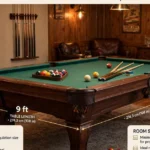
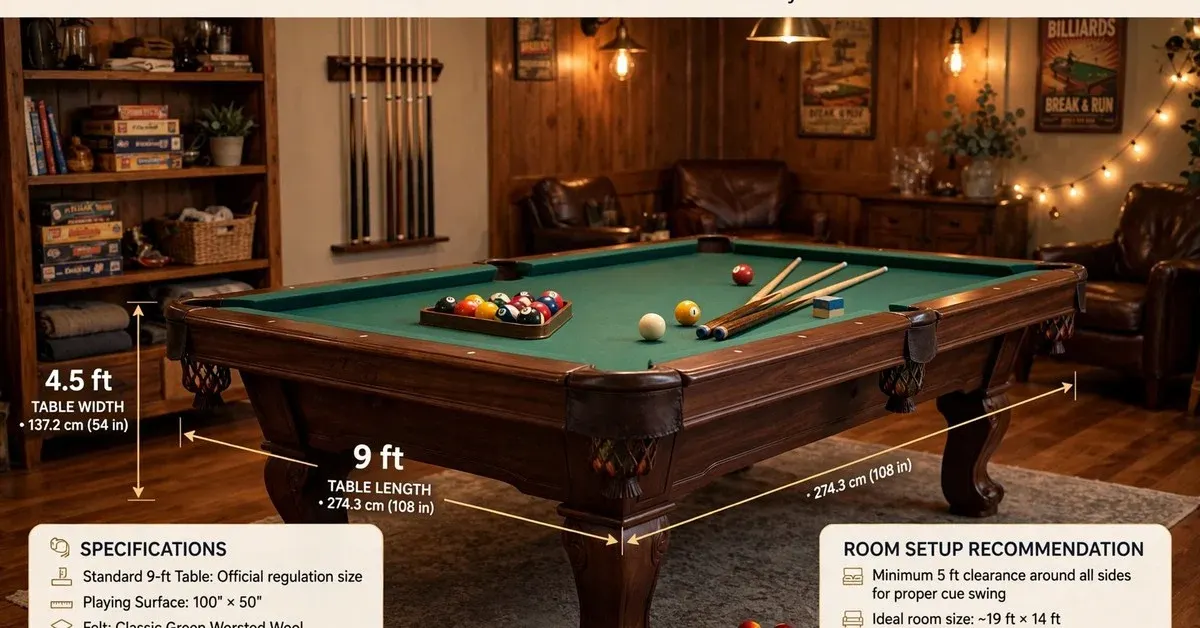
A 9-foot pool table has a playing surface of 100 inches by 50 inches, while a 7-foot table plays on 80 by 40 inches and an 8-foot table on 88 by 44 inches. Those “foot” sizes refer to the nominal length of the table, but the number that really matters is the playfield — the area inside the cushions where the balls actually roll. This guide compares all three standard sizes, the room each one needs, and the smaller measurements (height, slate, pockets, cues) that complete the picture.
Buying or placing a pool table without checking dimensions is one of the most common mistakes in game rooms. The table itself is only half the equation — you need about 5 feet of clearance on every side for a comfortable cue stroke, which means an 8-foot table really needs a room around 13 by 17 feet. Read on for the conversion chart, reference tables, and fifteen detailed sections covering every measurement.
Pool Table Conversion Chart
| Table Size | Playfield | Playfield (cm) | Outer (approx.) | Room Needed |
|---|---|---|---|---|
| 7-foot | 80 × 40 in | 203 × 102 cm | ~93 × 53 in | ~13 × 16 ft |
| 8-foot | 88 × 44 in | 224 × 112 cm | ~103 × 59 in | ~13 × 17 ft |
| 9-foot | 100 × 50 in | 254 × 127 cm | ~114 × 64 in | ~14 × 18 ft |
| Table height | 29–31 in | 74–79 cm | — | — |
| Slate thickness | 0.75–1 in | 19–25 mm | — | — |
| Standard cue | 58 in | 147 cm | — | — |
Standard Table Sizes at a Glance
| # | Feature | Measurement |
|---|---|---|
| 1 | 7-ft table, outer approx. | ~93 × 53 in (236 × 135 cm) |
| 2 | 8-ft table, outer approx. | ~103 × 59 in (262 × 150 cm) |
| 3 | 9-ft table, outer approx. | ~114 × 64 in (290 × 163 cm) |
| 4 | 7-ft playfield | 80 × 40 in (203 × 102 cm) |
| 5 | 8-ft playfield | 88 × 44 in (224 × 112 cm) |
| 6 | 9-ft playfield | 100 × 50 in (254 × 127 cm) |
| 7 | Room for 7-ft table | ~13 × 16 ft (4.0 × 4.9 m) |
| 8 | Room for 8-ft table | ~13 × 17 ft (4.0 × 5.2 m) |
Parts, Clearances and Weights
| # | Feature | Measurement |
|---|---|---|
| 9 | Room for 9-ft table | ~14 × 18 ft (4.3 × 5.5 m) |
| 10 | Table height | 29–31 in (74–79 cm) |
| 11 | Slate thickness | 0.75–1 in (19–25 mm) |
| 12 | Corner pocket width | ~4.5 in (~11.4 cm) |
| 13 | Standard cue length | 58 in (147 cm) |
| 14 | Rail and cushion width | ~6 in (~15 cm) per side |
| 15 | 9-ft table weight | ~700–1,000 lb (318–454 kg) |
1. 7-Foot Table: Outer Dimensions Around 93 by 53 Inches
The 7-foot table is the size you find in most bars and pubs. Its outer dimensions run roughly 93 inches long by 53 inches wide, though this varies a bit by manufacturer because rail and leg styles differ. The “7-foot” name is nominal — it refers to the table’s class, not an exact outer measurement. This is the most popular size for home game rooms because it fits where bigger tables will not, and it still plays a proper game of 8-ball or 9-ball.
2. 8-Foot Table: Outer Dimensions Around 103 by 59 Inches
The 8-foot table is the classic home size, measuring about 103 inches long by 59 inches wide on the outside. It strikes the balance most buyers want: noticeably roomier than a bar table, but still fitting in a standard finished basement or large living room. Many families choose the 8-foot size because it plays close to a professional feel without demanding the 14-by-18-foot room a 9-footer needs. If you are unsure which size to buy, the 8-foot table is the safe middle ground.
3. 9-Foot Table: Outer Dimensions Around 114 by 64 Inches
The 9-foot table is the tournament standard — the size used in professional pool. Its outer frame measures roughly 114 inches long by 64 inches wide, or about 9.5 feet by 5.3 feet. Everything about the game gets harder on a 9-footer: longer shots, tighter position play, and pockets that feel smaller because the distances are greater. Serious players prefer it precisely because it is demanding, and every major championship is contested on this size.
4. 7-Foot Playfield: 80 by 40 Inches
The playfield — the cloth-covered area inside the cushions — is what the nominal size is really describing. On a 7-foot table it measures 80 inches long by 40 inches wide. Notice the 2-to-1 ratio: every regulation pool table playfield is twice as long as it is wide, which keeps the geometry of bank shots and angles consistent across sizes. The 40-inch width is why bar tables feel quick and congested — there just is not much room to hide.
5. 8-Foot Playfield: 88 by 44 Inches
An 8-foot table’s playfield measures 88 inches by 44 inches, again holding that exact 2-to-1 ratio. Those extra 8 inches of length and 4 inches of width over the 7-foot table make a real difference in play: shots stretch out, clusters break up more naturally, and position play starts to resemble the professional game. When players say an 8-footer “plays bigger than it looks,” this is the measurement they are feeling.
6. 9-Foot Playfield: 100 by 50 Inches
The tournament 9-foot playfield is 100 inches long by 50 inches wide — a full 8 feet 4 inches of playing length. That is 25 percent more surface area than a 7-foot table’s playfield, and the difference shows in every rack. Long rail shots that are routine on a bar table become genuine tests of stroke on a 9-footer. If you ever get the chance to play on one after learning on a smaller table, expect your game to feel humbling for the first few sessions.
7. Room Size for a 7-Foot Table: About 13 by 16 Feet
A 7-foot table needs a room of roughly 13 by 16 feet for comfortable play. The rule is simple: take the playfield dimensions and add about 5 feet on each side for the cue stroke — a standard cue is 58 inches, and players need room to draw it back. A 13-by-16-foot room gives you that clearance with a little margin. You can squeeze a 7-footer into a smaller space with a short cue for tight spots, but tight walls will cost you shots.
8. Room Size for an 8-Foot Table: About 13 by 17 Feet
The 8-foot table wants a room around 13 by 17 feet. That is only a foot longer than the 7-foot requirement, which is why so many buyers step up to the 8-footer — the room cost is small and the playing gain is real. Measure your space carefully before ordering, and remember to account for doors, furniture, and light fixtures. A ceiling lamp hanging over the table is fine, but a wall too close behind you on the long rail will ruin your backswing.
9. Room Size for a 9-Foot Table: About 14 by 18 Feet
A tournament 9-foot table needs a room of roughly 14 by 18 feet — about 252 square feet of dedicated space. This is the number that surprises buyers most: the table itself is under 10 feet long, but the playing envelope is nearly double that. If your room is smaller, every shot along the rails near a wall becomes a compromise. Many people who want a 9-footer discover their basement is an 8-foot room, and the honest advice is to size the table to the room, not the ambition.
10. Table Height: 29 to 31 Inches
Pool tables stand 29 to 31 inches tall at the playing surface — about the height of a dining table. This height is standardized so a player’s stance and bridge feel the same everywhere. Tables outside this range feel wrong immediately: too low and tall players hunch uncomfortably, too high and shorter players cannot sight down the cue properly. When leveling a table during setup, the goal is a consistent 29 to 31 inches at every point on the slate.
11. Slate Thickness: Three-Quarters to 1 Inch
Quality pool tables use a slate bed between three-quarters of an inch and 1 inch thick, usually in three pieces. Slate is used because it can be machined dead flat and it will not warp with humidity the way wood does. Thicker, one-inch slate is the mark of a better table — it holds its level longer and gives a truer roll. Cheap tables substitute wood or synthetic beds, and experienced players can feel the difference in how balls roll within minutes.
12. Pocket Width: About 4.5 Inches at the Corners
Corner pockets on a standard table measure about 4.5 inches wide at the mouth — just over twice the 2.25-inch diameter of a pool ball. Side pockets are slightly wider, around 5 inches. Tighter pockets (4 to 4.25 inches) appear on some pro-cut tables and make pocketing noticeably harder. The pocket opening is one of the least understood specs: two tables of the same size can play very differently if one has generous buckets and the other has tight pro-cut pockets.
13. Standard Cue Length: 58 Inches
The standard pool cue is 58 inches long — about 147 centimeters — typically made in two pieces that screw together. That length suits the vast majority of adult players, giving enough reach for long table shots without being unwieldy. Shorter cues (48 to 52 inches) exist for tight rooms and for younger players, and some break cues run slightly shorter and heavier. If a wall forces you to choke up on every other shot, a short cue for those spots beats moving the table.
14. Rail and Cushion Width: About 6 Inches Per Side
The rails — the wooden frame around the playfield — add roughly 6 inches of width on each side beyond the cushions. This is the difference between the playfield numbers and the outer dimensions: a 100-inch playfield plus two 6-inch rails plus cushion noses lands you near the 114-inch outer length of a 9-footer. The cushions themselves are rubber bonded to the rail wood, and their profile determines how balls rebound. Worn cushions play dead and unpredictable, which is why re-rubbering an old table transforms it.
15. 9-Foot Table Weight: 700 to 1,000 Pounds
A 9-foot slate table weighs roughly 700 to 1,000 pounds — 318 to 454 kilograms — with most of that in the three-piece slate bed and the hardwood frame. This is why professional installation matters: moving a table this heavy without the right equipment risks cracked slate and a table that never plays level again. Measure your hallways and doorways before delivery day too — the slate ships in three pieces, but the one-piece rails and the assembled frame still need a clear path in. Even a 7-foot slate table weighs several hundred pounds. Plan the table’s final position before delivery day, because you will not be casually sliding it across the room later.
Measuring Your Room Before You Buy
The single most useful thing you can do is tape out the table’s outer dimensions on your floor — reading a measuring tape correctly matters here — then mark 5 feet of clearance on all four sides and try a practice cue stroke along each rail. Pay attention to doors that swing inward, support posts, and stairwell openings — all classic room-killers. If you are finishing a basement around a future table, run the numbers before the walls go up. A foot of planning now saves the frustration of a table that almost fits.
Frequently Asked Questions
What size room do I need for an 8-foot pool table?
An 8-foot table needs a room of about 13 by 17 feet for comfortable play with a standard 58-inch cue. That allows roughly 5 feet of clearance on each side of the playfield for your backswing. Smaller rooms can work with a short cue for tight spots, but expect compromised shots near walls.
What is the difference between a 7-foot and 8-foot pool table?
The 8-foot table’s playfield is 88 by 44 inches versus 80 by 40 inches on the 7-footer — about 21 percent more playing area. The 8-footer also needs a slightly bigger room (13×17 ft vs 13×16 ft). Bar tables are 7-foot; the 8-foot is the most popular home size; the 9-foot (100×50 in playfield) is the tournament standard.
How tall is a standard pool table?
A standard pool table’s playing surface sits 29 to 31 inches off the floor — roughly dining-table height. This is consistent across 7, 8, and 9-foot tables so stance and sighting feel the same regardless of size.
How much does a 9-foot pool table weigh?
A 9-foot slate pool table weighs about 700 to 1,000 pounds, mostly in its three-piece slate bed and hardwood frame. Professional installation is strongly recommended — cracked slate from a bad move is an expensive mistake, and a heavy table that is not perfectly level will never play right.
Final Thoughts
Pool table dimensions come down to three numbers that matter most: the playfield size (80×40, 88×44, or 100×50 inches), the room it needs (roughly 13×16, 13×17, or 14×18 feet), and the 58-inch cue that sets the clearance rule. Match the table to your room first and your ambitions second — a well-placed 8-footer you play every night beats a cramped 9-footer you avoid. Tape the footprint on your floor, check every doorway on the delivery path, and budget for professional setup with a proper leveling. Get the slate level, the cloth clean, and the pockets honest, and any of these three sizes will give you years of great games with family and friends. And when delivery day comes, protect your floors first — a thousand pounds resting on four legs will leave its mark on anything softer than concrete.

I’m Elena Cross, a content writer at MeasuresIt.com, where I turn complex measures, units, and mathematical concepts into clear, accurate, and easy-to-read articles. I’m passionate about precision in numbers and in words and I write to help readers actually understand measurements, not just memorize them.