Liters to Gallons Conversion: Formula & Chart
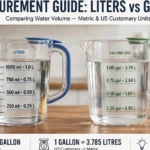
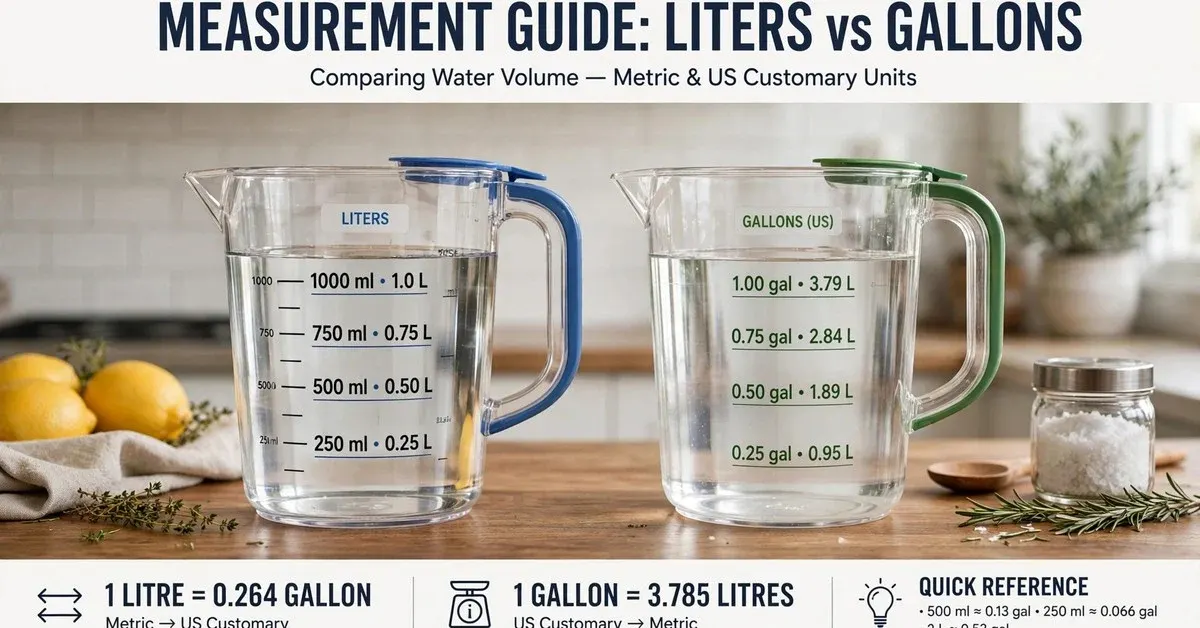
One US gallon equals 3.78541 liters, so to convert liters to gallons, multiply the number of liters by 0.264172. That single multiplication handles everything from a soda bottle to a car’s fuel tank. Whether you are reading a European fuel pump, sizing an aquarium, or following a recipe across the Atlantic, the liters-to-gallons conversion is the one travelers, drivers, and cooks reach for most.
The liter is a metric unit of volume defined as exactly one cubic decimeter, and it is used nearly everywhere in the world. The US gallon is defined as exactly 231 cubic inches, a definition dating back to 18th-century English wine measures. Because the United States still sells fuel and milk by the gallon while most of the world uses liters, knowing how to move between the two keeps you fluent at the pump, in the kitchen, and at the pet store. This guide gives you the exact formula, worked examples, a fast mental trick, fuel economy context, and charts of the volumes people look up most.
Liters to Gallons Conversion Chart
Start with the quick reference table. Find your liters in the left column and read the US gallon value on the right.
| Liters | US Gallons |
|---|---|
| 1 L | 0.264 gal |
| 2 L | 0.528 gal |
| 5 L | 1.321 gal |
| 10 L | 2.642 gal |
| 15 L | 3.963 gal |
| 20 L | 5.283 gal |
| 50 L | 13.208 gal |
| 100 L | 26.417 gal |
Values are rounded to three decimal places, which is more than enough precision for fuel, cooking, and everyday volumes.
Everyday Reference Volumes
These familiar containers help you feel what a liter or a gallon really is.
| Reference | Liters | US Gallons |
|---|---|---|
| Standard water bottle | 0.5 L | 0.132 gal |
| Two-liter soda bottle | 2 L | 0.528 gal |
| Milk jug | 3.785 L | 1 gal |
| Typical compact car fuel tank (rough) | 45 L | 11.9 gal |
| Typical sedan fuel tank (rough) | 57 L | 15.1 gal |
| Standard bathtub full (rough) | 150–300 L | 40–80 gal |
| 55-gallon steel drum | 208.2 L | 55 gal |
Fuel tank and bathtub figures vary by model, so treat those rows as typical ranges rather than exact specs.
1. The Formula: Liters to Gallons
The exact conversion formula is simple: US gallons = liters × 0.264172. Because one US gallon is defined as exactly 3.785411784 liters, dividing 1 by that number gives 0.264172052, and 0.264172 captures it to six decimal places. The formula works at every scale, from milliliters of medicine to thousands of liters of heating oil, and it never changes. Keep 0.264172 saved in your phone notes and you will always have the conversion ready. For the reverse trip, gallons to liters, multiply by 3.78541 instead.
2. Worked Example: 1 Liter to Gallons
Take the base case first: 1 liter × 0.264172 = 0.264172 gallons, usually rounded to 0.264 gal or “just over a quarter gallon.” This is the number behind the familiar fact that a liter is slightly larger than a US quart — a quart is 0.946 liters, as our guide on how big a quart is explains in detail. If a European recipe calls for a liter of stock and your measuring jug reads in cups, aim for about 4.23 cups. Rounding to 0.26 gallons introduces an error of about a tablespoon, which is negligible in cooking.
3. Worked Example: Converting Larger Volumes
Scale the formula up the same way. Ten liters: 10 × 0.264172 = 2.64172 gallons, about 2.64 gal. Twenty gallons going the other direction: 20 × 3.78541 = 75.7082 liters, about 75.71 L. Fifty liters: 50 × 0.264172 = 13.2086 gallons. Notice the pattern — the decimal point simply shifts as the liters grow, so converting 5 liters (1.321 gal) feels no harder than converting 500 liters (132.09 gal). Fuel buyers use this when comparing prices across borders: 50 liters of petrol in Europe is the same purchase as 13.2 gallons in the US.
4. The Mental Shortcut: Liters to Gallons
When you need an answer in your head, divide the liters by 4 and add a small correction. Since a gallon is about 3.79 liters, dividing by 4 gets you within 5 percent. For 20 liters: 20 ÷ 4 = 5 gallons, versus the exact 5.28 gallons — close enough for conversation. For better accuracy, take the divide-by-4 answer and add 5 percent of it: 5 + 0.25 = 5.25 gallons, nearly exact. An even simpler everyday version: a liter is “about a quarter gallon plus a splash.” Save the full 0.264172 for fuel logs, aquarium dosing, and engineering.
5. Common Volumes: Bottles and Jugs
These are the volumes people convert most often at the store. A half-liter water bottle is 0.132 gallons. A two-liter soda bottle is 0.528 gallons, just over half a gallon. A gallon milk jug is 3.785 liters. A 5-liter water cooler bottle is 1.321 gallons. Large 5-gallon water cooler jugs — the ones flipped onto office dispensers — hold 18.93 liters. Knowing these pairs makes label-reading automatic: when a European label says 1.5 liters, you instantly know it is about 0.4 gallons, a little less than a half-gallon carton.
6. Fuel Tanks: From Compact Cars to Trucks
Fuel is where this conversion earns its keep. A typical compact car tank holds around 45 liters (11.9 gallons); a midsize sedan around 57 liters (15.1 gallons); a large SUV or pickup anywhere from 80 to 130 liters (21 to 34 gallons). At a European pump showing €1.85 per liter, a 50-liter fill-up costs €92.50 — convert the volume to 13.2 gallons first and the price comparison with home becomes meaningful. Rental cars abroad have smaller tanks than many Americans expect, so converting the tank size before a road trip prevents an optimistic fuel plan.
7. US Gallon vs. Imperial Gallon
Not all gallons are equal, and this is the trap. The US gallon is 3.78541 liters, but the Imperial gallon used in the UK is 4.54609 liters — exactly 20 percent larger. So 10 Imperial gallons is 45.46 liters, while 10 US gallons is 37.85 liters. This matters most for fuel economy: a car rated at 40 mpg in the UK is not directly comparable to 40 mpg in the US, because the gallons differ. When a British source quotes gallons, check which gallon it means before converting. For everything in this guide, “gallon” means the US gallon unless stated otherwise.
8. Fuel Economy: mpg and L/100km
Fuel economy flips units along with volume. The US uses miles per gallon (higher is better); most of the world uses liters per 100 kilometers (lower is better). Convert with this formula: L/100km = 235.214 ÷ mpg (US). So 25 mpg is 9.41 L/100km, 30 mpg is 7.84 L/100km, 40 mpg is 5.88 L/100km, and 50 mpg is 4.70 L/100km. A European rental rated at 6.5 L/100km equals about 36 mpg — respectable. Because UK mpg uses the bigger Imperial gallon, always confirm which mpg a foreign figure uses before comparing it with your car’s window sticker.
9. Cooking: Liters, Cups, and Quarts
American recipes measure volume in cups, quarts, and gallons while much of the world uses liters and milliliters. One liter is 4.227 cups, one gallon is 16 cups, and one quart is 0.946 liters — just under a liter, which is why the two are so often confused. A recipe calling for 2 liters of stock needs about 8.45 cups, or just over half a gallon. A gallon of soup is 3.785 liters, nearly four of those 1-liter cartons. For baking and canning, where ratios matter, convert with the full factor; for a weeknight soup, rounding a liter to “about a quart” is perfectly fine.
10. Aquariums and Fish Tanks
Aquarium sizes are sold in gallons in the US and liters almost everywhere else, so fishkeepers convert constantly. A standard “20-gallon” tank holds about 75.7 liters. A 10-gallon tank is 37.85 liters, and a 55-gallon tank is 208.2 liters. The conversion matters beyond the label: water conditioners dose per gallon or per liter, heaters are rated by tank volume, and stocking guidelines often read “one inch of fish per gallon.” If you are setting up a tank, measure it first — a tape measure and our guide on how to read a measuring tape will get you accurate inches, from which the volume in gallons follows.
11. The Reverse: Gallons to Liters
To go the other way, multiply gallons by 3.78541. So 10 gallons × 3.78541 = 37.8541 liters, about 37.85 L. Five gallons is 18.93 liters, and one gallon is 3.785 liters. The mental shortcut works in reverse too: multiply gallons by 4 and subtract 5 percent. For 10 gallons, 10 × 4 = 40, minus 2 gives 38 liters, close to the exact 37.85. Americans traveling abroad use this at the fuel pump: a sign reading 60 liters means you just bought about 15.9 gallons.
12. Bathtubs, Pools, and Hot Tubs
Big household volumes make the conversion feel dramatic. A standard bathtub filled to the brim holds roughly 40 to 80 gallons (150 to 300 liters), though a typical bath uses less. A small above-ground pool of 1,000 gallons is 3,785 liters — nearly 4 cubic meters of water. Hot tubs commonly range from 300 to 500 gallons (1,136 to 1,893 liters), which is why filling one takes a garden hose the better part of an hour. Water heater tanks are labeled in gallons too: a 40-gallon heater holds 151.4 liters, and a 50-gallon heater holds 189.3 liters.
13. Industrial Volumes: Drums and Tanks
Industry runs on big round numbers in both systems. The classic 55-gallon steel drum holds 208.2 liters, and its metric cousin the 200-liter drum holds 52.83 gallons — close but not identical, so check the label. Heating oil in the US is delivered by the gallon: 100 gallons is 378.5 liters. A 275-gallon home heating-oil tank holds 1,041 liters. Chemical totes marked 1,000 liters equal 264.17 gallons. Because these volumes feed directly into dosing, billing, and safety calculations, industrial users convert with the full 3.78541 factor and keep every decimal the paperwork requires.
14. Why the US Still Uses Gallons
The United States is one of only a few countries that has not fully adopted metric volumes in daily life, alongside Liberia and Myanmar. A 1970s metrication effort stalled, and the cost of replacing every fuel pump, label, and measuring cup in the country kept gallons in place. Science, medicine, and the military went metric anyway, which is why American life runs on both systems at once. The UK uses a hybrid — liters at the fuel pump but pints in the pub. This split is exactly why the liters-to-gallons conversion stays essential: it bridges the two systems every time an American fills up, cooks, or shops internationally.
15. Rounding Rules: When Precision Matters
Round to the situation. For conversation and cooking, one or two decimals are plenty: 10 liters is 2.64 gallons. For fuel logs and aquarium dosing, keep two or three: 2.642 gallons. For industrial billing, laboratory work, and engineering, use the full factor and keep every decimal the paperwork requires: 37.8541 liters. Never round before the final step of a multi-part calculation, since early rounding compounds the error. And always confirm which gallon a source means — converting Imperial gallons with the US factor silently introduces a 20 percent error no rounding rule can fix.
Frequently Asked Questions
How many gallons is 10 liters?
10 liters equals 2.6417 US gallons (10 × 0.264172). For quick estimates, dividing liters by 4 gives 2.5 gallons — close enough for conversation, though the exact figure matters at the fuel pump.
How many liters are in a gallon?
One US gallon contains 3.78541 liters. The Imperial gallon used in the UK is larger at 4.54609 liters, so always check which gallon a source means before converting — mixing them up introduces a 20 percent error.
How do I convert gallons to liters in my head?
Multiply the gallons by 4 and subtract 5 percent of the result. For 20 gallons: 20 × 4 = 80, minus 4 gives 76 liters, very close to the exact 75.71 liters. For paperwork and fuel logs, use the exact factor of 3.78541.
What is the difference between a liter and a quart?
A liter is slightly larger than a US quart: 1 liter equals 1.057 quarts, and 1 quart equals 0.946 liters. The two are close enough that cooks often substitute one for the other, but for canning and precise recipes the 5.7 percent difference matters.
Final Thoughts
Converting liters to gallons comes down to one number, 0.264172, and one habit: multiply liters by it, or divide by 4 and adjust when an estimate will do. The chart above handles the volumes people look up most, from a half-liter bottle to a hundred liters, while the reverse factor 3.78541 translates gallons back just as easily. Drivers get the most daily use from it every time a fuel pump reads in unfamiliar units, cooks need it whenever a recipe crosses the Atlantic, and aquarists live by it with every tank. Keep the formula, the divide-by-4 shortcut, and the US-versus-Imperial distinction within reach, and the two systems stop feeling like two languages. Volume is volume — the units are just the accent.

Hi, I’m Vera Lindqvist, a content writer at MeasuresIt.com, where I turn measurement standards, unit conversions, and precision tools into clear, practical guides. I care about getting the details right so you don’t have to second-guess them.