Ping Pong Table Dimensions: Official Size & Room Needed
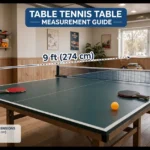
An official ping pong table is 9 feet long, 5 feet wide, and 2.5 feet tall — that is 2.74 meters by 1.525 meters by 76 centimeters under the rules of the International Table Tennis Federation (ITTF). Every table used in sanctioned competition follows these dimensions exactly, so a table in your basement and a table at the Olympics share the same playing surface.
Knowing the real numbers matters before you buy. A full-size table looks compact in a store but needs a surprising amount of floor space once you add swinging room on every side. This guide covers the official table size, net dimensions, fold-up and outdoor variants, mini and junior tables, and exactly how much room you need to play comfortably.
Official Table Dimensions Conversion Chart
| Dimension | Feet | Meters | Inches | Centimeters |
|---|---|---|---|---|
| Length | 9 ft | 2.74 m | 108 in | 274 cm |
| Width | 5 ft | 1.525 m | 60 in | 152.5 cm |
| Height (floor to top) | 2.5 ft | 0.76 m | 30 in | 76 cm |
| Net height | 0.5 ft | 0.1525 m | 6 in | 15.25 cm |
| Net assembly width | 6 ft | 1.83 m | 72 in | 183 cm |
Table Types Compared
| # | Table Type | Playing Surface | Folds Down To (approx.) | Best For |
|---|---|---|---|---|
| 1 | Official ITTF competition | 9 x 5 ft | Varies by model | Tournaments, clubs |
| 2 | Standard fold-up (rollaway) | 9 x 5 ft | ~5 x 2.5 ft footprint | Home game rooms |
| 3 | Stationary (non-folding) | 9 x 5 ft | Does not fold | Dedicated spaces |
| 4 | Outdoor weatherproof | 9 x 5 ft | ~5 x 2.5 ft footprint | Patios, driveways |
| 5 | Midsize (mini) table | ~7 x 4 ft | ~4 x 2.5 ft footprint | Kids, small rooms |
| 6 | Junior (3/4 size) table | ~6.75 x 3.75 ft | Varies by model | Children learning |
| 7 | Portable folding mini | ~5-6 ft long | Folds flat for a car trunk | Travel, apartments |
| 8 | Conversion top | 9 x 5 ft | Lifts off; stores flat | Pool or dining tables |
Folded sizes vary by brand and model, so always check the product’s spec sheet before assuming it fits your storage spot.
Clearances and Reference Sizes
| # | Item | Measurement | Notes |
|---|---|---|---|
| 1 | Minimum casual room | 17 x 11 ft | Tight but playable |
| 2 | Comfortable home room | 19 x 11 ft | Recommended for most players |
| 3 | Tournament play space | ~28 x 16 ft | Surrounds and officials included |
| 4 | Recommended ceiling height | 8-10 ft | Higher is better for lobs |
| 5 | Net assembly total width | 6 ft (183 cm) | Extends 6 in past each side edge |
| 6 | Net height above table | 6 in (15.25 cm) | Measured at the center |
| 7 | Ball and paddle scale | 40 mm ball | Paddle roughly 10 in long |
1. Official ITTF Competition Table
The official table is defined by the ITTF rulebook: a rectangular playing surface 2.74 meters long and 1.525 meters wide, sitting 76 centimeters above the floor. In imperial units, that is exactly 9 feet by 5 feet by 2.5 feet. The surface must be uniformly dark in color with a white sideline 2 centimeters wide running along each 2.74-meter edge and a white end line along each 1.525-meter edge. A 3-millimeter white center line divides the table lengthwise for doubles play. Competition tables use a top at least 25 millimeters thick, which gives a consistent, true bounce. If you buy a table labeled “official size” or “regulation size,” these are the numbers it should match.
2. Standard Fold-Up (Rollaway) Table
Fold-up rollaway tables keep the full 9-by-5-foot playing surface but split it into two halves that fold upright for storage. Each half typically stands about 5 feet wide and 2.5 feet deep when folded, so the table tucks against a wall and takes up roughly the footprint of a small bookshelf. Most rollaways ride on caster wheels, which makes one person able to move a table that weighs 150 to 200 pounds. One half can also fold up while the other stays flat, creating a “playback” position for solo practice against the raised half. If you need to wheel it through interior doors, measure the doorway first against the table’s folded width — see the notes on standard door size before you buy.
3. Stationary (Non-Folding) Table
A stationary table is a full-size 9-by-5-foot table built on a fixed frame with no folding mechanism. Because there are no hinges or folding hardware, these tables tend to feel sturdier and often cost less than an equivalent rollaway. The trade-off is obvious: the table permanently occupies its full 45 square feet of floor space plus the clearance around it. These are common in school gyms, rec centers, and dedicated home game rooms where the table never needs to move. Assembly is usually simpler since the frame bolts together as one rigid piece. Weights vary, but a stationary table with a 1-inch top often lands in the 150-to-200-pound range, so plan your room layout before delivery day.
4. Outdoor Table
Outdoor tables keep the official 9-by-5-foot playing surface but use weatherproof materials. The top is usually a resin-composite or aluminum panel rather than wood, so rain and sun do not warp it, and the frame is powder-coated or galvanized steel to resist rust. Table height stays at the standard 2.5 feet, and most outdoor models still fold and roll for storage. Expect them to be heavier than indoor tables of the same size — weatherproofing adds weight. Bounce on an outdoor top can feel slightly different from a wood competition top, which is why outdoor tables are rarely used in sanctioned tournaments. For backyard and driveway play, though, they are the practical choice.
5. Midsize (Mini) Table
Midsize or “mini” tables shrink the playing surface to roughly 70 percent of a full table, commonly around 7 feet long by 4 feet wide, though exact sizes vary by manufacturer. There is no official mini-table standard, so one brand’s mini may differ from another’s by several inches — check the spec sheet rather than trusting the label. Table height on midsize models is often the full 2.5 feet, which keeps the playing feel realistic for adults while the smaller surface fits tight rooms. These suit kids, casual family play, and apartments where a full 9-footer will not fit. They usually fold flat and weigh far less than full-size tables, often under 80 pounds.
6. Junior (Three-Quarter Size) Table
Junior tables are built for children, at roughly three-quarters of official size — about 6.75 feet long by 3.75 feet wide. Like midsize tables, there is no single official junior standard, so dimensions drift between brands. Many junior models also lower the playing height below the regulation 2.5 feet or offer adjustable legs, which helps younger players reach the ball comfortably. They are light, inexpensive, and easy to fold and store, making them a reasonable first table for a child who is still growing. Just know that skills learned on a smaller surface do not transfer perfectly: the ball angles, distances, and timing all change when a junior player steps up to a full-size table.
7. Portable Folding Mini Table
Portable folding minis are the smallest usable tables, with tops around 5 to 6 feet long that fold in half or into quarters. Folded flat, many fit in a car trunk, which makes them popular for offices, dorm rooms, and travel. Legs are usually simple folding supports rather than full rollaway frames, and the whole package often weighs under 50 pounds. The playing experience is closer to a toy than to real table tennis — the short surface compresses rallies and changes every angle. Treat these as fun, portable games rather than training equipment. If you go this route, verify the unfolded length before buying, because “mini” covers everything from a 4-foot toy to a near-midsize table.
8. Conversion Top
A conversion top is a full-size 9-by-5-foot playing surface with no legs of its own. It sits on top of an existing pool table or dining table, using foam pads to protect the furniture underneath. The advantage is clear: you get a regulation-size playing surface without dedicating floor space to a second table. The catch is that the combined height of your furniture plus the top often exceeds the official 2.5 feet, which changes the playing feel slightly. Conversion tops split into two halves for storage and typically weigh 60 to 90 pounds per set. They work best when the table underneath is sturdy, level, and close to the right height.
9. How Much Room You Need Around the Table
The table itself is 9 by 5 feet, but nobody plays standing still. For casual home play, plan on a room roughly 19 feet long by 11 feet wide: that gives about 5 feet of clearance behind each end and 3 feet on each side for backswings and side steps. A tighter room of 17 by 11 feet is playable but cramped, especially for two aggressive players. Tournament venues use far more — around 28 by 16 feet — to fit barriers, officials, and camera positions. Before buying, measure your actual room with a tape measure (a refresher on how to read a measuring tape helps if it has been a while) and mark the table outline on the floor with painter’s tape so you can see the real footprint.
10. Ceiling Height for Indoor Play
Ceiling height matters more than most buyers expect. A low ceiling clips lobs, high serves, and defensive returns. For casual play, 8 feet of ceiling clearance is workable; 9 to 10 feet is noticeably better and lets players use the full range of shots. Basements are the classic problem spot — a 7-foot basement ceiling technically fits the 2.5-foot table, but lobs will hit the ceiling and light fixtures become targets. Tournament halls typically offer much more. If your room has a ceiling fan, treat the fan’s lowest point as your effective ceiling height and consider whether it can be switched off or raised during play.
11. Net Assembly Dimensions
The net assembly is wider than the table. ITTF rules set the net at 1.83 meters long — exactly 6 feet — so it extends 15.25 centimeters (6 inches) beyond each side edge of the 5-foot-wide table. The posts clamp to the table sides and the net hangs between them, with the bottom of the net sitting as close to the table surface as possible along its full length. Net posts are adjustable on most tables so you can keep the net taut and centered. When you buy a replacement net, match the 6-foot width rather than the 5-foot table width, or the net will not reach the posts.
12. Net Height Above the Table
The top of the net must sit 15.25 centimeters — 6 inches — above the playing surface, measured at the center of the table. Because nets sag slightly under their own weight, the height at the posts may read a touch higher; the 15.25-centimeter figure is the center measurement that matters. Most clamp-style net sets include a small height adjustment, so check the center with a ruler after setup rather than trusting the factory setting. A net set even half an inch too high turns easy returns into net balls, and one set too low makes the game artificially easy. This is the single most commonly mis-set dimension on home tables.
13. Tabletop Thickness and Bounce
Tabletop thickness drives bounce quality. Competition tables use tops at least 25 millimeters (1 inch) thick, usually medium-density fiberboard, which returns the ball with a consistent, predictable bounce. Recreational tables range from 12 to 19 millimeters; thinner tops can produce dead spots and a hollow sound on hard hits. Outdoor tables substitute resin or aluminum-composite panels of similar thickness to wood tops. As a rough rule, the thicker the top, the truer the bounce and the heavier the table — a 25-millimeter top on a steel frame is what pushes full-size tables into the 150-to-200-pound range. If you play seriously, prioritize top thickness over folding features.
14. Leg and Frame Styles
Table legs come in a few common designs. Rollaway tables use a center-fold frame: each half has its own leg assembly with caster wheels, and the halves meet at the middle. Stationary tables use four corner legs or a panel-style base for maximum rigidity. Outdoor models use similar frames with rust-resistant coatings. Stability matters because a wobbly table ruins the game — look for adjustable leg levelers, which let you compensate for uneven floors, and cross-bracing between legs on lighter models. Wheel locks are worth checking too: a table that drifts mid-rally is a hazard. Whatever the style, the legs must hold the surface level at exactly 2.5 feet.
15. Ball and Paddle Sizes for Scale
For a sense of scale, the official ball is 40 millimeters in diameter (about 1.57 inches) and weighs 2.7 grams, made of plastic since the celluloid era ended. A standard paddle is roughly 10 inches long overall, with a blade about 6 inches wide — regulations cap the blade at no more than 15.7 centimeters wide and require specific rubber coverings, but recreational paddles vary. Against the 9-foot table, the ball looks tiny, which is exactly why the sport demands such fast reactions: a ball crossing 9 feet at 60-plus miles per hour gives you a fraction of a second to respond. These small dimensions are part of what makes the full-size table feel so large in play.
Frequently Asked Questions
How much room do you need for a ping pong table?
Plan on a room about 19 feet long by 11 feet wide for comfortable home play. That gives roughly 5 feet of clearance behind each end of the 9-foot table and 3 feet on each side. A 17-by-11-foot room works for casual games but feels tight. Tournament spaces run around 28 by 16 feet.
Can a full-size ping pong table fit through a standard doorway?
Most fold-up rollaway tables fit through a standard 30-to-36-inch interior doorway when folded, since the folded half is about 5 feet wide but only around 2.5 feet deep — you wheel it through on its side. Always measure your specific doorway and the table’s folded dimensions before delivery, because models vary.
What is the official net height in table tennis?
The top of the net must be 15.25 centimeters (6 inches) above the playing surface, measured at the center of the table. The net assembly itself is 6 feet wide, extending 6 inches past each side edge of the 5-foot-wide table.
Are mini ping pong tables the same height as official tables?
Often, but not always. Many midsize (mini) tables keep the regulation 2.5-foot height so the playing feel stays realistic, while junior tables frequently sit lower or have adjustable legs for children. Since there is no official mini standard, check the product specifications for both surface size and height.
Final Thoughts
A regulation ping pong table is 9 feet long, 5 feet wide, and 2.5 feet tall, with a 6-inch net stretching 6 feet across — numbers that have not changed in decades of ITTF competition. The table itself is only half the purchase decision, though: you need roughly a 19-by-11-foot room, 8 to 10 feet of ceiling, and a doorway plan for getting a folded rollaway inside. Fold-up, outdoor, junior, and mini tables all bend these numbers for smaller spaces, but none match the true bounce of a 1-inch-thick competition top. Measure your room, pick the table type that fits your space, and double-check the net height after setup. Do that, and the table will play exactly the way the sport was designed to be played.

I’m Marcus Kane, a measurement content specialist at MeasuresIt.com. I write clear, accurate, and practical articles about measurements, dimensions, conversions, and everyday size comparisons, making complex topics simple and easy to understand.