Miles to Kilometers Conversion: Formula & Chart
One mile equals 1.60934 kilometers, so to convert miles to kilometers, multiply the number of miles by 1.60934. That single multiplication covers everything from a morning run to a cross-country road trip. Whether you are reading a European speed limit sign, training for a race measured in kilometers, or checking how far your flight travels, the miles-to-kilometers conversion is the one travelers and runners reach for most.
The mile is an imperial unit with roots in the Roman mille passus, a thousand paces, and it was fixed at exactly 1,609.344 meters by international agreement in 1959. The kilometer belongs to the metric system, used by nearly every country in the world for road distances. Because the United States still measures roads in miles while most of the world uses kilometers, knowing how to move between the two keeps you oriented anywhere you travel. This guide gives you the exact formula, worked examples, a fast mental shortcut, speed conversions, and a chart of the distances people look up most.
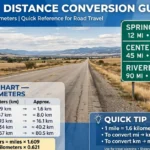
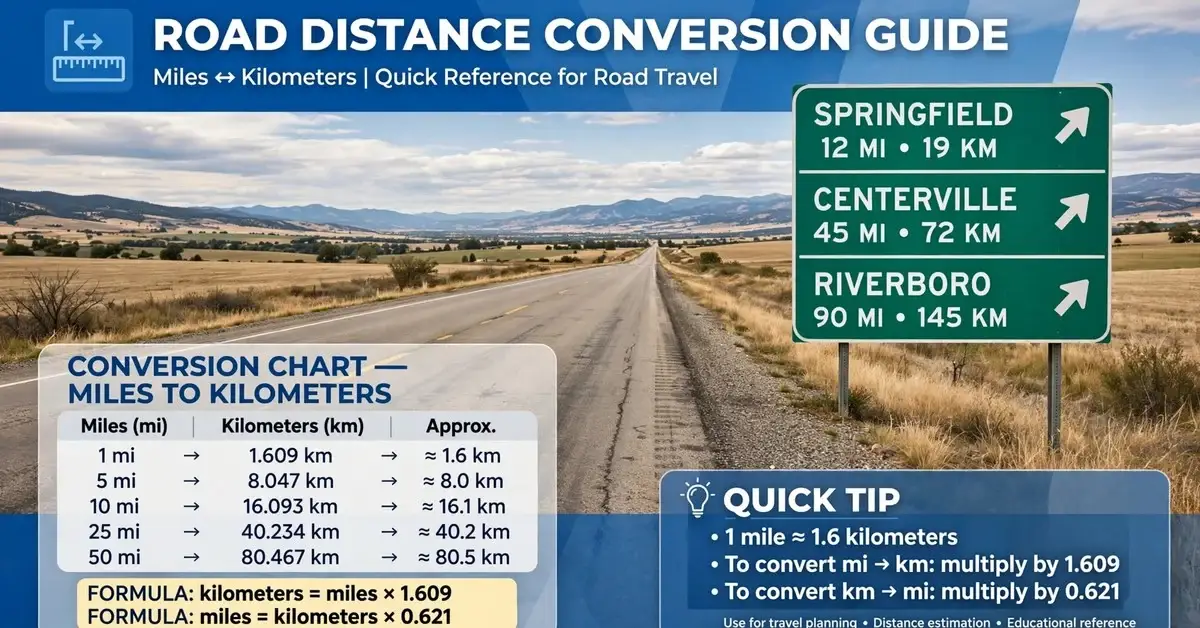
Miles to Kilometers Conversion Chart
Start with the quick reference table. Find your miles in the left column and read the kilometer value on the right.
| Miles | Kilometers |
|---|---|
| 1 mi | 1.609 km |
| 2 mi | 3.219 km |
| 5 mi | 8.047 km |
| 10 mi | 16.093 km |
| 20 mi | 32.187 km |
| 26.2 mi | 42.165 km |
| 50 mi | 80.467 km |
| 100 mi | 160.934 km |
Values are rounded to three decimal places, which is more than enough precision for travel, running, and everyday planning.
Everyday Reference Distances
These landmarks help you feel what a mile or a kilometer really is.
| Reference | Miles | Kilometers |
|---|---|---|
| Football field, goal line to goal line (100 yd) | 0.057 mi | 0.091 km |
| Standard running track lap (400 m) | 0.249 mi | 0.400 km |
| Walking steps in a mile (rough estimate) | 1 mi | 1.609 km |
| 5K race | 3.11 mi | 5 km |
| 10K race | 6.21 mi | 10 km |
| Half marathon (official) | 13.11 mi | 21.10 km |
| Marathon (official) | 26.22 mi | 42.195 km |
Step counts vary a lot with stride length, so treat the 2,000-step figure as a rough average rather than a rule.
1. The Formula: Miles to Kilometers
The exact conversion formula is simple: kilometers = miles × 1.60934. Because the international mile is defined as exactly 1,609.344 meters, one mile is exactly 1.609344 kilometers, and 1.60934 is that value rounded to five decimal places. Multiply any distance in miles by this number and you get the distance in kilometers. The formula works in both directions of scale, from fractions of a mile to thousands of miles, and it never changes. Keep 1.60934 saved in your phone notes and you will always have the conversion ready.
2. Worked Example: 1 Mile to Kilometers
Take the base case first: 1 mile × 1.60934 = 1.60934 kilometers, usually rounded to 1.61 km. This is the number behind the familiar running fact that a mile is “about 1.6 kilometers.” If a race course or a hiking trail is listed as one mile, you can picture just over one and a half kilometers. Rounding to 1.61 km introduces an error of less than a meter, which is negligible for anything except surveying. For most purposes, remembering that a mile is roughly one and six-tenths kilometers is all you need.
3. Worked Example: Converting Larger Distances
Scale the formula up the same way. Ten miles: 10 × 1.60934 = 16.0934 km, about 16.1 km. Fifty miles: 50 × 1.60934 = 80.467 km. One hundred miles: 100 × 1.60934 = 160.934 km. Notice the pattern — the decimal point simply shifts as the miles grow, so converting 5 miles (8.0467 km) feels no harder than converting 500 miles (804.672 km). Long-haul drivers use this when a trip crosses into Canada or Mexico, where road signs switch to kilometers. A 300-mile driving day, for instance, becomes 482.8 km of road.
4. The ×1.6 Mental Shortcut
When you need an answer in your head, multiply by 1.6 instead of 1.60934. The shortcut is easy: take the miles, add half the miles, then add a tenth of the miles. For 10 miles, that is 10 + 5 + 1 = 16 km, very close to the true 16.09 km. For 25 miles: 25 + 12.5 + 2.5 = 40 km, versus the exact 40.23 km. The error stays under half a percent, which is fine for estimating arrival times or reading a foreign speedometer. Save the full 1.60934 for paperwork, fuel logs, and race records.
5. Common Distances: 1, 5, and 10 Miles
These three distances cover daily life. One mile is 1.609 km, the distance of a relaxed 15 to 20 minute walk. Five miles is 8.047 km, a typical short commute or a solid training run. Ten miles is 16.093 km, a long training run or a cross-town drive in many cities. Runners often convert these when following a training plan written in kilometers: a plan calling for an 8K run is essentially asking for 5 miles. Cyclists do the same with route maps. Once these three anchors feel natural, every other distance becomes easy to estimate.
6. Long Distances: 26.2 and 100 Miles
Two famous long distances anchor the top of the scale. The marathon distance of 26.2 miles converts to 42.165 km with the standard factor, though the official marathon course is defined as exactly 42.195 kilometers (about 26.22 miles). The tiny gap comes from rounding 26.2188 miles down to 26.2 in everyday speech. A 100-mile ultramarathon, or “century ride” in cycling, equals 160.934 km. Endurance athletes crossing between US and European events convert these constantly, since American ultras are measured in miles and European ones in kilometers.
7. Converting Speed: mph to km/h
The same factor converts speed. Kilometers per hour = miles per hour × 1.60934. So 60 mph becomes 96.56 km/h, 65 mph becomes 104.61 km/h, and 70 mph becomes 112.65 km/h. This matters the moment you drive abroad: a 130 km/h limit on a French autoroute is about 80.8 mph, and a 100 km/h limit in Canada is about 62.1 mph. Many rental cars show both scales on the speedometer, but knowing the conversion keeps you legal in cars that do not. Cyclists also use it — 20 mph on a bike computer is 32.19 km/h.
8. The Reverse: Kilometers to Miles
To go the other way, divide kilometers by 1.60934, or multiply by 0.621371. So 10 km × 0.621371 = 6.21371 miles, about 6.21 miles. A 5K race is 3.11 miles, and 42.195 km is 26.22 miles. The mental shortcut works in reverse too: kilometers × 0.6 plus a small correction gets you close. For 100 km, 100 × 0.62 = 62 miles, versus the exact 62.14 miles. Travelers returning from abroad use this to translate what they saw: that “200 km to Paris” sign meant about 124 miles.
9. Running and Race Distances
Running is where most people meet this conversion. The standard race ladder — 5K, 10K, half marathon, marathon — is defined in kilometers, and American runners constantly translate it: 5K is 3.11 miles, 10K is 6.21 miles, the half marathon is 13.11 miles, and the marathon is 26.22 miles. Treadmills in the US often default to miles, so a runner following a kilometer-based plan converts each workout. Pace converts too: a 5:00-per-kilometer pace equals about 8:03 per mile. Race directors certify courses in metric, then publish the familiar mile equivalents for local runners.
10. Driving Abroad: Reading km/h Signs
Landing in a country that uses kilometers changes every number you see. Speed limits, distances on green highway signs, and your rental car’s odometer all read in kilometers. A sign reading “Berlin 150 km” means about 93 miles to go. A 50 km/h city limit is about 31 mph. Fuel economy also flips: instead of miles per gallon, you will see liters per 100 kilometers, where a smaller number is better. Before the trip, convert a few anchor speeds — 30, 50, 70, and 100 mph — into km/h so the signs feel familiar on day one.
11. The Marathon: 42.195 Kilometers
The marathon deserves its own section because its number is famous. The official distance is 42.195 kilometers, set for the 1908 London Olympics and standardized in 1921. In miles that is 42.195 × 0.621371 = 26.2188 miles, universally shortened to 26.2. When you convert 26.2 miles with the standard factor you get 42.165 km, about 30 meters short of the true course — a good reminder that rounded inputs give rounded outputs. Race organizers always work from the 42.195 km definition and convert outward, never the reverse.
12. Walking a Mile: Time and Steps
A mile takes the average walker 15 to 20 minutes at a moderate pace of 3 to 4 mph, which is 4.8 to 6.4 km/h. In steps, a mile is roughly 2,000 to 2,500 walking steps, though stride length shifts this a lot — taller walkers take fewer, longer steps. Fitness trackers that count in kilometers will show the same walk as 1.61 km. If you are calibrating a pedometer or estimating a walking commute, these equivalents turn an abstract distance into something your body understands. To picture the length itself, think of about 18 football fields laid end to end — or roughly 790 queen-size beds in a row, since a standard queen bed is 80 inches long (see bed sizes in inches for the full breakdown).
13. Measuring Routes Yourself
For short distances, you can measure directly instead of converting. A measuring wheel or a GPS app handles anything from a driveway to a 5K course, and race organizers use calibrated bicycles for official certification. For very short measurements — a stride, a room, a piece of furniture — a tape measure is the right tool, and our guide on how to read a measuring tape walks through the markings step by step. Once you have measured in feet or inches, convert to metric from there. Direct measurement beats conversion whenever the original distance was never recorded in miles at all.
14. Why the US Still Uses Miles
The United States is one of only a few countries — alongside Liberia and Myanmar — that has not fully adopted the metric system for road distances. A 1970s metrication effort stalled, and the cost of replacing every road sign in the country kept miles in place. The UK uses a hybrid: road distances in miles but most other measurements metric. Everywhere else, kilometers rule the roads. This split is exactly why the miles-to-kilometers conversion stays essential: it bridges the two systems every time an American drives, runs, or flies internationally.
15. Rounding Rules: When Precision Matters
Round to the situation. For travel talk and race chat, one decimal place is plenty: 10 miles is 16.1 km. For fuel logs, training records, and engineering, keep three or more: 16.093 km. Never round before the final step of a multi-part calculation, since early rounding compounds the error. And remember that converting a rounded number, like the “26.2” in marathon, cannot recover precision that was already lost. When the input is approximate, say so — “about 42.2 km” is more honest than “42.165 km” if you started from a rounded 26.2 miles.
Frequently Asked Questions
How many kilometers are in a mile?
One mile equals 1.60934 kilometers, often rounded to 1.61 km. This comes from the international definition of the mile as exactly 1,609.344 meters. For quick mental math, multiplying miles by 1.6 gets you within half a percent of the exact answer.
How do I convert mph to km/h?
Multiply the mph value by 1.60934. For example, 60 mph × 1.60934 = 96.56 km/h. This is the conversion you need when driving in countries that post speed limits in kilometers per hour, such as Canada, Mexico, and most of Europe.
How many miles is a 10K run?
A 10K is 10 kilometers, which equals 6.21371 miles — usually stated as 6.2 miles. Similarly, a 5K is 3.11 miles, a half marathon (21.0975 km) is 13.11 miles, and a marathon (42.195 km) is 26.22 miles.
Why is the marathon 42.195 km instead of a round number?
The 42.195-kilometer distance was set for the 1908 London Olympics so the race could start at Windsor Castle and finish in front of the royal box at the Olympic Stadium. It was adopted as the standard marathon distance in 1921 and has never changed since.
Final Thoughts
Converting miles to kilometers comes down to one number, 1.60934, and one habit: multiply miles by it, or use 1.6 when an estimate will do. The chart above handles the distances people look up most, from a single mile to a hundred, while the speed conversions keep you legal on foreign roads. Runners get the most daily use from it, translating kilometer-based training plans and race distances into familiar miles, but travelers benefit just as much every time a highway sign switches units at a border. Keep the formula, the ×1.6 shortcut, and the reverse factor 0.621371 within reach, and the two systems stop feeling like two languages. Distance is distance — the units are just the accent. Once the conversion becomes automatic, reading foreign signs and following international training plans feels completely natural.

I’m Elena Cross, a content writer at MeasuresIt.com, where I turn complex measures, units, and mathematical concepts into clear, accurate, and easy-to-read articles. I’m passionate about precision in numbers and in words and I write to help readers actually understand measurements, not just memorize them.