Hockey Rink Dimensions: NHL, Olympic & Youth Sizes
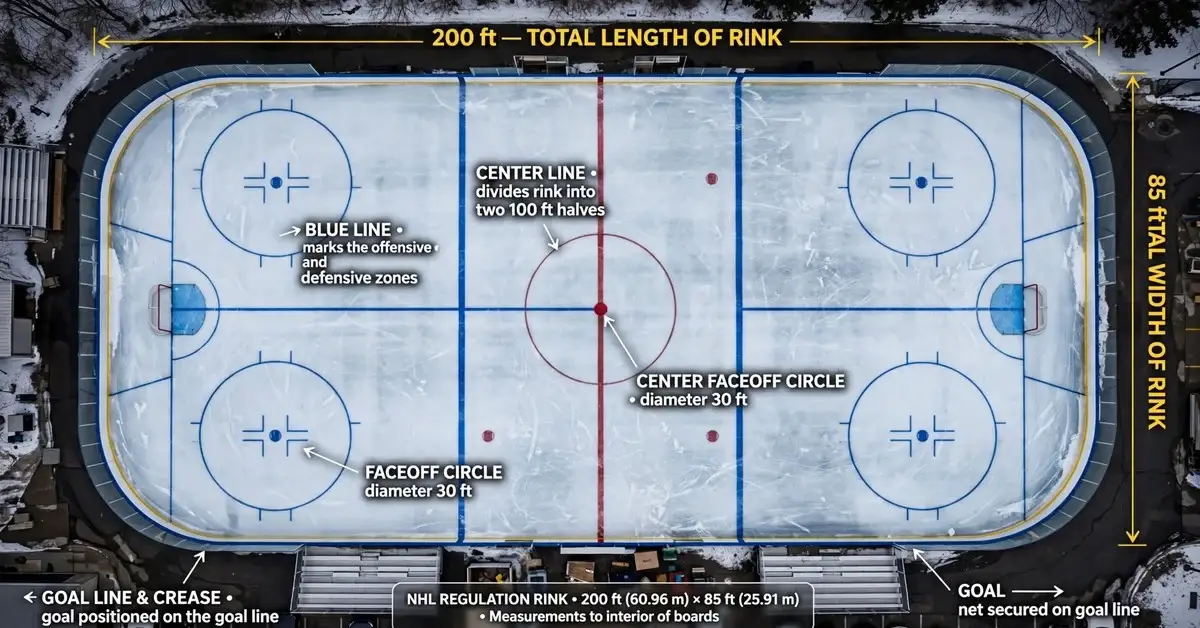
An NHL hockey rink is 200 feet long and 85 feet wide, with rounded corners and boards that stand about 42 inches high. If you have ever watched a game and wondered how all those lines, circles, and zones fit onto one sheet of ice, this guide walks you through every dimension — from NHL and Olympic rinks down to youth and backyard versions — so you can picture exactly what you are looking at.
One reason hockey rinks come in different sizes is history. The NHL standardized on the 200-by-85-foot rink, while international play under IIHF rules uses a wider sheet of 200 by 100 feet. That extra 15 feet of width changes how the game is played, giving skaters more room on the wings and more space to dodge defenders. Below, you will find a conversion chart, reference tables, and fifteen detailed sections covering the measurements that matter most.
Rink Size Conversion Chart
| Rink Type | Length | Length (m) | Width | Width (m) | Area |
|---|---|---|---|---|---|
| NHL | 200 ft | 61.0 m | 85 ft | 25.9 m | 17,000 sq ft |
| Olympic / IIHF | 200 ft | 61.0 m | 100 ft | 30.5 m | 20,000 sq ft |
| Youth (typical) | 185 ft | 56.4 m | 85 ft | 25.9 m | ~15,725 sq ft |
| Backyard (typical) | 40 ft | 12.2 m | 20 ft | 6.1 m | ~800 sq ft |
| Goal net | 6 ft wide | 1.83 m | 4 ft tall | 1.22 m | — |
| Dasher boards | — | — | 42–48 in tall | 107–122 cm | — |
Key Rink Dimensions at a Glance
| # | Feature | Measurement |
|---|---|---|
| 1 | NHL rink length | 200 ft (61 m) |
| 2 | NHL rink width | 85 ft (25.9 m) |
| 3 | Olympic rink width | 100 ft (30.5 m) |
| 4 | Corner radius | 28 ft (8.5 m) |
| 5 | Blue lines from each goal line | 75 ft (22.9 m) |
| 6 | Neutral zone width (NHL) | 50 ft (15.2 m) |
| 7 | Goal line from end boards | 11 ft (3.35 m) |
| 8 | Goal net size | 6 ft wide × 4 ft tall |
Rink Structures and Markings
| # | Feature | Measurement |
|---|---|---|
| 9 | Faceoff circle radius | 15 ft (4.6 m) |
| 10 | Center ice circle | 15 ft radius, blue |
| 11 | Goal crease | 6 ft radius semicircle |
| 12 | Dasher boards | 42–48 in (107–122 cm) tall |
| 13 | Glass above boards | 5–8 ft (1.5–2.4 m) tall |
| 14 | Penalty boxes | Two boxes, one per team |
| 15 | Backyard rink (typical) | ~40 × 20 ft (12 × 6 m) |
1. NHL Rink Length: 200 Feet
The standard NHL rink is 200 feet long from one end board to the other, which is about 61 meters. This length has been the league standard for decades, and it is measured along the center of the ice surface. To picture 200 feet, imagine about two-thirds of an American football field, or roughly twelve standard cars parked bumper to bumper. Every NHL arena you see on television — from the largest to the smallest — plays on this same 200-foot length, so the game looks and feels consistent no matter where it is played.
2. NHL Rink Width: 85 Feet
NHL rinks are 85 feet wide, about 26 meters. This is noticeably narrower than the Olympic sheet, and it makes the North American game faster and more physical because players have less room to avoid checks along the boards. The 85-foot width gives a total playing area of 17,000 square feet. If you walk the width of a rink, you will cross in about 28 adult steps. Many youth and community rinks in North America copy these NHL dimensions so young players train on the same proportions the pros use.
3. Olympic and International Width: 100 Feet
Under IIHF rules used at the Olympics and World Championships, rinks are 200 feet long but 100 feet wide — a full 15 feet wider than the NHL sheet. That wider ice surface, sometimes called “big ice,” adds 3,000 square feet of playing area. The extra width favors skating, passing, and puck possession over physical checking, which is why European-trained players often look so comfortable in open space. When NHL players compete at the Olympics, adjusting to the extra width is one of the biggest changes they talk about.
4. Corner Radius: 28 Feet
Hockey rink corners are not square — they are rounded with a radius of about 28 feet (roughly 8.5 meters). Rounded corners keep play moving because the puck slides smoothly around the boards instead of dying in a sharp corner. Defenders also use the curved glass to bank passes to teammates. The 28-foot radius is part of the official NHL specification, and it applies equally to both ends of the rink so the shape stays symmetrical.
5. Blue Lines: 75 Feet From Each Goal Line
The two blue lines run across the width of the rink, each one sitting 75 feet (about 22.9 meters) from the goal line at its end. These lines divide the rink into three zones: two end zones and the neutral zone in the middle. The blue line is 12 inches wide, and it is the line that determines offsides — an attacking player cannot cross it ahead of the puck. Because the blue lines are 75 feet from each goal line on a 200-foot rink, the neutral zone between them measures 50 feet wide.
6. Neutral Zone: 50 Feet Wide
The neutral zone is the 50-foot-wide strip of ice between the two blue lines. This is where teams regroup, where dump-and-chase plays begin, and where much of the game’s transitional speed shows up. Fifty feet is about 15 meters — wide enough for a few strides but tight enough that a turnover here can turn into a scoring chance in seconds. On the wider Olympic sheet the neutral zone has the same 50-foot depth, but its greater width gives playmakers more room to operate.
7. Goal Line: 11 Feet From the End Boards
Each goal line sits 11 feet (about 3.35 meters) in front of the end boards. The goal net itself is centered on this line. That 11-foot pocket of ice behind the net is prime real estate — it is where skilled forwards set up wraparound attempts and where defensemen battle for loose pucks. On television, watch how often play cycles behind the net; that space exists because of this exact 11-foot measurement.
8. Goal Net: 6 Feet Wide by 4 Feet Tall
A regulation hockey goal is 6 feet wide and 4 feet tall at the mouth of the net, with a depth of about 44 inches at the base. The posts and crossbar are 2 inches in diameter and painted red. Six feet wide is roughly the wingspan of a tall adult — wider than a standard interior door — which is why goaltenders look like they fill so much of the net — a good goalie in the butterfly position can cover most of it. The 4-foot height means the top corners, the spots shooters aim for, sit about chest-high on an average adult.
9. Faceoff Circle Radius: 15 Feet
Each of the four faceoff circles in the end zones has a radius of 15 feet, making each circle 30 feet across. The circles are painted red with a 2-inch-wide line, and two hash marks sit on either side where wingers line up. The faceoff dot at the center of each circle is 2 feet in diameter and painted blue. These circles keep players at a fair distance during faceoffs and give centers a defined area to work within when the puck drops.
10. Center Ice Circle: 15-Foot Blue Circle
At the exact center of the rink sits the center ice faceoff circle — also with a 15-foot radius, but painted blue instead of red. The center ice dot is blue as well. This is where every period begins and where faceoffs happen after goals. The blue color makes it easy to spot from the stands, and the surrounding red center line, 12 inches wide, marks the middle of the 200-foot length. Icing calls are judged against this line.
11. Goal Crease: 6-Foot Semicircle
The goal crease is the light-blue semicircle in front of each net with a 6-foot radius, centered on the goal line. This is the goaltender’s protected area — opposing players cannot enter it and interfere with the goalie without risking a penalty or a disallowed goal. The crease is painted a pale blue so officials and players can see its boundary clearly. Its 6-foot radius matches the width of the goal itself, extending the protected zone a full stick-length in front of the net.
12. Dasher Boards: 42 to 48 Inches Tall
The dasher boards that ring the rink stand 42 inches tall in the NHL, and between 40 and 48 inches at most other levels. They are made of high-density polyethylene over a wooden or steel frame, with a yellow kickplate at the bottom and a colored stripe — usually red or blue — along the top. The boards need to be tall enough to keep pucks in play but low enough that fans can see over them. At 42 inches, the boards come up to about the waist of an average adult standing on the ice.
13. Protective Glass: 5 to 8 Feet Above the Boards
Above the boards sits tempered or acrylic glass that protects spectators from flying pucks. The glass runs 5 to 6 feet high along the sides of the rink and 8 feet high behind the goals at each end, where shots are most likely to fly into the stands. After a few serious fan injuries in the early 2000s, the NHL extended netting above the glass at both ends of every arena. The glass panels flex slightly on impact, which is by design — rigid glass would shatter more easily.
14. Penalty Boxes: One Per Team
Each rink has two penalty boxes, one for each team, located on the same side of the ice as the team benches — usually across from the scorer’s table or beside it. A standard penalty box is roughly 6 to 8 feet wide, with a small door opening onto the ice and a bench inside. Timekeepers sit nearby to open the door when a penalty expires. The boxes are separated so penalized rivals cannot reach each other, which matters more than you might think in a heated game.
15. Backyard Rink: About 40 by 20 Feet
A typical backyard rink built with boards or a liner kit measures around 40 feet long and 20 feet wide — about one-tenth the area of an NHL sheet. Some families go bigger, up to 60 by 30 feet, while others squeeze a small practice pad into 20 by 16 feet. Backyard boards are usually 12 to 24 inches tall, much lower than arena boards. Building one takes a flat, level spot in the yard and a few cold weeks — grab a measuring tape to lay out your lines — and the size is really dictated by how much flat ground and water you have available.
Youth Rink Sizes Worth Knowing
Not every young player skates on a full NHL sheet. Many youth programs use the same 200-by-85-foot dimensions, but smaller community rinks sometimes measure 185 by 85 feet to fit inside older buildings. For the youngest players, cross-ice games are played widthwise across a standard rink, creating a playing surface of roughly 85 by 60 feet with small nets — a setup that gives kids more puck touches and is widely used in development programs across North America and Europe.
Frequently Asked Questions
How big is an NHL hockey rink in square feet?
An NHL rink covers 17,000 square feet of ice — 200 feet long multiplied by 85 feet wide, minus a small amount for the rounded corners. The Olympic sheet is larger at about 20,000 square feet thanks to its extra 15 feet of width.
Why are Olympic rinks wider than NHL rinks?
The wider 100-foot international sheet comes from European rink-building traditions that favored more skating room. The IIHF kept that width as its standard, while the NHL standardized on the narrower 85-foot rink common in North American arenas. The wider ice rewards puck possession and skating; the narrower ice rewards speed and physical play.
How far apart are the blue lines on a hockey rink?
The blue lines are 75 feet from each goal line, which leaves a 50-foot neutral zone between them on a standard 200-foot rink. The same spacing applies on the wider Olympic sheet.
How tall are hockey boards?
NHL dasher boards are 42 inches tall, and most rinks fall between 40 and 48 inches. Tempered glass above the boards adds another 5 to 6 feet on the sides and 8 feet behind the goals, with protective netting above the end glass in NHL arenas.
Final Thoughts
Hockey rink dimensions shape the sport more than most fans realize. The NHL’s 200-by-85-foot sheet creates the fast, physical game North American audiences love, while the Olympic 200-by-100-foot surface opens up a more skating-oriented style built on possession and open ice. The smaller details matter too — the 11 feet behind the goal line where wraparounds are born, the 75-foot blue line spacing that defines offsides, the 15-foot faceoff circles, and the 42-inch boards all work together to create the geometry players read instinctively. Whether you are watching the pros, coaching youth hockey, or flooding your own backyard rink, knowing these measurements gives you a deeper appreciation for how the game is built on its ice — every line and circle is there for a reason.

I’m Marcus Kane, a measurement content specialist at MeasuresIt.com. I write clear, accurate, and practical articles about measurements, dimensions, conversions, and everyday size comparisons, making complex topics simple and easy to understand.