PSI to Bar Conversion: Tire Pressure Chart & Formula
PSI to Bar Conversion: Tire Pressure Chart & Formula
One bar equals 14.5038 PSI, so to convert PSI to bar you divide the PSI value by 14.5038. If your car tire reads 32 PSI, that is about 2.2 bar. Most drivers run into both units because tire gauges sold in different countries label their dials differently.
PSI (pounds per square inch) is the standard pressure unit in the United States, while bar is common across Europe, the UK, and most of the rest of the world. Your car’s door jamb sticker may list the recommended tire pressure in PSI only, but a portable air compressor bought online might show bar on its gauge. Knowing the quick conversion keeps you from guessing — and guessing at tire pressure is never a good idea.
Quick PSI to Bar Conversion Chart
| PSI | Bar | kPa |
|---|---|---|
| 20 | 1.38 | 138 |
| 25 | 1.72 | 172 |
| 30 | 2.07 | 207 |
| 32 | 2.21 | 221 |
| 35 | 2.41 | 241 |
| 40 | 2.76 | 276 |
| 45 | 3.10 | 310 |
| 50 | 3.45 | 345 |
Keep this chart handy in your glovebox or save it on your phone. The values in the middle of the range — 30 to 35 PSI — cover most passenger cars, which is the range you will need most often.
1. The PSI to Bar Formula
Converting PSI to bar uses a single division. Take the PSI value and divide it by 14.5038. That number is the exact conversion factor between the two units.
Written as a formula:
Bar = PSI ÷ 14.5038
Why 14.5038? A bar is defined as exactly 100,000 pascals, and a PSI as exactly 6,894.757 pascals. Divide 100,000 by 6,894.757 and you get 14.5038 — most people round it to 14.5 for quick mental math.
Going the other direction is just as simple. To convert bar to PSI, multiply the bar value by 14.5038. So a tire inflated to 2.2 bar holds roughly 32 PSI.
2. The Bar to PSI Formula in Practice
The reverse conversion matters when your equipment speaks a different language than your car’s manual. Many air compressors and digital gauges sold internationally display bar by default, while an American car owner’s manual lists PSI.
PSI = bar × 14.5038
For example, if your gauge reads 2.4 bar, multiplying by 14.5038 gives 34.8 PSI — essentially 35 PSI. That is the upper end of the normal range for many passenger cars and SUVs.
A helpful rounding trick: multiplying bar by 15 gets you within a few percent of the true PSI value. The 2.4 bar example becomes 36 PSI by this shortcut, which is close enough for a rough check but not precise enough for setting your final pressure. Use the full factor for the actual inflation.
3. Worked Example: 32 PSI to Bar
Thirty-two PSI is the single most common recommended tire pressure for passenger cars, so let us walk through it step by step.
Step 1: Write down the formula — Bar = PSI ÷ 14.5038.
Step 2: Insert the value — Bar = 32 ÷ 14.5038.
Step 3: Do the division — 32 ÷ 14.5038 = 2.206.
Rounded to one decimal place, 32 PSI equals 2.2 bar. Most digital gauges round to one decimal anyway, so 2.2 bar is exactly what you would aim for on a bar-reading gauge.
Double-check with the reverse formula: 2.2 × 14.5038 = 31.9 PSI, which rounds to 32. The math checks out in both directions.
4. Worked Example: 2.5 Bar to PSI
Now the reverse direction, which you might need when a European car’s sticker lists pressure in bar and your gauge reads PSI.
Step 1: Write down the formula — PSI = bar × 14.5038.
Step 2: Insert the value — PSI = 2.5 × 14.5038.
Step 3: Multiply — 2.5 × 14.5038 = 36.26.
2.5 bar equals 36.3 PSI, usually rounded to 36 PSI. This is a common recommended pressure for the rear tires of a loaded SUV or a car carrying heavy cargo.
Notice how a half-bar change moves PSI by about 7.3. That sensitivity is worth remembering: even a small misreading on a bar gauge changes the actual tire pressure more than you might expect.
5. The 20 to 50 PSI Tire Pressure Chart in Context
The chart at the top of this article spans 20 to 50 PSI because that range covers nearly every road vehicle most people will ever own. Here is how the range breaks down in real life.
Pressures below 25 PSI (1.7 bar) usually mean a tire is flat or seriously under-inflated for a passenger car — on pavement, anything near 20 PSI needs air immediately.
The 30 to 35 PSI (2.1 to 2.4 bar) band is home base for most sedans, hatchbacks, and crossovers. Your door jamb sticker almost certainly names a number in this band.
40 to 50 PSI (2.8 to 3.4 bar) belongs to heavier vehicles: loaded pickup trucks, vans, trailers, and some performance cars with low-profile tires. Always check the sticker rather than assuming.
6. kPa Equivalents: The Third Unit
Many gauges — especially digital ones — offer a third unit: kilopascals, or kPa. You may also see it on the tire pressure labels of cars sold in Australia and some Asian markets.
The conversion is straightforward: kPa = PSI × 6.89476. One PSI equals 6.89476 kilopascals.
Handily, 100 kPa is almost exactly 1 bar. That makes kPa easy to read: 220 kPa is 2.2 bar is 32 PSI. Just move the decimal point.
If your gauge only shows kPa and your car asks for 32 PSI, multiply 32 by 6.89476 to get 220.6 kPa — aim for 221.
7. Why Gauges Show Both PSI and Bar
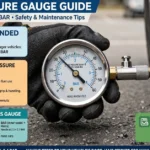
Walk into any auto parts store and most analog tire gauges have two scales printed on the dial: PSI on the outside, bar (or kPa) on the inside. There are practical reasons for this.
First, manufacturers sell the same gauge worldwide. Printing both scales avoids making separate versions for the US and European markets, which keeps costs down and inventory simple.
Second, cars cross borders. A driver who buys a car in Germany and moves it to the US — or vice versa — can use one gauge for both the car’s sticker and their own habits. The dual scale removes a source of confusion at exactly the moment when a mistake matters most.
Third, many digital inflators let you switch units with a button, and showing both on analog dials matches that expectation. A quick tell for which scale you are reading: car-tire bar values sit between 1 and 3.5, while PSI values sit between 15 and 50.
8. Common Pressure Conversions: The 8-Value Table
Here are the eight PSI values drivers encounter most often, converted to bar and kPa. These are the numbers worth memorizing — or at least bookmarking.
| PSI | Bar | kPa | Typical Use |
|---|---|---|---|
| 26 | 1.79 | 179 | Low end; some compact cars |
| 30 | 2.07 | 207 | Common sedan pressure |
| 32 | 2.21 | 221 | Most common car pressure |
| 33 | 2.28 | 227 | Many crossovers |
| 35 | 2.41 | 241 | SUVs, loaded cars |
| 38 | 2.62 | 262 | Rear tires under load |
| 42 | 2.90 | 290 | Light trucks, vans |
| 50 | 3.45 | 345 | Trailer tires, max sidewall |
The “typical use” column is a rough guide, not a recommendation. Your specific vehicle’s correct pressure is printed on the driver’s door jamb sticker (or inside the fuel flap on some cars) — always follow that over any general table.
9. Everyday Pressure Reference Points
Tire pressure is not the only place PSI and bar show up. Here are seven everyday reference points to build your intuition for what these numbers feel like.
| Item | Typical Pressure |
|---|---|
| Car tire (sedan) | 32 PSI / 2.2 bar |
| Bicycle tire (road) | 80–120 PSI / 5.5–8.3 bar |
| Bicycle tire (mountain) | 25–35 PSI / 1.7–2.4 bar |
| Basketball | 8 PSI / 0.55 bar |
| Football (soccer) | 9–11 PSI / 0.6–0.8 bar |
| Home water pressure | 40–60 PSI / 2.8–4.1 bar |
| Pressure washer | 1,300–3,000 PSI / 90–207 bar |
Notice the enormous range: a basketball holds 8 PSI while a pressure washer delivers thousands. That is why context matters — “high pressure” means completely different things in different jobs. For tires, though, everything important happens between 20 and 50 PSI.
10. Bike, Motorcycle, and Truck Pressures
Two-wheeled vehicles and work trucks live outside the car-tire comfort zone, so they deserve their own section.
Road bicycles run surprisingly high pressures: 80 to 120 PSI (5.5 to 8.3 bar). The narrow tires need high pressure to avoid pinch flats. Mountain bikes are the opposite — 25 to 35 PSI (1.7 to 2.4 bar) — because the wide, knobby tires grip better when they can deform over rocks and roots.
Motorcycles typically call for 28 to 42 PSI (1.9 to 2.9 bar), with the rear tire usually higher than the front because it carries more of the rider’s weight. Check the owner’s manual or the swingarm sticker.
Pickup trucks and vans range from about 35 PSI (2.4 bar) unloaded up to 50–80 PSI (3.4–5.5 bar) when towing or hauling. Many trucks list two pressures on the door sticker: one for normal use and one for maximum load. If you are learning how to read a measuring tape for a DIY project, note that vehicle specs reward the same habit — read the label, don’t guess.
11. TPMS: Your Car’s Pressure Watchdog
TPMS stands for Tire Pressure Monitoring System, and it has been mandatory on new cars sold in the US since 2007 and in the EU since 2014. It watches your tire pressure and lights a dashboard warning when a tire drops significantly below the recommended level.
Most systems warn when pressure falls about 25% below the target. For a car set to 32 PSI, the light typically comes on around 24 PSI (1.65 bar). By that point the tire is meaningfully under-inflated — handling suffers and the tire runs hotter.
Two things to know: first, TPMS is a warning system, not a maintenance system. It will not tell you that you are 2 PSI low, which is enough to affect fuel economy. Check pressures monthly with a gauge. Second, many cars need a TPMS reset after you inflate the tires or rotate them — the procedure is in your owner’s manual and usually takes under a minute.
12. How Temperature Changes Tire Pressure
Tire pressure is not a fixed number — it moves with temperature. The rule of thumb used across the tire industry is that pressure changes by about 1 PSI for every 10°F (5.6°C) of temperature change.
That means a tire correctly set to 32 PSI on a 70°F afternoon will read about 29 PSI on a 40°F morning, with no air lost at all. This is why TPMS lights love to appear on the first cold morning of autumn — the air inside the tire contracted overnight.
The practical advice: check and set your pressures when the tires are cold (the car has been parked for at least three hours), and recheck seasonally. In winter, many drivers add 1–2 PSI above the sticker value to compensate for cold mornings, though staying within a couple of PSI of the recommendation is the safe approach.
13. How to Check Tire Pressure Correctly
A correct reading takes about two minutes per tire, but small mistakes are common. Here is the reliable method.
Check cold. Drive less than a mile, or wait three hours after driving. Warm tires read 3–5 PSI high, which will mislead you into under-inflating.
Use your own gauge. Gas-station gauges get dropped, run over, and left in the sun. A five-dollar pencil gauge or a ten-dollar digital gauge that lives in your glovebox is more trustworthy.
Press firmly and read once. Remove the valve cap, press the gauge straight onto the valve stem, and read the number. If you hear hissing, you are losing air — reseat the gauge.
Compare to the sticker, not the sidewall. The number molded into the tire’s sidewall is the maximum safe pressure, not the recommended pressure. The recommendation lives on the driver’s door jamb. Inflate to the sticker value, replace the cap, and move on.
14. Over-Inflation vs Under-Inflation
Both directions cause problems, but they cause different ones — and under-inflation is the more dangerous of the two.
Under-inflated tires (more than a few PSI below target) flex excessively, which builds heat in the sidewalls. Sustained heat is what causes blowouts at highway speed. Under-inflation also wears the outer edges of the tread faster, hurts fuel economy by roughly 0.2% per PSI low (per US Department of Energy estimates), and makes steering feel vague.
Over-inflated tires wear the center of the tread faster, give a harsher ride, and shrink the contact patch — the rubber actually touching the road — which can lengthen braking distances slightly.
The takeaway: aim for the sticker value, and if you must err, err very slightly high rather than low — but never near the sidewall maximum.
15. Quick Mental Math Tricks
You will not always have a calculator at the air pump. These shortcuts get you close enough for a sanity check.
PSI to bar, quick version: divide PSI by 15 instead of 14.5038. For 32 PSI: 32 ÷ 15 = 2.13, versus the true 2.21. You are within 0.1 bar, which is fine for deciding whether a gauge reading looks plausible.
Bar to PSI, quick version: multiply bar by 15. For 2.4 bar: 2.4 × 15 = 36, versus the true 34.8. Slightly high, but close enough to confirm you are in the right neighborhood.
The kPa bridge: if you can remember only one thing, remember that 100 kPa ≈ 1 bar ≈ 14.5 PSI. From there you can estimate any common tire pressure: 200 kPa is about 2 bar is about 29 PSI.
For the final setting, though, always use the real gauge reading against the real sticker number. Shortcuts are for checking plausibility, not for setting pressure.
Frequently Asked Questions
How many PSI is 1 bar exactly?
One bar equals exactly 14.5038 PSI. This comes from the formal definitions: a bar is 100,000 pascals and a PSI is 6,894.757 pascals, so 100,000 ÷ 6,894.757 = 14.5038. For everyday tire pressure work, rounding to 14.5 PSI per bar is perfectly fine.
What is 2.2 bar in PSI?
2.2 bar equals 31.9 PSI, which rounds to 32 PSI. This is the most common recommended tire pressure for passenger cars, which is why 2.2 bar appears so often on dual-scale gauges and European car door stickers.
Is bar the same as kPa?
Not exactly, but they are close enough to treat as interchangeable for tire pressures. One bar equals 100 kilopascals by definition, so 2.2 bar is 220 kPa. The tiny difference between bar and the older “atmosphere” unit (1 atm = 101.325 kPa) does not matter at the pressures tires use.
Should I fill my tires to the sidewall number or the door sticker number?
Always use the door jamb sticker number. The sidewall shows the tire’s maximum safe pressure, which is a safety limit, not a recommendation. The carmaker’s sticker accounts for your specific vehicle’s weight and handling, and it is the number the car was engineered around.
Final Thoughts
Converting PSI to bar is one of those small skills that pays off every time you touch a tire gauge, an air compressor, or a rental car in another country. The core facts are easy to hold: divide PSI by 14.5 to get bar, multiply bar by 14.5 to get PSI, and remember that 32 PSI and 2.2 bar are the same everyday pressure wearing two different labels. Temperature swings move your readings by about 1 PSI per 10°F, so recheck seasonally rather than assuming a warning light means a leak. Keep the chart saved on your phone, check pressures monthly when tires are cold, and trust your door jamb sticker over any rule of thumb — a two-minute check with your own gauge is the cheapest maintenance your car will ever get.

I’m Elena Cross, a content writer at MeasuresIt.com, where I turn complex measures, units, and mathematical concepts into clear, accurate, and easy-to-read articles. I’m passionate about precision in numbers and in words and I write to help readers actually understand measurements, not just memorize them.