Stone to kg Conversion: Formula & Chart
Stone to kg Conversion: Formula & Chart
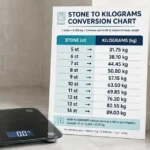
One stone equals 6.35029 kilograms, so to convert stones to kilograms you multiply the stone value by 6.35029. A person who weighs 12 stone, for example, weighs about 76.2 kg. The stone remains the everyday unit for body weight in the UK and Ireland, even though kilograms are the official metric unit.
If you have ever read a British fitness article, watched a UK doctor discuss weight, or stepped on a scale in London, you have met the stone. It feels old-fashioned, but it is very much alive: bathroom scales sold in Britain still offer a stone setting, and most Britons state their weight in stones and pounds rather than kilograms. This guide gives you the exact formula, a chart of common body weights, and the quick mental tricks that make the conversion painless.
Quick Stone to kg Conversion Chart
| Stone | Kilograms | Pounds |
|---|---|---|
| 8 | 50.80 | 112 |
| 9 | 57.15 | 126 |
| 10 | 63.50 | 140 |
| 11 | 69.85 | 154 |
| 12 | 76.20 | 168 |
| 13 | 82.55 | 182 |
| 14 | 88.90 | 196 |
| 15 | 95.25 | 210 |
This chart covers the most common adult body-weight range. One stone is defined as exactly 14 pounds, and one pound is exactly 0.45359237 kg, which is where the 6.35029 figure comes from: 14 × 0.45359237 = 6.35029318, rounded to five decimal places.
1. The Stone to kg Formula
The conversion is a single multiplication. Take the number of stones and multiply by 6.35029.
kg = stone × 6.35029
That is the whole formula. There are no extra steps and no hidden constants. The factor 6.35029 is exact to five decimal places — more precision than any bathroom scale can display.
A note on notation: the stone is abbreviated “st” (plural “st”). You will see body weights written as “11 st 7 lb”, meaning 11 stone and 7 pounds. Kilograms are abbreviated “kg”. Mixing the two notations in one sentence is common in British writing, so it helps to recognize both.
2. The kg to Stone Formula (Reverse Direction)
Going the other way — kilograms back to stones — uses division by the same factor. Divide the kilogram value by 6.35029.
stone = kg ÷ 6.35029
Equivalently, you can multiply kilograms by 0.157473, the reciprocal of 6.35029. Both give the same answer; division by 6.35029 is easier to remember because you only need one number.
For example, 70 kg ÷ 6.35029 = 11.02 stone — essentially 11 stone. That is a useful landmark: 70 kg, a very common adult weight, sits almost exactly on 11 stone.
3. Worked Example: 12 Stone to kg
Twelve stone is a frequently cited weight — roughly the average for an adult woman in the UK — so let us work it through.
Step 1: Write the formula — kg = stone × 6.35029.
Step 2: Insert the value — kg = 12 × 6.35029.
Step 3: Multiply — 12 × 6.35029 = 76.20348.
12 stone equals 76.20 kg (rounded to two decimals). Bathroom scales display to one decimal at most, so 76.2 kg is what you would actually see.
Sanity check with pounds: 12 stone × 14 lb = 168 lb, and 168 × 0.45359237 = 76.2 kg. Both routes agree.
4. Worked Example: 80 kg to Stone
Now the reverse, the kind of conversion a traveler faces when a UK clinic or gym asks for weight in stones.
Step 1: Write the formula — stone = kg ÷ 6.35029.
Step 2: Insert the value — stone = 80 ÷ 6.35029.
Step 3: Divide — 80 ÷ 6.35029 = 12.598.
80 kg equals about 12.6 stone. In the traditional stones-and-pounds format, 0.6 of a stone is 0.6 × 14 = 8.4 lb, so you would say “12 stone 8” — twelve and a half stone, roughly.
5. The Quick ×6.35 Mental Trick
For everyday estimates, you do not need five decimal places. Multiplying stones by 6.35 gives an answer within a fraction of a percent of the exact value.
Even simpler: multiply by 6 and add a bit. Ten stone is roughly 60 kg plus a touch — actually 63.5 kg. The “touch” is about 0.35 kg per stone, so for 10 stone you add roughly 3.5 kg to 60.
Another handy shortcut: double the stones and triple the result, then adjust. That sounds complicated, but it is just 6 × stone done in two steps. For 12 stone: double to 24, triple to 72, then add about 4 (the 0.35-per-stone correction) to get 76. Close to the true 76.2.
For kilogram-to-stone estimates, remember that 1 kg ≈ 0.157 stone, or roughly one-seventh of a stone. So 70 kg is about 10–11 stone (actually 11.02). These shortcuts are for conversation, not for medical records — use the full factor when precision matters.
6. Common Body Weights: 8 to 20 Stone
Here are eight of the most commonly referenced adult body weights, converted precisely. This is the table to bookmark if you read British health content regularly.
| Stone | Kilograms | Context |
|---|---|---|
| 8 | 50.80 | Light adult frame |
| 10 | 63.50 | Common healthy range |
| 12 | 76.20 | UK average adult woman (approx.) |
| 13 | 82.55 | Common adult weight |
| 14 | 88.90 | UK average adult man (approx.) |
| 15 | 95.25 | Heavier adult frame |
| 17 | 107.95 | Upper reference range |
| 20 | 127.01 | Clinical obesity discussions |
The “context” labels are rough guides, not medical judgments — healthy weight depends on height, build, and muscle mass, not on the scale alone. The averages cited are widely reported UK figures and move a little from survey to survey, so treat them as landmarks rather than exact statistics.
7. Stones and Pounds Together: Reading “11 st 7 lb”
British weights are usually spoken in stones and remaining pounds, like “eleven stone seven.” This confuses visitors because the pounds part is always less than 14 — it is the remainder after whole stones.
To convert “11 st 7 lb” to kilograms, do it in two steps. First convert everything to pounds: 11 × 14 = 154, plus 7 = 161 lb. Then multiply by 0.45359237: 161 × 0.45359237 = 73.03 kg.
Or convert the fractional stone directly: 7 lb ÷ 14 = 0.5 stone, so 11 st 7 lb = 11.5 stone, and 11.5 × 6.35029 = 73.03 kg. Same answer.
Common splits worth recognizing: “half a stone” is 7 lb (3.18 kg), and weight-loss goals are often stated in stones — “I want to lose a stone” means losing 6.35 kg or 14 lb.
8. Reverse Conversions: kg Back to Stone and Pounds
When a European scale or a fitness app gives you kilograms and you think in stones, you need the reverse conversion expressed the traditional way.
The method: divide kg by 6.35029 to get decimal stones, then take the decimal fraction and multiply by 14 to get the remaining pounds.
Worked example for 75 kg: 75 ÷ 6.35029 = 11.81 stone. The fraction 0.81 × 14 = 11.3 lb. So 75 kg ≈ 11 st 11 lb.
A few landmarks to memorize: 60 kg ≈ 9 st 6 lb, 70 kg ≈ 11 st 0 lb, 80 kg ≈ 12 st 8 lb, 90 kg ≈ 14 st 2 lb, 100 kg ≈ 15 st 10 lb. With these five anchors you can estimate any nearby weight in conversation.
9. Why the UK Still Uses Stone
The stone is one of the oldest English units of weight, used since medieval times for trade goods — its exact size once varied by commodity, which sounds chaotic because it was. The 14-pound stone was standardized by law in the 19th century.
So why does it survive in the metric era? Mostly habit and human scale. A stone is a convenient human-sized chunk: adult body weights fall in a tidy range of about 7 to 20 stone, and changes register in meaningful steps — losing half a stone (3.2 kg) feels like a real milestone, while 3.2 kg sounds oddly precise.
Officially, the UK is metric: shops sell food in grams, road signs are the famous exception in miles. But body weight is personal, not commercial, so no regulation forced the change. Most Britons still think in stones and pounds for their own weight while using kilograms for everything else — luggage, food, gym plates.
10. Weighing Scales: What the Settings Mean
Modern digital bathroom scales sold in the UK typically cycle through three units: kg, lb, and st (stone). The stone setting usually displays in the “st lb” format — for example, “11:07” or “11 st 7 lb” — which matches how Britons speak their weight.
If you step on a scale and see a confusing number, check the unit first. A reading of 76 could be 76 kg (11 st 13 lb — a normal adult) or 76 lb (34.5 kg — a child). The unit indicator is usually a small symbol in the corner of the display.
Smart scales that sync to fitness apps add another wrinkle: the scale may display stones while the app records kilograms, or vice versa. Most apps let you set a preferred unit in settings. Pick one unit and stick with it for tracking — converting back and forth introduces rounding noise that can mask real trends of a few hundred grams.
11. Everyday Reference Weights in Stone and kg
Beyond body weight, the stone-to-kg conversion helps you interpret weights you meet in daily life, especially in British contexts.
| Item | Weight |
|---|---|
| Newborn baby | ~7–8 lb / 3.2–3.6 kg (about half a stone) |
| Carry-on luggage limit | 10 kg / 1.57 st |
| Checked bag (typical) | 23 kg / 3.62 st |
| Bag of cement (UK) | 25 kg / 3.94 st |
| Adult bicycle | ~12–15 kg / ~2 st |
| Washing machine | ~65–70 kg / ~10–11 st |
| American football | ~400 g / 0.88 lb |
The luggage rows matter most in practice: airlines quote limits in kilograms everywhere, so a British traveler thinking “about a stone and a half” for carry-on needs to know that is only 9.5 kg — under the usual 10 kg limit, but closer than it sounds. For precise packing, a small luggage scale set to kilograms removes all doubt.
12. Medical and Fitness Contexts
Doctors, nurses, and fitness professionals increasingly record weight in kilograms because medical dosing, BMI calculations, and research all use metric units. But many UK patients still report their weight in stones, so clinicians convert constantly.
BMI is the main reason precision matters here. Body Mass Index is calculated as kg ÷ height in meters squared, and the category boundaries (18.5, 25, 30) are defined in metric. A rounding error of half a stone (3.2 kg) can shift a BMI by more than a full point for a shorter person — enough to cross a category line.
Practical advice: if a medical form asks for kilograms and you know your weight in stones, convert with the full 6.35029 factor and round to one decimal. And if you track weight loss, weigh yourself at the same time of day under the same conditions — daily fluctuations from food and water dwarf any conversion rounding.
13. Stone vs Pound vs kg: Choosing Your Unit
Three units for the same measurement is two too many, so which should you actually use? It depends on your audience and your tools.
Use stone when talking about body weight with British people, reading UK media, or setting a UK-bought scale. It is the social default, and quoting kilograms in casual conversation in Britain can draw blank looks.
Use pounds when dealing with American contexts — US scales, American fitness programs, and US medical forms all use pounds. Remember the bridge: 1 stone = 14 lb exactly, so stones convert to pounds with simple multiplication.
Use kilograms for science, medicine, international travel, sport (weightlifting plates are metric worldwide), and anything involving an airline. Kilograms are also the best unit for tracking small changes, since a kilogram is a finer-grained unit than a stone.
Many people end up bilingual: stones for conversation, kilograms for the spreadsheet. That is fine — just be consistent within each context.
14. Conversion Mistakes to Avoid
A few errors come up again and again with stones and kilograms.
Confusing stone with the US “stone.” There is no US stone — Americans simply do not use the unit. If an American hears “12 stone,” they may guess wildly. Always convert for American audiences.
Forgetting the 14-pound remainder. “11 st 7 lb” is not 11.7 stone — it is 11.5 stone, because the 7 pounds are sevenths of a 14-pound stone, not tenths. Treating it as a decimal (11.7 × 6.35029 = 74.3 kg instead of the correct 73.0 kg) introduces a 1.3 kg error.
Rounding too early. If you round 6.35029 to 6.3 and then convert 20 stone, you get 126 kg instead of 127 — a full kilogram off. Keep at least two decimals (6.35) until the final step.
Mixing up the direction. Multiplying when you should divide gives absurd answers — 70 kg × 6.35 = 444 “stone,” which is obviously wrong. Sanity-check: stones are always a smaller number than kilograms for the same weight. If your “stone” result is bigger than your kg input, you went the wrong way.
15. Quick Reference: The Numbers Worth Memorizing
If you remember nothing else from this guide, these five facts cover 90% of real-world stone-to-kg conversions.
1 stone = 6.35 kg. The master fact. Everything else derives from it.
1 stone = 14 lb exactly. The bridge to pounds, useful for American contexts and for the stones-and-pounds format.
10 stone = 63.5 kg. A round anchor in the middle of the healthy adult range — easy to scale up or down from.
70 kg ≈ 11 stone. The most useful single landmark, since 70 kg is one of the most common adult weights worldwide.
To estimate fast, multiply stones by 6 and add a little. Twelve stone is about 72-plus-a-bit — actually 76.2. The “bit” is roughly a third of a kilo per stone, so for 12 stone add about 4.
Keep this list on your phone or pin it near the scale, and you will never be stuck converting again. For anything formal — medical forms, official records — run the full 6.35029 calculation rather than the estimate.
Frequently Asked Questions
How many kg is 1 stone exactly?
One stone equals exactly 6.35029 kilograms. This is derived from the legal definitions: a stone is exactly 14 pounds, and a pound is exactly 0.45359237 kilograms, so 14 × 0.45359237 = 6.35029318 kg, rounded to five decimal places.
What is 11 stone in kg?
Eleven stone equals 69.85 kg (11 × 6.35029 = 69.85319). In pounds that is 154 lb. It sits near the middle of the common adult weight range and is close to the widely cited average for adult women in the UK.
How do I convert kg to stone on a calculator?
Divide the kilograms by 6.35029. For example, 85 kg ÷ 6.35029 = 13.38 stone. To express the fraction in pounds, multiply 0.38 by 14 to get about 5 lb — so 85 kg is roughly 13 st 5 lb.
Why do British people use stone instead of kg?
Tradition and human scale. The stone has been used in England for centuries, and adult body weights fall into a convenient 7-to-20 range in stones, with half-stone steps making satisfying milestones. Official and medical use is metric, but for personal body weight the stone remains the everyday social default in the UK and Ireland.
Final Thoughts
The stone-to-kg conversion is simpler than it looks: one multiplication by 6.35029, or 6.35 for quick estimates, and you can move between the two worlds with confidence. The key landmarks — 10 stone is 63.5 kg, 70 kg is about 11 stone — cover nearly every situation, from fitness articles to medical forms. Remember to treat the pounds in “stones and pounds” as fourteenths rather than tenths, keep full precision for anything official, and pick one unit for tracking. With the chart saved and the five anchor numbers memorized, the stone stops being a mystery and becomes just another familiar unit.

I’m Marcus Kane, a measurement content specialist at MeasuresIt.com. I write clear, accurate, and practical articles about measurements, dimensions, conversions, and everyday size comparisons, making complex topics simple and easy to understand.