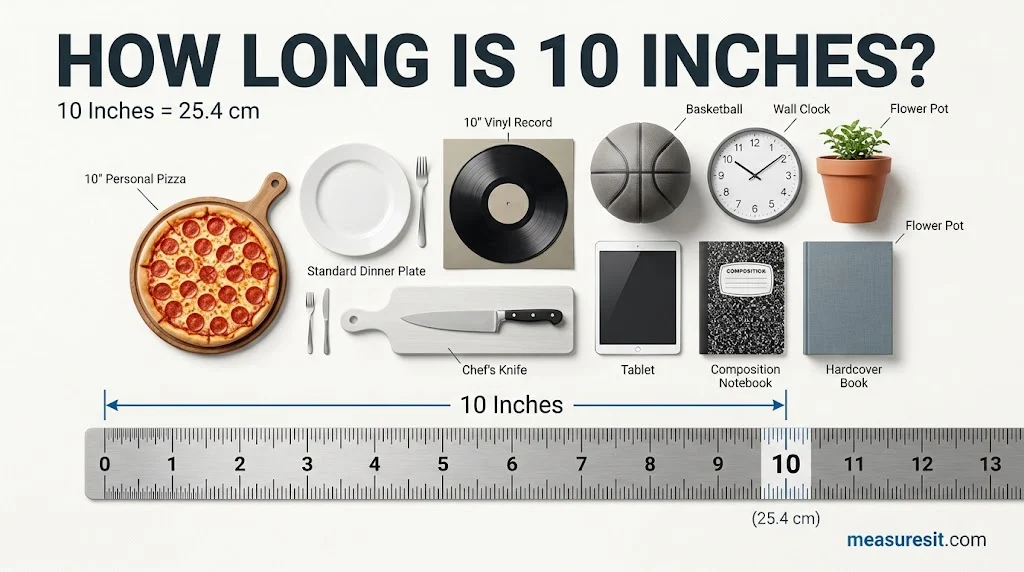
Hold a dinner plate up next to a stack of mail and a record sleeve, and you’ve basically got a hands-on ruler for this exact length. 10 inches equals 25.4 centimeters, or just over 0.83 feet a bit short of a full foot and a couple inches shy of a standard 12-inch ruler. That’s the number most people searching for this actually want, so there it is, no scrolling required.
But a number like 25.4 cm doesn’t really stick in your head the way an object does. Once you’ve pictured a large dinner plate, a 10-inch record, or the width of a personal pizza, 10 inches stops being an abstract figure and starts being something you can spot across a room.
That’s useful more often than you’d expect: when you’re comparing pizza sizes on a takeout menu, figuring out if a gift will fit in a box before you tape it shut, or checking If a new planter will actually clear the windowsill.
Conversion Chart
No mental math required here’s exactly where 10 inches lands across the units you’re most likely to need.
| Unit | Converted Value |
| Inches | 10 in |
| Feet | ≈ 0.83 ft |
| Yards | ≈ 0.28 yd |
| Millimeters | 254 mm |
| Centimeters | 25.4 cm |
| Meters | 0.254 m |
These are fixed conversions (1 inch = 2.54 cm exactly), so the only rounding happens in the feet and yards figures.
Common Objects That Are About 10 Inches
Start with these eight. They’re things most people have handled recently enough to picture without effort.
| Object | Approximate Length |
| Personal pizza (diameter) | ≈ 10 in |
| Standard dinner plate (diameter) | ≈ 10–10.5 in |
| 10-inch vinyl record (diameter) | 10 in |
| No. 10 business envelope | 9.5 in |
| Chef’s knife (blade only) | ≈ 10 in |
| Regulation basketball (diameter) | ≈ 9.5 in |
| Wall clock (face diameter) | ≈ 10–12 in |
| Adult forearm (wrist to elbow) | ≈ 9.5–10.5 in |
More Everyday Items Around 10 Inches
Here are seven more, pulled from tech, food, and everyday shopping.
| Object | Approximate Length |
| 10-inch tablet screen (diagonal) | ≈ 10 in |
| 10-inch subwoofer (driver diameter) | 10 in |
| Men’s size 10 shoe (length) | ≈ 10.5 in |
| Composition notebook (height) | ≈ 9.75 in |
| Dry spaghetti strand (length) | ≈ 9.8–10 in |
| Large hardcover book (height) | ≈ 9–9.5 in |
| 10-inch flower pot (rim diameter) | 10 in |
How Long Is 10 Inches, Really?
Set a large dinner plate down on the counter and look at it straight on. That’s about 10 inches, give or take, depending on the pattern. It’s a size you walk past constantly without ever needing to name it, which is exactly why it’s tricky to estimate cold when someone asks.
It helps to know its neighbors. A standard sheet of copy paper is 8.5 inches across the short side, so 10 inches is a little past that. Go the other direction and you hit 12 inches a full foot, and the length of a standard ruler which is only two inches further out. So 10 inches sits in a fairly narrow, familiar band: bigger than a sheet of paper, smaller than a ruler.
Once that range is set in your head, guessing nearby lengths gets a lot less stressful.
Easy ways to estimate 10 inches without a tape measure:
- Check your forearm. For a lot of adults, wrist to elbow crease lands close to this mark, though hand and arm size vary enough that it’s a starting point, not a guarantee.
- Grab a dinner plate. It’s already in your kitchen, and it’s about as close to a portable 10-inch stand-in as you’ll find.
- Think of a record sleeve. If you’ve ever flipped through a crate of 10-inch singles, the size is probably already muscle memory.
- Start from a sheet of paper. Add roughly an inch and a half to the short edge of standard letter paper.
- Picture a tablet, corner to corner. Most 10-inch tablets are named for their diagonal screen measurement, so holding one up gets you there directly.
- Split a foot almost in half again. Ten inches is a foot minus two inches, which is easier to judge than it sounds once you’ve done it a couple of times.
1. A 10-Inch Personal Pizza
Pizzerias size their menus by diameter, and 10-inch usually shows up as the personal or small option, a step below a 12-inch medium. That labeling exists because diameter is the fastest way for a customer to judge how much food they’re actually getting before it arrives. Most people have ordered enough pizza to have a rough feel for how a 10-inch pie looks on a table compared to a 14-inch one. If you’re ever debating between menu sizes, this comparison alone can save you from over- or under-ordering.
2. A Standard Dinner Plate
Most Western dinnerware sets put their standard plate somewhere between 10 and 10.5 inches across big enough for a full meal, small enough to still fit a table setting with room for a glass and napkin. That range has held steady across decades of dishware manufacturing, so it’s one of the more dependable references on this list. Because almost every kitchen has at least one, it doubles as a built-in measuring tool. Try it next time you’re packing dishes into a box or deciding If a placemat is actually big enough.
3. A 10-Inch Vinyl Record
Before the 12-inch LP took over as the industry default, 10-inch records were the standard format for a stretch of the mid-20th century, and the size still turns up today for singles and reissues. The diameter is fixed by pressing equipment, so a 10-inch record from any era measures the same. Collectors who’ve sorted through even a small crate usually develop a feel for the difference between a 10-inch and 12-inch sleeve within a few minutes of handling both. That instinct comes in handy if you’re shopping for record storage or sleeves and need to know which size bin something belongs in.
4. A No. 10 Business Envelope
That envelope sitting in your junk mail pile has a name, and it’s a size: the No. 10 envelope, the standard used for most bills and business letters in the US, measures 9.5 inches long. It’s set by long-established office supply conventions, so it barely varies between brands. Nearly everyone has stuffed a check or letter into one without a second thought. Next time you’re wondering If a folded document will fit inside an envelope, this one’s close enough to 10 inches to use as a quick gauge.
5. A 10-Inch Chef’s Knife
Walk down a kitchenware aisle and you’ll usually see chef’s knives sold in a few set blade lengths, with 10 inches sitting one step up from the more common 8-inch option. That length is a hard spec printed right on the box, not a rough estimate. Cooks who’ve handled both sizes tend to notice the difference in reach and weight almost immediately. If you’re trying to picture how much drawer or knife-block space a larger blade needs, this is the size to imagine.
6. A Regulation Basketball
Official basketball specifications, including those used by FIBA and the NBA, put a regulation ball’s diameter at roughly 9.5 inches just under the 10-inch mark, and close enough that the two get used interchangeably in casual comparisons. Because the size is governed by sport regulations rather than brand preference, it barely varies from one official ball to another. Anyone who has played, coached, or even just watched a game has a rough sense of how that ball fits in a player’s hands. That familiarity makes it a handy gut-check for If something round will fit through a gap or opening.
7. A Standard Wall Clock
Wall clocks in most homes and offices land somewhere between 10 and 12 inches across the face, a range manufacturers settled on because it reads clearly from across a room without dominating the wall. It’s a size that gets glanced at dozens of times a day, which means most people already carry a rough sense of it without realizing. Try picturing the clock in your own kitchen or classroom chances are it’s close to this mark. That mental image is genuinely useful when you’re deciding how much wall space a new piece of art or a shelf actually needs.
8. An Adult Forearm
Measured from the wrist crease to the elbow, an adult forearm often falls somewhere around 9.5 to 10.5 inches, though this varies with height, build, and simply who you’re measuring it’s a personal reference, not a fixed spec like a manufactured object would be. The upside is that it’s always with you. No object on this list is easier to check on the spot than your own arm. That makes it a useful first gut-check while shopping, right before you confirm with an actual tape measure if precision matters.
9. A 10-Inch Tablet Screen
Tablets are marketed by screen size measured diagonally, and the 10-inch class sits in a sweet spot between compact 8-inch models and larger 12-inch options. That number is a spec, listed clearly on every box and product page, so there’s no ambiguity involved. Given how many households now own at least one tablet, most people already have a mental picture of what 10-inch looks like held in two hands. That picture is genuinely handy when you’re comparing sizes online or checking If one will actually fit in a specific bag or case.
10. A 10-Inch Subwoofer
Car and home audio subwoofers are sized by the diameter of the speaker cone itself, and 10 inches is one of the most common choices for balancing deep bass against a manageable cabinet size. Unlike some comparisons on this list, this measurement is a hard engineering spec, since it directly determines how the speaker fits into an enclosure. Anyone who’s shopped for a car stereo or home theater setup has likely compared 8-, 10-, and 12-inch options side by side at some point. That side-by-side habit makes the 10-inch subwoofer an easy size to recall when you’re picturing round objects of a similar width.
11. A Men’s Size 10 Shoe
In standard US men’s sizing, a size 10 shoe measures close to 10.5 inches from heel to toe, which makes the size number and the real-world length line up almost by coincidence. Shoe brands vary a little in fit, but the length itself stays fairly consistent because it’s tied to a shared sizing scale used across most of the industry. Shoe shopping is common enough that a lot of adults already have a rough sense of their own foot length in inches without ever measuring it directly. That makes a shoe, or even just its box, a convenient stand-in when you’re checking shelf or drawer depth at home.
12. A Standard Composition Notebook
That marbled black-and-white notebook from the school supply aisle measures close to 9.75 inches tall, just under the 10-inch line. The format has barely changed in generations, since it’s tied to standard paper stock sizes rather than any particular brand’s design choice. Almost everyone has owned one for school or note-taking at some point, so its size tends to register instantly without needing a description. Next time you’re packing a bag, this notebook height is a fast way to check If something similarly sized will actually fit in a pocket or sleeve.
13. A Strand of Dry Spaghetti
Pull a strand of dry spaghetti straight out of most boxes and you’ll find it measures close to 9.8 to 10 inches long before cooking, a length that’s remained fairly consistent across brands for decades. It’s one of the few food items that comes with a built-in, ruler-like measurement, since pasta-making equipment produces strands to a fairly uniform length. Spaghetti dinners are common enough that most people have handled this exact length dozens of times without ever thinking of it that way. Next time you’re portioning pasta for a recipe, that strand is already doing double duty as a measuring stick.
14. A Large Hardcover Book
Larger hardcover novels and coffee-table books often stand around 9 to 9.5 inches tall, just short of the full 10-inch mark. Books vary more in size than manufactured objects like envelopes or notebooks, so this one works better as a close enough reference than an exact one. Still, anyone with even a small bookshelf has likely built up an instinct for book height just from years of browsing their own collection. That instinct is genuinely useful when you’re figuring out If a box or shelf has enough vertical clearance for your bigger titles.
15. A 10-Inch Flower Pot
Garden centers commonly sell planters by rim diameter, and 10 inches is a popular mid-size choice for herbs, small shrubs, or anything that’s outgrown a starter pot. Because nursery tags print this measurement directly, it’s one of the more precisely labeled comparisons on this list. Gardeners who’ve shopped for pots even a handful of times tend to develop a decent eye for what a 10-inch rim actually looks like on a shelf. That eye for size comes in handy when you’re deciding how much patio or windowsill space a new pot will actually need.
FAQ
Is 10 inches bigger than a standard ruler? No. A standard ruler measures 12 inches, so 10 inches is about 2 inches shorter than a full ruler.
What household item is closest to exactly 10 inches? A 10-inch vinyl record, a 10-inch flower pot, and a 10-inch subwoofer are all manufactured to that specific diameter, which makes them some of the most precise references on this list.
How many centimeters is 10 inches? 10 inches equals exactly 25.4 centimeters, based on the standard conversion of 2.54 cm per inch.
Is a regulation basketball exactly 10 inches wide? Not quite. Official specifications from bodies like FIBA and the NBA put a regulation ball’s diameter at roughly 9.5 inches, just under the 10-inch mark.
Is 10 inches the same as a foot? No. A foot is 12 inches, so 10 inches is 2 inches short of a full foot, or about 83% of one.
Final Thoughts
So, how long is 10 inches? In short: 25.4 centimeters, just over 0.83 feet, and a size that’s already sitting somewhere in your house right now, If that’s a dinner plate, a record, or the notebook you had in school. The exact math answers the question, but the objects are what make it stick.
That’s really the point of comparisons like these. A number on its own is easy to forget five minutes after you read it. A dinner plate, a personal pizza, or the shoe on your foot isn’t.
So the next time you’re sizing up a pizza order, figuring out if something will fit in a box before you seal it, or checking If a new pot will actually clear the windowsill, you’ve already got a handful of 10-inch references on hand, no tape measure required.
Read More About!
- How Long Is 8 Inches? 15 Everyday Comparisons
- How Long Is 7 Inches? Real-Life Size Comparisons
- How Long Is 9 Inches? Quick Answer + Comparisons

I’m Elena Cross, a content writer at MeasuresIt.com, where I turn complex measures, units, and mathematical concepts into clear, accurate, and easy-to-read articles. I’m passionate about precision in numbers and in words and I write to help readers actually understand measurements, not just memorize them.






1 thought on “How Long Is 10 Inches? Real Comparisons & Chart”