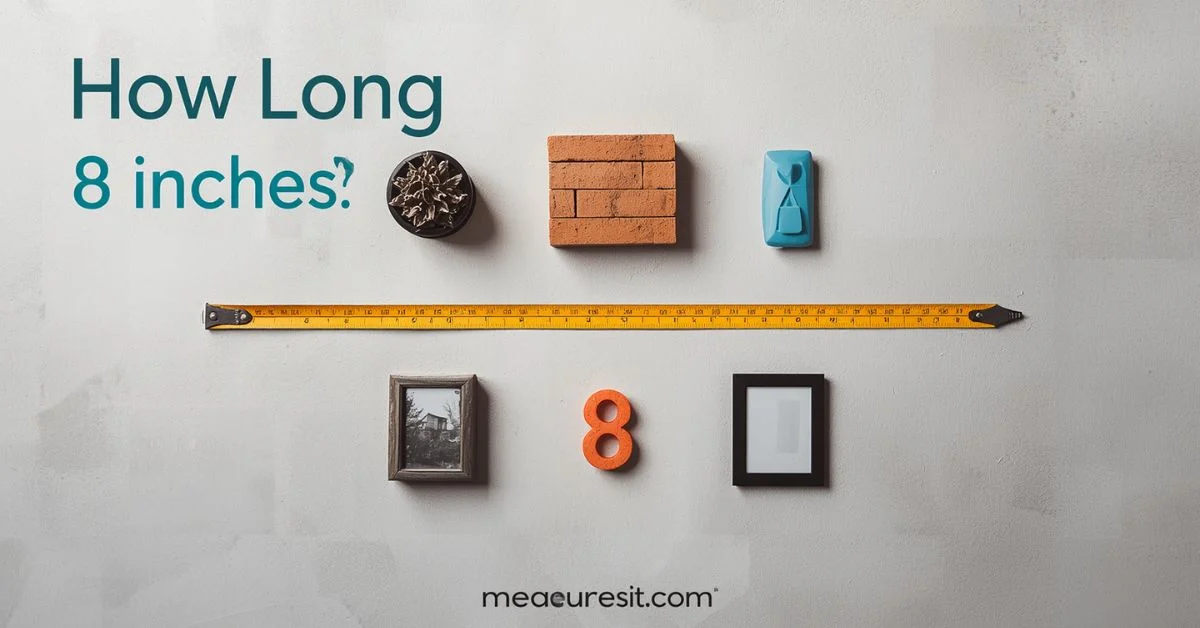
Picture yourself holding a picture frame at the store, or eyeing a gap behind the couch where you’re hoping a shelf will fit. Someone says about 8 inches, and unless you’ve got a tape measure handy, that number doesn’t mean much on its own.
Eight inches is close to the length of a standard brick, the blade on a chef’s knife, or the short side of an 8×10 picture frame about two-thirds of a foot, or 20.32 centimeters. Once you attach that number to something you can actually picture, it stops being an abstraction.
This length turns up more often than most people notice. It’s close to the width of a printer-paper sheet, the diameter of a small dessert plate, and a common blade length for kitchen knives.
Knowing how long 8 inches is comes in handy for quick, no-tools-needed decisions: sizing up a box before you tape it shut, checking If a gift will fit in a drawer, or judging if a sandwich roll is worth the extra bread.
What follows is a conversion chart, two tables of real-world comparisons, and a closer look at each one.
Conversion Chart: 8 Inches in Other Units
If you need 8 inches in a different unit for a recipe, a set of build plans, or a furniture listing, here’s the full breakdown.
| Unit | Converted Value |
| Inches | 8 in |
| Feet | ≈ 0.67 ft |
| Yards | ≈ 0.22 yd |
| Millimeters | 203.2 mm |
| Centimeters | 20.32 cm |
| Meters | ≈ 0.20 m |
Common Objects That Are About 8 Inches
Eight everyday items that land right around 8 inches, starting with the ones that are easiest to picture.
| Object | Approximate Length |
| Chef’s knife blade | 8 in |
| Standard brick (nominal, with mortar joint) | 8 in |
| Unsharpened pencil | ≈ 7.5 in |
| Small dessert plate | ≈ 8 in |
| Adult hand span | ≈ 7.5–8.9 in (varies by sex) |
| Short side of an 8×10 frame | 8 in |
| Trade paperback book (height) | ≈ 8–9 in |
| Printer paper (width) | 8.5 in |
More Everyday Items Around 8 Inches
Seven more objects, none overlapping with the list above, that also sit close to 8 inches.
| Object | Approximate Length |
| iPad mini (physical height) | ≈ 7.7–7.9 in |
| Small hoagie roll | ≈ 8 in |
| Large burrito | ≈ 8 in |
| Medium mixing bowl (diameter) | ≈ 8 in |
| Small garden trowel | ≈ 8 in |
| Standard office stapler | ≈ 7.5–8 in |
| Composition notebook (width) | 7.5 in |
How Long Is 8 Inches, Really?
Eight inches sits in a useful middle zone: long enough to notice, short enough to hold comfortably in one hand. It’s well past a credit card, which runs about 3.4 inches, but still a good four inches shy of a standard ruler laid flat. If you’ve ever bought a footlong sandwich and split it into thirds with a friend, each third comes out close to 8 inches which is a strange but surprisingly effective way to remember it.
You don’t need a tape measure to get a feel for this length once you’ve anchored it to something familiar. A brick, a butter knife’s bigger cousin (the chef’s knife), or a paperback pulled off the shelf all work. Pick one you already know well and let it become your personal 8-inch yardstick.
Easy ways to estimate 8 inches in everyday life:
- Use your hand: Spread your thumb and pinky as wide as they’ll go. For most women that’s close to 8 inches; for most men it runs slightly longer.
- Grab a sheet of paper: The short side of a standard letter-size page measures 8.5 inches, just a touch over.
- Picture a brick: Laid on its long side, a standard U.S. brick comes out to 8 inches once you include the mortar joint.
- Check a dessert plate: The smaller plates in most cabinets, meant for salad or dessert, run close to 8 inches across.
- Pull an 8×10 frame: The short edge is exactly 8 inches, no estimating needed.
- Recall a chef’s knife: An 8-inch blade is the size most kitchen knife brands treat as their all-purpose default.
1. An 8-Inch Chef’s Knife
Most kitchens have at least one chef’s knife, and the 8-inch blade is the size manufacturers treat as their standard offering long enough to rock through vegetables, short enough to control with one hand. Knife makers cut blades to whole and half-inch lengths, so an 8-inch chef’s knife really does measure 8 inches from heel to tip.
That precision is what makes it such a dependable mental reference. Next time you’re eyeing a gap on a shelf or trying to guess if something will fit in a drawer, picture that blade laid flat; it’s about as exact a stand-in for 8 inches as you’ll find in a kitchen.
2. A Standard Brick
Here’s where the standard gets a little more interesting than it first appears. A modular brick, as manufactured, actually measures about 7⅝ inches long not 8. But brick construction is built around 4-inch mortar joints, and once you add a standard ⅜-inch joint on each side, the brick occupies a full 8 inches of wall space. That 8-inch figure is what masons call the nominal size, and it’s the number that governs how walls, windows, and door openings line up.
It’s a small distinction, but it explains why the brick shows up on so many size charts as 8 inches even though no single brick actually measures that on its own. Either way, picturing a brick set into a wall mortar joint included gives you a solid, easy-to-recall 8-inch reference.
3. A New, Unsharpened Pencil
Fresh from the box, a standard wooden pencil runs close to 7.5 inches. Add the metal ferrule and eraser tip, and many pencils come within a hair of the full 8-inch mark before any sharpening starts shortening them.
Pencils are one of the few objects nearly everyone has handled since grade school, which is exactly what makes the comparison stick. Set one next to a drawer, a box, or the space behind a piece of furniture, and you’ve got a fast, no-effort way to size things up.
4. A Small Dessert Plate
Step past the large dinner plates in your cabinet, and you’ll usually find a smaller stack meant for salad or dessert. Those plates commonly measure close to 8 inches across, a noticeable step down from the 10- to 11-inch dinner plates they’re often paired with.
Plate sizes vary a bit by brand, but this comparison holds up well from kitchen to kitchen. It’s a practical one to keep in mind when you’re shopping for placemats, coasters, or figuring out how much cabinet space a new set will take up.
5. An Adult Hand Span
Spread your hand as wide as it goes, thumb tip to pinky tip, and you’ll land somewhere in the 8-inch neighborhood though where exactly depends on your sex and overall size. Anthropometric research generally puts the average adult male hand span around 8.5 to 8.9 inches, while the average adult female hand span runs closer to 7.5 to 8 inches.
This comparison has one advantage nothing else on this list can match: it’s always attached to you. Measure your own span against a ruler once, and you’re carrying a built-in 8-inch estimator for life, useful, but worth double-checking against an actual tape measure when precision matters.
6. The Short Side of an 8×10 Picture Frame
Photo frames are almost always labeled by their exact dimensions, and 8×10 is one of the most common sizes on store shelves. The shorter of the two sides measures precisely 8 inches, with no rounding involved.
Because the size is printed right on the box, this is one of the most reliable references in this entire list. If you’ve ever hung family photos or gone shopping for a frame, you’ve held this exact measurement without giving it a second thought.
7. A Trade Paperback Book
Trade paperbacks, the somewhat larger format used for a lot of modern fiction and nonfiction, typically stand about 8 to 9 inches tall, depending on the publisher’s chosen trim size. That’s noticeably taller than the smaller mass-market paperbacks sold in grocery store racks.
A bookshelf makes this one easy to test for yourself. Pull a trade paperback down and hold it upright, and you’re looking at something close to 8 inches, cover to cover.
8. The Width of a Sheet of Printer Paper
Standard U.S. letter paper measures 8.5 by 11 inches, and that 8.5-inch width lands just a touch above the 8-inch mark. Grab any sheet from a printer tray and you’re holding a close, ready-made stand-in for this length.
Because letter paper is standardized nationwide, this comparison works the same in an office, a classroom, or a home printer setup. It’s a particularly good one for judging the width of envelopes, folders, or binders built to hold a full page.
9. An iPad Mini
Apple’s smaller tablet measures close to 8 inches in physical height, though the exact figure shifts by generation; recent models run about 7.69 to 7.87 inches tall, just under the mark. The 8.3-inch spec you’ll see in marketing refers to the diagonal screen size, not the device itself, which is a common mix-up.
Tablets have become common enough that a lot of people already have a rough sense of their size. Holding one gives a modern, tech-based way to picture 8 inches, especially handy when you’re comparing bag or sleeve dimensions.
10. A Small Hoagie Roll
Delis and sandwich shops often carry a smaller roll size, sometimes sold as an 8-inch hoagie, sitting between a 6-inch sub and a full footlong. It’s a popular pick when you want a real lunch without the extra bread that comes with a foot of sandwich.
Food comparisons tend to work well because you’re picturing something you could hold in one hand and actually eat. Next time you’re deciding between roll sizes at the counter, that 8-inch option doubles as a length reference you already understand.
11. A Large Burrito
A generously wrapped burrito from a typical taqueria often stretches close to 8 inches end to end once it’s rolled and folded shut. Thinner, less-loaded burritos can fall short of that, but a fully packed one regularly reaches this length.
Given how common burritos are as a lunch order across the country, this comparison lands for a lot of readers without much explanation needed. It’s a useful one for judging if something will fit inside a lunch bag or a food container.
12. A Medium Mixing Bowl
Most kitchen bowl sets include a medium size with a diameter close to 8 inches, sitting between the small prep bowls and the larger ones used for bread dough or big batches of batter. It’s usually the one reached for on an ordinary cooking day.
Bowls stack and nest, which makes them easy to compare side by side for a quick size check. If you’re shopping for storage containers or trying to gauge cabinet space, an 8-inch mixing bowl is a solid mental yardstick to keep handy.
13. A Small Garden Trowel
Hand trowels made for planting and light digging often run close to 8 inches from handle to tip in their compact versions, though larger models exist for heavier digging. The smaller size is a common pick for container gardening and tight flower beds.
Gardeners tend to know their tools’ dimensions well, since they’re often working around the tight edges of a raised bed or a pot. This comparison comes in handy specifically when you’re deciding if a trowel will fit inside a narrow planter.
14. A Standard Office Stapler
A typical desktop stapler measures somewhere around 7.5 to 8 inches long, front to back a size and shape most people have handled at a desk without ever thinking about the actual measurement.
Office supplies make for consistent comparisons because manufacturers tend to converge on similar ergonomic dimensions. Picture a stapler lying flat next to a stack of papers, and you’ve got a familiar, fast way to judge If something else nearby is close to 8 inches.
15. A Composition Notebook
The classic black-and-white marbled composition notebook, a staple of American classrooms, measures 7.5 inches wide by 9.75 inches tall putting its width just a half-inch short of 8.
Because that size has stayed consistent across brands for decades, it’s a comparison that works if you last held one in school last year or twenty years ago. It’s a particularly good one for judging binder or backpack pocket sizes, since the notebook itself is the benchmark most of those pockets are built around.
FAQ
Is 8 inches bigger than a standard ruler?
No. A standard ruler measures 12 inches, so 8 inches covers only about two-thirds of it.
What household item is closest to exactly 8 inches?
The short side of an 8×10 picture frame is one of the most exact matches, since it’s manufactured to that precise dimension rather than an estimate.
How many centimeters is 8 inches?
Eight inches equals 20.32 centimeters.
Is 8 inches longer than a dollar bill?
Yes. A U.S. dollar bill measures about 6.14 inches long, so 8 inches is nearly two inches longer.
Final Thoughts
So, how long is 8 inches? It’s a length you run into constantly without noticing the blade of a chef’s knife, the short edge of a picture frame, the width of the paper coming out of your printer right now.
Once you tie that number to two or three objects you already know well, you stop needing a tape measure for the small, everyday judgment calls: If a gift fits in a drawer, If a shelf will clear a gap, If that sandwich roll is worth ordering.
That’s the real value of comparisons like these: not perfect precision, but a fast, reliable gut check. A brick, a dessert plate, and your own hand span will get you close enough almost every time.
Keep one or two of them in mind, and the next time something looks about 8 inches, you’ll have a real object to check it against instead of just guessing.
Discover More About!
- How Long Is 9 Inches? Quick Answer + Comparisons
- How Long Is 10 Inches? Real Comparisons & Chart
- How Long Is 7 Inches? Real-Life Size Comparisons

Hi, I’m Vera Lindqvist, a content writer at MeasuresIt.com, where I turn measurement standards, unit conversions, and precision tools into clear, practical guides. I care about getting the details right so you don’t have to second-guess them.





3 thoughts on “How Long Is 8 Inches? 15 Everyday Comparisons”