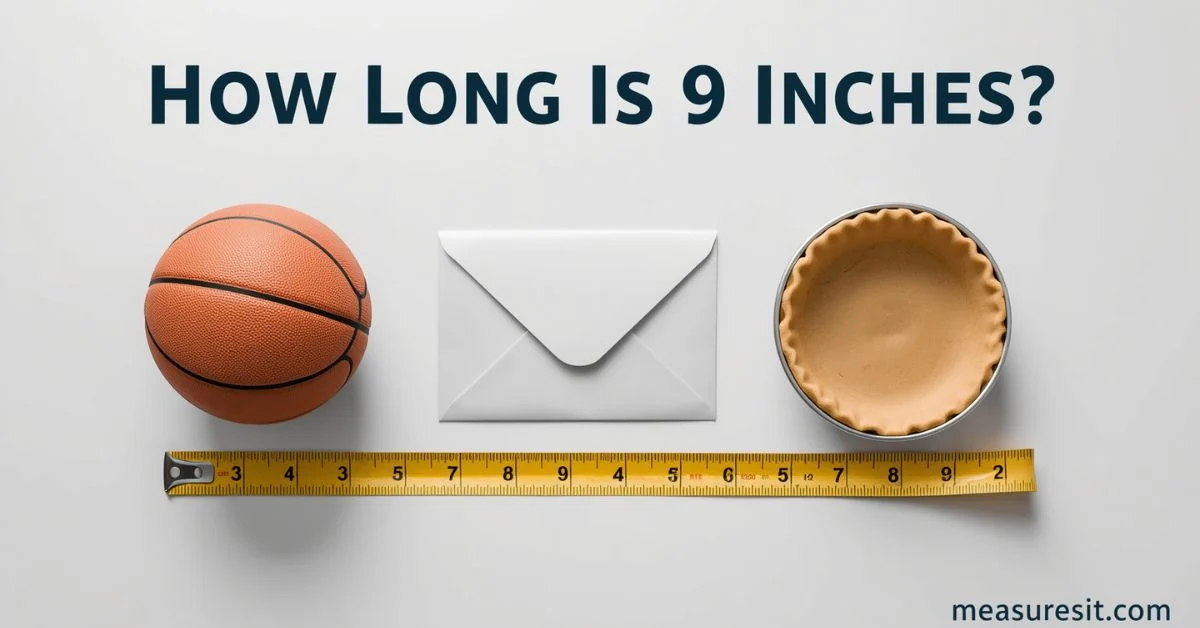
Say a product listing tells you something is 9 inches long, or a recipe calls for a 9-inch pan, and you’re left guessing If that’s small enough for the drawer you have in mind or big enough to actually feed four people. Nine inches equals 22.86 centimeters, or three-quarters of a standard 12-inch ruler close to the diameter of a basketball, or the length of the envelope your last bill probably came in.
It’s a size that comes up more often than you’d think: sizing a pie pan before you bake, checking If a package will fit through a mail slot, measuring trim for a small home repair, or judging If a phone case, tablet, or kitchen tool will actually fit where you want it to go.
Nine inches sits right in that awkward zone between pocket-sized and a full ruler’s length, which is exactly why it’s worth having a few solid mental references for it.
Below, you’ll find the exact conversions, a breakdown of how accurate each comparison really is, and 15 everyday objects you can use to picture 9 inches without ever picking up a tape measure.
Conversion Chart
| Unit | Converted Value |
| Inches | 9 in |
| Feet | 0.75 ft |
| Yards | 0.25 yd |
| Millimeters | 228.60 mm |
| Centimeters | 22.86 cm |
| Meters | 0.23 m |
The Closest Matches to 9 Inches
These eight items have a standardized or widely documented size that lands right at, or almost exactly on, 9 inches. If you want the most accurate mental reference possible, start here.
| Object | Approximate Length |
| Standard basketball (diameter) | 9.4–9.5 in |
| #10 business envelope | 9.5 in |
| 9-inch pie pan | 9 in |
| 9-inch cake pan | 9 in |
| 9-inch paper plate | 9 in |
| 9.7-inch tablet screen (diagonal) | 9.7 in |
| Composition notebook | 9.75 in |
| Sheet of letter paper (short edge) | 8.5 in |
Objects in the Same Ballpark
These seven show up in everyday life too, but their size varies more from item to item, so treat them as in the neighborhood of 9 inches rather than exact matches.
| Object | Typical Range |
| Large dinner plate | 9–11 in |
| Large chef’s knife blade | 8–10 in |
| Standard brick | ≈8 in |
| Large burrito | 9–10 in |
| Adult forearm (wrist to elbow) | 9–10 in |
| Volleyball (diameter) | ≈8.3 in |
| Shoebox (width) | 8–9 in |
How Long Is 9 Inches, Really?
Hold your hands about three-quarters of the way across a standard ruler and that’s the length you’re picturing. It’s shorter than the long edge of a sheet of printer paper (11 inches) but noticeably longer than most smartphones, which typically run 5.5 to 6.5 inches tall.
If you want two reference points to bracket it, a volleyball’s diameter (about 8.3 inches) lands just under 9, while a #10 envelopes (9.5 inches) sit just over it. Picture the space between those two, and you’ve got 9 inches.
There’s no single object that’s the definitive 9-inch item, which is exactly why a handful of go-to comparisons work better than trying to memorize one perfect example. Once you’ve got two or three of these in your head, judging distances gets a lot faster.
Ways to estimate 9 inches without a ruler:
- Line up two dollar bills, loosely: One bill is 6.1 inches, so 9 inches is a bit less than a bill and a half.
- Stretch your hand out wide: Most adult hand spans, thumb tip to pinky tip, run close to 8 or 9 inches, making your own hand a rough built-in gauge.
- Grab a sheet of paper: The short edge is 8.5 inches, just under 9, which is close enough for most quick estimates.
- Picture a basketball: Its diameter is about 9.5 inches, one of the tightest matches you’ll find.
- Use three-quarters of a 12-inch ruler: If one’s handy, the 9-inch mark is exactly what you’re after.
- Think of a standard envelope: The kind most bills and letters arrive in runs 9.5 inches long.
1. Standard Basketball
A regulation basketball measures 9.4 to 9.5 inches across, which makes it one of the tightest real-world matches to 9 inches available. It also has an advantage most comparisons don’t: even people who’ve never played basketball have seen one up close.
Because the ball’s size is fixed by league regulations rather than left up to manufacturers, this comparison holds steady no matter where you encounter it. Picture one sitting on a counter next time you need to judge how wide something 9 inches across would actually look.
2. A #10 Business Envelope
If you’ve ever paid a bill by mail, you’ve held one of these. The #The 10 envelope, the standard size for business letters in the US, measures 9.5 inches long by 4.125 inches wide.
Its usefulness comes from how common it is. Nearly every household has at least one tucked in a drawer, which makes about the length of an envelope an easy shorthand. It’s a particularly good comparison when you’re deciding if a flat item, like a photo print or a greeting card, will slide into a standard mailer.
3. A 9-Inch Pie Pan
Walk into almost any American kitchen and there’s a decent chance a 9-inch pie pan is in the cabinet. It’s the size most pie recipes are written for, which means bakers already have a physical sense of what 9 inches looks like without thinking about it.
The size is consistent enough across brands that it’s a dependable go-to. If you bake even occasionally, picturing a pie pan is often faster than picturing a ruler.
4. A 9-Inch Cake Pan
Round cake pans commonly come in a 9-inch diameter, right alongside the pie pan as a baking-aisle default. Layer cakes, cheesecakes, and cornbread recipes frequently call for this exact size.
Since bakeware sizing tends to stay consistent across manufacturers, this is one of the more reliable comparisons on this list. Setting a cake pan down flat gives you a near-exact sense of a 9-inch diameter, which comes in handy for estimating other round objects, like a wreath or a small serving tray.
5. A 9-Inch Paper Plate
Paper plates usually list their diameter right on the packaging, and 9 inches is one of the standard sizes for everyday meals, larger than the smaller dessert plates that run closer to 6 or 7 inches.
Because the measurement is printed directly on the package, this is one of the more precise comparisons here. It’s especially useful for gauging round objects like coasters or small decorative trays.
6. A 9.7-Inch Tablet Screen
Several widely used tablets, including a popular generation of iPads, feature a 9.7-inch screen measured diagonally, corner to corner rather than edge to edge.
Given how common tablets have become, this is an easy size to recall even if you don’t own one yourself. It works well for estimating the diagonal size of other rectangular objects, like a picture frame or a small monitor.
7. A Composition Notebook
The black-and-white marbled composition notebook, a staple of school supply lists everywhere, measures 9.75 inches long, just a touch over the 9-inch mark.
Its size stays consistent across brands, and most people have handled one at some point, If in a classroom or an office supply run. It’s a solid stand-in when you’re picturing the length of a small book or clipboard.
8. A Large Dinner Plate
Dinner plate sizes vary by set, typically running from about 9 to 11 inches across, larger than the smaller salad or dessert plates most brands size closer to 7 or 8.5 inches. Because the range is wide, treat this one as a loose reference rather than an exact match.
Even with that variation, plates are something almost everyone handles daily, which makes this comparison intuitive. It’s useful for judging round household items on the larger end of the 9-inch range, like a serving tray or a wall clock face.
9. A Large Chef’s Knife Blade
Chef’s knives commonly come with blades in the 8-to-10-inch range, and a 9-inch blade is a common middle ground for people who want more cutting surface than a smaller utility knife provides.
Anyone who cooks regularly has some physical memory of handling a full-size chef’s knife, which makes this a practical mental reference. Use it when estimating other slim objects, such as a ruler, spatula, or letter opener.
10. A Sheet of Letter Paper
Standard US letter paper measures 8.5 by 11 inches, and its shorter edge comes in just under 9 inches. Because printer paper is sitting in nearly every home or office, it’s one of the most accessible comparisons on this list.
Picture that edge stretched slightly longer and you’re right at 9 inches. This one is handy for estimating the width of items like a laptop, tablet case, or small picture frame.
11. A Standard Brick
A typical US building brick runs about 8 inches long in its nominal size, just under the 9-inch mark. Bricks show up so often on homes, walkways, and garden borders that their size is easy to picture even without handling one directly.
Because brick dimensions stay fairly standardized in construction, this comparison holds up well for DIY projects, especially planning a paver path or estimating spacing between stacked materials.
12. A Large Burrito
A generously rolled restaurant burrito commonly runs about 9 to 10 inches long, depending on how it’s wrapped and how full it is. It’s an informal comparison, admittedly, but a workable one, since most people have a strong mental image of a large burrito without needing further explanation.
This one’s genuinely handy for picturing the length of other cylindrical objects, like a rolling pin or a paper towel roll, especially when you don’t have anything more precise on hand.
13. An Adult Forearm
The distance from wrist to elbow on an average adult typically falls somewhere around 9 to 10 inches. This figure comes from general body-measurement data used in fields like ergonomics and clothing design, where forearm length is a standard reference point for sizing tools, sleeves, and workstations. It varies from person to person, so treat it as a loose guide rather than a precise tool.
Even so, it has one clear advantage over every other item on this list: it’s always with you. In a pinch, your own forearm can double as a rough built-in measuring stick.
14. A Volleyball
A regulation volleyball measures about 8.3 inches in diameter, a bit smaller than a basketball but still close enough to serve as a useful marker. Like basketballs, volleyballs are recognizable to most people regardless of If they play the sport.
Because it lands just under the 9-inch mark, it pairs well with the basketball comparison above; one sits slightly under 9 inches, the other slightly over, giving you a range to work within.
15. A Shoebox
Most standard shoeboxes run roughly 8 to 9 inches wide, though the length and height shift more depending on the shoe style. It’s the kind of object nearly every household has at least one of, tucked away in a closet somewhere.
Since the width lands so close to 9 inches, it’s a practical comparison for judging storage space, like If something will fit in a drawer or a moving box.
FAQ
Is 9 inches bigger than a smartphone?
Yes. Most smartphones measure between 5.5 and 6.5 inches tall, so 9 inches is noticeably longer than even a large phone.
What household item is closest to 9 inches?
A basketball’s diameter (about 9.4 to 9.5 inches) and a #10 envelope’s length (9.5 inches) are both close, easily recognizable matches.
Is 9 inches the same as a foot?
No. A foot is 12 inches, so 9 inches is three-quarters of a foot, or 3 inches short of a full one.
How many centimeters is 9 inches?
Nine inches equals 22.86 centimeters, based on the standard conversion of 1 inch to 2.54 cm.
Final Thoughts
Nine inches works out to 22.86 centimeters, roughly three-quarters of a standard ruler, and just about the exact diameter of a basketball or the length of a #10 envelope.
What makes this measurement easier to grasp isn’t a single perfect example, though it’s having a small set of familiar objects, from a pie pan to your own forearm, that you can mentally reach for instead of hunting down a tape measure.
That’s really the point of building a reference list like this one. The next time you’re sizing up a package before you buy it, prepping a pan for a recipe, or planning a small home project, you won’t need to guess. You’ll already know what 9 inches looks like, because you’ve already got it sitting in your kitchen, your desk drawer, or your own two hands.
Read More Posts!
How Long Is 8 Inches? 15 Everyday Comparisons
How Long Is 7 Inches? Real-Life Size Comparisons
How Long Is 10 Inches? Real Comparisons & Chart

I’m Marcus Kane, a measurement content specialist at MeasuresIt.com. I write clear, accurate, and practical articles about measurements, dimensions, conversions, and everyday size comparisons, making complex topics simple and easy to understand.








1 thought on “How Long Is 9 Inches? Quick Answer + Comparisons”