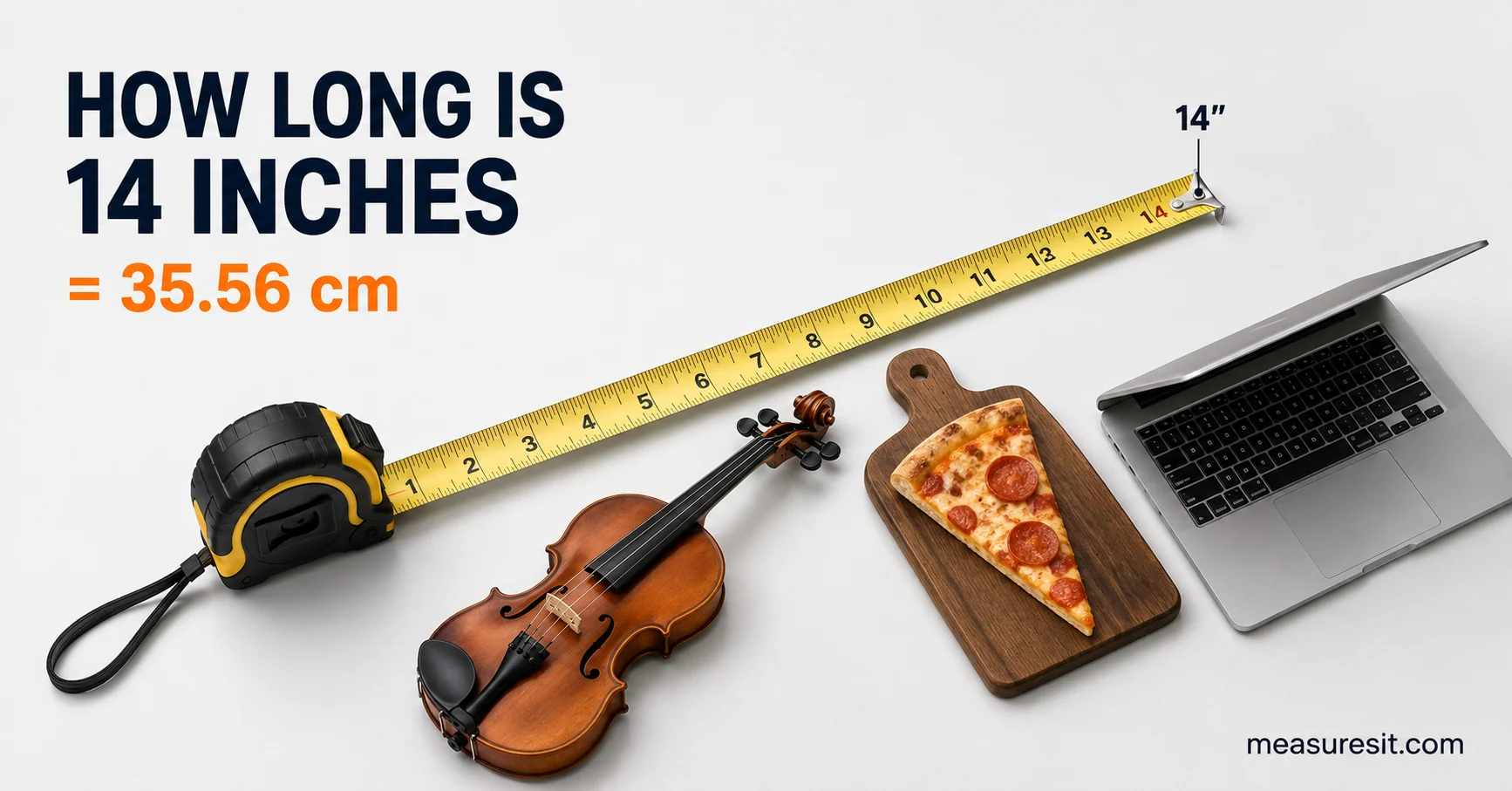
You measure a skillet for a new stovetop. You order a pizza and the menu says 14-inch. You buy a laptop sleeve and the label reads fits 13–14 inch devices.
Fourteen inches turns up constantly, but most of us don’t actually know what it looks like until we hold a ruler up to it.
14 inches equals 35.56 centimeters, or about 1.17 feet roughly the length of a violin’s body, or two inches longer than a standard ruler. Below is a full conversion chart, 15 everyday objects that sit right around this length, and a few tricks for eyeballing 14 inches without reaching for a tape measure.
Conversion Chart
| Unit | Converted Value |
| Inches | 14 in |
| Feet | ≈1.17 ft |
| Yards | ≈0.39 yd |
| Millimeters | ≈355.60 mm |
| Centimeters | ≈35.56 cm |
| Meters | ≈0.36 m |
Common Objects That Are About 14 Inches
| Object | Approximate Length |
| 14-inch pizza | 14 in (diameter) |
| 14-inch laptop screen | 14 in (diagonal) |
| Large skillet or frying pan | 12–14 in |
| Car steering wheel | 14–15 in (diameter) |
| Bowling pin | 15 in (USBC regulation height) |
| 14-inch subwoofer | 14 in (driver diameter) |
| Decorative wall clock | 12–14 in (diameter) |
| Large serving platter | ≈14 in |
More Everyday Items Around 14 Inches
| Object | Approximate Length |
| Men’s size 13 shoe | ≈13 in |
| Full-size violin body | 14 in |
| Laptop sleeve or bag (for 13–14 laptops) | ≈14 in |
| Rolling pin | 15–18 in |
| Footlong sub sandwich roll | ≈12 in |
| Large cutting board | 14–16 in |
| Standard shoebox | ≈13 in |
How Long Is 14 Inches, Really?
Picture a standard 12-inch ruler, then add about two finger-widths past the end. That gap is exactly what makes 14 inches such an easy length to underestimate. It looks close to a foot at a glance, but it’s noticeably longer once you actually lay something down next to it.
It sits between two familiar reference points. A footlong sub roll, at around 12 inches, falls short of it. A yardstick’s halfway mark, at 18 inches, overshoots it by a good margin. Fourteen inches lands squarely in that gap, which is exactly why so many manufactured objects, pizzas, laptop screens, violin bodies, skillets cluster right around it. It’s a practical, handleable size for both hands and household spaces.
A few ways to estimate it on the fly:
- Start with a ruler. A 12-inch ruler plus roughly two finger-widths gets you close.
- Think of a 14-inch pizza. Most pizzerias sell this size, so if you’ve ever ordered one, you’ve held the diameter in your hands.
- Check a 14-inch laptop. If you own one, its screen measures this length corner to corner.
- Picture a large platter. A serving platter used for a holiday roast is usually close to this length.
- Use two dollar bills. Laid end to end, two U.S. bills (about 6.14 inches each) come in just over 14 inches.
1. 14-Inch Pizza
Order a 14-inch at most pizzerias and you’re getting a pie roughly midway between a personal size and an extra-large, with the diameter measured straight across the crust. It’s one of the more standardized comparisons on this list because pizza sizing tends to follow the actual inch measurement fairly closely, unlike a lot of eyeballed household items.
If you’ve ever had to figure out if a pizza box would fit in the fridge or on a small table, you already have a working sense of this length. That makes it a fast mental shortcut for anything close to 14 inches across.
2. 14-Inch Laptop Screen
When a laptop is marketed as 14-inch, the number refers to the screen’s diagonal, not its width. It’s one of the most common laptop sizes sold today, favored for splitting the difference between portability and usable screen space.
Most people have already seen this exact figure while shopping for a computer, which makes it an easy reference to recall. It’s especially useful when comparing bag or sleeve dimensions, since those products are almost always labeled using this same number.
3. Large Skillet or Frying Pan
Large skillets and frying pans typically run from 12 to 14 inches across, with the bigger end of that range popular in households that cook for a crowd or batch-prep meals. Fourteen-inch pans sit at the top of what most home kitchens stock before moving into commercial territory.
Cooks tend to have a rough physical memory of their largest pan’s size just from using it regularly. That makes this comparison genuinely useful when you’re sizing up burner space or figuring out what will actually fit in a cabinet.
4. Car Steering Wheel
Steering wheels on most passenger cars measure 14 to 15 inches across, a range chosen for a comfortable grip and enough leverage to steer without excess effort. Trucks and larger vehicles sometimes use bigger wheels, but this range covers the majority of everyday cars.
Anyone who drives has their hands on this measurement constantly, even without noticing. It’s one of the more physically intuitive comparisons on this list, since you don’t need to picture the object you can just picture your own hands on the wheel.
5. Bowling Pin
A regulation ten-pin bowling pin stands exactly 15 inches tall, per specifications set by the United States Bowling Congress just an inch over 14 inches. Because that height is tightly regulated for competition play, this is one of the more precisely documented comparisons here, rather than a loose estimate.
Even people who haven’t bowled in years usually remember roughly how tall a pin looks standing at the end of the lane. That mental image works well for judging vertical length, like how tall a box or a plant might stand.
6. 14-Inch Subwoofer
In car and home audio, a 14-inch subwoofer refers to the diameter of the speaker cone itself, and it’s a large, established size used for deep bass output. It’s less common than 10- or 12-inch drivers, but it’s a standard option in most audio catalogs.
If you’ve shopped for speakers or built a car stereo system, you’ve likely seen this size listed. It’s a handy comparison for round measurements, particularly when you’re calculating a speaker cutout or enclosure size.
7. Decorative Wall Clock
Wall clocks made for living rooms and offices commonly measure 12 to 14 inches across, large enough to read from across a room without dominating the wall. Bigger statement clocks exist, but this range covers most standard designs sold today.
There’s a good chance the clock in your own home already falls close to this size. That familiarity makes it an easy visual anchor for round objects, especially when you’re deciding how much wall space something new will need.
8. Large Serving Platter
A large oval or rectangular serving platter, the kind pulled out for holiday meals, usually measures close to 14 inches along its longest edge enough room for a whole roasted chicken or a full spread of appetizers.
Because platters like this tend to live in the back of a cabinet until a big meal calls for them, most people have handled one even if they don’t own it. That makes it a solid, tactile comparison for judging counter or cabinet space.
9. Men’s Size 13 Shoe
A men’s U.S. size 13 shoe runs close to 13 inches in length, just under the 14-inch mark. Sizing isn’t perfectly standardized across brands, so actual measurements shift a little depending on the manufacturer and shoe style.
For anyone familiar with shoe sizing, this still offers a relatable, body-scale comparison. It’s particularly useful for judging if something will fit in a shoebox-sized space, like a storage bin or a small drawer.
10. Full-Size Violin Body
A full-size (4/4) violin has a body length of exactly 14 inches, measured from the bottom edge to where the neck meets the body, one of the more precise matches on this entire list. Instrument makers have kept this dimension consistent for centuries because it’s tied directly to the violin’s sound and playability.
Musicians and former music students often have a strong physical sense of this length just from years of handling the instrument. It’s a genuinely accurate comparison to reach for whenever you need an exact 14-inch reference rather than a rough estimate.
11. Laptop Sleeve or Bag
Sleeves and bags labeled for 13- to 14-inch laptops are built to snugly fit devices at this screen size, with just enough extra room for padding. Manufacturers design these dimensions directly around the common laptop sizes sold at that time.
If you’ve bought a laptop bag before, the number on the label was probably built around this exact benchmark. It’s a convenient point of reference when shopping for cases or storage meant to hold slim electronics.
12. Rolling Pin
A standard wooden rolling pin, handles included, usually runs 15 to 18 inches long, just past the 14-inch mark. Shorter, tapered French-style rolling pins without handles can land closer to this exact length.
Home bakers tend to have at least a rough sense of their rolling pin’s size from regular use. It’s a useful stand-in when measuring drawer space or comparing other long, cylindrical kitchen tools.
13. Footlong Sub Sandwich Roll
A classic footlong sub roll measures close to 12 inches, a couple of inches short of 14. Add roughly the width of two fingers to a footlong, and you’ve covered the difference.
Because footlong subs are such a familiar fast-food size, this comparison works even for people who don’t usually think in inches. It’s a practical way to visualize narrow, elongated objects, like a wrapped package or a long, slim box.
14. Large Cutting Board
Large cutting boards meant for carving meat or prepping bigger meals often measure 14 to 16 inches along their longest edge, noticeably bigger than the smaller boards used for quick chopping jobs.
Most kitchens have at least one board in this larger category tucked away in a cabinet. That makes it a dependable comparison for flat, rectangular lengths around the house, like shelf liners or drawer inserts.
15. Standard Shoebox
A typical shoebox runs about 13 inches long, just shy of 14, though the exact figure shifts with shoe style and brand boots and larger sizes tend to need longer boxes.
Since shoeboxes are common storage containers in most closets, this comparison is easy to picture without needing the actual object nearby. It comes in handy when judging what will fit inside a moving box or a stack of storage bins.
FAQ
Is 14 inches bigger than a standard ruler?
Yes. A ruler measures 12 inches, so 14 inches runs about 2 inches longer roughly two finger-widths past the end.
What household item is closest to 14 inches?
A full-size violin body is one of the most precise matches, measuring exactly 14 inches. A 14-inch pizza or laptop screen comes just as close for a more common household comparison.
How many centimeters is 14 inches?
14 inches works out to approximately 35.56 centimeters, based on the standard conversion of 2.54 centimeters per inch.
Is 14 inches a foot?
Not quite. A foot is 12 inches, so 14 inches is about 1.17 feet roughly 2 inches longer than a foot.
Final Thoughts
14 inches comes out to about 35.56 centimeters, or roughly 1.17 feet a length that shows up far more often than most people notice, from the pizza on your counter to the laptop on your desk.
What makes it easy to grasp isn’t the number itself, but the objects built around it: a violin body, a bowling pin, a steering wheel, a well-worn skillet.
That’s really the point of comparisons like these. A measurement stops being abstract the moment you connect it to something you’ve actually held. Next time you’re eyeing a pan for the stove, checking if a laptop bag will fit, or guessing If a package will squeeze into a drawer, you’ll already have a mental ruler ready to go.
Read More About!
How Long Is 7 Inches? Real-Life Size Comparisons
How Long Is 8 Inches? 15 Everyday Comparisons
How Long Is 5 Inches? Real-Life Size Comparisons

I’m Marcus Kane, a measurement content specialist at MeasuresIt.com. I write clear, accurate, and practical articles about measurements, dimensions, conversions, and everyday size comparisons, making complex topics simple and easy to understand.






3 thoughts on “How Long Is 14 Inches? Real-World Comparisons”