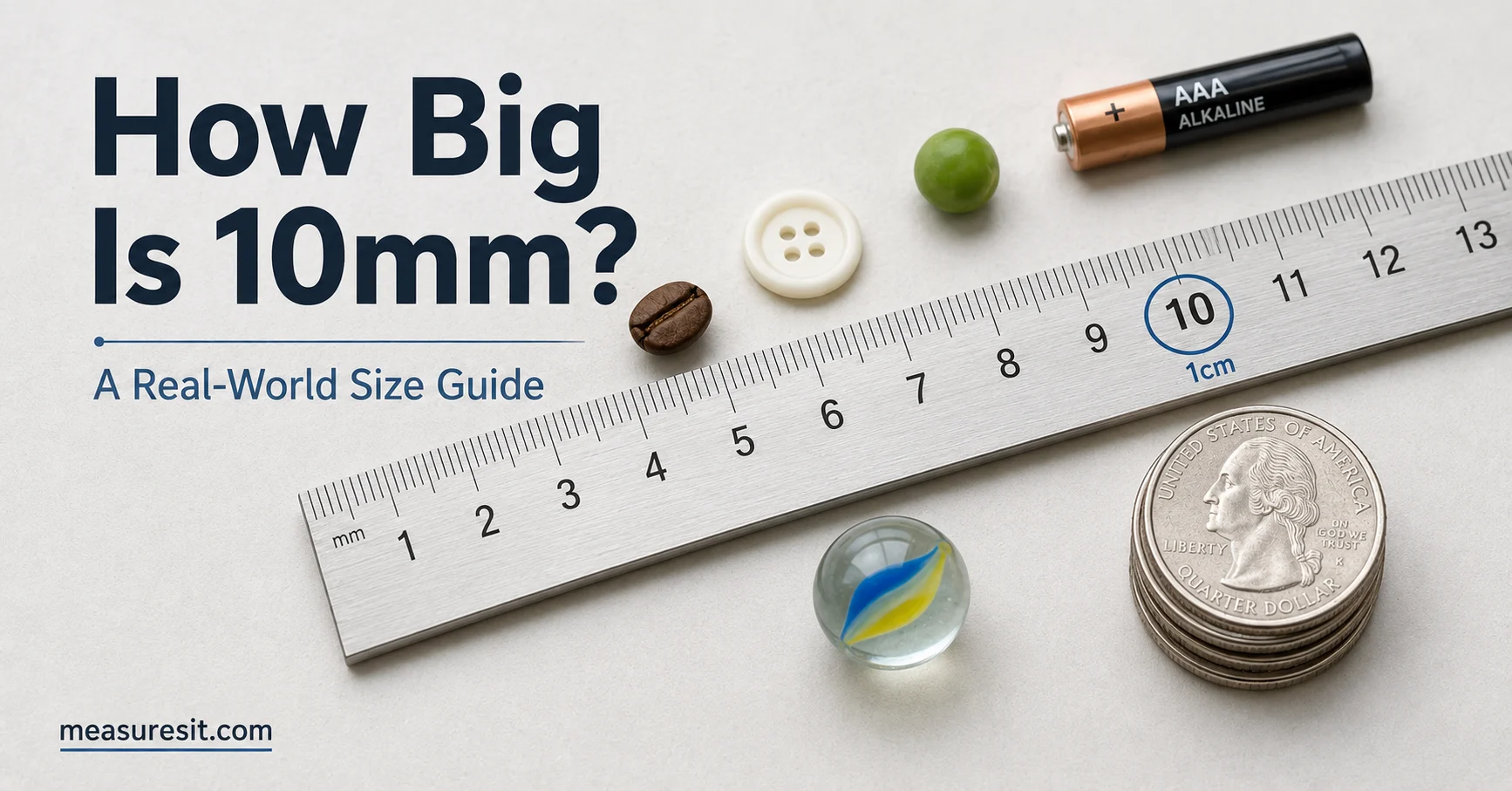
I’ve stood in a hardware store aisle more than once, staring at a bolt labeled 10mm, with no real sense of If it would fit the gap I was trying to fill.
Ten millimeters equals exactly 1 centimeter, or roughly 0.39 inches about the width of a AAA battery or a standard pencil eraser. That single comparison has saved me a return trip more than once.
It’s a size that comes up more often than you’d expect: on jewelry and piercing charts, on screw and drill-bit packaging, in sewing patterns, and on nutrition labels describing tablet thickness. If you’ve ever looked at 10mm on a tape measure and drawn a blank, the objects below should fix that for good.
Conversion Chart
| Unit | Converted Value |
| Millimeters (mm) | 10 mm |
| Centimeters (cm) | 1.00 cm |
| Meters (m) | 0.01 m |
| Inches (in) | ≈0.39 in |
| Feet (ft) | ≈0.03 ft |
| Yards (yd) | ≈0.01 yd |
Two numbers are worth memorizing here. First, 10mm is always 1cm, that’s just how the metric system is built, since a centimeter is defined as ten millimeters. Second, an inch is fixed at exactly 25.4mm under the international yard-and-pound agreement that the US and UK adopted in 1959, which is why 10mm consistently comes out to about 0.39 inches rather than a round number.
Common Objects That Are About 10mm
| Object | Approximate Length |
| Pencil eraser (top width) | ≈10 mm |
| Garden pea | ≈10 mm |
| AAA battery (diameter) | ≈10.5 mm |
| Shirt button (medium size) | ≈10 mm |
| Coffee bean | ≈10 mm |
| Ladybug | ≈8–10 mm |
| Chickpea | ≈9–10 mm |
| Pinky finger (width, average adult) | ≈10–12 mm |
More Everyday Items Around 10mm
| Object | Approximate Length |
| Mini marble (pee wee size) | ≈10 mm |
| Gummy bear (width) | ≈10–12 mm |
| Raisin | ≈10 mm |
| Small staple (length) | ≈10–12 mm |
| Large blueberry | ≈10–12 mm |
| Stack of six US quarters | ≈10.5 mm |
| Wide bubble tea straw (diameter) | ≈10–12 mm |
Picturing 10mm Without a Ruler
Hold a pencil up and look at the rubber cap on top. That cap is almost exactly 10mm wide, small enough to balance on one fingertip, but big enough to spot from across a desk. It sits comfortably between a grain of rice (about 6–7mm) and a US penny (19mm across), which makes it a useful midpoint when you’re judging something by eye.
Where this gets genuinely practical is hardware and jewelry. A 10mm socket or wrench is one size up from 9mm and one down from 11mm, and the difference between them is barely noticeable until you’re trying to loosen a stuck bolt with the wrong one. Piercing jewelry uses the same logic a 10mm hoop reads as small-to-medium, noticeably more compact than the 14–16mm hoops sold as statement pieces.
A few low-effort ways to estimate it on the spot:
- Check a AAA battery. Its diameter is standardized at 10.5mm under IEC battery sizing conventions, so it barely varies between brands.
- Compared to your pinky. The width across an adult pinky finger’s middle knuckle lands close enough for a quick gut check.
- Stack six quarters. Each US quarter is about 1.75mm thick, so six of them stacked flat gets you to roughly 10.5mm.
- Pull a button off a spare shirt. Craft and sewing suppliers label buttons by millimeter, and medium shirt buttons are almost always right at 10mm.
- Look at a paperclip’s short edge. The narrow end of a standard paperclip is close enough to use in a pinch.
1. Pencil Eraser
Nearly every pencil sold has a rubber or vinyl cap fitted over its metal ferrule, and that cap’s width has stayed remarkably consistent across manufacturers for decades. It’s one of the few 10mm objects you can probably find within arm’s reach right now.
That consistency is exactly why it works so well as a reference. Next time you’re sizing up a bead, a bearing, or a small hardware part, hold a pencil eraser next to it before you reach for a ruler.
2. Garden Pea
A fully grown garden pea, fresh or frozen, tends to land right around 10mm across. Their round, uniform shape makes the comparison easy to hold in your head even without one in front of you.
Because bags of frozen peas are a kitchen staple, this is one of the more accessible size checks on this list. If you’re picturing a bead, a bearing, or a small hardware part, pea-sized gets you close.
3. AAA Battery
At 10.5mm across, a AAA battery’s diameter is set by international battery-sizing standards, which is why it’s identical If you buy it at a gas station or order it online. That reliability makes it one of the sturdiest comparisons on this whole list.
Most households have a spare AAA rolling around a junk drawer somewhere. It’s especially useful for judging the width of cylindrical objects screws, dowels, tubing where a flat object like a button doesn’t translate as well.
4. Shirt Button
Sewing and craft suppliers sell buttons by millimeter size, and the medium buttons used on dress shirts are almost always listed right around 10mm. That’s not a coincidence; it’s the size that balances a secure hold with a clean, unobtrusive look on a packet.
If you sew or mend clothes, you likely have loose buttons in a jar somewhere. Fishing one out gives you an immediate, tactile sense of the measurement.
5. Coffee Bean
Roasted coffee beans average close to 10mm in length, though the exact figure shifts with the variety and how dark the roast is. The beans shrink slightly as they roast. Arabica beans tend to sit a touch larger than Robusta.
Since so many kitchens have whole beans on hand, for brewing or just as a jar of decor, this is a comparison you can act on before your coffee’s even finished brewing.
6. Ladybug
Adult ladybugs typically run between 8mm and 10mm in length, which puts the larger end of that range squarely at our target size. Their domed, rounded shells make the length easy to judge at a glance, even from a short distance.
Because ladybugs are a common backyard sighting, they’re a memorable, slightly playful stand-in for a small measurement useful for estimating the size of insects or other tiny garden finds.
7. Chickpea
Dried or cooked chickpeas usually measure about 9 to 10mm across, with their characteristic bumpy, rounded shape making them instantly recognizable to anyone who cooks with them.
Chickpeas are sold by the bag and used in everything from hummus to salads, so they’re an easy one to picture mid-recipe, particularly when a recipe calls for uniformly sized ingredients.
8. Pinky Finger
Measured across the middle knuckle, an adult pinky finger typically comes in around 10 to 12mm wide. It varies from person to person, obviously, but it’s close enough to use as a fast, always-available estimate.
This might be the single most convenient comparison here, simply because your hand is always with you. Hold your pinky next to a small object, and you’ll get a rough read on If it’s around 10mm without digging through a drawer for a battery or a button.
9. Mini Marble
Classic toy marbles usually measure about 16mm, but the smaller pee wee marbles included in many traditional sets run closer to 10mm. If you played marbles as a kid, or kept a jar of them around for decoration, you may already own a few objects at exactly this scale.
They’re a solid comparison for craft and jewelry work, where bead sizes are often specified in millimeters and a physical reference beats guessing.
10. Gummy Bear
A standard gummy bear candy measures roughly 10 to 12mm across the body at its widest point, and because the candies are mass-produced from a single mold, that size barely shifts from bag to bag.
For anyone estimating bead sizes for jewelry-making, this is a genuinely useful, low-stakes reference: gummy bears and craft beads often land in a similar range.
11. Raisin
Dried raisins typically measure close to 10mm in length, though the exact figure depends on the grape variety and how much moisture remains after drying. Sultanas tend to run a touch smaller than standard raisins.
They turn up in lunchboxes, trail mix, and baking recipes often enough that most people have handled one recently, which makes this an easy, no-effort size reference to keep in mind.
12. Small Staple
Before it’s folded closed, the crown of a standard office staple measures around 10 to 12mm. That width isn’t arbitrary; it’s wide enough to hold several sheets of paper together without tearing through them.
Anyone who’s worked in an office or put together school projects has handled staples more times than they could count, which makes this comparison quick to picture even without one nearby.
13. Large Blueberry
Blueberry size varies quite a bit by variety. Wild blueberries tend to run smaller, closer to 5–8mm, while the larger cultivated blueberries sold at most grocery stores measure roughly 10 to 12mm across.
Since blueberries are a common fridge staple, grabbing one gives you a quick, edible way to visualize the measurement handy if you’re mid-recipe and need a fast size check.
14. Stack of Six Quarters
A single US quarter measures about 1.75mm thick, a figure set by US Mint coin specifications. Stack six of them evenly, and you land right around 10.5mm.
It’s a neat trick for anyone who wants a reasonably precise reference using nothing but pocket change and unlike some comparisons on this list, it doubles as something you can test right now on a table.
15. Bubble Tea Straw
The wide straws designed for bubble tea, built to let tapioca pearls pass through, typically measure about 10 to 12mm in diameter noticeably chunkier than a regular drinking straw, which usually sits closer to 6mm.
If you’ve ordered bubble tea before, you’ve already held this exact width in your hand. It’s one of the more intuitive ways to picture a 10mm diameter specifically, as opposed to a 10mm length.
Related Size Conversions
If 10mm isn’t quite the number you were looking for, a couple of nearby measurements are worth keeping in mind: 5mm is roughly the width of a pencil’s lead core, and 1 inch (25.4mm) is about two and a half times longer than 10mm. Keeping these anchor points in mind makes it much easier to estimate anything in between.
FAQ
Is 10mm bigger than an inch?
No. An inch equals 25.4mm, so 10mm is well under half an inch closer to two-fifths of one.
What household item is closest to 10mm?
A AAA battery’s diameter, at about 10.5mm, is one of the closest and most consistent matches you’re likely to have on hand.
Is 10mm the same as 1cm?
Yes, always. There are exactly 10 millimeters in every centimeter, by definition, so the two figures are interchangeable.
What does 10mm look like on a ruler?
On a metric ruler, it’s the distance from the 0 mark to the first bold centimeter line. On an imperial ruler, it falls just short of the 3/8-inch mark.
Final Thoughts
So, how big is 10mm? It comes down to one dependable pairing: 10mm is 1 centimeter, or about four-tenths of an inch roughly the width of a AAA battery or the eraser on top of a pencil. Once that comparison sticks, sizing up small objects gets a lot less guesswork-y.
The point of a list like this isn’t to memorize quarter-thickness trivia. It’s to have two or three go-to comparisons ready the next time you’re standing in a hardware aisle sizing a bolt, checking a piercing chart, or sorting beads for a craft project, and a tape measure isn’t within reach.
Grab a AAA battery or glance at your pinky finger, and you’ll have your answer before you’d have finished digging one out of a drawer anyway.
Read More About!
- How Big Is 8mm? A Simple Size Chart & Comparisons
- How Big Is 3mm? Real-Life Comparisons & Conversions
- How Big Is 7mm? Real-Life Size Comparisons & Chart

Hi, I’m Vera Lindqvist, a content writer at MeasuresIt.com, where I turn measurement standards, unit conversions, and precision tools into clear, practical guides. I care about getting the details right so you don’t have to second-guess them.





1 thought on “How Big Is 10mm? A Real-World Size Guide”