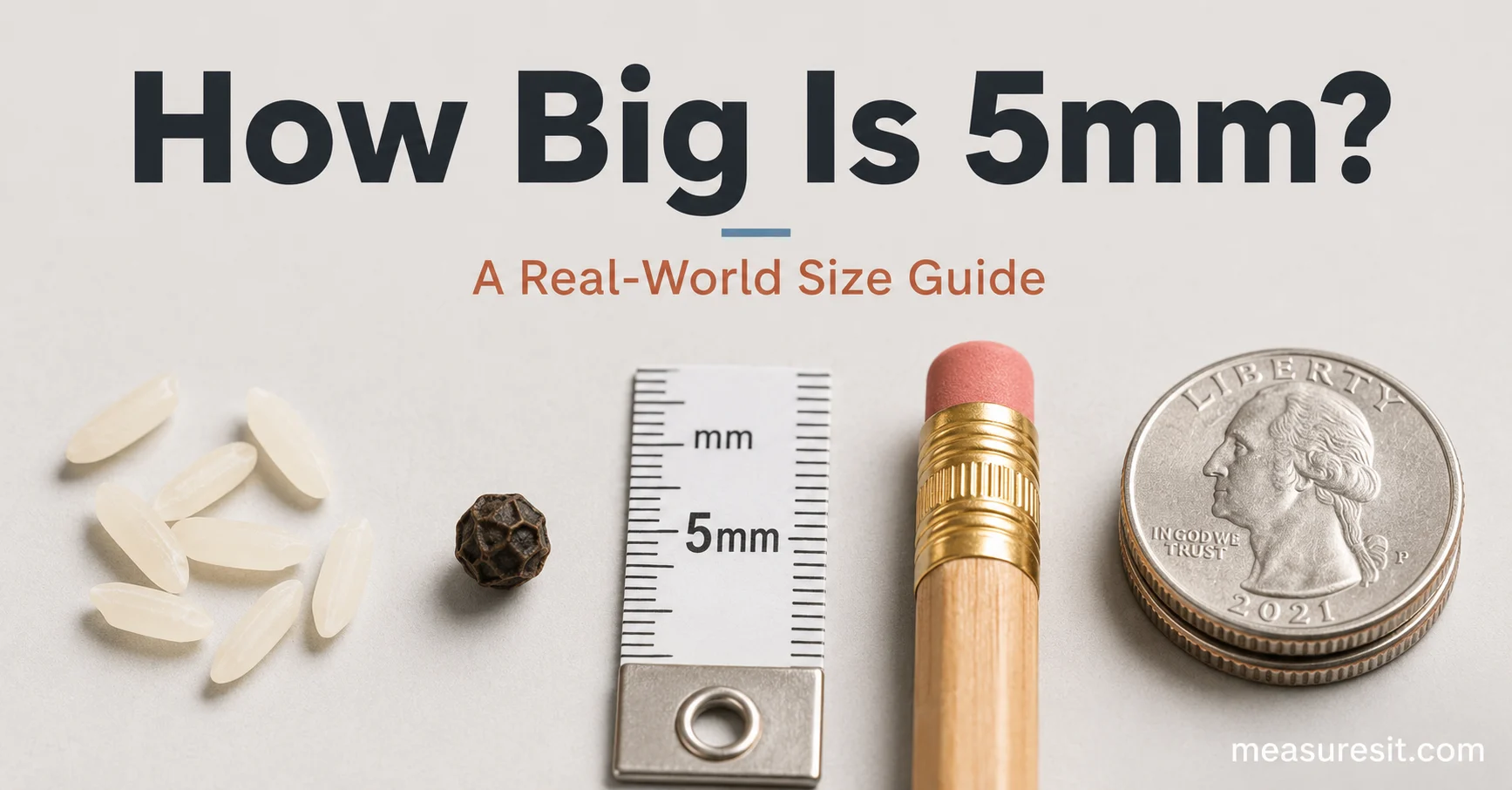
Pull a grain of rice out of the pantry, or a peppercorn out of the grinder, and look at it closely. That’s 5mm about a fifth of an inch, or roughly the width of a pencil eraser. It’s one of those measurements that sounds abstract on a spec sheet but turns out to be something you’re already holding several times a day without noticing.
People land on this question for very different reasons. Maybe a product listing quotes a part as 5mm and you want to know if it’ll fit. Maybe a doctor mentioned a 5mm finding on a scan and you’re trying to picture what that actually means.
Maybe you’re just holding a drill bit and guessing. This guide covers all three: the exact conversions, fifteen everyday objects that are genuinely close to 5mm, and what that number tends to mean in a medical context.
Conversion Chart
| Unit | Converted Value |
| Millimeters (mm) | 5 mm |
| Centimeters (cm) | 0.5 cm |
| Inches (in) | ≈ 0.20 in (about 3/16) |
| Feet (ft) | ≈ 0.02 ft |
| Yards (yd) | ≈ 0.01 yd |
| Meters (m) | 0.005 m |
Common Objects That Are About 5mm
| Object | Approximate Size |
| Grain of medium-grain rice | ≈ 5–6 mm |
| Ladybug | ≈ 5–7 mm |
| Pencil eraser tip | ≈ 5–6 mm |
| Wooden match head | ≈ 4–5 mm |
| .177 caliber BB pellet | ≈ 4.5 mm |
| Common large ant | ≈ 5 mm |
| Stack of three US pennies | ≈ 4.6 mm |
| Half-carat round diamond | ≈ 5.1–5.2 mm |
More Everyday Items Around 5mm
| Object | Approximate Size |
| Whole black peppercorn | ≈ 4–5 mm |
| Pea-sized dab of toothpaste | ≈ 5–7 mm |
| Piece of aquarium gravel | ≈ 5 mm |
| Small four-hole shirt button | ≈ 5–6 mm |
| Watch crown (the winding stem) | ≈ 5 mm |
| Head of an M3 machine screw | ≈ 5.5 mm |
| Earring stud backing | ≈ 5 mm |
What 5mm Actually Looks Like
Hold a grain of rice next to a pea and you’ll notice something: they’re not the same size at all, even though people casually lump them together as small. A pea usually runs 7–8mm across, while 5mm is meaningfully smaller closer to that grain of rice, or a single peppercorn. On the other end, a fine mechanical pencil lead (0.5–0.9mm) is 5-10 times thinner than 5mm. So 5mm sits in a specific, narrow middle ground: visible at a glance, but small enough to lose in a couch cushion.
If you want to check your instincts without a ruler, a few tricks work surprisingly well:
- Stack three pennies. US pennies are 1.52mm thick each, so three together land right around 4.6mm close enough for a quick check.
- Grab a peppercorn from the spice rack. Whole black peppercorns are one of the most consistent 5mm references in a typical kitchen.
- Look at a pencil eraser. The rubber tip on a standard wooden pencil is usually 5–6mm wide.
- Picture a pea-sized dab of toothpaste. It’s a phrase most people already have a mental image for, and it lands close to 5mm.
What 5mm Means in a Medical Context
This is one of the most common reasons people search for this exact measurement, so it’s worth addressing directly. Millimeters are the standard unit doctors use to describe things like kidney stones, moles, nodules, or cysts on an imaging report. For kidney stones specifically, several urology resources point to roughly 4–6mm as a meaningful gray zone: stones smaller than that tend to pass on their own fairly often, while stones at 5mm and above have a noticeably lower chance of passing without help, and larger stones are more likely to need treatment. The exact odds vary by source and depend heavily on the stone’s location and your own anatomy so a size on a report is a starting point for a conversation with a doctor, not a diagnosis on its own. If you’ve been given a 5mm measurement for anything medical, treat these comparisons as a way to visualize the number, not as medical guidance.
15 Reference Objects, Explained
1. Grain of rice. Medium-grain rice measures about 5–6mm long, and because grains within a bag are remarkably uniform, it’s one of the steadiest visual references you’ll find. It’s also almost always within reach, which is half the reason it works so well as a mental shortcut.
2. Ladybug. Most backyard ladybugs run 5–7mm from head to tail. Their size doesn’t vary much between the common spotted varieties, and since they’re bright red and easy to spot on a leaf or windowsill, the image tends to stick.
3. Pencil eraser tip. The pink rubber cap on a standard wooden pencil comes in at roughly 5–6mm across. It barely changes from brand to brand, so once you’ve checked one pencil, you can trust the comparison on the next.
4. Wooden match head. The round striking tip of a wooden match measures about 4–5mm. Match heads are made to a tight, safety-driven tolerance, which is part of why this comparison holds up so consistently.
5. BB pellet. Standard .177 caliber BBs are manufactured to 4.5mm, since they have to fit a specific barrel diameter. Of everything on this list, it’s arguably the most precisely controlled size useful if you want a comparison with almost no wiggle room.
6. A large ant. Ant sizes vary a lot by species, but a common backyard ant is frequently cited around 5mm as a general reference. It’s not a precise figure the way the BB pellet is, but it’s genuinely useful because ants are everywhere.
7. Three stacked pennies. Each US penny is 1.52mm thick, so three stacked together measure close to 4.6mm. Coins are struck to tight manufacturing tolerances, so this trick is more reliable than it sounds and it doubles as a fun way to demonstrate the size to someone else.
8. Half-carat diamond. A round brilliant diamond weighing 0.5 carats typically measures somewhere around 5.1 to 5.2mm across, according to standard jeweler size charts, though the exact figure shifts slightly with cut depth and proportions. If you’ve ever browsed engagement rings, you’ve likely scrolled past this exact number.
9. Whole peppercorn. A dried whole black peppercorn measures roughly 4–5mm. Because peppercorns are graded by size during processing, they’re more consistent than most spices and a pepper grinder is one of the most universally available kitchen items around.
10. Pea-sized toothpaste. Dental guidance has used the phrase pea-sized amount for so long that most people already carry the image around, even if the real size closer to 5–7mm across runs a little smaller than an actual pea. It’s not a manufactured object, so treat it as a loose visual rather than a precise one.
11. Aquarium gravel. Standard fish tank gravel is typically sold pre-sifted to around 5mm per piece. If you’ve ever set up a tank, you’ve scooped handfuls of it and have a real feel for the scale already.
12. Small shirt button. The compact four-hole buttons found on baby clothes and dress shirt cuffs usually run 5–6mm across. Button sizing follows an industry standard, so smaller buttons in this range are fairly predictable no matter the brand.
13. Watch crown. The small knob on the side of a wristwatch, used to set the time, is typically close to 5mm in diameter. It’s a nice one to check in real time if you’re wearing a watch right now, the reference is already on your wrist.
14. M3 screw head. In hardware and DIY circles, an M3 machine screw, one of the most common small screw sizes, has a head that measures about 5.5mm across. If you’ve ever assembled flat-pack furniture or opened up an electronics enclosure, you’ve almost certainly handled one.
15. Earring stud backing. The small metal disc that secures a stud earring in place typically measures close to 5mm. Jewelry findings like this are mass-produced to consistent sizes, so the comparison travels well from one pair of earrings to the next.
FAQ
Is 5mm bigger than a grain of rice?
They’re essentially the same size medium-grain rice measuring about 5–6mm, so the two line up closely.
What household item is closest to 5mm?
A whole black peppercorn or the eraser tip on a pencil are two of the fastest, most reliable things to grab for a quick comparison.
How many millimeters are in an inch?
There are 25.4mm in one inch, which is why 5mm converts to roughly 0.2 inches, or about 3/16 of an inch.
Is a 5mm kidney stone considered big?
It’s right in the range where outcomes vary. Multiple urology resources describe 5mm as sitting near a decision point; some stones this size pass with time and fluids, others don’t, and location and hydration matter as much as size. A doctor’s evaluation, not a size comparison, is what should guide next steps.
Is a 5mm mole or skin spot something to worry about?
Size alone isn’t the deciding factor for skin checks dermatologists look at shape, color, and change over time as much as size. If a spot on your skin is new, changing, or concerning you, that’s worth a dermatologist visit regardless of its measurement.
Final Thoughts
5mm works out to about 0.2 inches the size of a grain of rice, a peppercorn, or the eraser on a pencil. It’s small enough to overlook and just large enough to be genuinely useful once you can picture it.
That mental picture is the real point of this guide. A number on a screen or a lab report doesn’t mean much until you can hold something familiar next to it: three stacked pennies, a peppercorn from the cabinet, the button on a shirt cuff.
If you’re checking a part before a repair, comparing gemstone sizes, or just trying to make sense of a measurement someone mentioned in passing, having a real object in mind beats guessing every time.
Discover Other Posts!
How Big Is 10mm? A Real-World Size Guide
How Big Is 7mm? Real-Life Size Comparisons & Chart
How Big Is 8mm? A Simple Size Chart & Comparisons

I’m Elena Cross, a content writer at MeasuresIt.com, where I turn complex measures, units, and mathematical concepts into clear, accurate, and easy-to-read articles. I’m passionate about precision in numbers and in words and I write to help readers actually understand measurements, not just memorize them.