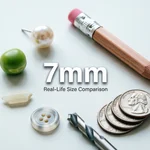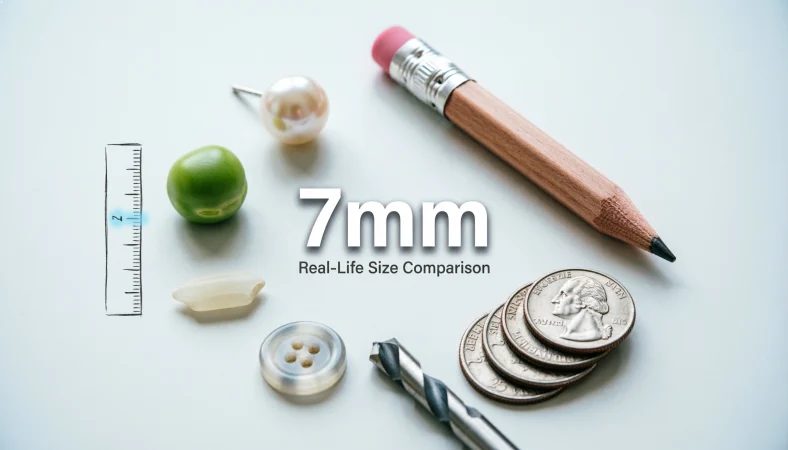
Hold up a pea between your fingers, and you’re holding almost exactly 7mm. 7mm equals about 0.28 inches, roughly a quarter of an inch, plus a hair more.
It’s one of those measurements that shows up constantly without anyone noticing: on an earring’s product tag, a drill bit’s shank, or a doctor’s note after a scan.
Once you connect 7mm to something you can picture, it stops being an abstract number. This guide walks through where 7mm actually turns up jewelry counters, hardware bins, kitchen cupboards and gives you a fast conversion chart so you’re not left guessing If it’s kind of small or actually small.
Conversion Chart
| Unit | Converted Value |
| Millimeters | 7 mm |
| Centimeters | 0.7 cm |
| Meters | 0.007 m |
| Inches | ≈ 0.28 in |
| Feet | ≈ 0.023 ft |
| Yards | ≈ 0.008 yd |
Values are rounded to two decimal places. For anything requiring precision jewelry sizing, machining, medical measurements always confirm with a calibrated tool rather than a rough conversion.
Common Objects That Are About 7mm
| Object | Approximate Size |
| Pencil eraser tip | ≈ 7mm wide |
| Standard pearl stud earring | 6–8mm |
| Green pea | ≈ 7mm diameter |
| Grain of rice, lengthwise | ≈ 6–7mm |
| Ballpoint pen tip housing | ≈ 7mm wide |
| Standard shirt button | ≈ 7–10mm |
| Small watch battery (CR927) | ≈ 7.9mm |
| Pencil barrel diameter | ≈ 7mm |
More Everyday Items Around 7mm
| Object | Approximate Size |
| Aquarium gravel piece | ≈ 5–7mm |
| 7mm drill bit | 7mm exactly, by definition |
| Small hex nut (metric) | ≈ 7mm across flats |
| Chickpea | ≈ 7–8mm diameter |
| Thick mechanical pencil lead | 5.6–7mm |
| Kidney stone at treatment threshold | ≈ 7mm |
| Four stacked US quarters | ≈ 7mm (quarters are 1.75mm each) |
Visualizing 7mm Without a Ruler
There’s a reason people reach for comparisons instead of just quoting a number millimeters don’t mean much until you’ve held one. Seven millimeters sits in that narrow, useful middle ground: too small to bump into, but large enough to spot from across a table. Think of the width of a wooden pencil, or a pearl earring catching the light.
Scale it down slightly and you land closer to 5mm, roughly the width of a standard pencil lead. Scale it up and you hit 10mm one full centimeter, about the size of a highlighter’s cap. 7mm sits comfortably between those two, closer to the smaller end but with real physical presence.
A few practical ways to eyeball it:
- Pick up a pencil. An unsharpened wooden pencil’s width is one of the closest everyday matches.
- Roll a pea between your fingers. Fresh peas from the pod land almost exactly at this size.
- Check a jewelry tag. Pearl and stud earrings are commonly sold in 6–8mm sizes, so trying one on gives you an instant reference.
- Look at a shirt button. Smaller buttons on dress shirts hover right around 7mm.
- Stack four quarters. US quarters run about 1.75mm thick each, so four of them stacked gets you close.
- Use a metric ruler. 7mm falls just short of the 1cm mark easy to spot if you have one in a drawer.
1. Pencil Eraser Tip
Most people have handled a pencil eraser more times than they could count, which makes it a genuinely useful mental yardstick. Its width lines up closely with 7mm, and because pencils are manufactured to fairly consistent dimensions, the comparison holds up across brands.
Next time you’re trying to eyeball a small part or a loose bead, grab a pencil and hold the eraser end next to it. It’s a faster gut check than pulling out a ruler.
2. Standard Pearl Stud Earring
Jewelers list earring sizes in millimeters right on the product page, and 7mm is one of the most commonly sold sizes for everyday pearl studs. That precision is what makes this comparison more reliable than most; it’s not an estimate, it’s a spec.
Anyone who’s shopped for earrings has scrolled past this exact number without thinking twice about it. If you’re comparing a small object to jewelry, a pearl stud is a dependable reference point.
3. Green Pea
Shell a handful of fresh peas and you’ll notice most land somewhere close to 7mm across, depending on how ripe they are. Because peas are round, familiar, and easy to hold, they translate into a size cue almost instantly no measuring required.
This one works particularly well for sizing small round beads, seeds, or tiny hardware components.
4. A Grain of Rice, Lengthwise
Measured along its longest edge, a single grain of long-grain rice typically comes in around 6 to 7mm. Rice sits in most kitchen cupboards, so there’s no need to go hunting for a comparison object; it’s usually within arm’s reach.
Its slim, tapered shape is also a useful reminder that 7mm can look different depending on which direction you’re measuring.
5. Ballpoint Pen Tip Housing
The tapered metal or plastic cone at the writing end of a standard ballpoint pen measures close to 7mm at its widest point. Pens get handled daily, so this comparison doesn’t require digging through a drawer; there’s probably one within reach right now.
The cone shape also makes it a handy stand-in when you’re picturing pointed or tapered small objects rather than perfectly round ones.
6. Standard Shirt Button
Buttons on dress shirts generally run from about 7mm to 10mm, with the smaller end landing right at this measurement. Because buttons are handled constantly while getting dressed, this size tends to register almost automatically for anyone who sews or does their own mending.
If you’ve ever replaced a missing button, you already have a working sense of what 7mm feels like between two fingers.
7. Small Watch Battery
Coin-cell batteries like the CR927 measure about 7.9mm across, putting this comparison just slightly above the 7mm mark close enough to be useful, and it’s a verified spec rather than a guess, per manufacturer datasheets. Anyone who’s popped open the back of a watch to swap a battery has handled one of these.
It’s a solid reference for estimating the width of small electronic components or coin cells more broadly.
8. Pencil Barrel Diameter
Beyond the eraser, the hexagonal wooden barrel of a standard pencil also measures close to 7mm across its flat sides. Pencil manufacturing has stayed fairly standardized for decades, so this comparison holds steady If the pencil is new or worn down.
Woodworkers occasionally use a spare pencil as a rough go/no-go check for small drilled holes not precise, but close enough for a quick rationality check.
9. Aquarium Gravel
Aquarium gravel is typically sold in a range from about 5mm to 7mm per piece, with the larger stones landing right at this size. Anyone who’s set up a fish tank has scooped handfuls of this material and developed a rough feel for the scale.
The irregular, rounded shape is also a good reminder that 7mm in nature rarely looks like a perfect cube or sphere.
10. A 7mm Drill Bit
Unlike most items on this list, a 7mm drill bit isn’t an approximation; it’s manufactured to that exact diameter. Hardware stores stock these by the millimeter, so if you want a completely precise physical reference, this is about as close as you’ll get without a caliper.
Anyone doing home repairs or assembling flat-pack furniture has likely sorted through a bit set that includes this size.
11. Small Hex Nut
Certain metric hex nuts measure close to 7mm across their flat sides, depending on the bolt size they’re paired with. Hardware is labeled by exact millimeter dimensions, so this comparison is grounded in real manufacturing specs rather than a rough guess.
If you’ve ever sorted through a parts bin looking for the right fastener, you’ve likely handled nuts in this exact range.
12. Chickpea
A dried or cooked chickpea typically measures somewhere between 7mm and 8mm across, depending on the variety. Chickpeas turn up often enough in everyday cooking hummus, salads, curries that most people have handled a handful without thinking about their size.
Their slightly irregular shape also reflects how natural objects near 7mm rarely come out perfectly uniform.
13. Thick Mechanical Pencil Lead
Larger mechanical pencil leads, the kind used for drafting or bold sketching, range from about 5.6mm up to 7mm in some sizes. Artists and drafters who work with specialty leads have direct, repeated experience with this exact measurement.
Because the lead is rigid and manufactured to a precise diameter, it’s a sharper visual anchor than softer or irregularly shaped comparisons.
14. A Kidney Stone at the 7mm Mark
In medical imaging, 7mm is a size doctors pay close attention to; stones around this size are less likely to pass on their own and more likely to need treatment, according to guidance from the National Kidney Foundation. This comparison sticks with people specifically because it’s tied to something with real consequences, not just an abstract object.
Anyone who’s read a radiology report mentioning stone size in millimeters already has a concrete sense of what this measurement means.
15. Four Stacked US Quarters
A single US quarter is about 1.75mm thick, so stacking four of them gets you to roughly 7mm. Since quarters are something almost everyone has within reach, this is one of the easiest comparisons to test right now without leaving your seat.
It’s a particularly good trick when you don’t have a pencil, pea, or earring handy but do have spare change in a pocket or jar.
FAQ
Is 7mm bigger than a grain of rice?
Slightly. A grain of rice measured lengthwise usually falls around 6–7mm, so 7mm is about the same size or just a touch larger.
How many inches is 7mm?
7mm converts to approximately 0.28 inches a bit more than a quarter of an inch.
Is 7mm bigger than 1cm?
No. One centimeter equals 10mm, so 7mm is noticeably smaller, about seven-tenths of a centimeter.
What’s a reliable household item to compare to 7mm?
A pencil’s barrel or eraser tip is one of the most consistent household matches, since pencils are manufactured to fairly standard dimensions.
Final Thoughts
So, how big is 7mm? It’s small enough to miss at a glance but large enough to matter the width of a pea, a pencil, or a pearl earring you’d actually notice on someone’s ear. Once it’s tied to something familiar, the number itself becomes almost beside the point.
That’s really the useful takeaway here: If you’re comparing earring sizes before an online order, checking if a drill bit will fit a hole, or trying to picture a measurement mentioned in a medical report, you don’t need a ruler in hand.
A pea in your palm or a pencil on your desk gets you close enough to know exactly what you’re dealing with.
Read Other Posts!
- How Big Is 3mm? Real-Life Comparisons & Conversions
- How Big Is 8mm? A Simple Size Chart & Comparisons
- How Big Is 5mm? A Real-World Size Guide

I’m Marcus Kane, a measurement content specialist at MeasuresIt.com. I write clear, accurate, and practical articles about measurements, dimensions, conversions, and everyday size comparisons, making complex topics simple and easy to understand.