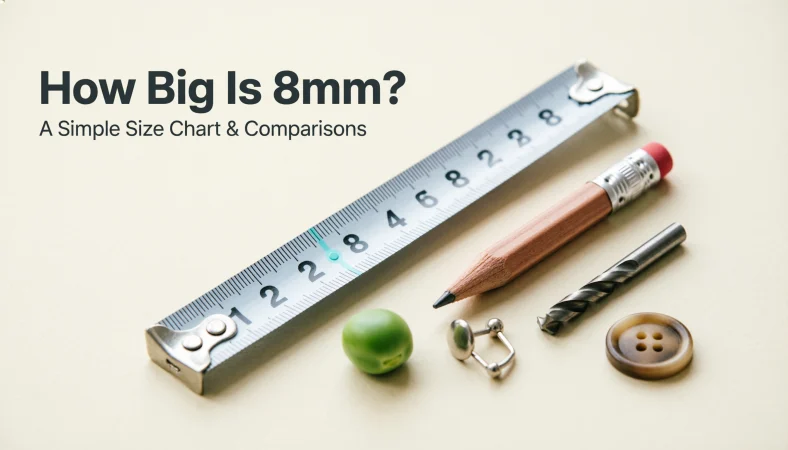
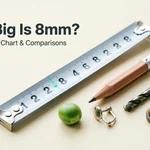
8mm works out to about 0.31 inches, just shy of a third of an inch, and close to the size of a garden pea or the eraser tip on a standard pencil.
It’s a measurement you’ll run into constantly without realizing it: on earring packaging, drill bit sets, bead strands for jewelry making, and even in a doctor’s notes if you’ve ever had a kidney stone scan.
The tricky part isn’t the math, it’s that millimeters rarely show up in daily conversation, so the number doesn’t mean much until you attach it to something you can picture. That’s the goal here: turn 8mm from an abstract figure into something you can hold in your hand, If you’re comparing bead sizes for a necklace, picking the right drill bit for a wall anchor, or just trying to sanity-check a product listing before you buy.
Conversion Chart
The math is simple once you know the constant: one inch equals exactly 25.4mm, a fixed international standard maintained by the National Institute of Standards and Technology. Here’s how 8mm lines up against the units you’re likely to actually need.
| Unit | Converted Value |
| Millimeters (mm) | 8 mm |
| Centimeters (cm) | 0.8 cm |
| Meters (m) | 0.008 m |
| Inches (in) | ≈ 0.315 in |
| Feet (ft) | ≈ 0.026 ft |
| Yards (yd) | ≈ 0.009 yd |
A rougher but faster way to remember it: 8mm sits between 1/4 inch (6.35mm) and 3/8 inch (9.5mm) closest to 5/16 inch on a standard ruler.
Objects That Are About 8mm
These eight are the ones I’d reach for first common enough that most people have one nearby, and consistent enough in size to trust as a reference.
| Object | Approximate Size |
| Garden pea | ≈ 8 mm |
| Pencil eraser tip | ≈ 7–8 mm |
| 8mm drill bit | 8 mm exactly |
| Aquarium gravel piece | ≈ 6–10 mm |
| Small stud earring | ≈ 6–8 mm |
| Kidney stone flagged for treatment | ≈ 8 mm and up |
| Chickpea | ≈ 8 mm |
| .32 ACP bullet diameter | ≈ 7.65 mm |
More Everyday Items Around 8mm
A second set, none of them overlapping with the list above, for when you want a backup reference.
| Object | Approximate Size |
| Large blueberry | ≈ 8–12 mm |
| M8 bolt shaft | 8 mm exactly |
| Wooden pencil barrel (flat to flat) | ≈ 7–8 mm |
| Medium shirt button | ≈ 8–10 mm |
| Skateboard bearing (inner diameter) | ≈ 8 mm |
| Corn kernel | ≈ 8–9 mm |
| Small button-cell battery (LR41) | ≈ 7.9 mm |
Getting a Feel for 8mm
Hold a pencil eraser between two fingers and you’ve basically got it. It’s small enough to disappear in a junk drawer but large enough to see clearly across a room nothing like the almost-invisible scale of a 2mm or 3mm object.
For a sense of scale in both directions: a 5mm object, like a small watch screw, reads as noticeably finer closer to a grain of rice. A 12mm object, like a large marble, already feels like a real handful by comparison. 8mm sits right in the middle of that range, which is part of why it’s such a common size for beads, screws, and small stones it’s substantial enough to work with but still compact.
A few ways to eyeball it without a ruler:
- Grab a pea from the freezer. Frozen peas are remarkably uniform, and one is just about spot-on for 8mm.
- Check the eraser on a pencil. Nearly everyone has one within reach, which makes it the most reliable gut-check reference on this list.
- Compare it to a shirt button. Medium buttons on dress shirts land right around this size.
- Stack six US dimes. Each dime is about 1.35mm thick, so six stacked gets you close to 8mm in height.
- Look at your pinky nail. Most adult pinky nails are somewhere around 8–10mm across.
- Pull an M8 bolt from the toolbox, if you have one. The 8 in M8 literally refers to the 8mm shaft it’s a built-in ruler.
15 Reference Objects, Explained
1. Garden Pea
Fresh or frozen, garden peas grow to a strikingly consistent size, which is exactly why they work so well here. Pour out a handful of frozen peas and you’re essentially holding a bag of 8mm reference points. If you bead or bake and need a fast visual check, a pea from the freezer beats digging out a ruler.
2. Pencil Eraser Tip
The pink eraser capping a standard pencil measures roughly 7 to 8mm across. What makes it useful isn’t the precision of its availability. Almost everyone has a pencil somewhere nearby, at a desk, in a junk drawer, in a kid’s backpack, so it doubles as a size reference you don’t have to remember to bring with you.
3. 8mm Drill Bit
This one needs no rounding. Drill bits are manufactured to exact millimeter sizes, and an 8mm bit is precisely that. If you’ve ever hung a shelf or built flat-pack furniture, there’s a decent chance you already own one. Holding it against an unfamiliar object gives you a genuinely tool-grade comparison, not an estimate.
4. Aquarium Gravel
Individual pieces of standard aquarium gravel usually fall somewhere between 6mm and 10mm, clustering close to 8mm on average. Because gravel is sold and poured in bulk, no two pieces are identical, but anyone who’s set up a fish tank has handled this size range by the handful. It’s a tactile, if slightly unusual, way to calibrate your eye.
5. Small Stud Earring
Simple stud earrings, the plain ball or cubic zirconia kind, typically run 6mm to 8mm across the front. Jewelry listings almost always state the diameter, so shoppers pick up this scale fast. If you’re buying earrings online and want to avoid a surprise when the package arrives, comparing the listed size to a stud you already own is the easiest gut check there is.
6. Kidney Stone Near the Treatment Threshold
Doctors track kidney stone size in millimeters because it directly shapes the treatment plan. According to the National Kidney Foundation, smaller stones often pass on their own, while stones around 8mm and larger are far less likely to pass without medical help and more often require a procedure. This is one comparison where the number isn’t just trivia if you or someone close to you has been told a stone’s size in millimeters, this is roughly where the conversation shifts from wait and see to let’s talk options. As always, treatment decisions depend on your own doctor’s evaluation, not a general size chart.
7. Chickpea
A dried or cooked chickpea sits close to 8mm at its widest point. It’s a strange thing to measure, admittedly, but anyone who’s made hummus has handled hundreds of them without a second thought. That familiarity is the whole point: you don’t need a new mental model, just a glance at something already in your kitchen.
8. .32 ACP Bullet
The .32 ACP cartridge has a bullet diameter of about 7.65mm close enough to 8mm to be a useful cross-check for anyone already familiar with firearm specs. Ammunition dimensions are tightly standardized, so this reference is precise rather than a loose approximation, even if it’s a niche one for most readers.
9. Large Blueberry
Blueberries vary quite a bit by variety, but the bigger cultivated ones commonly reach 8 to 12mm across. You’ve probably never consciously measured one, since they’re sold by weight, not size, but picking out a larger berry from the carton gives you a quick, produce-aisle version of this comparison.
10. M8 Bolt
The name gives it away: an M8 bolt has an 8mm shaft, following the metric bolt sizing system used in hardware stores worldwide. If you’ve assembled furniture or worked on a bike, you’ve likely handled one without registering the number. Keep one in a drawer and you’ve got a permanent, pocket-sized 8mm gauge.
11. Wooden Pencil Barrel
Measured flat to flat across its hexagonal body, an unsharpened wooden pencil runs close to 7 to 8mm. It’s a different measurement than the eraser tip mentioned earlier; this is the width of the barrel itself, not the eraser cap which makes a single pencil a handy two-in-one reference.
12. Medium Shirt Button
The buttons on a typical dress shirt usually measure 8mm to 10mm across. Manufacturers keep this fairly consistent so buttonholes line up properly across sizes and brands. Since most people own a closet full of these, it’s one of the more accessible comparisons on this list you might be wearing the answer right now.
13. Skateboard Bearing
Standard skate and inline bearings run close to 8mm on their inner diameter, a spec skaters and mechanics reference constantly when shopping for replacement parts. Bearings are sold to tight tolerances, so this is a genuinely precise comparison if you happen to have one in a toolbox or a skate bag.
14. Corn Kernel
A single kernel from a fresh ear of corn typically measures 8 to 9mm across, depending on the variety and how ripe the ear is. It’s a comparison that works well for explaining sizes to kids, since shucking a single ear puts dozens of near-identical reference points right in their hands.
15. Small Button-Cell Battery
Certain button-cell batteries, like the LR41 used in some watches and calculators, measure about 7.9mm across essentially 8mm on the nose. Battery specs are held to tight tolerances because even a fraction of a millimeter can keep a battery from fitting its device. Check a junk drawer; there’s a decent chance you already have one to compare.
Frequently Asked Questions
Is 8mm bigger than 1/4 inch?
Yes. A quarter inch equals 6.35mm, so 8mm is noticeably larger, closer to 5/16 inch on a standard tape measure.
What’s the easiest household item to compare to 8mm?
A pencil eraser or a medium shirt button. Both are common enough that most people have one within arm’s reach.
How many 8mm objects would span one inch?
About three. An inch is 25.4mm, so 8mm objects lined up edge to edge would need roughly 3.2 of them to cover an inch.
Is 8mm a common size in jewelry making?
Yes it’s one of the most widely used bead and stud sizes, striking a balance between noticeable and understated.
Final Thoughts
So, how big is 8mm? About a third of an inch roughly the size of a garden pea, a pencil eraser, or a medium shirt button, and precisely the diameter of an 8mm drill bit or M8 bolt if you want an exact reference rather than an approximate one.
The number itself isn’t the hard part; connecting it to something familiar is. If you’re buying earrings, choosing hardware for a repair, sizing beads for a jewelry project, or trying to understand a measurement from a medical scan, a physical comparison beats a decimal every time.
Keep a pea, a pencil, or a spare M8 bolt in mind, and 8mm stops being an abstract number and starts being something you can actually see.
Discover More!
How Big Is 3mm? Real-Life Comparisons & Conversions
How Big Is 7mm? Real-Life Size Comparisons & Chart
How Big Is 10mm? A Real-World Size Guide

I’m Marcus Kane, a measurement content specialist at MeasuresIt.com. I write clear, accurate, and practical articles about measurements, dimensions, conversions, and everyday size comparisons, making complex topics simple and easy to understand.




3 thoughts on “How Big Is 8mm? A Simple Size Chart & Comparisons”