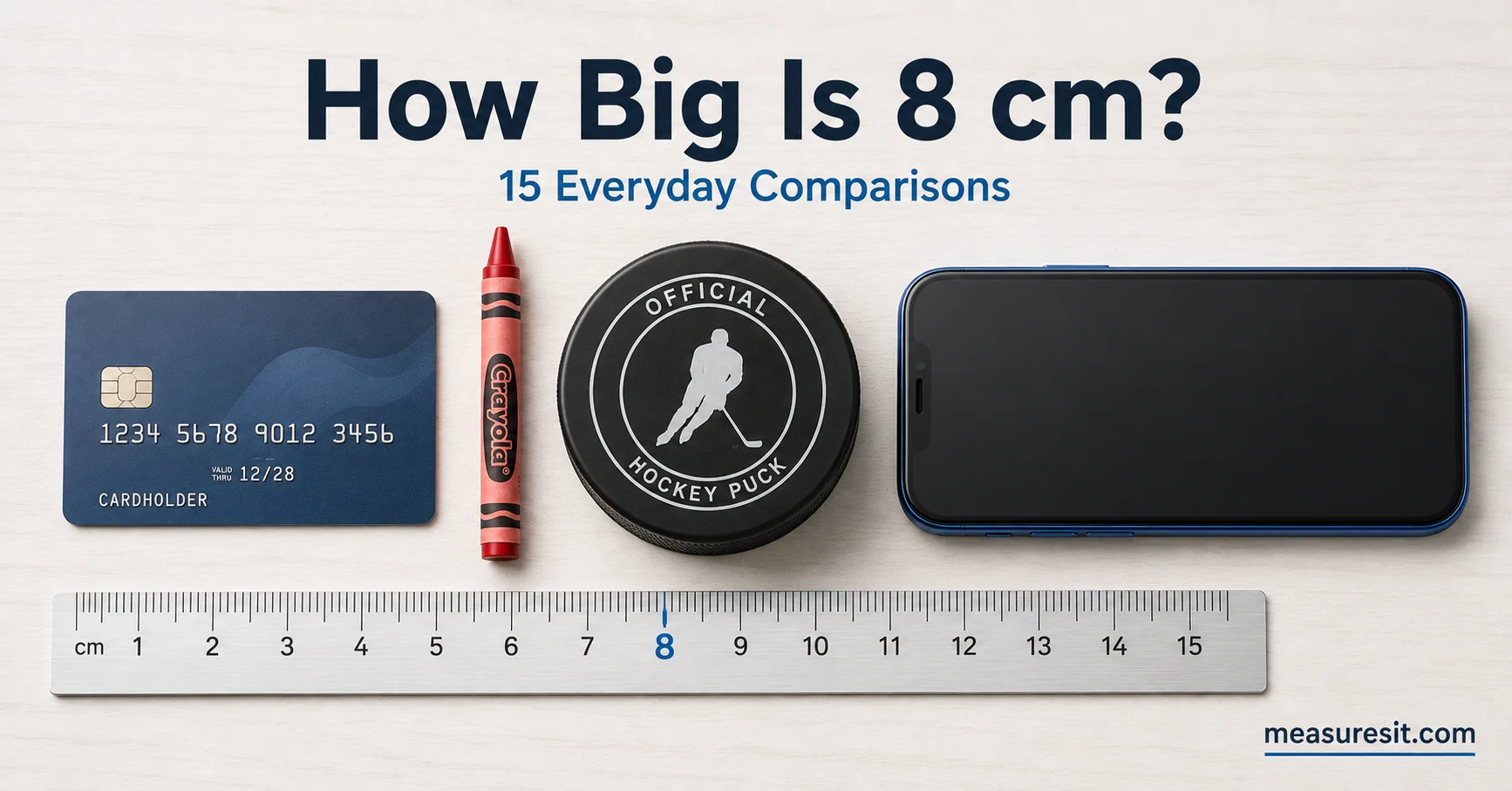
Pull a credit card out of your wallet and lay it flat. That long edge is almost exactly the size you’re picturing. 8 cm works out to about 3.15 inches roughly the length of a standard credit card. In millimeters that’s 80 mm, and in meters it’s a fraction of one, 0.08 m, which is a good reminder of how small this measurement really is next to full-sized objects.
You run into 8 cm more than you’d expect. Maybe you’re checking if a phone case will actually fit, cushioning something fragile for shipping, rolling out an 8 cm round of dough for a recipe, or trimming a piece of fabric for a craft project. None of those tasks need a ruler if you know what 8 cm already looks like sitting in your hand.
A quick note before the comparisons: every object below is checked against a real, documented size, an official sports regulation, a manufacturing standard, or a widely used product spec rather than an eyeballed guess. Where an item naturally varies (like a house key or a smartphone), that range is noted instead of a false-precision number.
Conversion Chart
Here’s the exact math for 8 cm across the units you’re most likely to need, rounded to two decimal places.
| Unit | Converted Value |
| Millimeters (mm) | 80 mm |
| Centimeters (cm) | 8 cm |
| Meters (m) | 0.08 m |
| Inches (in) | ≈ 3.15 in |
| Feet (ft) | ≈ 0.26 ft |
| Yards (yd) | ≈ 0.09 yd |
Common Objects That Are About 8 cm
These eight sit closest to 8 cm and double as reliable mental rulers, because most of us already own one.
| Object | Approximate Length |
| Credit or debit card | ≈ 8.6 cm |
| Standard crayon | ≈ 8.9 cm |
| Hockey puck (diameter) | ≈ 7.6 cm |
| Post-it note (side) | ≈ 7.6 cm |
| Baseball (diameter) | ≈ 7.3 cm |
| Smartphone (width) | ≈ 7–8 cm |
| Light switch plate (width) | ≈ 7.3 cm |
| Golf tee | ≈ 7 cm |
More Everyday Items Around 8 cm
These seven land in the same neighborhood and work just as well if the items above aren’t within reach.
| Object | Approximate Length |
| Tennis ball (diameter) | ≈ 6.7 cm |
| Small juice box (height) | ≈ 9.6 cm |
| House key | ≈ 6–8 cm |
| Stick of gum | ≈ 7 cm |
| USB flash drive | ≈ 6–7 cm |
| Standard playing card | ≈ 8.9 cm |
| 3×5 index card (short side) | ≈ 7.6 cm |
How Big Is 8 cm in Everyday Terms?
Stretch your hand out flat, thumb tucked in. For most adults, the width across the palm lands close to 8 cm a size you use constantly without ever thinking of it in centimeters.
Context helps more than numbers alone. A golf ball, at roughly 4.3 cm across, is barely half this size, while a CD spans a full 12 cm half again as large as 8 cm. So 8 cm sits in a comfortable middle zone: easy to spot across a room, but small enough to close a fist around.
A few low-effort ways to eyeball 8 cm without hunting for a tape measure:
- Grab a card from your wallet. A credit card’s long edge is one of the closest and most convenient matches on this whole list.
- Turn your phone sideways. Most smartphones are about 7 to 8 cm wide, which makes this comparison available basically anywhere.
- Count four fingers. Lined up side by side, an adult’s four fingers usually land somewhere close to 8 cm.
- Reach for a hockey puck or a Post-it. Both sit right around 7.6 cm a touch under, but close enough for a fast visual check.
- Add a thumbnail to a golf tee. A standard tee runs about 7 cm, so tack on roughly a centimeter and you’re there.
- Round to just over three inches. If a metric ruler isn’t handy but an imperial one is, 8 cm lines up with about 3 1/8 inches.
1. Credit or Debit Card
Bank cards are built to a global manufacturing standard (ISO/IEC 7810, ID-1 format) that fixes the long edge at 8.56 cm which is exactly why every card in every wallet feels the same size regardless of the bank that issued it. That consistency is what makes it such a dependable stand-in for 8 cm. Next time you’re deciding If a small part will fit through a slot, laying a card next to it beats guessing.
2. Standard Crayon
A full-length, unsharpened crayon measures close to 8.9 cm, a size most people last paid attention to in kindergarten but can still picture instantly. It’s proof that some size references don’t need a technical spec to be reliable decades of handling one is enough. If you’re sizing up a small toy or bead for a craft project, a crayon from the junk drawer works as well as any ruler.
3. Hockey Puck
Regulation pucks used by the NHL and IIHF measure 7.6 cm across, a dimension locked in so gameplay stays consistent from rink to rink. You don’t need to follow hockey to recognize the size it’s shown in enough highlight reels and photos to be familiar by osmosis. It’s a solid match for anything round and flat, like a coaster or a cookie cutter you’re trying to size up.
4. Post-it Note
The square sticky note popularized by 3M comes in at 7.6 cm per side, a size picked for legibility without wasting paper on every pad. Because these show up on monitors, fridges, and office desks everywhere, most people already carry a mental image of the size. Stick one next to a small object and you’ll know within a glance If it’s pushing past 8 cm.
5. Baseball
Major League Baseball’s official specs put a regulation ball at 7.3 cm across, a figure that’s stayed essentially unchanged for generations of the sport. Even people who’ve never picked up a bat tend to have a rough sense of the size from broadcasts alone. It’s a fair comparison for small round produce, like a plum or a large lime.
6. Smartphone Width
Phone width isn’t standardized the way a card or a ball is, but most current models cluster tightly between 7 and 8 cm, shaped by what fits comfortably in an average hand. Since a phone is within arm’s reach for most people at almost any moment, this might be the single most convenient comparison on the list. Turn yours on its side next to an object, and you’ve got an instant size check with zero extra effort.
7. Light Switch Plate
Standard single-gang wall plates run about 7.3 cm wide, a size dictated by U.S. electrical box conventions rather than anyone’s design preference. They’re mounted at eye level in nearly every room of every home, which makes the size oddly easy to recall once you start looking for it. It’s a useful gut check when you’re eyeing wall space for a small hook or shelf bracket.
8. Golf Tee
A standard wooden tee measures roughly 7 cm, long enough to hold a ball at a consistent height without digging into the turf. The shape is recognizable even to people who’ve never swung a club, thanks to how often it shows up in ads and broadcasts. If you need something slim and just shy of 8 cm, a tee is a fair mental placeholder.
9. Tennis Ball
The International Tennis Federation regulates ball diameter tightly, landing regulation balls at about 6.7 cm across. That bright yellow-green color makes it one of the easiest objects on this list to picture from memory alone. It holds up well as a comparison for round fruit, like a small orange.
10. Small Juice Box
A typical single-serve juice box stands about 9.6 cm tall, noticeably past 8 cm, which actually makes it useful as an upper boundary rather than a close match. Anyone who’s packed a lunch or stocked a pantry has handled dozens of these without a second thought. When you need a slightly bigger than 8 cm reference, this is the one to reach for.
11. House Key
Keys vary by manufacturer and lock type, but most fall somewhere between 6 and 8 cm a range rather than a fixed number, and one worth being honest about instead of forcing false precision. Almost everyone touches a set of keys multiple times a day without ever thinking about their size. Laying one against a small screw or bracket is a fast, no-tools way to judge If it’s approaching 8 cm.
12. Stick of Gum
A single stick of chewing gum runs close to 7 cm, sized to fit neatly into a pack that slides into a pocket without printing. It’s small enough to overlook, but familiar enough that most adults can picture the length without holding one in hand. It works well as a comparison for slim items, like a pen cap or a small screwdriver bit.
13. USB Flash Drive
Flash drive bodies vary by brand, but most run between 6 and 7 cm long, a range that’s held fairly steady since USB sticks became common desk and keychain items in the early 2000s. That two-decade run of everyday use is exactly what makes the size feel intuitive even to people who couldn’t quote a number. They’re a decent comparison point for small electronics or connector parts.
14. Standard Playing Card
Cards in a standard poker deck measure 8.9 cm long, a size set by casino and manufacturing conventions used worldwide. Card games are common enough across cultures that the size registers as familiar even to people who rarely play. If you’ve got a deck in a drawer, it’s one of the tightest matches for 8 cm on this entire list.
15. 3×5 Index Card
The short side of a standard 3-by-5 index card measures 7.6 cm, a size chosen decades ago for filing systems and still used today for study notes and recipe cards. Office supply aisles and school desks have kept this size in steady circulation for generations. It’s a clean, flat reference for measuring anything you’d otherwise lay a ruler against.
FAQ
Is 8 cm bigger than a golf ball?
Yes, by a wide margin. A regulation golf ball measures about 4.3 cm across, so 8 cm is close to double that width.
What household item is closest to 8 cm?
A standard credit or debit card is one of the tightest matches, at 8.56 cm along its long edge under the ISO card standard.
How many inches is 8 cm?
8 cm converts to about 3.15 inches, just over 3 1/8 inches on a standard imperial ruler.
Is 8 cm bigger than a smartphone?
It’s close to a smartphone’s width, which usually runs 7 to 8 cm, but smaller than a phone’s overall length.
Final Thoughts
8 cm comes out to roughly 3.15 inches about the length of a credit card, a crayon, or a hockey puck set flat on a table. It’s a size you already interact with daily, just never labeled in centimeters.
The fastest way to picture 8 cm isn’t memorizing a number, it’s matching it to something already in your pocket. A card from your wallet, a phone turned on its side, or a set of keys on your ring will all get you there without a tape measure in sight.
If you’re checking clearance for a small project, sizing ingredients in the kitchen, or figuring out if a gift will fit in a box, that mental shortcut holds up every time. Once 8 cm is anchored to an object you already carry, you’ll start noticing that size everywhere you look.
Discover More!
What Is 50 cm in Inches? Fast Answer
How Big Is 5 cm? Easy Size Comparisons & Chart
How Big Is 40cm? 15 Everyday Objects That Show You Instantly

I’m Marcus Kane, a measurement content specialist at MeasuresIt.com. I write clear, accurate, and practical articles about measurements, dimensions, conversions, and everyday size comparisons, making complex topics simple and easy to understand.



1 thought on “How Big Is 8 cm? 15 Easy Everyday Comparisons”