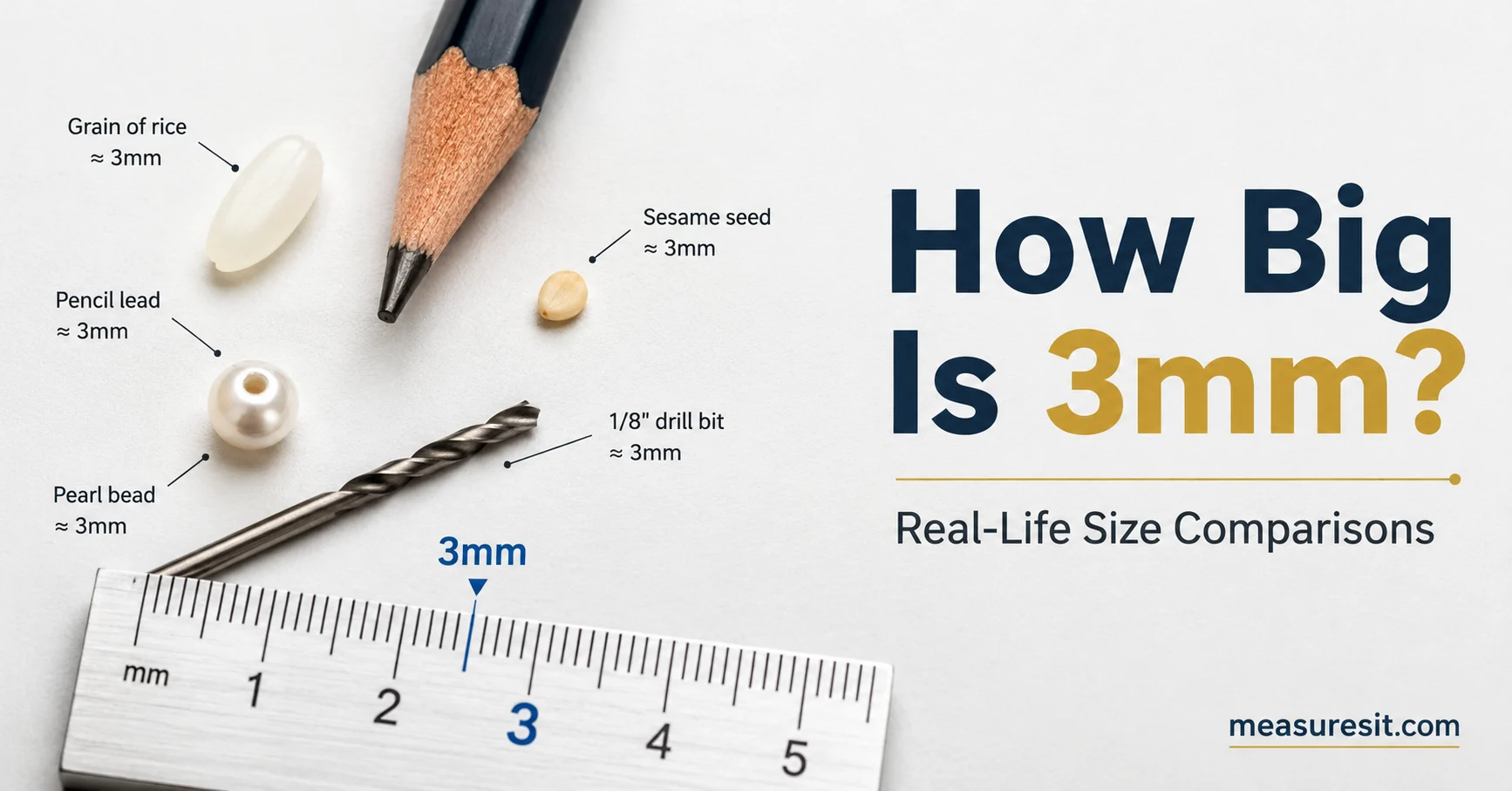
Hold a grain of rice between two fingers. That’s about 3mm roughly 0.118 inches, or just a hair under 1/8 of an inch.
It’s one of those measurements that sounds abstract until you see it next to something you already know, which is exactly the problem when a product listing, a doctor’s report, or a hardware store bin just says 3mm and leaves you guessing.
This size shows up in more places than you’d expect: jewelry and bead sizing, drill bits and wood screws, phone components, and less pleasantly medical scans, where a 3mm finding is a number a lot of people search the moment they leave the doctor’s office.
Below is a conversion chart, fifteen real-world objects at or very close to 3mm, and a few tricks for eyeballing this size without a ruler in hand.
Conversion Chart
| Unit | Value |
| Millimeters (mm) | 3 mm |
| Centimeters (cm) | 0.3 cm |
| Meters (m) | 0.003 m |
| Inches (in) | ≈ 0.118 in |
| Feet (ft) | ≈ 0.0098 ft |
| Nearest fraction | ≈ 1/8 in (very slightly under) |
Objects About 3mm
| Object | Approximate Size |
| Grain of rice | 2–3 mm wide |
| Standard pencil lead | 2–3 mm diameter |
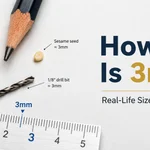
| Sesame seed | 2–3 mm long |
| Ballpoint pen tip | ≈ 3 mm diameter |
| Push pin point | 3–4 mm long |
| 1/8-inch drill bit | 3.175 mm diameter |
| #4 wood screw shaft | ≈ 2.9 mm diameter |
More Everyday References
| Object | Approximate Size |
| 3mm birthstone stud earring | 3 mm gem diameter |
| Small diamond (0.10 carat) | ≈ 3 mm diameter |
| Loose 3mm pearl bead | 3 mm diameter |
| Shoelace aglet | 2–3 mm diameter |
| Matchstick width | ≈ 2–3 mm |
| Smaller ladybug species | 3–4 mm long |
| Average raindrop | 2–3 mm diameter |
What Does 3mm Actually Look Like?
Set a grain of rice on a white countertop and step back a foot. It almost disappears, that’s the scale we’re talking about. 3mm sits just below the diameter of a standard pencil eraser and just above the thickness of a dime standing on its edge. It’s small enough to slip through a kitchen colander’s holes and large enough to see clearly without squinting.
For context, 1mm is closer to the thickness of a single sheet of paper, barely there at all. 5mm, by comparison, starts to feel like a genuine pencil-width object you could pick up between two fingers with confidence. 3mm sits right in between: visible, touchable, but still fine detail work, which is exactly why it shows up so often in jewelry sizing and small hardware.
A few ways to check it without a tape measure:
- Grab a pencil. Most standard graphite cores run 2–3mm across look at the tip head-on.
- Reach for rice. A single grain, measured across its width, lands close to 3mm.
- Check your junk drawer for a 1/8-inch drill bit. At 3.175mm, it’s essentially exact.
- Use a sesame seed from a spice jar or bun as a quick visual gut-check.
- Compared to a dime’s edge. A dime is 1.35mm thick, so two stacked on their sides get you close.
1. A Grain of Rice
Long-grain white rice measures roughly 2 to 3mm at its widest point, which makes it one of the most universally available comparisons; nearly every kitchen has a bag of it somewhere. Its small, tapered shape also happens to mirror a lot of tiny hardware and beads, so it’s a natural stand-in when you’re picturing something like a seed pearl or a miniature screw. Next time a listing says rice-grain sized, you can check it against the real thing in about ten seconds.
2. Standard Pencil Lead
Look closely at the tip of an unsharpened pencil and you’ll see the graphite core, usually 2 to 3mm across depending on the brand and hardness. Because pencils are one of the last things people still measure by feel twisting them, checking the point this comparison tends to stick. It’s especially handy when you’re trying to picture the diameter of a small drill bit or a length of wire before ordering online.
3. A Sesame Seed
A single sesame seed runs about 2 to 3mm long, small enough to balance on a fingertip without much effort. It’s a pantry staple, so this one requires zero shopping to verify. The pale, flattened shape is also a close visual match for craft seed beads, which is useful if a jewelry pattern calls for a size you can’t quite picture.
4. A Ballpoint Pen Tip
The small metal cone at the end of a standard ballpoint pen, where the ink ball sits, measures close to 3mm across at its widest point. Almost everyone has one within reach right now. Because it’s rounded rather than flat, it gives a better sense of how 3mm reads on a three-dimensional object useful when you’re estimating the width of a small cap, bead, or connector pin rather than a flat sheet.
5. A Push Pin’s Point
The metal point on a typical plastic-headed push pin extends about 3 to 4mm past the base. Anyone who’s tacked up a corkboard has handled one. That length isn’t arbitrary; it’s roughly what’s needed to hold paper against cork without punching all the way through, which makes it a genuinely functional reference for how deep a small fastener needs to sit.
6. A 1/8-Inch Drill Bit
If you want precision rather than an estimate, this is it: a 1/8-inch drill bit measures 3.175mm, making it the closest exact match on this list. Anyone who’s done basic home repairs or built flat-pack furniture has likely used one. Keep a spare in a toolbox specifically as a pocket-sized reference; it’s more reliable than eyeballing a ruler.
7. A #4 Wood Screw’s Shaft
Ignoring the threads, the bare shaft of a common #4 wood screw measures about 2.9mm just a shade under 3mm. Screw gauge numbers are notoriously confusing without something physical to compare them to, so matching a loose screw from your toolbox against a known 3mm object can save you a second trip to the hardware store.
8. A 3mm Birthstone Stud
Jewelers commonly sell birthstone studs by gemstone diameter, and 3mm is one of the standard sizes for a subtle, everyday earring. If you’ve ever shopped for a small gift and seen 3mm listed next to a gemstone, this is what it’s referring to: small enough to look understated, large enough to catch light. It’s a useful benchmark specifically because the size-to-appearance relationship in jewelry is hard to picture from a number alone.
9. A Small Diamond (0.10 Carat)
A round diamond weighing about 0.10 carat typically measures close to 3mm across. Jewelers lean on this size-to-carat relationship constantly, since carat weight alone tells a shopper very little about how a stone will actually look once it’s set. If a listing gives you a millimeter measurement instead of or alongside a carat weight, this is roughly what you’re picturing.
10. A Loose 3mm Pearl Bead
Craft and jewelry suppliers sell loose freshwater pearls by millimeter size, and 3mm is one of the smallest common options, often used for delicate, minimalist pieces. Bead shops typically display size charts right on the packaging, so this is one of the few objects on this list where 3mm is the literal, printed spec rather than an estimate.
11. A Shoelace Aglet
The plastic or metal tip capping the end of a shoelace, the part that keeps it from fraying, usually runs about 2 to 3mm in diameter. It’s an object everyone owns but almost never thinks about closely. Pinch one between your fingers and you’ve got a genuinely accurate 3mm reference without buying or borrowing anything.
12. A Matchstick’s Width
A standard wooden matchstick measures roughly 2 to 3mm across, not counting the sulfur tip. Most people have a box tucked in a kitchen drawer for candles or a grill. Because matchsticks are rigid and easy to hold still, they’re a nice, low-fuss way to compare thickness against something like a phone screen protector or a thin piece of wood trim.
13. A Smaller Ladybug
Full-grown common ladybugs usually run 5 to 8mm, but several smaller species and young ladybugs before they finish growing measure closer to 3 to 4mm. Gardeners tend to develop a sharp instinct for this scale simply from spotting them on leaves. It’s a slightly looser comparison than most on this list, but a genuinely memorable one if you’ve ever watched one crawl across your hand.
14. An Average Raindrop
Raindrops from light-to-moderate rain typically measure around 2 to 3mm in diameter before they hit the ground; heavier drops flatten and widen as they fall, but the smaller, more common ones stay close to this size. It’s a comparison you don’t need any object for at all, just a rainy afternoon and a window.
15. A 3mm Kidney Stone
This is the one a lot of readers are actually looking for. Kidney stones are frequently measured and reported in millimeters on imaging scans, and 3mm sits toward the smaller end stones around this size are generally more likely to pass on their own compared to larger ones, though that depends heavily on the individual and where the stone is located. This is general background information, not a substitute for guidance from a doctor or urologist, who can speak to your specific scan and situation.
FAQ
Is 3mm bigger than 1/8 inch?
Almost identical, but technically slightly smaller. An eighth of an inch equals 3.175mm, so 3mm falls just under that mark close enough that most people treat them as interchangeable.
What’s an easy way to picture 3mm without a ruler?
A grain of rice or a standard pencil’s graphite tip are two of the most reliable, since both are common household items that consistently measure in the 2–3mm range.
Is 3mm the same as 0.3cm?
Yes since there are 10mm in a centimeter, 3mm converts exactly to 0.3cm with no rounding involved.
Is a 3mm kidney stone considered small or large?
It’s generally considered on the smaller side. Stone size is one factor doctors weigh alongside location and symptoms, so this shouldn’t replace advice from a medical professional reviewing your actual scan.
Final Thoughts
So, how big is 3mm? Picture a grain of rice, the graphite tip of a pencil, or a 1/8-inch drill bit all genuinely close matches, no math or stacking required.
It’s a size that’s easy to underestimate on a screen but instantly recognizable once you’re holding something the right scale in your hand.
If you’re sizing a screw for a repair, picking out a birthstone stud, or trying to make sense of a number on a medical scan, these references are meant to do one thing: turn an abstract measurement into something you can actually picture. Keep a spare drill bit or a loose grain of rice nearby, and you’ll never have to guess at 3mm again.
Read More!
- How Big Is 8mm? A Simple Size Chart & Comparisons
- How Big Is 7mm? Real-Life Size Comparisons & Chart
- How Big Is 10mm? A Real-World Size Guide

Hi, I’m Vera Lindqvist, a content writer at MeasuresIt.com, where I turn measurement standards, unit conversions, and precision tools into clear, practical guides. I care about getting the details right so you don’t have to second-guess them.


3 thoughts on “How Big Is 3mm? Real-Life Comparisons & Conversions”