You’re eyeing a side table on a European furniture site, or a recipe from a UK baking blog calls for a 50 cm cake tin, and your tape measure only shows inches.
50 cm converts to 19.69 inches, call it 19¾ inches if you’re rounding by eye. That’s about a foot and eight inches, or a little short of 20 inches flat.
It’s a conversion that comes up more than people expect: checking If an imported item clears a doorway, matching a metric sewing pattern, or converting a European pan size before you preheat the oven. The number itself takes two seconds to look up.
Picturing what 50 cm or 19.7 inches actually looks like in front of you is the part that usually takes a bit more work, which is what the rest of this guide is built to solve.
Conversion Chart
Here’s how 50 cm breaks down across the units you’re most likely to need:
| Unit | Converted Value |
| Inches | ≈ 19.69 in |
| Feet | ≈ 1.64 ft |
| Yards | ≈ 0.55 yd |
| Millimeters | 500 mm |
| Centimeters | 50 cm |
| Meters | 0.5 m |
Worth noting: 50 cm is exactly half a meter, which is often the easiest way to hold the number in your head. If you already know a meter is a little longer than a yard, half of that gets you very close to 50 cm without any math at all.
Why the Metric and Imperial Systems Both Still Matter
Most of the world measures length in centimeters and meters, while the United States, and a few other countries, still rely on inches and feet for everyday use. That split is exactly why conversions like this one get searched so often a product spec, a recipe, or a pattern written for one system needs translating before it’s actually useful to you.
It’s also where small mix-ups happen. Centimeters and millimeters look similar on paper, but they’re a factor of ten apart, so mistaking one for the other can throw off a measurement badly. When in doubt, checking If a spec sheet says cm or mm is worth the extra second.
A Visual Way to See 50 cm
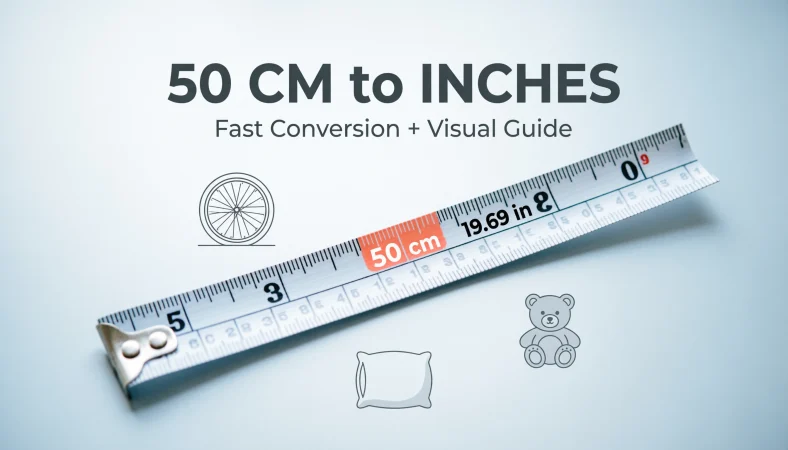
Numbers on a page don’t always translate into a feel for real space. The ruler below marks 50 cm against a 0–60 cm scale, with a few everyday objects sized in for context.
Common Objects That Are About 50 cm
Objects rarely land on a round number exactly, so the list below spans roughly 45 to 51 cm close enough to build an accurate mental picture, while staying honest about the small variation between real-world items.
| Object | Approximate Length |
| Average newborn baby | ≈ 50 cm |
| 20-inch bicycle wheel (diameter) | ≈ 50.8 cm |
| 20-inch TV or monitor (diagonal) | ≈ 50.8 cm |
| Dreadnought guitar body | ≈ 50 cm |
| Large gift-shop teddy bear | ≈ 50 cm |
| Large plastic cutting board | ≈ 50 cm |
| Domestic cat, nose to tail base | ≈ 46 cm |
| 18-inch collectible doll | ≈ 46 cm |
More Everyday Items Close to 50 cm
| Object | Approximate Length |
| French-style rolling pin | ≈ 50 cm |
| 18-inch pizza box (per side) | ≈ 46 cm |
| Queen-size pillow (width) | ≈ 50 cm |
| Average adult forearm (wrist to elbow) | ≈ 45–46 cm |
| Full-size computer keyboard (width) | ≈ 45 cm |
| Basketball hoop rim (diameter) | ≈ 45.7 cm |
| 15-inch laptop backpack (height) | ≈ 45–50 cm |
How Long Is 50 cm, Really?
Think of a large teddy bear propped up on a shelf, or a newborn baby laid flat on a hospital scale both land close to 50 cm. It’s noticeably longer than a standard 12-inch ruler (30 cm), but shorter than a full yardstick, which runs about 91 cm.
Lay a foot-long ruler down and add roughly seven more inches, and you’ve landed almost exactly on 50 cm. It occupies that in-between zone: too long for a jacket pocket, but easy enough to carry under one arm.
Quick ways to estimate 50 cm without a tape measure:
- Use your forearm: Elbow to fingertips runs close to 45–50 cm for most adults, making it a surprisingly reliable built-in ruler.
- Picture a bike wheel: A 20-inch kids’ bike wheel measures almost exactly 50 cm across.
- Think in screen sizes: A 20-inch monitor, measured corner to corner, sits right around 50 cm.
- Grab a pillow: The short edge of a queen-size pillow is about 50 cm.
- Compare to a yardstick: 50 cm is a bit more than half of a full yardstick.
- Stack two rulers loosely: One 12-inch ruler plus about 7–8 extra inches gets you close.
1. Average Newborn Baby Length
Public health growth data, including figures published by the CDC and the World Health Organization, puts the average length of a full-term newborn close to 50 cm, or about 19.7 inches. It’s one of the more dependable comparisons on this list because it comes from tracked population data rather than a rough visual guess.
Most adults have held or watched a newborn get measured at some point, which makes this an easy mental anchor. Picture a baby stretched out head to toe on a changing table, and you’re close to the true length of 50 cm.
2. A 20-Inch Bicycle Wheel
Bicycle wheels are sized by diameter, so a 20-inch kids’ bike wheel measures about 50.8 cm across a standard used consistently across bike manufacturers. That consistency is what makes it such a reliable visual reference.
Almost everyone has ridden or pushed a bike with this wheel size as a kid. Next time you pass one leaning against a fence, you’re looking at something within a couple of millimeters of 50 cm.
3. A 20-Inch TV or Computer Monitor
Screen sizes are always measured diagonally, so a 20-inch monitor or small television has a corner-to-corner measurement of roughly 50.8 cm. Because the size is printed right on the box, this comparison carries almost no guesswork.
Older desktop monitors and compact kitchen TVs commonly used this size. If you’ve ever set one up on a desk, you already have a physical sense of that 50 cm diagonal without realizing it.
4. A Dreadnought Acoustic Guitar Body
The dreadnought is the most widely used acoustic guitar body shape, and the body alone, not counting the neck, runs close to 50 cm long. It’s a shape most people recognize instantly, If or not they play music.
Because the dreadnought shape is fairly standardized across brands, it holds up well as a length reference. The next time you see one on stage or in a shop window, its rounded outline is a decent stand-in for 50 cm.
5. A Large Gift-Shop Teddy Bear
Stuffed bears sold in the large size at carnivals and gift shops typically run about 20 inches, or 50 cm, from head to foot. That size hits a sweet spot: substantial enough to feel like a real prize, without being awkward to carry home.
Plenty of people have owned or won a bear this size at some point. Holding one at arm’s length, usually reaching from about waist to chest height on a child, offers a quick, memorable size cue.
6. A Large Plastic Cutting Board
Cutting boards labeled large or family size often measure close to 50 cm long, giving enough surface to break down a whole chicken or slice a full loaf without crowding the edges. Kitchen tools like this make good references simply because they get handled so often.
Anyone who cooks regularly has a rough feel for how much counter space a board this size takes up. It’s a practical stand-in when you’re eyeballing if something new will fit in a drawer.
7. A Domestic Cat’s Body Length
Veterinary and pet-care references commonly cite the average house cat’s body length, nose to the base of the tail, at around 46 cm, not counting the tail. Individual cats vary quite a bit by breed and build, so this figure works better as a ballpark than an exact rule.
Cat owners tend to have a strong physical sense of their pet’s size from years of picking them up. It’s a friendly, familiar way to picture something just a few centimeters under 50 cm.
8. An 18-Inch Collectible Doll
Well-known 18-inch doll lines, popular with collectors and kids alike, stand about 46 cm tall. That height became something of an industry standard partly because it’s a manageable size for small hands to dress and carry.
If you’ve shopped for children’s toys, you’ve likely seen dolls this size on a shelf. That height sits just a handful of centimeters short of the full 50 cm mark.
9. A French-Style Rolling Pin
The long, thin French-style rolling pin, sold without handles, typically measures close to 50 cm end to end. Bakers favor the extra length because it makes rolling out a full sheet of dough in one pass much easier.
Even people who don’t bake often have spotted this style in a kitchen drawer or on a cooking show. Laying one flat on a counter is a quick, tactile way to get a feel for 50 cm.
10. An 18-Inch Pizza Box
Boxes built for large, 18-inch pizzas measure about 46 cm on each side, since the box has to sit slightly larger than the pizza itself. Pizzerias tend to stick to a handful of standard box sizes, which keeps this measurement fairly consistent from shop to shop.
Nearly everyone has carried a pizza box home at some point. That flat, square shape balanced on one hand is an easy, food-related way to remember roughly how far 50 cm stretches.
11. A Queen-Size Pillow’s Width
Standard queen-size bed pillows measure about 20 by 30 inches, which puts the shorter side right around 50 cm. Because bedding sizes in the US are fairly standardized, this comparison holds up well across brands.
Most people have fluffed, carried, or shopped for pillows without giving it much thought. The short edge of a queen pillowcase is a fast, no-tools-needed reference for 50 cm.
12. The Average Adult Forearm
Anthropometric design references, the kind ergonomists use to size furniture and tools, put the average adult forearm length, from wrist to elbow, at somewhere around 45 to 46 cm. It varies by height and build, but it’s close enough to be genuinely useful.
Because it’s part of your own body, this reference is always on hand, literally. Extending your forearm flat against an object is a fast way to sanity-check a measurement without hunting for a tape.
13. A Full-Size Computer Keyboard
A standard full-size desktop keyboard, the kind with a number pad on the right, measures roughly 45 cm across. Office workers and gamers using full-size boards interact with this measurement daily, even if they’ve never thought about it in centimeters.
It’s an easy check for anyone sitting at a desk right now. Glancing at the keyboard in front of you gives a fast, rough sense of just under 50 cm.
14. A Basketball Hoop’s Rim
A regulation basketball hoop has an inner rim diameter of 18 inches, or about 45.7 cm, a spec that holds true from school gyms to the NBA. That consistency makes it a dependable, widely recognizable reference.
You don’t need to play basketball to have seen a hoop up close. Picturing that rim from directly above gives a solid visual for a length just a touch under 50 cm.
15. A 15-Inch Laptop Backpack
Backpacks built to fit a 15-inch laptop typically run 45 to 50 cm tall, with room left over for books, a charger, and a water bottle. Sizing varies more here than with the other items on this list, since it’s set by individual brands rather than an industry standard.
Students and commuters handle bags like this daily, usually without ever checking the exact dimensions. Slinging one over a shoulder is a familiar, low-effort way to gauge something in the neighborhood of 50 cm.
Common Questions About 50 cm
Is 50 cm bigger than a foot?
Yes. A foot is 30.48 cm, so 50 cm is about 19.5 cm longer, or nearly a foot and eight inches.
What household item is closest to 50 cm?
A large cutting board and the short edge of a queen-size pillow are both close, everyday matches for 50 cm.
Is 50 cm the same as 20 inches?
Not quite. 50 cm equals about 19.69 inches, which only rounds up to 20 inches as a loose, quick estimate.
How many centimeters are in a yard?
A yard is about 91.44 cm, so 50 cm covers a little more than half a yard.
Why do cm and mm get confused so often?
Because they look similar written down, but a centimeter is ten times longer than a millimeter. Double-checking the unit on a spec sheet avoids a measurement that’s off by a factor of ten.
Final Thoughts
So, what is 50 cm in inches? It comes out to 19.69 inches, or about 1.64 feet, just shy of a foot and two-thirds. The math itself takes seconds.
Actually, picturing that length enough to check a doorway, a pattern, or a pan size before you commit to a purchase or a recipe is what makes the number genuinely useful.
If you’re checking if imported furniture will clear a hallway, convert a European baking pan, or cut fabric against a metric pattern, having a real mental image of 50 cm saves you a second trip back to the tape measure.
A large teddy bear, a 20-inch bike wheel, and the width of a queen-size pillow all sit right around this length, so next time you need a fast estimate, one of them is probably already within reach.
Read Other Posts!
How Big Is 40cm? 15 Everyday Objects That Show You Instantly
How Big Is 5 cm? Easy Size Comparisons & Chart
How Big Is 8 cm? 15 Easy Everyday Comparisons

Hi, I’m Vera Lindqvist, a content writer at MeasuresIt.com, where I turn measurement standards, unit conversions, and precision tools into clear, practical guides. I care about getting the details right so you don’t have to second-guess them.







3 thoughts on “What Is 50 cm in Inches? Fast Answer”