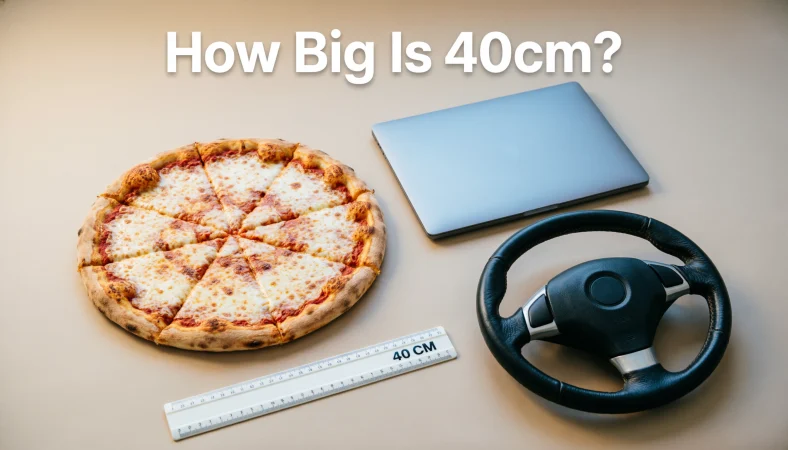
Hold a large pizza box flat in front of you, or picture the diagonal of a 15-inch laptop screen that’s almost exactly the size we’re talking about.
40cm works out to about 15.75 inches, or roughly 1.31 feet. It’s a length that shows up constantly in daily life without most people ever putting a number on it: a sheet of poster paper, a car steering wheel, a cutting board big enough to carve a turkey on.
This guide gives you the exact conversions first, then walks through everyday objects that sit right around 40cm, so the next time a listing says 40cm or a recipe calls for a 40cm pan, you’ll know instantly what you’re dealing with no tape measure required.
Conversion Chart
| Unit | Converted Value |
| Millimeters (mm) | 400 mm |
| Centimeters (cm) | 40 cm |
| Meters (m) | 0.4 m |
| Inches (in) | ≈ 15.75 in |
| Feet (ft) | ≈ 1.31 ft |
| Yards (yd) | ≈ 0.44 yd |
Common Objects That Are About 40cm
| Item | Approximate Length |
| Large 16-inch pizza | ≈ 40 cm diameter |
| A2 paper | 42 cm (short side) |
| 15.6-inch laptop screen | ≈ 40 cm diagonal |
| Car steering wheel | ≈ 38–40 cm diameter |
| Two standard bricks (end to end) | ≈ 38–40 cm |
| Large kitchen cutting board | ≈ 40 cm |
| Bowling pin | ≈ 38 cm tall |
| Small-to-average house cat (nose to tail base) | ≈ 40–46 cm |
More Everyday Items Around 40cm
| Item | Approximate Length |
| Dreadnought acoustic guitar (lower bout width) | ≈ 40 cm |
| 16-inch drafting ruler | 40 cm |
| Adult forearm (elbow to fingertips, rough estimate) | ≈ 40–46 cm |
| Compact microwave (width) | ≈ 40–45 cm |
| Tenkeyless keyboard (width) | ≈ 36–40 cm |
| Large serving platter (diameter) | ≈ 40 cm |
| School backpack (height) | ≈ 40–45 cm |
Getting a Feel for 40 Centimeters
Forty centimeters sits in an oddly useful middle ground. It’s noticeably bigger than a sheet of standard printer paper, but it won’t overwhelm a shelf, a drawer, or the trunk of a small car. Think of it as medium-large the size where an object stops being something you tuck into a bag and starts being something you carry with two hands.
For comparison, 30cm is about the length of a school ruler, and 50cm starts to approach the width of a small suitcase standing on end. 40cm falls neatly between the two: long enough to matter when you’re planning storage, short enough to still fit comfortably in most everyday spaces.
Once that mental anchor is in place, spotting 40cm in the wild gets easy. A few reliable shortcuts:
- Picture a large pizza. Most large pizzas run close to 40cm across, box included.
- Picture a laptop screen. A 15.6-inch screen, measured diagonally, lands almost exactly on 40cm.
- Picture a sheet of A2 paper. Its short edge is 42cm just a hair over.
- Use two bricks. Laid end to end, a pair of standard bricks gets you close to 40cm.
- Use a steering wheel. Most car steering wheels measure somewhere around 38 to 40cm across.
- Use your forearm as a rough guide. For many adults, elbow to fingertips lands somewhere in the 40cm neighborhood, not precise, but good enough for a quick gut-check.
1. A Large 16-Inch Pizza
A large pizza from most pizzerias runs about 16 inches across, which converts to roughly 40cm in diameter. Pizza sizing is fairly consistent across chains and independent shops alike, so this is one of the more dependable comparisons on the list. Most people have a mental picture of large pizza already loaded and ready to go. It comes in handy when you’re eyeing a box, a tray, or a shelf and trying to judge if something 40cm wide is actually going to fit.
2. A Sheet of A2 Paper
A2 paper is part of the international ISO 216 paper standard, measuring 42cm on its shorter edge. Because the ISO system defines these dimensions precisely rather than approximately, this comparison is one of the most exact on the list. Anyone who’s worked with posters, architectural prints, or large-format printing has likely handled a sheet. It’s a useful gauge when you’re framing artwork or checking If a printed piece will fit a given space.
3. A 15.6-Inch Laptop Screen
This is the most common laptop screen size sold today, and measured diagonally from corner to corner, it lands almost exactly at 40cm. Screen sizes are always advertised to a precise spec, which makes this a reliable benchmark rather than a rough guess. Most people either own a laptop this size or have used one recently. It’s especially handy when shopping for a laptop sleeve or bag and trying to estimate what size opening you actually need.
4. A Car Steering Wheel
Most passenger car steering wheels measure somewhere between 38 and 40cm across, depending on the make and model. The range stays fairly tight across everyday vehicles, so it works well as a mental benchmark even if you can’t picture the exact number. Since nearly everyone who drives has their hands on one regularly, the size is already familiar without needing to think about it. This comparison is useful for judging round objects: a wreath, a serving tray, a wall clock against.
5. Two Standard Bricks, End to End
A common U.S. modular brick measures about 19.4cm long, so two placed end to end, with a typical mortar joint, land right around 40cm a dimension confirmed in the Brick Industry Association’s technical guidance. Because brick dimensions are standardized for construction, this comparison holds up regardless of which brick you’re picturing. Almost everyone has seen a brick wall up close, which makes the size intuitive. It’s a handy trick outdoors, particularly for rough garden or patio measurements when a tape measure isn’t within reach.
6. A Large Kitchen Cutting Board
A large wooden or plastic cutting board the kind you’d use to carve a roast or prep vegetables for a big dinner typically runs close to 40cm in length. Boards in this size range are widely sold, so the comparison holds across brands and price points. Because they tend to sit out on the counter or hang in plain view, their size tends to stick in memory better than most kitchen tools. It’s a solid mental yardstick when you’re rearranging drawers or figuring out counter space.
7. A Bowling Pin
A regulation bowling pin stands about 38cm tall, just shy of 40cm. Pin dimensions are standardized for competitive play, so the figure holds steady no matter which alley you’re at. Even people who haven’t bowled in years tend to have a clear image of a pin’s shape and height. Picture one next to an object when you need a fast visual check for anything nearing 40cm tall.
8. A Small-to-Average House Cat
Most pet-care references put the average domestic cat’s body length nose to the base of the tail, not including the tail itself somewhere around 45 to 46cm, with plenty of individual and breed variation on either side. Smaller cats and younger adults often land closer to 40cm. It’s not a perfectly clean match, but for anyone picturing a typical house cat stretched out, the comparison lands close enough to be genuinely useful. It’s worth keeping in mind when sizing a cat carrier, bed, or crate and checking If the interior offers enough stretch-out room.
9. A Dreadnought Acoustic Guitar
The dreadnought is the most common acoustic guitar body shape, and its widest point called the lower bout measures close to 40cm across. This width stays fairly consistent across brands that build in the dreadnought style. The classic guitar silhouette is recognizable even to people who’ve never picked one up. This comparison is genuinely practical when shopping for a case or wall mount and needing to judge clearance.
10. A 16-Inch Drafting Ruler
Some drafting and architectural rulers are manufactured at exactly 40cm, or 16 inches, instead of the more familiar 30cm classroom ruler. Because these are made to a fixed length, there’s no rounding involved here it’s as close to an exact match as this list gets. Anyone who’s taken a drafting, art, or engineering class has likely used one. It’s the most precise way to picture 40cm on this entire list.
11. Your Own Forearm
For a lot of adults, the distance from the elbow to the tips of the fingers falls somewhere in the general neighborhood of 40 to 46cm, though this varies quite a bit by height and body proportions. This one isn’t a precise measurement, think of it as a body-based shortcut rather than a hard fact. Its real value is convenience: your arm is always with you, so it’s the fastest possible way to eyeball a length on the spot. Holding your forearm against a shelf or box gives a quick sense of If something is in the ballpark of 40cm.
12. A Compact Microwave
Compact and countertop microwaves commonly measure somewhere between 40 and 45cm in width, making them a familiar kitchen-sized reference point. Manufacturers tend to cluster around similar dimensions for small kitchens and dorm rooms, so the range stays fairly consistent across brands. Most people have owned or used a microwave in this size class at some point. It’s a practical comparison when planning cabinet or counter space during a kitchen renovation.
13. A Tenkeyless Keyboard
A tenkeyless keyboard one that skips the number pad found on full-size boards typically measures between 36 and 40cm wide. These compact keyboards have grown more popular as people look to reclaim desk space. Anyone who’s shopped for a smaller keyboard has likely run into this size range. It’s a useful comparison when figuring out exactly how much desk real estate a compact setup will actually take.
14. A Large Serving Platter
A large oval or round serving platter the kind that comes out for holidays or big family dinners often measures close to 40cm across. Platters in this size range are widely available in kitchenware stores, so the comparison applies broadly rather than to one specific brand. Because these platters tend to show up at gatherings, many people already associate the size with big enough for the whole dish. It’s a handy reference when checking If cabinet shelves can accommodate larger serving pieces.
15. A School Backpack
A standard school or daypack backpack typically stands somewhere between 40 and 45cm tall once it’s packed. Sizing varies by brand, but most everyday backpacks cluster in this range. Since backpacks get used daily by students and commuters, their size is easy to picture without much effort. This comparison is genuinely useful when checking If a bag will fit under an airline seat or into a locker.
FAQ
Is 40cm bigger than a standard sheet of paper?
Yes, noticeably. A4 paper measures 29.7cm on its long side, so 40cm is meaningfully longer closer to the short side of A2 paper instead.
What household item is closest to 40cm?
A 15.6-inch laptop screen, measured diagonally, and a 16-inch drafting ruler are two of the closest matches, since both are manufactured to a precise spec near that size.
Is 40cm the same as 16 inches?
Almost, but not quite. 40cm converts to about 15.75 inches, just under 16 inches.
How many 40cm lengths make a meter?
Two and a half. A meter is 100cm, so 40cm fits into it two and a half times.
Final Thoughts
How big is 40cm? Once you connect it to a handful of familiar objects: a large pizza, a laptop screen, a steering wheel, a couple of bricks laid end to end it stops being an abstract number and becomes something you can picture instantly. That’s really the whole point of comparisons like these: they turn a measurement on a label into something your hands and eyes already understand.
The next time you’re shopping online, packing a bag, or trying to figure out if something will actually fit on a shelf, you don’t need to reach for a tape measure first.
Picture the pizza, the laptop screen, or the steering wheel, and you’ll already be in the right range accurate enough for nearly anything you’re likely to be measuring for.
Discover More!
What Is 50 cm in Inches? Fast Answer
How Big Is 8 cm? 15 Easy Everyday Comparisons
How Big Is 5 cm? Easy Size Comparisons & Chart

I’m Elena Cross, a content writer at MeasuresIt.com, where I turn complex measures, units, and mathematical concepts into clear, accurate, and easy-to-read articles. I’m passionate about precision in numbers and in words and I write to help readers actually understand measurements, not just memorize them.






2 thoughts on “How Big Is 40cm? 15 Everyday Objects That Show You Instantly”