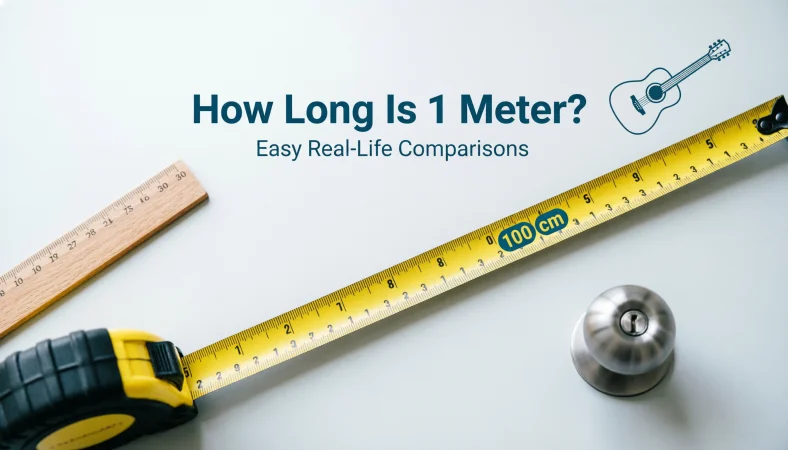
Try to picture a meter without a tape measure, and most people freeze for a second. It’s not an inch, obviously too small, and it’s not quite a yard either, close but not exact.
A meter is about 3.28 feet, or 39.37 inches, and one of the easiest ways to picture it is the width of a standard twin bed.
That gap between I know the number and I can picture it is where this guide comes in. Once you’ve got 1 meter locked into your head using a few familiar objects, you’ll find yourself using it constantly: reading furniture dimensions on an overseas retailer’s site, checking If a rug will actually fit your hallway, sizing up a piece of luggage before a flight, or following a recipe or knitting pattern written in metric. None of that requires math once the length is in your muscle memory.
Conversion Chart
| Unit | Converted Value |
| Millimeters | 1,000 mm |
| Centimeters | 100 cm |
| Meters | 1 m |
| Inches | ≈ 39.37 in |
| Feet | ≈ 3.28 ft |
| Yards | ≈ 1.09 yd |
| Miles | ≈ 0.00062 mi |
Common Objects That Are About 1 Meter
These eight are the ones I’d point to first, mostly because they’re either already in your house or you’ve stood next to one within the last week.
| Object | Approximate Length |
| Yardstick | 0.91 m |
| Twin bed width | 0.99 m |
| Full-size acoustic guitar | ≈ 1.02 m |
| Average height of a 3-year-old child | ≈ 0.95 m |
| Golf driver club | ≈ 1.13 m |
| 40-inch TV (measured diagonally) | 1.02 m |
| Kitchen countertop height | ≈ 0.91 m |
| Doorknob height from the floor | ≈ 0.97 m |
More Everyday Items Around 1 Meter
These seven fill in the gaps, and two of them are included on purpose because they sit just outside a true meter, which turns out to be genuinely useful. More on that below.
| Object | Approximate Length |
| Refrigerator width | ≈ 0.90 m |
| Front-loading washing machine height | ≈ 0.85 m |
| Broomstick or mop handle | ≈ 1.20 m |
| Dining chair height | ≈ 0.91 m |
| Baseball bat | ≈ 0.86 m |
| Bar-height café table | ≈ 1.07 m |
| Shopping cart handle height | ≈ 0.95–1.00 m |
How Long Is 1 Meter, Really?
Here’s a trick worth knowing: you don’t need one object that’s exactly a meter. You need two that bracket it. A baseball bat, at 0.86 meters, is clearly shorter. A broomstick, at 1.20 meters, is clearly longer. Hold both of those in mind, and a meter is the length sitting somewhere between them, closer to the bat than the broom.
That’s really all a meter is in practical terms: taller than a kitchen bar stool, shorter than a golf club, right around the height most builders set a bathroom counter or a doorknob. It’s a proportion the human body already understands, because so much of what surrounds us, countertops, door hardware, furniture, gets built around comfortable reach and grip height, which tends to land right around a meter.
Ways to estimate 1 meter without a tape measure:
- Check a doorknob. Most residential doorknobs sit close to a meter off the floor, based on typical building hardware guidelines, so a quick glance gives you an instant reference.
- Use a twin bed’s width. At 0.99 meters, it’s about as close to exact as household objects get.
- Lean on the counter. Standard kitchen counters run close to meter height, and you’ve probably rested a hip against one today.
- Bracket it. Picture a baseball bat (a bit short) and a broomstick (a bit long), and split the difference.
- Use your arm span. For most adults, one extended arm from chest to fingertips covers close to half a meter.
- Picture a guitar. A full-size acoustic guitar, end to end, is one of the more precise everyday matches out there.
1. Yardstick
A yardstick measures 0.91 meters, just shy of a full meter, and it’s the obvious starting point since it’s a measuring tool by design rather than a rough approximation.
Because it’s manufactured to a fixed standard, its length doesn’t drift the way estimates from furniture or appliances sometimes can. That reliability is exactly what makes it worth trusting when you need a fast, repeatable reference.
Hold one up against a wall, add roughly three inches, and you’ve marked off a meter with reasonable accuracy.
2. Twin Bed Width
At 0.99 meters, a standard twin bed frame is about as close to a true meter as ordinary furniture gets.
Bed sizing follows industry-wide standards, so this measurement holds up If you’re looking at a mattress from a big-box store or a boutique brand. That consistency is what earns it a spot near the top of this list.
If a listing gives room dimensions in meters, picturing a twin bed’s width is often the fastest gut check you can do.
3. Full-Size Acoustic Guitar
A full-size acoustic guitar runs about 1.02 meters from the top of the headstock to the base of the body.
It’s a shape almost everyone recognizes instantly, If not they’ve ever picked one up, and its long, simple silhouette makes the length easy to read at a glance rather than something you have to calculate.
When you’re eyeing wall space for a shelf or gauging If a piece of furniture will clear a hallway, about one guitar’s length is a quick and surprisingly accurate stand-in.
4. Average Height of a 3-Year-Old Child
According to CDC growth chart data, the average height for a 3-year-old lands around 0.95 meters.
Most adults have spent real time around a child that age, If their own, a niece or nephew, or a friend’s kid, which makes the comparison land intuitively rather than abstractly. It’s the rare reference point that people can picture from memory rather than guesswork.
Parents shopping for a car seat, bunk bed, or clothing sized for that age range often find this the single most useful comparison on the list.
5. Golf Driver Club
A standard golf driver measures around 1.13 meters, noticeably past a true meter.
Golfers develop a physical sense of this length just from swinging one regularly, and even non-golfers usually have a rough visual sense of how long a driver is. That semi-familiarity is enough to make it useful as an over a meter marker.
It’s a good comparison when you’re trying to judge If something, a fishing rod, a piece of molding, a curtain rod, runs noticeably longer than a meter.
6. 40-Inch TV Screen
Measured diagonally, a 40-inch television comes out to almost exactly 1.02 meters, one of the tightest matches on this entire list.
TV sizes are advertised by that diagonal figure everywhere you shop, so it’s a number most people already have some intuitive feel for without needing conversion help.
Anyone measuring a media console or wall mount can lean on this comparison directly, since the screen size itself is doing double duty as the reference.
7. Kitchen Countertop Height
Standard kitchen counters sit close to 0.91 meters off the floor, a figure that follows common U.S. residential building guidelines for comfortable working height.
Because kitchen design leans heavily on these standards, the height barely varies from one home to the next, which is what makes it such a dependable everyday marker.
Next time you’re cooking, notice where the counter edge hits your hip. That’s roughly what a meter feels like in real space, not just on paper.
8. Doorknob Height From the Floor
Doorknobs are typically mounted around 0.97 meters up, in line with widely used residential hardware guidelines, including ADA-referenced accessibility standards.
You pass a dozen doorknobs a day without a second thought, which makes this one of the few reference points that’s genuinely always within reach, sometimes literally.
It’s especially handy for judging shelf height or light switch placement relative to a meter without pulling out a tool.
9. Refrigerator Width
Full-size refrigerators typically measure close to 0.90 meters wide, a figure that’s stayed fairly steady across major appliance brands for decades.
Kitchens are designed around fitting standard-size appliances, so this width has effectively become a fixed point in most home layouts rather than a rough guess.
If you’re planning a kitchen remodel, comparing a proposed gap to about one fridge’s width is a fast way to sanity-check the numbers before cabinets get ordered.
10. Front-Loading Washing Machine Height
A front-loading washing machine generally stands close to 0.85 meters tall, just under a full meter.
Laundry appliances are built to standardized dimensions so they fit under counters and into tight utility spaces, which keeps this figure consistent no matter the brand.
This one’s useful for measuring laundry room or garage space when you need a rough sense of what a meter of height actually takes up.
11. Broomstick or Mop Handle
A typical broomstick or mop handle runs about 1.20 meters, clearly past a true meter and one of the two bracket items mentioned earlier.
It’s an object nearly every home has tucked in a closet somewhere, so it requires no explanation or photo to picture accurately.
Grabbing a broom and marking a meter along the handle with your thumb is a genuinely fast, tool-free way to visualize the length before starting a project.
12. Dining Chair Height
A standard dining chair measures roughly 0.91 meters from floor to the top of the backrest, putting it right in line with a true meter.
Chair height follows fairly tight furniture-industry norms so seating pairs properly with standard tables, which is why this figure barely shifts between manufacturers.
If you’re arranging a dining space or checking If new chairs will clear a table edge, this comparison gives you a dependable reference without measuring a thing.
13. Baseball Bat
A standard adult baseball bat measures around 0.86 meters, the shorter half of the bracket described earlier.
Even people who’ve never played the sport tend to recognize a bat’s general size from movies, media, or casual games, which makes it an accessible shorthand for just under a meter.
Pair it mentally with the broomstick, and you’ve got a simple upper and lower bound to work from whenever you’re estimating on the fly.
14. Bar-Height Café Table
A bar-height café or pub table typically stands close to 1.07 meters, a common target height in commercial and residential furniture design alike.
This height shows up often enough, in coffee shops, kitchen islands, home bars, that most people have leaned an elbow on one without registering the exact measurement.
It’s a useful marker for anyone shopping for stools or counter-height furniture and trying to judge proportions before buying.
15. Shopping Cart Handle Height
The push-bar handle on a standard shopping cart sits close to 0.95 to 1.00 meters off the ground, a height designed for comfortable pushing across a broad range of adult heights.
It’s a measurement your hands already know, even if you’ve never thought about it in meters, since most people push a cart at least occasionally.
Next time you’re at the store, notice exactly where your hands rest on the bar. That’s just about where a meter lands.
FAQ
Is 1 meter bigger than 1 yard?
Yes, slightly. A meter equals about 1.09 yards, so the difference is small enough that people often treat them as roughly interchangeable in casual estimates.
What household item is closest to exactly 1 meter?
A twin bed’s width, at 0.99 meters, is about as close as common household objects come.
How many centimeters are in 1 meter?
There are 100 centimeters in 1 meter, one of the reasons the metric system is so easy to convert within.
Is 1 meter about the same as 3 feet?
Close, but not exact. A meter is about 3.28 feet, roughly 3 inches longer than 3 feet.
Final Thoughts
A meter comes out to about 3.28 feet, or 39.37 inches, but the number matters less than the picture in your head. A twin bed’s width. A doorknob’s height off the floor. Something a little longer than a baseball bat and a little shorter than a broomstick. Once one of those images sticks, converting meters stops being a math problem and starts being a glance.
That’s the real payoff here. If you’re checking furniture dimensions from an overseas retailer, packing a suitcase, sizing up a rug for a hallway, or working through a recipe written in metric, you don’t need a tape measure on hand, just a mental anchor you already trust. Pick whichever comparison stuck with you most, the bed, the counter, the bracket between a bat and a broom, and you’ll find yourself reaching for it automatically the next time a measurement in meters crosses your path.
Read More About!
How Long Is 5 Meters? Real-Life Size Comparisons

I’m Marcus Kane, a measurement content specialist at MeasuresIt.com. I write clear, accurate, and practical articles about measurements, dimensions, conversions, and everyday size comparisons, making complex topics simple and easy to understand.





1 thought on “How Long Is 1 Meter? 15 Easy Real-Life Comparisons”