You’re standing in a parking lot trying to figure out if a moving truck will actually clear the space between two poles. Or maybe you’re eyeing a listing for a 40-foot lot and have no idea if that’s generous or cramped. Numbers like this only become useful once you can picture them.
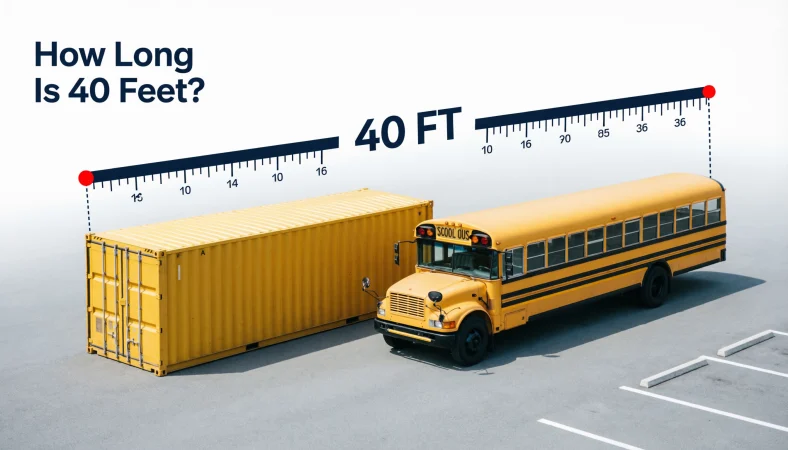
40 feet equals about 13.33 yards, or roughly 12.19 meters close to the length of a full-size school bus or a standard shipping container.
That last comparison isn’t random. Shipping containers are actually built to this exact length under international freight standards, which makes them one of the most dependable real-world stand-ins for 40 feet you’ll find.
If you’re planning a fence line, checking if a boat will fit at the dock, or just settling an argument about how far something really stretches, the comparisons below turn an abstract number into something you can actually picture.
Conversion Chart
| Unit | Converted Value |
| Inches | 480 in |
| Feet | 40 ft |
| Yards | ≈13.33 yd |
| Miles | ≈0.0076 mi |
| Millimeters | 12,192 mm |
| Centimeters | 1,219.2 cm |
| Meters | ≈12.19 m |
Common Objects That Are About 40 Feet
| Object | Approximate Length |
| A 40-foot shipping container | 40 ft (exact, by ISO standard) |
| A full-size school bus | ≈35–40 ft |
| A telephone or utility pole | ≈35–40 ft |
| A 40-foot sailboat | ≈40 ft |
| Two compact parking spaces end to end | ≈36–40 ft |
| A badminton court | ≈44 ft |
| A tennis court’s doubles width | 36 ft |
| Four sea kayaks lined up end to end | ≈40–48 ft |
More Everyday Items Around 40 Feet
| Object | Approximate Length |
| Three sedans parked bumper to bumper | ≈45 ft |
| A backyard lap pool | ≈40 ft |
| A suburban house’s street frontage | ≈40–50 ft |
| A large recreational motorhome | up to 40 ft |
| A fully extended extension ladder | up to 40 ft |
| A flatbed trailer | ≈40–48 ft |
| A regulation shuffleboard court | ≈39 ft |
How Long Is 40 Feet, Really?
Forty feet lands in an odd in-between zone. It’s twice as long as a two-car driveway, but it’s still shorter than a basketball court or a bowling lane. If you’ve ever stood at the front of a school bus and looked toward the back seats, you already have a decent feel for the distance that’s roughly it.
A simpler way to picture it: line up two compact parking spaces nose to tail instead of side by side. Most spots run 18 to 20 feet, so two of them together land almost exactly at 40. Compare that to something shorter, like a 20-foot shipping container (half the length), or something longer, like a 60-foot bowling lane, and the number starts to feel less abstract and more like a real distance you could walk off in about sixteen steps.
Easy ways to estimate 40 feet in everyday life:
- Use a school bus. Most full-size buses run close to 40 feet nose to tail, and almost everyone has a mental image of one parked at a curb.
- Count your steps. An average adult stride covers about 2.5 feet, so roughly 16 steps in a straight line gets you close.
- Picture a shipping container. A standard 40-foot container is an exact match, no rounding required.
- Think about car lengths. Three average sedans parked bumper to bumper land somewhere around 40 to 45 feet.
- Uncoil a garden hose. A common long hose runs 50 feet, so 40 feet is about four-fifths of that.
- Double a parking space. Two compact spots end to end get you close to the mark.
1. A 40-Foot Shipping Container
This one isn’t an approximation; a 40-foot shipping container is built to that exact length under the ISO 668 freight container standard, which is why the size stays consistent If the box came from a port in Shanghai or Los Angeles.
You’ve probably seen these stacked on cargo ships, parked at construction sites, or converted into backyard studios and storage units. Because the dimension is locked in by international shipping regulations rather than rough estimation, it’s the single most precise comparison on this list.
If you’re trying to gauge a driveway, a fence run, or a warehouse aisle, picturing one of these parked there gives you an instant and accurate read on the space.
2. A Full-Size School Bus
A full-size school bus is one of the most recognizable objects on this list, and depending on the model, its length lands somewhere between 35 and 40 feet. Larger Type D buses, the ones with the flat front end, tend to sit closer to the upper end of that range.
What makes this comparison work isn’t precision, it’s familiarity. Nearly everyone has waited behind one at a stop sign or watched one pull away from a curb, so the image is already loaded in your head.
Next time you’re wondering how far a driveway extension or retaining wall will stretch, picture a bus parked along the edge of it.
3. A Telephone or Utility Pole
Most wooden utility poles installed along U.S. streets stand between 35 and 40 feet tall, a range set by longstanding utility industry engineering guidelines. Tip one over in your mind, and that height becomes a length.
These poles are useful as a reference precisely because they’re unavoidable; there’s one on nearly every block, running along highways, alleys, and residential streets alike.
If you’re trying to judge how far a rope, cable, or extension cord needs to reach, imagining a felled utility pole is a fast, reliable gut-check.
4. A 40-Foot Sailboat
In sailing circles, a 40-footer refers to a specific and well-known boat class large enough to sleep a small crew comfortably, yet still manageable for a couple to sail without a full-time crew.
Because boat lengths are marketed down to the foot, this comparison carries more precision than most casual size references. Boat buyers shop specifically within categories like this one.
If you’re picturing a marina slip, a private dock, or how much space a boat would take up in dry storage, this is a solid, ready-made reference.
5. Two Compact Parking Spaces End to End
A standard compact parking space runs about 18 to 20 feet long, so placing two of them end to end lands you almost exactly at 40 feet. Parking lots are about as universal a size reference as it gets.
This works well because parking dimensions, while not identical everywhere, stay fairly consistent across most U.S. cities and shopping centers.
The next time you’re circling a crowded lot, picture two spaces stacked nose to tail that’s your 40 feet.
6. A Badminton Court
A regulation badminton court, as defined by the Badminton World Federation, measures 44 feet from baseline to baseline just a few feet past the 40-foot mark, close enough to serve as a useful reference.
Because the dimensions are set by an official governing body, this measurement doesn’t vary from gym to gym or country to country.
If you’ve ever played a match, walking baseline to baseline gives you a physical, in-your-legs sense of what 40-plus feet actually covers.
7. A Tennis Court’s Doubles Width
The doubles width of a regulation tennis court, as set by the International Tennis Federation, is exactly 36 feet, a few feet short of 40, but one of the more precise sports-based comparisons available.
Tennis courts show up at parks, schools, and clubs everywhere, so most people have stood beside one even without playing.
Standing at one sideline and looking across to the other gives a strong physical sense of how much ground 40 feet actually covers.
8. Four Sea Kayaks Lined Up End to End
A typical sea kayak runs 10 to 12 feet long, so lining up four of them bow to stern lands somewhere between 40 and 48 feet, depending on the models involved.
Kayaks are a common sight at lakes, rental shops, and sporting goods stores, which makes this an easy image to summon even if you’ve never paddled one yourself.
Anyone trying to figure out how much garage or dock space a small kayak fleet would take up can lean on this comparison directly.
9. Three Sedans Parked Bumper to Bumper
The average sedan runs close to 15 feet long, so three of them parked in a row land around 45 feet a bit past 40, but close enough to be genuinely useful.
Cars are about as universal a size reference as exists. Most people interact with car-length spaces daily, If they’re parking, driving, or just walking through a lot.
It’s a handy way to estimate how much curb space a double-parked delivery van or moving truck might realistically need.
10. A Backyard Lap Pool
Residential lap pools are commonly built around 40 feet long, a length that gives swimmers enough room for a few real strokes before hitting the wall. Pool builders often treat this figure as a popular, practical baseline for home installs.
Exact sizes vary by property, budget, and local code, so treat this one as a common benchmark rather than a fixed rule.
If a home pool is on your radar, picturing this length helps you gauge how much yard space you’d realistically need to give up.
11. A Suburban House’s Street Frontage
In many suburban subdivisions, a single-family lot’s street frontage the width facing the road commonly falls between 40 and 50 feet, a range that’s often baked into local zoning minimums.
This comparison connects an abstract number to something almost everyone has walked past without thinking twice about it: the front width of an average house.
It’s a useful gut-check when picturing how far a fence, hedge, or new sidewalk section might run along a property line.
12. A Large Recreational Motorhome
Most U.S. states cap motorhome length at 40 feet under standard vehicle road regulations, which makes this figure the practical ceiling for the largest Class A RVs sold today.
Unlike some comparisons on this list, this one is tied directly to road law rather than a loose estimate, which gives it unusual reliability.
Anyone shopping for a large RV, or just trying to picture how much driveway space one would eat up, can treat this as a solid upper-limit reference.
13. A Fully Extended Extension Ladder
Heavy-duty extension ladders used in construction and painting can reach up to 40 feet when fully extended, the kind used for upper-story work or roof access on taller homes.
Because these ladders are labeled by their maximum reach, this comparison comes with a built-in number rather than a rough guess.
If you’ve ever wondered if a ladder could reach a third-story window, picturing one stretched to its full 40 feet answers the question at a glance.
14. A Flatbed Trailer
Commercial flatbed trailers used in freight trucking commonly run in the 40- to 48-foot range, depending on what they’re built to haul, from lumber to heavy equipment.
Exact lengths vary by trailer type and manufacturer, so this is more of a ballpark than an exact match, but it’s a familiar one for anyone who’s driven behind a truck on the highway.
Picturing one parked at a loading dock offers a strong, industrial-scale sense of what 40 feet looks like laid flat on the ground.
15. A Regulation Shuffleboard Court
A regulation outdoor shuffleboard court measures 39 feet from end to end, making it one of the closest and most exact comparisons on this entire list, second only to the shipping container.
You’ll find these courts at retirement communities, cruise ships, and public parks, which makes the reference more common than it might first seem.
If you’ve ever played a round, walking the court end to end gives you an almost exact physical sense of 40 feet.
FAQ
Is 40 feet bigger than a tennis court?
Not in length, a full tennis court runs 78 feet but 40 feet is a few feet longer than the court’s 36-foot doubles width.
What household item comes closest to 40 feet?
Nothing indoors usually reaches that far, but a long 50-foot garden hose, or a couple of extension cords connected end to end, gets close.
How many steps is 40 feet?
With an average adult stride of about 2.5 feet, it takes roughly 16 steps to cover the distance.
Is a school bus really 40 feet long?
Many full-size models land close to this length, though it varies by bus type Type D buses tend to run longest, while smaller models fall a bit short.
Final Thoughts
So, how long is 40 feet? In short: about 13.33 yards, 480 inches, or 12.19 meters roughly the length of a school bus, a 40-foot shipping container, or two parking spaces lined up end to end.
On paper it’s just a number, but once you connect it to something you’ve actually stood next to, it stops being abstract.
That’s really the point of comparisons like these. A tape measure gives you precision, but a mental reference to a bus, a boat, a stretch of driveway gives you speed. The next time you’re eyeing a listing, packing a truck, or trying to settle a friendly argument about distance, you won’t need to do the math. You’ll already know roughly what 40 feet looks like, because you’ll have seen it before.
Discover More!
How Long Is a Foot?
How Long Is 30 Feet? Everyday Comparisons

I’m Elena Cross, a content writer at MeasuresIt.com, where I turn complex measures, units, and mathematical concepts into clear, accurate, and easy-to-read articles. I’m passionate about precision in numbers and in words and I write to help readers actually understand measurements, not just memorize them.










1 thought on “How Long Is 40 Feet? 15 Real-Life Size Comparisons”