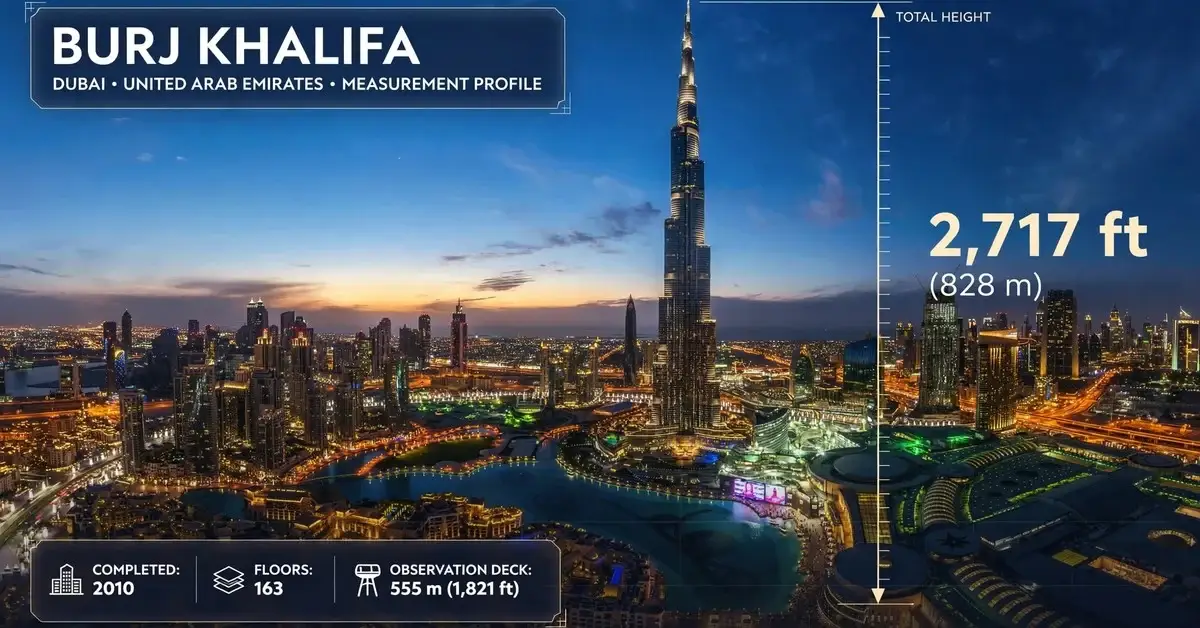
How Tall Is the Burj Khalifa? Height in Feet & Meters
The Burj Khalifa stands 2,717 feet (828 meters) tall, making it the tallest building — and tallest human-made structure — in the world. Its 163 floors rise over half a mile into the Dubai sky, topped by a 700-foot spire. Completed in 2010, it exceeds the previous record holder by more than 1,000 feet, a margin so large that no competitor has come close in the years since.
Height for skyscrapers is measured to the architectural top, which includes the spire but not antennas — a distinction that has decided “world’s tallest” controversies for decades. The Burj Khalifa wins on every measure: architectural top, highest occupied floor, and highest observation deck. This guide breaks down exactly where those 2,717 feet go, floor by floor, and compares the tower to everything from the Empire State Building to the clouds themselves.
Burj Khalifa Height Breakdown
| Section | Height | In meters | Notes |
|---|---|---|---|
| Total architectural height | 2,717 ft | 828 m | World record |
| Roof (top occupied floor area) | ~2,585 ft | ~788 m | Mechanical levels above |
| Spire | ~700 ft | ~213 m | Part of architectural height |
| Highest occupied floor (level 163) | ~1,920 ft | ~585 m | Offices and suites |
| Observation deck (At The Top) | 1,823 ft | 555.7 m | Levels 148/124/125 |
| Tip of spire | 2,717 ft | 828 m | Architectural top |
World’s Tallest Buildings Compared
| # | Building | Height | Floors | City |
|---|---|---|---|---|
| 1 | Burj Khalifa | 2,717 ft / 828 m | 163 | Dubai |
| 2 | Merdeka 118 | 2,227 ft / 679 m | 118 | Kuala Lumpur |
| 3 | Shanghai Tower | 2,073 ft / 632 m | 128 | Shanghai |
| 4 | Abraj Al-Bait Clock Tower | 1,972 ft / 601 m | 120 | Mecca |
| 5 | Ping An Finance Centre | 1,965 ft / 599 m | 115 | Shenzhen |
| 6 | Lotte World Tower | 1,819 ft / 555 m | 123 | Seoul |
| 7 | One World Trade Center | 1,776 ft / 541 m | 104 | New York |
| 8 | Guangzhou CTF Finance Centre | 1,739 ft / 530 m | 111 | Guangzhou |
Burj Khalifa in Everyday Context
| # | Comparison | Size | Context |
|---|---|---|---|
| 9 | Empire State Building | 1,454 ft | Burj is 1.87× taller |
| 10 | Eiffel Tower | 1,083 ft | Burj is 2.5× taller |
| 11 | Half a mile | 2,640 ft | Burj exceeds it by 77 ft |
| 12 | Elevator ride to top | ~60 seconds | Among the fastest elevators |
| 13 | Concrete used | 330,000 m³ | Weight of ~100,000 elephants |
| 14 | Windows cleaned | 24,000+ panels | Months-long cleaning cycle |
| 15 | Foundation piles | 192 piles, 164 ft deep | Anchored in desert sand |
1. The 2,717-Foot Total
The Burj Khalifa’s official height of 2,717 feet (828 meters) is measured to the architectural top — the tip of its spire. This is the Council on Tall Buildings and Urban Habitat standard, and it is the number that holds the world record. The figure was kept secret during construction to prevent competitors from overtaking it, and revealed only at the 2010 opening. At 2,717 feet, the tower clears the half-mile mark (2,640 feet) by 77 feet — the first building in history to stand more than half a mile tall.
2. The 163 Floors
The Burj Khalifa contains 163 habitable floors above ground, plus mechanical levels. The lowest 37 floors hold the Armani Hotel; floors 45 through 108 are residential apartments; corporate suites occupy the upper office floors; and the top occupied levels are mechanical and communications. Floor-to-floor heights average about 12 feet in residential sections. With 163 floors, the building has more stories than many cities have tall buildings — the entire vertical program of a small downtown stacked into one tower.
3. The 700-Foot Spire
Roughly 700 feet of the total height is spire — the telescoping needle that crowns the tower. The spire houses communications equipment and aircraft warning lights, and its inclusion in the architectural height follows skyscraper tradition: spires count, antennas do not. Critics note that without the spire the roofline would still be a record, which blunts the controversy that dogged buildings like One World Trade Center. The spire alone is taller than most cities’ tallest buildings.
4. Observation Decks at 1,823 Feet
“At The Top” observation decks sit at 1,823 feet (555.7 meters) on levels 148, 124, and 125 — among the highest public observatories on earth. Level 148 held the world record for highest observation deck at opening. From 1,823 feet, the horizon curves visibly and the Palm Jumeirah resolves into its full frond shape. The elevator ride takes about 60 seconds at 33 feet per second. On clear days visitors see 60-plus miles; on hazy days they see the top of the haze layer from above it.
5. Merdeka 118: The Runner-Up at 2,227 Feet
Merdeka 118 in Kuala Lumpur, completed in 2023, stands 2,227 feet (679 meters) — the world’s second-tallest building and the only other to clear 2,000 feet. Even so, it trails the Burj Khalifa by 490 feet, a gap larger than most skyscrapers’ total height. The margin shows how far ahead the Burj remains a decade and a half after completion. No building under construction as of 2026 is designed to challenge 2,717 feet.
6. Burj Khalifa vs. Empire State Building: 1,454 Feet
The Empire State Building stands 1,454 feet to its spire — the Burj Khalifa is 1.87 times taller, or 1,263 feet taller in absolute terms. Stack the Empire State on top of itself and it still falls 263 feet short of the Burj’s tip. The comparison spans eras: the Empire State held the world title for 40 years (1931–1971); the Burj took it by a margin the Empire State’s builders could not have imagined. Both used spires to claim their records — a century-old tradition.
7. Burj Khalifa vs. Eiffel Tower: 1,083 Feet
The Eiffel Tower reaches 1,083 feet with its antennas — the Burj Khalifa is two and a half Eiffels tall. The tower that defined “tallest structure” for 41 years would reach only to the Burj’s 100th floor or so. The comparison is a favorite of tour guides because nearly everyone has internalized the Eiffel Tower’s scale. Two and a half of them, stacked, still leaves the Burj’s spire poking above.
8. Half a Mile High: 2,640 Feet
Half a mile is 2,640 feet, and the Burj Khalifa clears it by 77 feet — the first and still only building to do so. The half-mile milestone matters because it was long considered the practical limit for skyscrapers: elevator logistics, wind sway, and economics all argued against it. The Burj’s buttressed-core design — a hexagonal center with three wings, inspired by desert flowers and Islamic geometry — solved the structural challenge. Engineers now discuss mile-high towers, but none has left the drawing board.
9. Elevators: 60 Seconds to the Top
The Burj’s 57 elevators include double-deck cabs traveling 33 feet per second — among the fastest in the world. The ride from ground to the observation decks takes about a minute, with pressure-regulated cabs to spare riders’ ears. Total elevator travel across all shafts would stretch for miles. Otis engineered the system for a building where a maintenance worker’s commute can itself take 20 minutes. For scale, 33 feet per second is roughly 22 mph straight up.
10. The Y-Shaped Footprint
The tower’s Y-shaped plan — three wings around a hexagonal core — is the structural secret behind 2,717 feet. Each wing buttresses the others against wind, and the stepped profile confuses wind vortices that would otherwise set the tower swaying. The shape draws from the Hymenocallis desert flower and Islamic geometric patterns. Wind tunnel testing shaped every setback: the tower’s silhouette is not decorative but aerodynamic, tuned the way an aircraft wing is tuned.
11. Foundation: 192 Piles, 164 Feet Deep
The Burj stands on 192 concrete and steel piles driven 164 feet into the desert ground — deeper than a 15-story building is tall. Dubai’s soil is weak sedimentary rock, so the foundation spreads the tower’s 500,000-ton weight across a 12-foot-thick raft. Cathodic protection guards the steel against corrosive groundwater. The foundation alone used 45,000 cubic meters of concrete. It is the invisible half of the height record: 2,717 feet up requires 164 feet down.
12. Concrete and Steel by the Numbers
Construction consumed 330,000 cubic meters of concrete and 39,000 tons of steel rebar — the concrete alone weighs as much as 100,000 elephants. At peak, 12,000 workers were on site. Concrete was pumped to record heights, with special mixes that could set in Dubai’s heat at 2,000 feet up. The aluminum facade uses 26,000 hand-cut glass panels. These quantities turn the abstract height into material reality: half a million tons of building standing on desert sand.
13. Cleaning 24,000 Windows
The facade holds over 24,000 glass panels, and cleaning them is a months-long operation. Eighteen window-washing machines track the setbacks, with crews working in shifts. A full cleaning cycle takes months, so the tower is perpetually being washed somewhere. The glass is coated to reflect Dubai’s brutal sun, which also means it shows every speck of dust — the cleaning never really ends. It is the mundane maintenance behind the gleaming postcard.
14. Sway and Wind Engineering
At 2,717 feet, wind is the governing design force. The tower sways — all tall buildings do — with a maximum designed deflection of several feet at the top in extreme storms. Tuned mass dampers are not needed because the aerodynamic shaping does the work: the stepped, spiraling form breaks up organized vortices. Residents of the upper apartments report feeling nothing in normal winds. The engineering margin is enormous by design; the Burj was built to stand for a century of desert storms.
15. The View from 2,717 Feet
No public deck reaches the very top, but engineers and maintenance crews who do describe a horizon that curves, clouds that form below, and a Dubai reduced to a diorama. At 2,717 feet the air is measurably cooler and the city’s noise inaudible. The spire’s aircraft warning lights blink above weather that never reaches the ground. It is the closest most humans will come to the edge of the atmosphere without leaving it — half a mile of building between your feet and the desert.
How the Height Was Kept Secret
During construction, the Burj Khalifa’s final height was a closely guarded secret — the developers feared a rival would add floors to steal the record before completion. Cranes were removed and the spire installed in the final months, with the 2,717-foot figure revealed only at the January 2010 opening ceremony. The secrecy worked: no competitor emerged, and the margin over the previous record-holder — Taipei 101 at 1,667 feet — was a staggering 1,050 feet. It remains the largest jump in the history of the world’s-tallest-building title, a record set deliberately out of reach.
FAQs
How tall is the Burj Khalifa in feet?
The Burj Khalifa is 2,717 feet (828 meters) tall to its architectural top, with 163 floors. It is the tallest building and tallest human-made structure in the world, completed in 2010 in Dubai.
How many floors does the Burj Khalifa have?
The Burj Khalifa has 163 habitable floors above ground, plus mechanical levels. The lower floors hold the Armani Hotel, the middle floors are residential apartments, and the upper floors are corporate suites and mechanical space.
What is taller, the Burj Khalifa or the Empire State Building?
The Burj Khalifa is much taller: 2,717 feet versus the Empire State Building’s 1,454 feet. The Burj is 1,263 feet taller — nearly double. The Empire State would need to be stacked on itself almost twice to match.
How long does the elevator take to the top of the Burj Khalifa?
The high-speed elevators travel at 33 feet per second, reaching the observation decks at 1,823 feet in about 60 seconds. The building has 57 elevators, including double-deck cabs, engineered for the half-mile vertical commute.
Final Thoughts
The Burj Khalifa’s 2,717 feet — 828 meters, 163 floors, half a mile plus 77 feet — remains the definitive answer to “how tall can a building be,” unchallenged since 2010. The breakdown tells the story: 700 feet of spire, observatories at 1,823 feet, a Y-shaped core that tames desert wind, and 164 feet of foundation gripping weak soil. Runner-up Merdeka 118 trails by 490 feet, and the Empire State Building would need to nearly double to compete. Whether you measure it in Eiffel Towers (2.5), half-miles (just over one), or elevator seconds (60), the Burj Khalifa’s height is not just a record but a margin — the largest winning gap in the history of the world’s-tallest title.

Hi, I’m Vera Lindqvist, a content writer at MeasuresIt.com, where I turn measurement standards, unit conversions, and precision tools into clear, practical guides. I care about getting the details right so you don’t have to second-guess them.