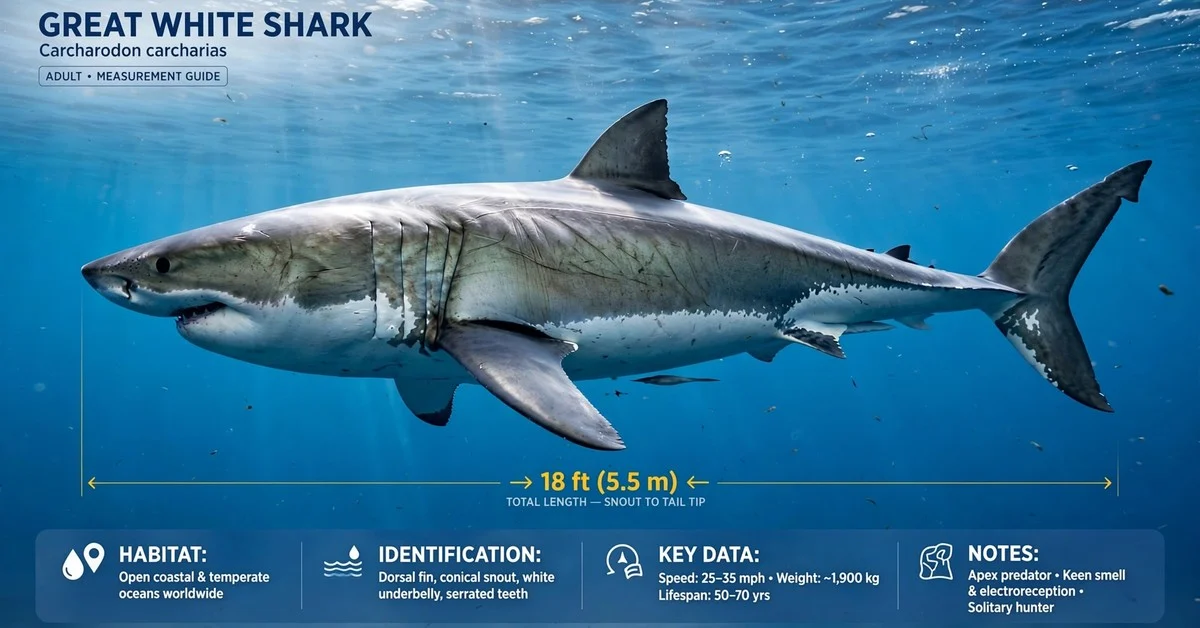
How Long Is a Great White Shark? Size & Length Guide
Great white sharks typically measure 15 to 20 feet long, with females notably larger than males. Most adult females fall in the 15 to 16-foot range and males 11 to 13 feet. The largest reliably measured specimens reached about 20 feet — and despite a century of 30-foot fish stories, no shark over 20 feet has ever been scientifically confirmed.
The great white’s size is inseparable from its reputation. A 16-foot female weighing 2,500 pounds is an animal that can bite a seal in half, breach clear of the water, and patrol thousands of miles of ocean. This guide gives verified lengths, explains why the old records collapsed, and compares the white shark to the ocean’s other giants with honest numbers.
Great White Shark Length Conversion Chart
| Measurement | Feet | Meters | Inches |
|---|---|---|---|
| Female (typical adult) | 15–16 ft | 4.6–4.9 m | 180–192 in |
| Male (typical adult) | 11–13 ft | 3.4–4.0 m | 132–156 in |
| Large female (verified) | 19–20 ft | 5.8–6.1 m | 228–240 in |
| Largest reliably measured | ~20 ft | 6.1 m | 240 in |
| Newborn pup | 4–5 ft | 1.2–1.5 m | 48–60 in |
| Teeth (large) | 2–3 in | 5–7.5 cm | 2–3 in |
| Dorsal fin (large) | ~2 ft tall | ~0.6 m | ~24 in |
Shark Species by Length Compared
| # | Species | Typical length | Max verified | Notes |
|---|---|---|---|---|
| 1 | Great white (female) | 15–16 ft | ~20 ft | Largest predatory fish |
| 2 | Great white (male) | 11–13 ft | ~18 ft | Smaller than females |
| 3 | Tiger shark | 10–14 ft | ~18 ft | Second-largest predator |
| 4 | Bull shark | 7–11 ft | ~11.5 ft | Stocky, aggressive |
| 5 | Whale shark | 20–40 ft | ~61 ft | Filter feeder, harmless |
| 6 | Basking shark | 20–26 ft | ~40 ft | Filter feeder |
| 7 | Shortfin mako | 8–10 ft | ~14 ft | Fastest shark, 45+ mph |
| 8 | Deep Blue (famous white) | ~20 ft | estimated | Largest observed living |
Great White Size in Everyday Context
| # | Comparison | Size | Context |
|---|---|---|---|
| 9 | Compact car | ~13–14 ft | A big female outstretches it |
| 10 | Standard interior door | 6 ft 8 in | A 16-ft shark is 2.4 doors long |
| 11 | Basketball hoop | 10 ft | A big female is 1.5+ hoops |
| 12 | School bus | ~40 ft | Two big females end to end |
| 13 | Human (6 ft) | 6 ft | A 16-ft shark is nearly 3 humans |
| 14 | Surfboard (longboard) | ~9 ft | A pup is half a longboard |
| 15 | Telephone pole | ~30–35 ft | Under two big females |
1. Female Great Whites: 15 to 16 Feet Typical
Adult female great whites typically measure 15 to 16 feet and weigh 1,500 to 2,500 pounds. Females grow larger than males in this species — a pattern called reversed sexual dimorphism, common in sharks — because bigger bodies produce more and larger pups. A 16-foot female is longer than a compact car and carries the mass of a small rhinoceros. She is also the animal behind nearly every “huge shark” sighting: the truly large white sharks observers report are almost always mature females.
2. Male Great Whites: 11 to 13 Feet Typical
Male great whites typically reach 11 to 13 feet and 1,000 to 1,700 pounds — still an enormous predator, but a full size class below big females. Males mature smaller and younger, around 26 years versus 33 for females. An 11-foot male is already longer than a standard doorway is tall by a wide margin, and at 1,200 pounds it outweighs a grand piano. The sexes’ size gap widens with age, since females keep growing decades longer.
3. The 20-Foot Maximum: Verified
The largest reliably measured great white was about 20 feet (6.1 meters) — a female documented from Ledge Point, Western Australia, in the 1980s, with a Canadian specimen of similar size verified by the Canadian Shark Research Center. The famous 1945 Cuban “21-footer” was later re-examined and revised down to about 16 feet, a textbook case of measurement inflation. Modern science is blunt: no shark over 20 feet has ever been confirmed. Twenty feet of verified white shark is the honest ceiling, and it is enormous.
4. Deep Blue: The Famous 20-Footer
Deep Blue, a female great white filmed off Guadalupe Island, Mexico, is estimated at nearly 20 feet — the largest living white shark reliably observed. At an estimated 50 years old, she represents what a female can achieve with decades of successful hunting. Her fame comes from footage showing her dwarfing dive cages and researchers. Estimates from video carry uncertainty, but multiple experts converge near 20 feet. She is the living embodiment of the species’ verified maximum — and she got there without any exaggeration.
5. Why the Old 30-Foot Records Collapsed
For decades, textbooks cited a 36.5-foot great white until marine biologist J.E. Randall re-examined the specimen’s jaws in 1973 and showed it was really about 17 feet — the original measurement had been botched. Similar revisions hit nearly every historical giant: the Cuban 21-footer became 16 feet, and countless dockside “25-footers” shrank under calipers. The pattern is consistent — excitement, poor measurement conditions, and sometimes deliberate inflation. Modern researchers treat any claim over 20 feet with deep skepticism unless backed by verifiable evidence.
6. Newborn Pups: 4 to 5 Feet
Great white pups are born 4 to 5 feet long — already the size of a 10-year-old child — after an 11-month gestation. Litters run 2 to 10 pups, and the mother provides no care; newborns must immediately hunt fish and avoid larger sharks, including their own species. A 4-foot pup beside its 16-foot mother shows the same dramatic scale as an elephant calf beside its mother, compressed into an animal with no childhood. Pup mortality is high, which is why females invest in size: bigger mothers make bigger, more survivable pups.
7. Teeth: 2 to 3 Inches
A large great white’s teeth measure 2 to 3 inches long — triangular, serrated steak knives set in jaws that can exert nearly a ton of bite force per square inch at the rear teeth. White sharks shed and replace teeth continuously, going through thousands in a lifetime. The teeth’s size scales with the shark: a 16-foot female’s 2.5-inch teeth are proportionally enormous compared to a 12-foot male’s. Beach-found teeth over 2 inches almost certainly came from a mature female.
8. Weight: 1,500 to 4,000 Pounds
Weight scales steeply with length: a 13-foot male may weigh 1,200 pounds while a 19-foot female can exceed 4,000 pounds — the famous Kangaroo Island specimen weighed an estimated 4,200 pounds. The IGFA all-tackle record, a 2,664-pound shark caught off Australia in 1959, remains the heaviest officially documented. Because length cubed drives weight, each extra foot on a big female adds hundreds of pounds. A 20-foot female is not just 25 percent longer than a 16-footer — she is roughly twice as heavy.
9. Great White vs. Compact Car: 13 to 14 Feet
A compact car runs 13 to 14 feet long — a typical 15-foot female great white outstretches it, and a 20-foot giant exceeds it by half a car length. Lay the shark alongside a parked sedan and the tail extends well past the rear bumper. It is the comparison that finally makes people stop: this is not a big fish, it is a vehicle-sized predator. The car’s weight, around 2,800 pounds, also matches a big female’s — similar mass, very different temperament.
10. Dorsal Fin: 2 Feet Tall
A large great white’s dorsal fin stands about 2 feet tall — the iconic triangle that has launched a thousand beach panics. Fin height scales with body length, so a 2-foot fin reliably indicates a shark in the 16-plus-foot class. Smaller sharks’ fins look proportionally similar, which is why fin sightings mislead: without a scale reference, a 10-footer’s fin looks “huge.” Lifeguards are trained to estimate total length from fin size and behavior, not fear.
11. How Sharks Are Measured
Measuring a live great white means working from boats with laser photogrammetry, stereo video, or — for tagged sharks — physical measurement during brief capture. Total length runs snout to tail tip with the tail in its natural position; depressed-tail measurements read longer and caused some historical inflation. Dead specimens measured on docks are the most reliable but the rarest. OCEARCH’s tagged male “Contender,” at nearly 14 feet and 1,653 pounds, shows modern measurement at its best: precise, documented, and publicly shared.
12. Growth: Decades to 20 Feet
Great whites grow slowly: males mature around 26 years, females around 33, and large females may be 50-plus years old. A shark reaches 15 feet only after decades of successful hunting across thousands of ocean miles. This slow growth makes the species vulnerable — late maturity plus low pup numbers means populations recover slowly from losses. Every 20-foot female represents half a century of survival, which is part of why researchers treat the giants with something approaching reverence.
13. Tiger Sharks and Makos for Scale
The tiger shark, the white shark’s closest rival as a predator, reaches 10 to 14 feet typically and 18 feet at maximum — a big tiger is the size of an average female white. The shortfin mako, fastest of all sharks at 45-plus mph, tops out around 14 feet. Neither approaches the white shark’s verified 20-foot ceiling. These comparisons matter because “big shark” stories often involve tigers or makos misidentified as whites — knowing the size brackets helps sort sightings.
14. Whale Sharks: 40 Feet of Gentle Giant
For true ocean scale, the whale shark — a filter feeder, not a predator — reaches 20 to 40 feet typically with a verified 61-foot giant on record. A 40-foot whale shark makes a 20-foot great white look modest, which is a useful corrective: the white shark is the largest predatory fish, not the largest fish. Basking sharks reach 40 feet the same way. The white shark’s fame comes from what it does with its 20 feet, not from being the longest thing in the sea.
15. Separating Fact from Jaws
Peter Benchley’s fictional 25-footer and the film’s mechanical monster cemented the idea that 25-foot white sharks patrol the coasts. Reality: 15 to 16 feet for a big female, 20 feet for the verified giants, and nothing confirmed beyond. That does not make them small — a 16-foot, 2,500-pound predator with 2.5-inch serrated teeth is an awesome animal. It makes them real. The honest numbers, measured with lasers and calipers rather than box-office imagination, are fearsome enough.
FAQs
How long is the biggest great white shark ever recorded?
The largest reliably measured great white sharks reached about 20 feet (6.1 meters). Historical claims of 30-plus feet were debunked — the famous “36.5-footer” was re-measured at 17 feet. No shark over 20 feet has ever been scientifically confirmed.
How long is a great white shark on average?
Adult females average 15 to 16 feet; adult males average 11 to 13 feet. Most white sharks encountered by divers and researchers fall in the 11 to 15-foot range. Truly large specimens over 18 feet are rare mature females.
How much does a 20-foot great white shark weigh?
A 20-foot female would weigh roughly 4,000-plus pounds, based on measured specimens — the 19.7-foot Kangaroo Island shark was estimated at 4,200 pounds. Weight scales with the cube of length, so big females gain mass dramatically with each added foot.
How long are great white shark teeth?
Teeth on a large great white measure 2 to 3 inches long. They are triangular and serrated, replaced continuously throughout the shark’s life. Teeth over 2 inches typically come from mature females over 15 feet.
Final Thoughts
The great white shark’s honest dimensions — 15 to 16 feet for a typical adult female, 11 to 13 for males, 20 feet for the verified giants — describe the ocean’s largest predatory fish without any need for exaggeration. The collapsed 30-foot records are a cautionary tale about measurement, excitement, and storytelling, corrected by scientists with calipers and published in peer-reviewed journals. From 4-foot pups to Deep Blue’s estimated 20 feet, from 2.5-inch teeth to 4,200-pound females, every number traces to documented animals. Picture the 16-footer beside a compact car she outstretches, and the abstraction ends: this is a real, measured, magnificent predator, exactly as long as the science says. When you see the numbers written plainly, the great white needs no myth-making to inspire genuine awe and lasting respect.

I’m Marcus Kane, a measurement content specialist at MeasuresIt.com. I write clear, accurate, and practical articles about measurements, dimensions, conversions, and everyday size comparisons, making complex topics simple and easy to understand.