Baseball Diamond Dimensions: Bases, Mound & Outfield
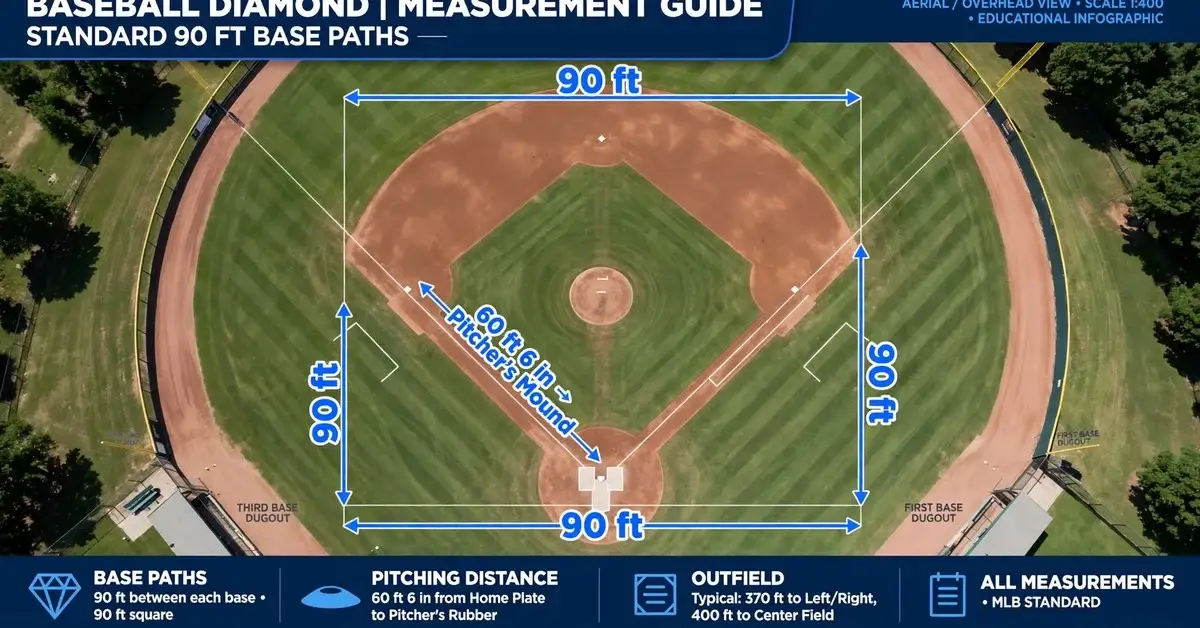
In official baseball, the bases sit 90 feet apart and the pitcher’s mound is 60 feet 6 inches from home plate. Those two numbers define the entire infield: a perfect square (rotated 45 degrees) with the mound sitting just in front of its center.
The 90-foot basepath is one of the most famous measurements in sports. It is short enough that a fast runner can beat a routine ground ball, and long enough that fielders have time to make plays. The 60-foot-6-inch pitching distance gives hitters roughly four-tenths of a second to react to a 95 mph fastball. Change either number and baseball becomes a different game.
Everything else on the field hangs off those anchors — the 127-foot diagonal from home to second, the 10-inch mound height, the 325-foot minimum down the foul lines. This guide walks through every official dimension, plus how Little League and softball shrink the diamond for younger and different players.
Quick Conversion Chart
| Measurement | Feet | Meters | Inches |
|---|---|---|---|
| Base paths (MLB) | 90 ft | 27.4 m | 1,080 in |
| Mound to home plate | 60 ft 6 in | 18.44 m | 726 in |
| Home plate to second base | 127 ft 3⅜ in | 38.8 m | 1,527.4 in |
| Base paths (Little League) | 60 ft | 18.3 m | 720 in |
| Mound to home (Little League) | 46 ft | 14.0 m | 552 in |
| Outfield center (typical MLB) | 400 ft | 121.9 m | 4,800 in |
Infield Dimensions
| # | Feature | Measurement |
|---|---|---|
| 1 | Base paths (base to base) | 90 ft |
| 2 | Pitching distance (mound to home) | 60 ft 6 in |
| 3 | Home plate to second base | 127 ft 3⅜ in |
| 4 | Pitcher’s plate (rubber) | 24 in × 6 in |
| 5 | Mound height above home plate | 10 in |
| 6 | Mound diameter | 18 ft |
| 7 | Batter’s box | 6 ft × 4 ft |
| 8 | Base size | 15 in square |
Field Details & Variations
| # | Feature | Measurement |
|---|---|---|
| 9 | Home plate width | 17 in |
| 10 | Outfield foul lines (minimum) | 325 ft |
| 11 | Center field (typical) | 400 ft |
| 12 | Grass infield arc | 95 ft radius |
| 13 | Catcher’s box | 8 ft × 43 in |
| 14 | On-deck circle | 5 ft diameter |
| 15 | Little League base paths | 60 ft |
1. Base Paths: 90 Feet
The distance between consecutive bases — home to first, first to second, and so on — is 90 feet. That number has been standard in professional baseball since the 19th century, and it is the single most defining dimension of the sport.
Ninety feet is a carefully tuned distance. An average MLB runner takes about 4.3 seconds to go from home to first; a routine ground ball takes the fielder roughly the same time to field and throw. That near-tie is what makes bang-bang plays at first base so common and so thrilling.
The bases form a square, but it is usually called a “diamond” because home plate sits at the bottom point. The infield dirt area extends a bit beyond the basepaths themselves, giving fielders room to range for ground balls.
2. Pitching Distance: 60 Feet 6 Inches
The front edge of the pitcher’s plate (the rubber) sits 60 feet 6 inches from the back point of home plate. That odd extra six inches dates to the 1890s, when the pitching distance was moved back from 50 feet and a surveying quirk added the half-foot.
Those 60 feet 6 inches are the heart of baseball’s difficulty. A 95 mph fastball covers that distance in about 0.4 seconds, and the hitter must decide whether and where to swing in roughly half that time. Move the mound even a few feet and the balance between pitcher and hitter shifts dramatically.
The distance is measured to the front of the rubber, not to where the pitcher’s foot lands. Pitchers stride toward home as they deliver, releasing the ball closer to 55 feet from the plate — which is why the pitch feels even faster than the raw distance suggests.
3. Home Plate to Second Base: 127 Feet 3⅜ Inches
The diagonal across the diamond — from the back point of home plate to the center of second base — measures 127 feet 3⅜ inches. This is not an independent rule; it is pure geometry, the diagonal of a 90-foot square (90 × √2 ≈ 127.28 feet).
This measurement matters most for catchers. The throw from home to second on a steal attempt covers that full diagonal, and the pop time — the catcher’s throw time — is judged against the runner’s roughly 3.3-second sprint from first.
Umpires and groundskeepers use this diagonal to check the diamond’s accuracy. If home-to-second is not 127 feet 3⅜ inches, the square is off somewhere. It is the field’s built-in quality control.
4. The Pitcher’s Plate: 24 by 6 Inches
The pitcher’s plate — commonly called the rubber — is a white slab 24 inches wide and 6 inches deep, set into the top of the mound. The pitcher must start the delivery with a foot in contact with it.
The rubber’s position defines the 60-foot-6-inch pitching distance: the measurement runs from its front edge to the back point of home plate. Move the rubber and you move the entire geometry of pitching.
The plate sits 10 inches above home plate level (see the next section), so the pitcher delivers slightly downhill. That small slope is a big deal — it adds perceived velocity and downward plane to every pitch.
5. Mound Height: 10 Inches
The top of the pitching mound is 10 inches above the level of home plate. The mound slopes gradually down from the rubber toward the plate, giving pitchers a slight downhill delivery.
Ten inches sounds minor, but the slope changes pitching mechanics significantly. Pitchers generate power driving down the slope, and the downhill angle makes fastballs appear to “rise” less and break sharper.
There was a time when mounds were higher — 15 inches was once common — but the rules capped the height at 10 inches after the 1968 season, famously the “Year of the Pitcher,” to give hitters a fairer chance. The 10-inch limit has held ever since.
6. Mound Diameter: 18 Feet
The pitcher’s mound is a circle 18 feet in diameter, centered on a point 59 feet from the back of home plate. The rubber sits slightly behind the circle’s center, 60 feet 6 inches from home.
The 18-foot circle gives the pitcher room to stride, follow through, and field comebackers without leaving the mound area. The grass-free dirt circle is one of the most recognizable shapes in sports.
Groundskeepers sculpt the mound carefully: the landing area in front of the rubber takes enormous abuse, with pitchers digging holes with their cleats every game. A well-maintained mound has a firm, consistent slope — a bad one can subtly alter a pitcher’s mechanics.
7. The Batter’s Box: 6 by 4 Feet
Each batter’s box is a rectangle 6 feet long and 4 feet wide, positioned beside home plate. The box gives the hitter a defined space — both feet must be inside it when the pitch is delivered.
Six feet of length lets hitters adjust their depth: some crowd the plate, others set up deep in the box to give themselves a split-second more reaction time. Four feet of width accommodates different stances and stride styles.
The lines of the batter’s box get obliterated within a few innings, but the rule stands regardless. Umpires rarely enforce foot position strictly unless a hitter is flagrantly out of the box — it is one of baseball’s most overlooked dimensions.
8. Base Size: 15 Inches Square
Each base is a 15-inch square bag, filled and anchored to the ground. First, second, and third use identical bags; home plate is a different shape entirely.
Fifteen inches gives fielders a target and runners something to touch without turning the base into an obstacle. The bags sit with one corner pointing along the basepath, centered on the 90-foot intersections.
In recent years, MLB enlarged the bases slightly from 15 to 18 inches square to encourage stolen bases and reduce collisions — one of the rare modern changes to these century-old dimensions. The classic 15-inch figure remains the standard reference for the traditional diamond.
9. Home Plate Width: 17 Inches
Home plate is a 17-inch-wide pentagon — the flat edge faces the pitcher, and the point faces the catcher. Its unusual shape defines the strike zone’s width: 17 inches, edge to edge.
The plate’s five-sided design dates to the early 1900s and replaced the earlier square and circular plates. The angled back edges help umpires see the corners and give catchers a defined target.
Seventeen inches is not much wider than a dinner plate, which is why painting the black — living on the edges of the strike zone — is such a prized pitching skill. A few inches off the plate is a ball; a few inches on is a strike.
10. Outfield Foul Lines: 325 Feet Minimum
Official rules require a minimum of 325 feet down each foul line from home plate to the outfield fence. Most MLB parks exceed this — 330 to 335 feet is common — but 325 is the floor.
The foul-line distance shapes a park’s character. Short porches down the lines, like Yankee Stadium’s famous 314-foot right field (grandfathered in below the modern minimum for older parks), turn routine fly balls into home runs.
Because the minimum is just a minimum, every ballpark’s outfield is a unique shape. Center field might be 400 feet in one park and 435 in another, while the lines stay near 330. That variety is part of baseball’s charm — no two fields play exactly alike.
11. Center Field: About 400 Feet
Center field in a typical MLB park sits about 400 feet from home plate. It is the deepest part of most outfields and the truest test of power: a ball hit 400 feet to dead center is a home run almost anywhere.
Some parks go much deeper — the Polo Grounds once stretched 483 feet to center — while a few modern parks pull center in to around 395. But 400 remains the mental benchmark for “deep.”
For young players, 400 feet is an almost unimaginable distance — more than a football field plus both end zones. Even most college hitters never clear a 400-foot fence. It is a useful reminder of how much power the professional game demands. If you want a feel for everyday scales, our guide to credit card dimensions covers one of the most-handled objects in your wallet.
12. Grass Infield Arc: 95-Foot Radius
The infield grass is cut in an arc with a 95-foot radius from the back point of home plate, creating the classic curved boundary between the infield dirt and the outfield grass. This is the graceful curve you see on every televised game.
The 95-foot arc is a groundskeeping standard rather than a hard rule, but it is followed almost universally. It puts the arc just past the basepaths — fielders ranging for ground balls stay on dirt, while outfielders play on grass.
The shape matters for play: balls rolling past the arc slow on grass, which is why infielders charge and outfielders hang back. The arc is also where the “infield fly” logic lives — pop-ups inside it are the infielders’ domain.
13. The Catcher’s Box: 8 Feet by 43 Inches
The catcher’s box is 8 feet deep and 43 inches wide, marked behind home plate. The catcher must stay inside it until the pitch is released.
The box gives the catcher room to set up at varying distances — closer for framing pitches, deeper for blocking balls in the dirt. Forty-three inches of width allows lateral movement to handle pitches off the plate.
You rarely notice the catcher’s box because it is erased by foot traffic within an inning or two. But its dimensions quietly govern one of the game’s key matchups: the catcher’s positioning affects pitch framing, stolen-base defense, and passed-ball risk.
14. The On-Deck Circle: 5 Feet in Diameter
The on-deck circle is a 5-foot-diameter circle where the next hitter warms up. There are two on each field, one on each side, so the on-deck hitter can stand on the side matching their batting handedness.
Five feet is just enough room to swing a bat without hitting the bat rack, the fence, or a teammate. It is a small circle with a simple job: keep the warming-up hitter close to the dugout and out of the field of play.
The on-deck circle also has a strategic role — the hitter there studies the pitcher’s release point and timing. Many players say those 60 seconds of tracking pitches from the circle are the most valuable preparation in the game.
15. Little League Base Paths: 60 Feet
Little League diamonds shrink everything: base paths are 60 feet and the mound is 46 feet from home plate. These dimensions suit players roughly ages 9 to 12, whose arms and legs cannot cover a full-size diamond.
The 60-foot basepath keeps the game’s timing intact — the ratio of runner speed to fielder throwing distance stays roughly proportional to the big leagues. A Little League steal of second feels like a major-league steal because the geometry scales.
As players grow, they graduate through intermediate diamonds: 70-foot basepaths with a 50-foot mound, then the full 90/60-foot-6 setup around age 13 or 14. Softball uses 60-foot basepaths too, but with a flat pitching circle instead of a raised mound. For more on reading precise measurements, see how to read a measuring tape.
Frequently Asked Questions
Why are baseball bases 90 feet apart?
Ninety feet creates a near-perfect balance between the runner and the defense — a fast runner and a routine ground ball arrive at first base at almost the same time. Shorter would favor runners too much; longer would make infield hits nearly impossible. The distance has been standard since the 1800s.
Why is the mound 60 feet 6 inches from home plate?
The pitching distance was moved back from 50 feet in 1893 to give hitters a fair chance, and the extra six inches came from how the new distance was surveyed and marked. It has stayed at 60 feet 6 inches ever since, defining the roughly 0.4-second reaction window hitters get against a fastball.
How big is a Little League baseball field?
Little League base paths are 60 feet apart and the pitching mound is 46 feet from home plate. Outfield fences are typically 200 feet or less. Players move up to larger diamonds — 70-foot basepaths, then the full 90-foot MLB dimensions — as they get older.
How far is it from home plate to second base?
It is 127 feet 3⅜ inches — the diagonal of the 90-foot square formed by the basepaths. Catchers throwing out would-be base stealers have to cover that full distance, which is why a catcher’s “pop time” is such a valued stat.
Final Thoughts
The baseball diamond is a study in tuned geometry: 90-foot basepaths, a mound 60 feet 6 inches from home, a 127-foot diagonal, and outfield fences starting at 325 feet down the lines. Every number exists because it keeps the contest between pitcher, hitter, fielder, and runner balanced on a knife’s edge. Youth leagues scale it all down — 60-foot bases and a 46-foot mound in Little League — without losing that balance. Next time you watch a bang-bang play at first, remember: it is close because 90 feet was chosen, over a century of trial and error, to make it exactly that close.

I’m Elena Cross, a content writer at MeasuresIt.com, where I turn complex measures, units, and mathematical concepts into clear, accurate, and easy-to-read articles. I’m passionate about precision in numbers and in words and I write to help readers actually understand measurements, not just memorize them.