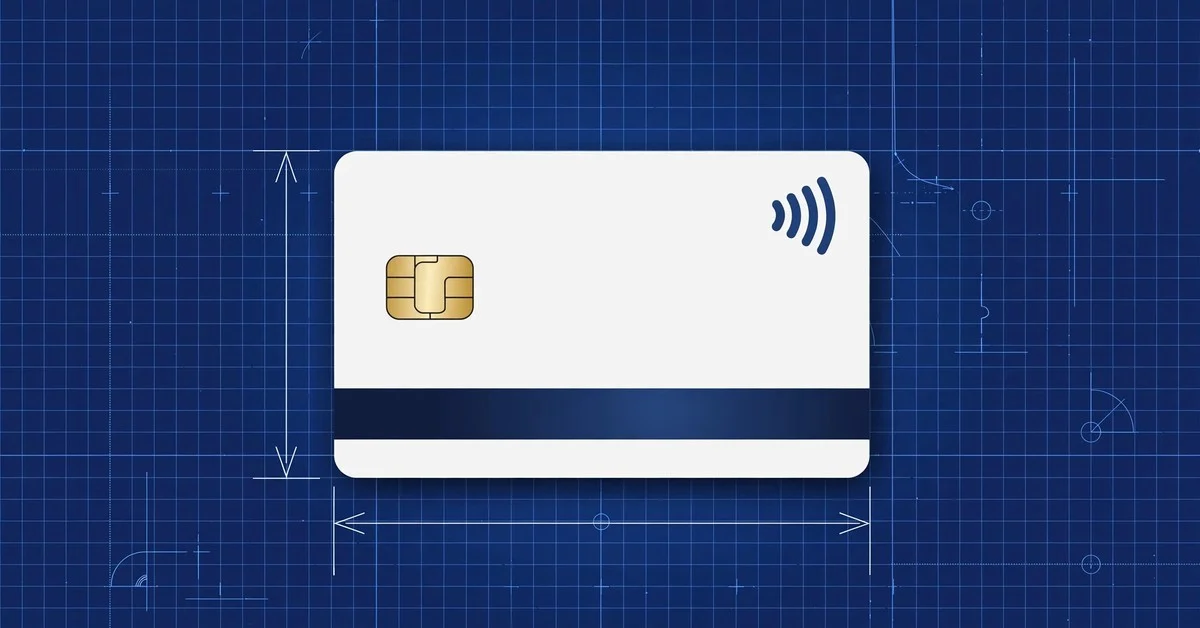
A standard credit card measures 85.60 × 53.98 millimeters, or 3.370 × 2.125 inches. It is 0.76 mm (0.030 in) thick, with each corner rounded to a 3.18 mm radius.
Those four numbers describe every credit card in your wallet, and they are anything but random. They come from the ISO/IEC 7810 ID-1 standard, the international specification that fixes the exact size of identification cards worldwide. Because every issuer follows the same specification, a card issued in New York slides into an ATM in Tokyo just as smoothly as it fits the card slot of a wallet bought in London.
In this guide, you will find the exact credit card dimensions in millimeters, centimeters, and inches, plus the official thickness and corner radius. We will also explain why the size was standardized in the first place, how the ID-1 format compares with the standard’s other card formats, and which everyday cards share these exact measurements. If you have ever wondered whether a debit card, a driver’s license, or a gift card is precisely the same size, the answer — and the numbers behind it — are below.
Credit Card Dimensions at a Glance
Here are the official ID-1 measurements in every unit you are likely to need, side by side.
| Measurement | Millimeters | Centimeters | Inches |
|---|---|---|---|
| Length | 85.60 | 8.560 | 3.370 |
| Width | 53.98 | 5.398 | 2.125 |
| Thickness | 0.76 | 0.076 | 0.030 |
| Corner radius | 3.18 | 0.318 | 0.125 |
The centimeter figures are simple shifts of the decimal point, while the inch values are the exact conversions used across the payments industry. Keep this chart handy: every section below builds on these four numbers, so you will not need to convert anything yourself.
Cards That Share the Exact Same Size
The ID-1 specification was written for identification cards in general, not just credit cards. That is why the same 85.60 × 53.98 mm footprint shows up all over your wallet and beyond. Every card in the table below is built around the identical ID-1 wallet-card format, also known in the industry as CR80.
| Card | Size | Why it matches |
|---|---|---|
| Credit card | 85.60 × 53.98 mm | The reference ID-1 card itself |
| Debit card | 85.60 × 53.98 mm | Must pass through the same ATMs and terminals |
| ATM card | 85.60 × 53.98 mm | Built for the same machine slots |
| Prepaid / gift card | 85.60 × 53.98 mm | Issued in the standard wallet format |
| National ID card | 85.60 × 53.98 mm | ID-1 by design |
| Driver’s license | 85.60 × 53.98 mm | Matches the ID-1 footprint |
| Health insurance card | 85.60 × 53.98 mm | Wallet-sized by the same format |
| Hotel key card | 85.60 × 53.98 mm | Made to fit standard wallets and readers |
This shared footprint is the whole point of the standard. One slot size in an ATM, one reader throat, one wallet pocket — and every card in the list above fits all three.
Credit Card Measurements in Perspective
Millimeters are precise, but they can be hard to picture. The comparisons below translate the card’s official dimensions into familiar reference points, using only the verified numbers from the chart above.
| Measurement | Equals | In plain terms |
|---|---|---|
| Length: 85.60 mm | 8.560 cm | A little under 8.6 cm on a ruler |
| Width: 53.98 mm | 5.398 cm | Just under 5.4 cm |
| Length: 3.370 in | 3.375 in = 3⅜ in | A hair under three and three-eighths inches |
| Width: 2.125 in | 2⅛ in | Exactly two and one-eighth inches |
| Thickness: 0.76 mm | 0.030 in | Roughly one-tenth of 8 mm |
| Corner radius: 3.18 mm | 0.125 in | Almost exactly one-eighth of an inch |
| Length vs. a 30 cm ruler | 28.5% | A little over a quarter of the ruler |
You can verify every figure above with an ordinary ruler — our guide on how to read a measuring tape walks through the technique. The inch columns feel more intuitive once you have a solid sense of how long an inch is, and picturing 8 mm makes the 0.76 mm thickness click: the card is roughly a tenth of that. Finally, holding the card against a 30 cm ruler makes the 85.60 mm length instantly visible.
1. Credit Card Dimensions in Millimeters
The millimeter is the native unit of the ISO/IEC 7810 standard, so these are the numbers that matter most: 85.60 mm long and 53.98 mm wide. The two-decimal precision is deliberate. Card readers, ATM throats, and embossing machines are engineered around clearances measured in fractions of a millimeter, so the standard leaves nothing to approximation.
To picture the millimeter figures, think in centimeters: the length is 8.560 cm and the width is 5.398 cm. On a standard ruler the long edge lands just past the 8.5 cm mark, while the short edge stops a hair before 5.4 cm. Because the standard fixes these values to two decimal places, any card printed to the specification — no matter which bank issued it — lands on the same marks.
Manufacturers work to these numbers with tight quality control, because even a small deviation would betray the card at a machine. A card that is a millimeter too wide can jam a motorized reader; one that is a millimeter too short can fail to trip the sensors that detect a card’s presence. The two-decimal specification exists so that “close enough” never has to be good enough.
2. Credit Card Size in Centimeters
In centimeters, the card is 8.560 × 5.398 cm — the same numbers with the decimal point shifted one place. Centimeters tend to feel more intuitive, which makes them handy when you are judging whether a wallet pocket, badge holder, or phone slot will swallow the card comfortably.
There is a neat mental shortcut here: because a centimeter is ten millimeters, you will never need a calculator to move between the two. Cover the last digit of 85.60 and you have 8.56 cm; cover the last digit of 53.98 and you have 5.398 cm. The decimal simply hops one place, in either direction, every time.
For quick estimates, 8.6 × 5.4 cm is close enough for everyday purposes — buying a sleeve, checking a pocket, or sketching the card to scale. When precision matters, though, always return to the full 85.60 × 53.98 mm specification.
3. Credit Card Dimensions in Inches
In inches, the card measures 3.370 × 2.125 inches. The width is the memorable one: 2.125 inches is exactly two and one-eighth inches, a figure that anyone who works with imperial measurements will recognize instantly.
The length, 3.370 inches, sits a whisper under three and three-eighths inches (3.375). That five-thousandths-of-an-inch gap is far too small to see; it only matters to the machines that grip, read, and sort the card.
If you grew up with inches, it can help to think of the card as roughly three and three-eighths inches long by two and one-eighth inches wide. Those rounded fractions describe the same card — they simply trade the standard’s laboratory precision for workshop convenience.
4. How Thick Is a Credit Card?
A credit card is 0.76 mm thick — 0.030 inches, or thirty thousandths of an inch. That thinness is a careful compromise. The card must be rigid enough to survive years of flexing in wallets and readers, yet thin enough to glide through the tightest ATM throat and stack neatly with a dozen other cards.
For a sense of scale, the card’s thickness is about one-tenth of 8 mm — picture a stack of ten cards and you are looking at roughly eight millimeters. It is also a touch under one thirty-second of an inch (0.03125 in), which is why the rounded 0.030 in figure appears in industry tables.
Thickness matters more than most people realize. Embossed characters rise above the surface, the magnetic stripe and chip add their own tiny profiles, and every one of those features must fit inside the clearances the 0.76 mm baseline assumes. It is a small number doing a large job.
5. Corner Radius: Why the Edges Are Rounded
Each corner of a credit card is rounded to a radius of 3.18 mm — almost exactly one-eighth of an inch. Put a coin against the corner and you will see the curve is gentle but unmistakable; sharp ninety-degree corners would look and feel completely different.
The rounding is functional. Sharp corners would catch on wallet pockets, fray at the edges, and concentrate stress where the card bends. The 3.18 mm curve lets the card slip in and out of tight slots thousands of times without snagging, and it spreads bending forces so the corner does not crack or delaminate.
It is also a quiet design signature. That familiar soft-cornered rectangle is recognizable instantly, and it is one of the reasons the card feels finished rather than cut from a larger sheet. Every millimeter of the curve is specified, just like the length and width.
6. Why Every Credit Card Is the Same Size
Imagine a world where every bank chose its own card size. ATMs would need adjustable throats, shop terminals would need custom slots, and wallets would need elastic pockets in a dozen shapes. Standardization exists to spare us that chaos: one size means every card works in every machine, everywhere.
The beneficiaries are easy to list. Travelers can use one card on every continent. Retailers can buy one terminal design for every checkout lane. Wallet makers can cut one pocket template and know it fits. And banks can issue cards confident that the entire world’s infrastructure already accommodates them.
This is the deeper logic of the ID-1 standard. It does not just describe a rectangle; it guarantees interoperability — the promise that a card and a machine built on opposite sides of the planet will still fit together. That promise is worth far more than the plastic it is printed on.
7. The ISO/IEC 7810 ID-1 Standard Explained
ISO/IEC 7810 is the international standard that defines the physical characteristics of identification cards. The “ID-1” label marks the specific format within that standard sized at 85.60 × 53.98 mm — the format assigned to financial cards, ID cards, and licenses. When a manufacturer says a card is “ID-1 compliant,” it means the card matches the dimensions in our chart above.
The standard does more than fix the outline. It pins down the thickness (0.76 mm) and the corner radius (3.18 mm) too, so that every mechanical interaction — insertion, ejection, stacking, embossing — behaves identically from one card to the next. Compliance is what lets a card printed in one country perform flawlessly in another’s machines.
For shoppers and travelers, the takeaway is simple: ID-1 is the reason “one size fits all” is literally true for payment cards. Look for the format name on card-printer specifications, and you will know the output will slide into any standard wallet or reader.
8. ID-1 vs. Other ISO Card Formats
ID-1 is not the only format in ISO/IEC 7810 — the standard defines a small family of card sizes, with ID-1 being the smallest and the one assigned to financial and identification cards. The larger formats exist for cards that need more surface area, such as certain government and travel documents. Each format is precisely specified, just like ID-1.
For everyday life, though, ID-1 is the format that matters. It is the rectangle in your wallet, the shape every terminal expects, and the reason this article’s numbers never change. Unless you are designing passports or visas, ID-1 is the only ISO card size you will ever need to know.
9. Debit Cards, National IDs, and Driver Licenses
The ID-1 footprint extends well beyond credit cards. Debit cards match it exactly — same 85.60 × 53.98 mm outline, same 0.76 mm thickness — because they travel through the same ATMs and terminals. National identity cards and driver’s licenses use the identical format for the same reason: one standard slot size serves every card a person carries.
That shared sizing is quietly convenient. A single wallet pocket design fits your whole carry; a single reader throat accepts payment and identification alike. It is standardization paying off in the most ordinary — and most frequent — moments of daily life.
Frequently Asked Questions
Are all credit cards exactly the same size?
Yes. Every credit card issued to the ISO/IEC 7810 ID-1 specification measures 85.60 × 53.98 mm, with a thickness of 0.76 mm and a corner radius of 3.18 mm. It does not matter which bank issued the card or which country you are in — the standard is the standard, and that uniformity is exactly what lets every card work in every reader.
Is a debit card the same size as a credit card?
Exactly the same. Debit cards are built to the identical ID-1 dimensions — 85.60 × 53.98 mm — because they must pass through the same ATMs, point-of-sale terminals, and wallet pockets as credit cards. Hold the two side by side and their outlines match perfectly.
Are credit cards the same size as business cards?
No. A standard US business card measures 3.5 × 2 inches (88.9 × 50.8 mm), so it is a touch longer but slightly narrower than a credit card’s 3.370 × 2.125 inches (85.60 × 53.98 mm). The two look similar at a glance, but a business card will not sit perfectly in a slot cut for ID-1 — it overhangs on the length and swims a little on the width.
Why isn’t the credit card a round number like 85 × 54 mm?
The metric figures are simply the exact conversion of 3.370 × 2.125 inches, which is why they land on hundredth-of-a-millimeter values instead of round numbers. Round figures would be easier to remember, but the standard prioritizes exactness: every machine clearance on earth is engineered around these precise values.
Final Thoughts
Credit card dimensions are a quiet triumph of global agreement. Four numbers — 85.60 × 53.98 millimeters, 0.76 mm thick, corners rounded to 3.18 mm — were settled once under the ISO/IEC 7810 ID-1 standard, and they have been honored ever since by banks, terminal makers, and wallet designers on every continent. The result is the rare object you never have to think about: it fits the ATM in Tokyo, the reader in Lisbon, and the pocket sewn in New York, all without adjustment. The next time you tap to pay, spare a thought for the two-decimal precision that makes it boring. In a world of incompatible chargers and mismatched standards, the humble ID-1 rectangle is proof that agreeing on the small things makes everyday life measurably smoother.

I’m Elena Cross, a content writer at MeasuresIt.com, where I turn complex measures, units, and mathematical concepts into clear, accurate, and easy-to-read articles. I’m passionate about precision in numbers and in words and I write to help readers actually understand measurements, not just memorize them.