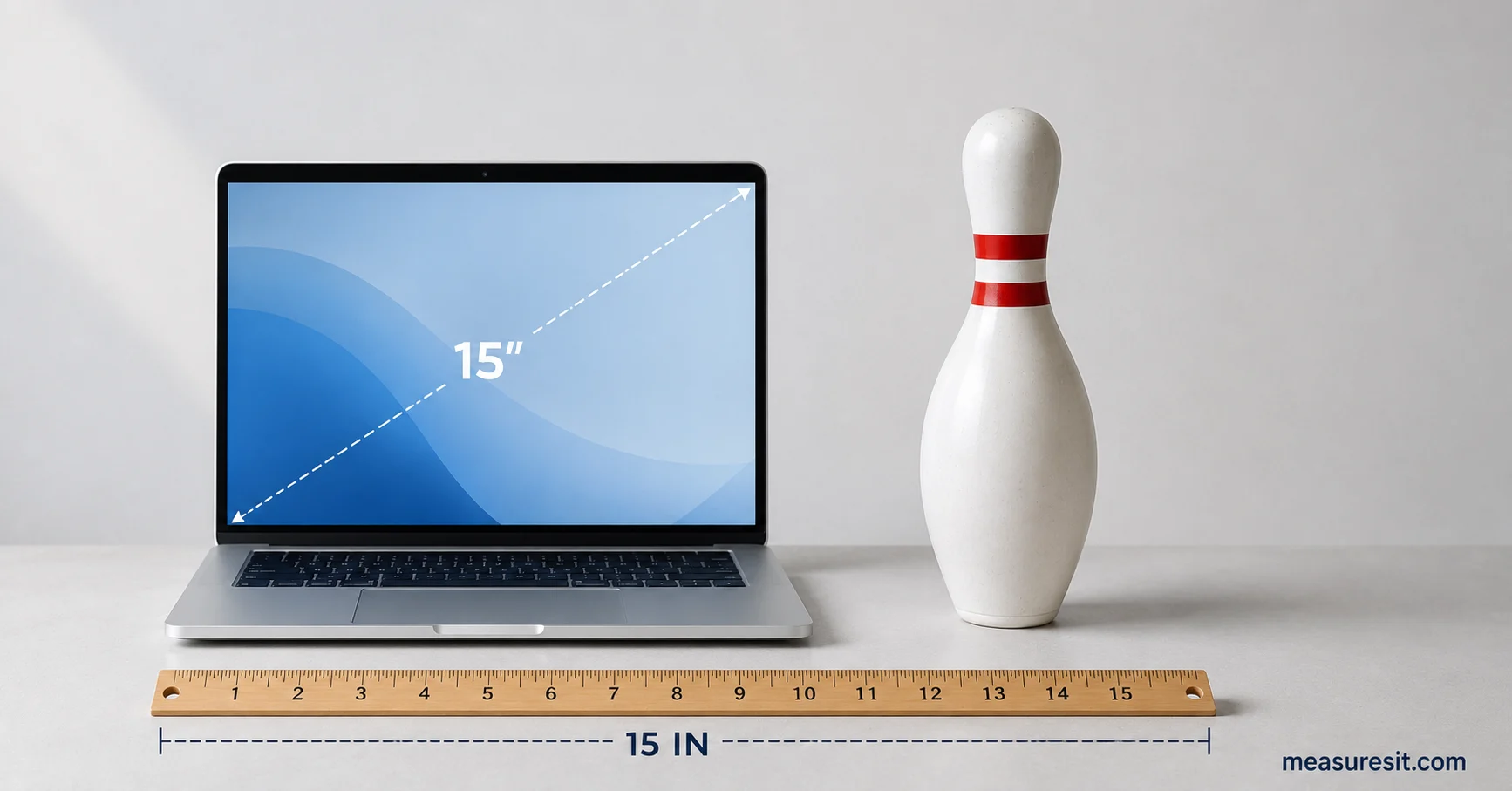
15 inches equals 1.25 feet, or 38.1 centimeters. If you want a picture instead of a number: it’s close to the diagonal of a 15-inch laptop screen, or the height of a regulation bowling pin standing on its own.
That’s the short answer. The more useful answer is what 15 inches actually feels like when you’re holding a tape measure up to a box, a bag, or a gap between two pieces of furniture because a number on its own doesn’t tell you much until you’ve got something real to compare it to.
The quick conversion
| Unit | Value |
| Inches | 15 |
| Feet | 1.25 |
| Yards | ≈ 0.42 |
| Millimeters | 381 |
| Centimeters | 38.1 |
| Meters | ≈ 0.38 |
A note on how this was put together: the comparisons below are split into two groups. The first group is tied to a real, checkable standard, a manufacturing spec, an organization’s official size, or a fixed government measurement so you can trust the number, not just the vibe. The second group is a looser, close enough list of household items, and it’s labeled that way rather than dressed up as more precise than it is.
Comparisons you can actually verify
A 15-inch laptop screen
This is probably the single most common real-world use of the number. Laptop screens are sold by diagonal measurement, and 15 inches (often listed as 15.6) sits right in the middle of the market bigger than a compact 13-inch ultrabook, smaller than a 17-inch gaming rig. If you’ve ever shopped for a laptop sleeve or checked If one would fit in a backpack pocket, you’ve already used this size as a reference without thinking about it.
A regulation bowling pin
The United States Bowling Congress specifies pin height at 15 inches. It’s one of the few objects on this list with an actual written standard behind it, which makes it a genuinely reliable mental ruler not just about 15 inches, but built to that number.
A 15-inch subwoofer
Car and home audio subwoofers are labeled by cone diameter, and 15 inches is a common size for anyone chasing serious bass. Unlike some of the softer comparisons further down, this one is exact by definition: a 15-inch sub is measured across at 15 inches, full stop.
Two and a half U.S. dollar bills, end to end
A dollar bill measures 6.14 inches long; that’s a fixed spec from the U.S. Bureau of Engraving and Printing, not a rounded guess. Lay two and a half bills end to end and you land at roughly 15.3 inches, close enough to work as a pocket ruler when you don’t have an actual one handy. It’s a small trick, but it’s the kind of thing that actually gets used when you’re standing in a store trying to figure out if something will fit.
Legal-size paper, plus a bit
A sheet of U.S. legal paper is 14 inches long, a fixed paper standard, not an estimate. Fifteen inches is just one inch past that, so if you’ve got legal paper nearby (most offices do), holding it up gets you almost exactly there.
A large chef’s knife
This one comes with a real range rather than a single number: full-size chef’s knives typically run 10 to 12 inches for the blade alone, and closer to 14–15 inches once you count the handle. It’s not a fixed standard the way a bowling pin is, but it’s a common enough kitchen size that most people who cook have handled one this long.
A quick mental cheat sheet (rough, everyday sizes)
These next few don’t have an official spec behind them; they vary by brand, style, and manufacturer but they’re common enough that most people can picture them without much effort. Treat these as in the ballpark, not exact measurements:
- Large teddy bears and baby dolls are frequently sold in a 15-inch size. It’s a popular labeling standard for gift-sized plush toys and dolls like the Bitty Baby style.
- A wooden rolling pin, handle to handle, tends to land somewhere close to 15 inches.
- A laptop bag built for a 15-inch laptop usually measures 15–16 inches across the inside.
- An oversized wall clock, the kind meant to anchor a big blank wall, often runs around 15 inches across.
- A large cutting board the kind meant for carving a turkey rather than slicing a lime is frequently close to this length.
- A violin body measures around 14 inches on its own, just under the mark, which makes it a decent slightly smaller reference.
- An interior door, at a typical 30–32 inches wide, means 15 inches is roughly half a doorway handy when you’re trying to work out if furniture will clear a hallway.
How to picture 15 inches without a tape measure
If none of the objects above are within reach, here’s a fast way to get close:
- Two hand spans. Most adult hands span roughly 7–8 inches from thumb to pinky, so two spans laid end to end gets you into the right neighborhood.
- A 12-inch ruler plus three fingers. A standard ruler covers 12 inches; add about three finger-widths and you’re close to 15.
- Legal paper. At 14 inches, it’s the single closest fixed object most people have lying around.
- A laptop lid. If it’s a 15-inch model, the screen’s diagonal is your answer, built in.
Useful Fractions and Multiples of 15 Inches
Fifteen inches is a friendly number to split. It divides cleanly into halves, thirds, and quarters, and its doubles land on round figures that show up constantly in shelving, spacing, and cutting jobs. Memorizing the handful of values below turns one measurement into a small toolkit.
The handy fractions
Because 15 is divisible by 3 and 5, its fractions come out tidier than most measurements:
| Fraction | Inches | Centimeters | Feet |
|---|---|---|---|
| One half | 7.5 in | 19.05 cm | 0.625 ft |
| One third | 5 in | 12.7 cm | ≈ 0.417 ft |
| One quarter | 3.75 in | 9.525 cm | 0.3125 ft |
| One fifth | 3 in | 7.62 cm | 0.25 ft |
Two of these earn their keep constantly. Half of 15 inches is 7.5 inches, or 19.05 cm, which is a common spacing for shelf brackets and a comfortable handhold width for carrying boxes. A third is exactly 5 inches, or 12.7 cm, which makes dividing any 15-inch span into three equal parts a no-math operation: just mark at 5 and 10.
The quarter, 3.75 inches, is the one people reach for when centering. If you need to center a 7.5-inch object on a 15-inch shelf, the margin on each side is 3.75 inches. Knowing the number in advance means one measurement instead of trial and error.
For the feet column, only the half and the fifth land on clean decimals worth remembering: 7.5 inches is 0.625 feet and 3 inches is exactly a quarter of a foot. The rest are easier to think about in inches.
The multiples
- Double: 30 inches. That is 2.5 feet, or 76.2 cm. It is one of the most common countertop and table heights in the world, which means if you have ever stood at a kitchen counter, you have felt 30 inches. Two 15-inch spans stacked are also a quick way to check whether a 30-inch doorway or appliance opening will clear.
- Triple: 45 inches. That is 3.75 feet, or 114.3 cm. It sits right in the range of standard railing and guard heights, and it is a useful rough check for the height of a typical office desk with a monitor riser.
- Half again: 22.5 inches. That is 1.875 feet, or 57.15 cm. Less famous than the double, but handy when you are scaling a 15-inch reference up by fifty percent, for instance judging whether a bag advertised for a 15-inch laptop has room to spare.
Notice that the double is exact in every unit: 30 inches is precisely 2.5 feet and precisely 76.2 cm. When a multiple lands this cleanly, it is worth committing to memory alongside the original.
Where the fractions save you real work
Fractions pay off in three everyday situations. First, equal spacing. Hanging three picture frames across a 15-inch wall section? Mark at 5 and 10 inches and each frame gets a third. No calculator, no cumulative rounding error from measuring 5 inches three times.
Second, centering. To center anything on a 15-inch surface, subtract the object’s width, halve the remainder, and measure that margin from each edge. A 9-inch cutting board centered on a 15-inch shelf leaves 3 inches per side, because 15 minus 9 is 6, and half of 6 is 3. The arithmetic only works smoothly because the starting number divides so well.
Third, scaling recipes and materials. Many craft and sewing patterns scale in simple ratios, and a 15-inch base measurement halves to 7.5 or thirds to 5 without the awkward decimals that a 14- or 16-inch base would produce. If you are resizing a pattern, starting from a number with clean fractions is a genuine advantage, not just a curiosity.
The broader lesson is that 15 inches is worth knowing not only as a length but as a divisible one. Halves, thirds, doubles: learn the set once and the number starts doing work for you.
Frequently asked questions
Is 15 inches bigger than a standard sheet of paper?
Yes U.S. letter paper is 11 inches long, so 15 inches is about 4 inches longer.
Is 15 inches more than a foot?
Yes. A foot is 12 inches, so 15 inches is a foot plus 3 more inches, or 1.25 feet.
What’s the most reliable everyday object to compare to 15 inches?
A 15-inch laptop screen or a regulation bowling pin both are tied to an actual standard rather than a rough estimate.
How many centimeters is 15 inches?
38.1 centimeters, using the standard conversion of 2.54 cm per inch.
Final thoughts
Fifteen inches is 1.25 feet, or 38.1 centimeters but the more useful takeaway is that you’ve probably already got a 15-inch object within reach. A laptop screen, a bowling pin, a couple of dollar bills laid end to end: these aren’t abstract comparisons, they’re things you can actually go check right now.
That’s really the point of a guide like this. A conversion chart tells you the math; a real object tells you what it means.
Next time you’re eyeing a product listing or trying to figure out if something fits in your bag, you don’t need a tape measure, just picture the laptop screen or the bowling pin, and you’ll be close enough to trust it.
Discover More About!
What Is 52 cm in Inches? Fast Answer + Chart
How Long Is 3 Inches? 15 Real-Life Comparisons
How Long Is 30 Inches? (Feet, CM & Real Examples)

Hi, I’m Vera Lindqvist, a content writer at MeasuresIt.com, where I turn measurement standards, unit conversions, and precision tools into clear, practical guides. I care about getting the details right so you don’t have to second-guess them.