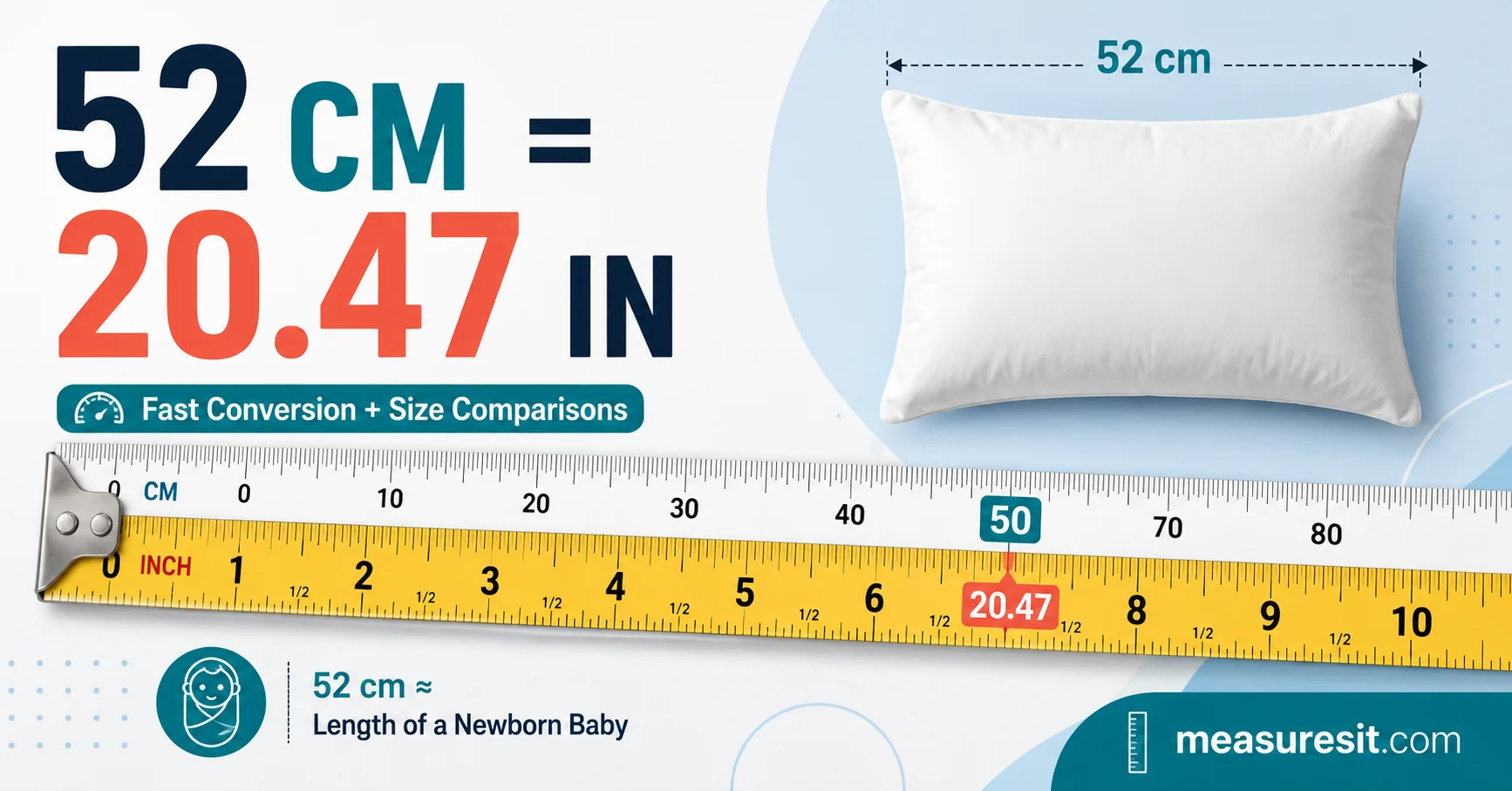
52 cm is about 20.47 inches. That’s the number, right up front, in case that’s all you came for.
But if you’re here, there’s a decent chance a product listing, a suitcase spec, or a recipe just threw a metric number at you and you needed it in something you can actually picture. That’s the annoying part of centimeters showing up in an inches-first world: the math is easy, but the sense of the length isn’t. Is 52 cm going to overflow your carry-on? Fit on that shelf? Look absurd next to a dinner plate?
This page covers both halves of the problem. First, the exact conversion and a full chart so you’re not stuck doing division in your head. Then, a set of everyday objects that happen to measure close to 52 cm, so you can stop thinking in numbers and start thinking in things you already know the size of, like a bed pillow or a bike wheel.
Conversion Chart
| Unit | Converted Value |
| Millimeters (mm) | 520 mm |
| Centimeters (cm) | 52 cm |
| Meters (m) | 0.52 m |
| Inches (in) | ≈ 20.47 in |
| Feet (ft) | ≈ 1.71 ft |
| Yards (yd) | ≈ 0.57 yd |
(Miles aren’t included at this scale, 52 cm works out to about three-thousandths of a mile, a number nobody actually needs.)
A Quick Mental Shortcut
If you don’t want to pull out a calculator every time, here’s the shortcut worth remembering: cut the centimeter number roughly in half, then add a bit back. 52 cm halved is 26; knock off about 5.5 and you land near 20.5 inches. It’s not exact; the real conversion factor is 2.54, not 2 but for a fast gut-check while scrolling a product page, it gets you close enough to know If something’s going to fit.
Objects That Are About 52 cm (20.47 Inches)
| Object | Approximate Length |
| Newborn baby | ≈ 19.5–20 in |
| 20-inch bike wheel | 20 in diameter |
| Standard bed pillow | 20 in wide |
| Carry-on suitcase | ≈ 21–22 in tall |
| Older 20-inch TV or monitor | 20 in diagonal |
| Rolling pin | ≈ 18–20 in |
| Housecat (nose to tail base) | ≈ 18–20 in |
| Knee-high boots | ≈ 18–20 in tall |
A Few More Everyday Comparisons
| Object | Approximate Length |
| Microwave oven | ≈ 20–24 in wide |
| 20-inch chain necklace | 20 in |
| Large cutting board | ≈ 18–20 in |
| Forearm, elbow to fingertips | ≈ 17–19 in |
| Large pizza box | ≈ 18–20 in per side |
| Acoustic guitar body | ≈ 19–20 in |
| Two sheets of letter paper, end to end | ≈ 22 in |
How Long Is 52 cm, Really?
Stand a two-liter soda bottle up and add a few inches on top. That’s roughly 52 cm. It’s almost double the length of a standard 12-inch ruler, but nowhere close to a yardstick it sits in that awkward middle zone that’s a little long for a drawer and a little short for a doorway.
Zoom out a bit and the range makes more sense. Something around 45 cm (about 17.7 inches) is closer to a large laptop bag. Something around 60 cm (about 23.6 inches) starts approaching the width of a bar stool seat. 52 cm lands right in between: long enough to notice when you’re packing or measuring a shelf, short enough that you can still picture the whole thing at once.
A few ways to eyeball it without a tape measure:
- Your own forearm. Elbow to fingertips is close to 18–19 inches on most adults stretch a little further and you’re near 52 cm.
- A bed pillow. Standard pillows run 20 inches wide, which is about as close a household match as you’ll find.
- Two rulers, almost. Line up two 12-inch rulers and you’d overshoot slightly (24 inches), so picture just short of that.
- Three phones. Lay three large smartphones end to end and you’ll land close to the mark.
- A newborn. If you’ve ever held a new baby or heard the length quoted at a hospital, you’ve already got a feel for this one.
- A suitcase tag. Airline carry-on height limits hover right around here, so luggage sizes double as a real-world ruler.
1. A Newborn Baby
The CDC puts the average newborn’s length at around 19.5 to 20 inches, which lines up almost exactly with 52 cm. It’s one of those numbers that sticks with people long after they’ve forgotten the actual math, since it’s usually attached to a real memory rather than a spec sheet.
If you’re picturing bassinet length or swaddle size, this is about as accurate a mental reference as you’ll find outside a tape measure.
2. A 20-Inch Bike Wheel
BMX bikes and a lot of kids’ bicycles use 20-inch wheels, and that diameter lands almost exactly on 52 cm. It’s printed right on the box at any bike shop, so it’s an easy one to double-check if you’re ever standing in front of one.
Next time you’re wheeling a kid’s bike out of a garage, that wheel is a pretty solid stand-in tape measure.
3. Your Bed Pillow
Most standard U.S. pillows measure 20 inches wide close enough to 52 cm that you could genuinely use one as a makeshift ruler. Chances are there’s one within reach of wherever you’re reading this.
That makes it one of the fastest checks available. Hold a pillow up against a box, a plant, or a stack of books, and you’ll know almost instantly If it’s in the same size range as 52 cm.
4. A Carry-On Suitcase
Airline carry-on limits usually cap height around 21 to 22 inches a touch over 52 cm, but close enough that frequent flyers already carry this number around in their heads without realizing it.
Because people actively measure luggage before a trip, it’s a comparison that tends to land. If your bag clears the overhead bin sizer, you already know roughly how long 52 cm feels.
5. An Old 20-Inch TV or Monitor
Before flatscreens ballooned in size, 20-inch monitors and TVs were everywhere, and that diagonal measurement sits right around 52 cm. Even now, most people can picture what one looked like.
It’s a handy reference if you’re trying to judge if something will fit in a cabinet gap or on a shelf imagine an old 20-inch screen sliding into that space.
6. A Rolling Pin
Wooden rolling pins, handles included, typically run somewhere between 18 and 20 inches. If you bake even occasionally, you’ve likely got a rough sense of this one already.
It’s especially useful in the kitchen, where recipes and bakeware often mix metric and imperial units without warning. Laying a rolling pin across a counter gives you an instant, physical sense of how much space 52 cm takes up.
7. A Housecat, Nose to Tail Base
Veterinary size guides put the average adult cat’s body length, not counting the tail, at somewhere around 18 to 20 inches. Anyone who’s shared a home with a cat has a built-in intuition for that length, even without thinking about it in numbers.
It’s a surprisingly reliable gauge for furniture and carrier sizing. If a cat can stretch out comfortably in a space, that space is somewhere near 52 cm.
8. Knee-High Boots
Depending on the style, knee-high boots run roughly 18 to 20 inches from sole to top edge. Anyone who’s scanned a shoe size chart online has probably seen shaft height listed in this exact range.
This one’s particularly useful for closet and storage planning: picturing a pair of boots standing upright gives you a fast read on If a bin or shelf is deep enough.
9. A Microwave’s Width
Countertop microwaves generally fall between 20 and 24 inches wide, with plenty landing right near the 52 cm mark. Since almost every kitchen has one, it’s a comparison most people can check without leaving the room.
If you’re eyeing counter space for something new, measuring against your existing microwave is often faster than grabbing a tape measure.
10. A 20-Inch Chain Necklace
Twenty inches is one of the most common lengths sold for necklaces, especially men’s chains. It’s a number that shows up constantly in jewelry listings, even if most shoppers never connect it to a broader unit of measurement.
Because it’s worn close to the body rather than sitting on a shelf, a necklace gives a different kind of reference draped in a loop, it shows how far 52 cm actually reaches around something curved.
11. A Butcher’s Cutting Board
Larger cutting boards, the kind meant for carving a turkey rather than slicing a lime, often run 18 to 20 inches long. Anyone who’s upgraded from a small board to a bigger one has a feel for the jump in size.
It’s a practical one for kitchen storage if you’re wondering If a drawer can hold something close to 52 cm, your biggest cutting board is a reasonable stand-in.
12. Your Own Forearm
From elbow to fingertips, most adults measure somewhere around 17 to 19 inches close to the old cubit measurement people used before rulers existed. It’s the one comparison on this list that’s attached to your body at all times.
That makes it the fastest option when nothing else is around. Stretch your arm out, and you’ve got a rough but genuinely usable estimate of 52 cm without touching a single tool.
13. A Large Pizza Box
Extra-large pizza boxes typically measure around 18 to 20 inches per side, which puts them squarely in this range. Odds are you’ve handled one within the last month.
This comparison works especially well for anything flat and square, like a picture frame or a sheet of poster board. Set a pizza box on a table and you’ve got an instant sense of both the length and the footprint of 52 cm.
14. A Guitar Body
Measured from the bottom edge up to where the neck begins, a standard acoustic guitar body runs close to 19 or 20 inches. Musicians tend to know this dimension well from hauling cases around.
It’s a good one for anything you’d store upright, like against a wall or in a closet corner. A guitar leaning in the corner gives a quick visual sense of how tall or long 52 cm reads in real space.
15. Two Sheets of Printer Paper
A standard U.S. letter sheet runs 11 inches along its long edge, so two sheets laid end to end come out to about 22 inches, just past 52 cm. Since paper is sitting in nearly every home or office, it’s one of the easiest comparisons to recreate on the spot.
When there’s no ruler in sight, grabbing two sheets from a printer tray is a decent stand-in. It won’t be perfectly precise, but it’ll get you close enough to make a call.
FAQ
Is 52 cm bigger than 20 inches?
Slightly, yes. 52 cm works out to about 20.47 inches, so it edges past a flat 20 inches by roughly half an inch.
How many feet is 52 cm?
About 1.71 feet.
What’s the closest household item to 52 cm?
A standard bed pillow, at 20 inches wide, is one of the closest and easiest matches to check at home.
I searched 52 in inches. Is that the same question?
Yes. That’s a shorthand version of the same query, and the answer works out the same either way: roughly 20.47 inches, assuming the starting measurement is in centimeters.
Final Thoughts
So, what is 52 cm in inches? About 20.47 inches long enough to matter when you’re packing a bag or checking if something fits on a shelf, but still short enough to hold the whole length in your head at once.
The math is the easy part. What actually helps is having something real to compare it to: a bed pillow, a bike wheel, your own forearm stretched out.
Keep one or two of those in mind, and you’ll be able to size things up the next time a listing throws a centimeter measurement at you and expects you to just know what that means.
Read More Posts!
How Long Is 14 Inches? Real-World Comparisons
How Long Is an Inch? Sizes, Conversions & Comparisons
How Long Is 16 Inches? Real-Life Size Comparisons

Hi, I’m Vera Lindqvist, a content writer at MeasuresIt.com, where I turn measurement standards, unit conversions, and precision tools into clear, practical guides. I care about getting the details right so you don’t have to second-guess them.







2 thoughts on “What Is 52 cm in Inches? Fast Answer + Chart”