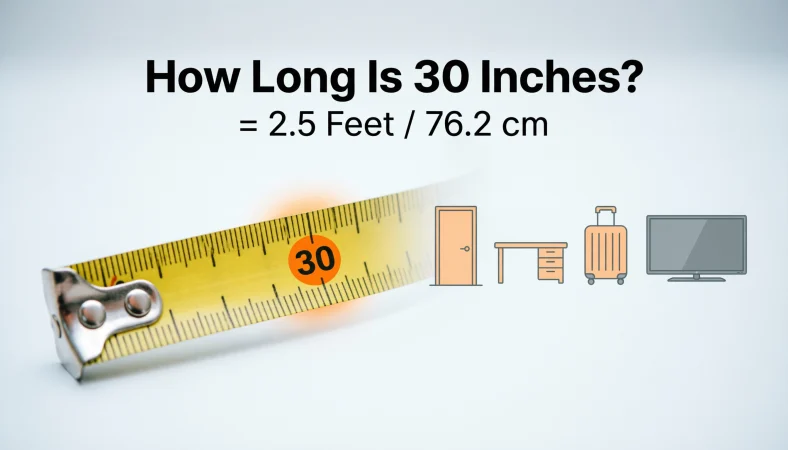
I measured my hallway door last year before buying a bookshelf, and the number that came back 30 inches meant almost nothing to me until I stood next to it. 30 inches equals 2.5 feet, or 76.2 centimeters (0.762 meters).
That’s it, that’s the answer. But numbers on their own rarely tell you what something actually looks like in your living room.
This length shows up constantly once you start noticing it: doorways, desks, suitcases, TVs. If you’re trying to picture 30 inches before you buy, pack, or build something, the fastest way is to compare it to things you already interact with every day. That’s what this guide does.
Conversion Chart
| Unit | Converted Value |
| Inches | 30 in |
| Feet | 2.5 ft |
| Yards | ≈0.83 yd |
| Millimeters | 762 mm |
| Centimeters | 76.2 cm |
| Meters | 0.762 m |
These are exact conversions 1 inch is defined as exactly 2.54 cm, so nothing here is rounded or estimated.
Common Objects That Are About 30 Inches
| Object | Approximate Length |
| Interior door | 30 in wide |
| Office desk | 29–30 in tall |
| Bathroom vanity | 30–32 in tall |
| 30-inch class TV | 30 in diagonal |
| Large checked suitcase | 28–30 in tall |
| Baby safety gate | ~30 in tall |
| Bath towel | ~30 in long |
| Skateboard | 31–32 in long |
More Everyday Items Around 30 Inches
| Object | Approximate Length |
| Car tire | 28–30 in diameter |
| Toddler around 18 months | ~30–32 in tall |
| Full-size violin case | ~30 in long |
| Kitchen step trash can | 30–33 in tall |
| Mountain bike 29er wheel | ~29 in diameter |
| Bar-height stool seat | 28–30 in tall |
| Ultrawide computer monitor | 30–32 in diagonal |
A quick note on accuracy: most of these are ranges, not fixed numbers, because real products vary by brand and manufacturer. Where a figure comes from an outside source rather than a fixed standard, I’ve said so directly instead of presenting it as exact.
Picturing 30 Inches Without a Tape Measure
Here’s a trick that’s stuck with me since a contractor showed it to me during a kitchen remodel: grab a yardstick, which measures exactly 36 inches, and mentally lop off the last six. What’s left is 30 inches, almost to the eye.
It also sits just above the halfway point of a standard 8-foot ceiling roughly a third of the way up and close to hip height on an average adult. If you’ve ever leaned against a kitchen counter or an office desk, your hip was probably resting right around 30 inches off the floor.
In metric, 76.2 cm rounds down just short of a meter. If you’ve shopped at IKEA or another European retailer and seen 76 cm listed on a desk or shelf, that’s this exact measurement.
A few fast reference points to keep in your back pocket:
- A yardstick minus six inches
- The width of a typical interior door
- Roughly hip-height on most adults
- Just under a meter (76.2 cm)
- Two and a half rulers laid end to end
1. Interior Door Width
Walk through most U.S. homes and the interior doors you pass through are almost certainly 30 inches wide. It’s the standard width builders have used for decades, wide enough for comfortable passage without eating into wall space.
I trust this comparison more than most on this list because door width doesn’t really vary house to house the way furniture or products do. If you know your own hallway door, you already know what 30 inches looks like.
It’s especially useful when you’re furniture shopping and need to know if a couch or dresser will actually clear the doorway.
2. Office Desk Height
Most desks, home office, dining table doubling as a workspace, corporate cubicle land between 29 and 30 inches tall. That range isn’t random; it’s roughly where ergonomic guidelines put a surface for comfortable typing without hunching your shoulders.
Sit down at almost any desk and your forearms are resting at close to 30 inches off the floor, which makes this one of the easiest heights to internalize simply by working at a desk every day.
Keep it in mind when shopping for a desk chair, since seat height needs to pair with this range to keep your knees at a comfortable angle.
3. Bathroom Vanity Height
Older and mid-range homes typically have vanities that sit 30 to 32 inches tall. Newer comfort height vanities run a few inches taller, closer to kitchen counter height, but the classic 30-inch version is still what you’ll find in a huge share of existing bathrooms.
Because bathrooms get used multiple times a day, this height tends to be one people can recall almost without thinking lean against your own vanity and you’ve got a built-in reference.
It’s worth checking before hanging a new mirror or light fixture, since spacing usually gets measured up from the vanity top.
4. 30-Inch Class TV Screen
TV sizes are always measured diagonally, corner to corner across the screen, so a 30-inch class television has a diagonal of right around 30 inches. It’s on the smaller end of what’s sold today think bedroom, kitchen, or dorm room rather than a main living room setup.
Screen size sticks in people’s heads because it’s the first number advertised on every box and product listing, so most shoppers already have a rough sense of scale before they even pick a TV up.
This comparison is handy when you’re figuring out how much wall or stand space a TV will actually take up before you buy.
5. Large Checked Suitcase Height
Large checked luggage, the kind meant for long trips or family vacations, typically runs 28 to 30 inches tall. Airlines cap total linear dimensions (height plus width plus depth), and a 30-inch suitcase sits near the upper limit of what most carriers allow.
Anyone who has hauled one through an airport knows the feeling of a suitcase standing roughly waist-high next to them; that physical memory is what makes this comparison so easy to recall later.
It’s a good gut-check when deciding If a suitcase will actually fit in a car trunk or closet.
6. Baby Safety Gate Height
Standard baby safety gates measure close to 30 inches tall, a height meant to stop a toddler from climbing over while still letting an adult step past without too much trouble. Extra-tall versions exist for bigger dogs or older kids, but 30 inches is the common baseline.
Parents in particular develop a strong internal sense of this height, since the gate becomes a daily obstacle for a few years running.
It doubles as a handy reference for estimating the height of low shelving, room dividers, or half-walls.
7. Bath Towel Length
A standard bath towel runs close to 30 inches long, usually paired with a width around 54 inches for the full towel. It’s the size most linen closets are stocked with by default.
Towels make an unusually relatable comparison simply because everyone handles one daily wrapping it around themselves, folding it, hanging it so the length isn’t abstract in the way a lot of measurements are.
Useful to know when shopping for towel bars or storage baskets sized to hold one folded.
8. Skateboard Length
A standard skateboard deck measures about 31 to 32 inches, just a touch over 30 inches, which makes it one of the closest matches on this entire list. Deck length barely varies across brands, so skaters can eyeball the size instantly.
Even people who’ve never ridden one tend to have the shape memorized. It’s distinctive enough that about the length of a skateboard lands immediately.
Good for estimating the length of narrow spaces, like a closet shelf or the gap beside a bed frame.
9. Car Tire Diameter
The overall diameter of a typical passenger car tire rubber plus wheel falls somewhere around 28 to 30 inches, though this varies by vehicle. Trucks and SUVs usually run larger.
Because tires are a fixed, unchanging shape people see constantly in driveways and parking lots, the size rarely catches anyone off guard once they think about it.
Handy for estimating clearance in a garage or picturing how much space a spare tire takes up in a trunk.
10. Toddler Height Around 18 Months
Per the CDC’s growth charts, the average 18-month-old measures roughly 30 to 32 inches tall though individual kids vary quite a bit, and this is a population average, not a rule. Pediatricians track this against a percentile curve rather than a single fixed number.
Parents tend to remember this range well simply because tracking height is part of every well-child visit at that age.
It’s a gentle, relatable way to picture the length even if you don’t have kids of your own; most people have stood next to a toddler at some point.
11. Full-Size Violin Case
A case built for a full-size violin usually measures close to 30 inches, sized to hold both the instrument and its bow. Smaller cases exist for younger students playing scaled-down instruments.
Musicians who’ve carried one on their back through a hallway or wedged one into a car trunk tend to know this length by feel rather than by number.
Worth remembering if you’re trying to estimate If a similarly shaped case, or anything long and narrow, will fit in a closet or trunk.
12. Kitchen Step Trash Can
Tall kitchen trash cans with a foot pedal and lid commonly stand 30 to 33 inches, a popular height for households that don’t want to bend down every time they toss something out.
It’s an easy one to recall because it sits in daily view at roughly hip height for most adults, right in the flow of the kitchen.
Useful when planning cabinet or pantry space that needs to leave room for a trash can to tuck in without the lid catching on a shelf.
13. Mountain Bike 29er Wheel
29er mountain bikes take their name directly from wheels measuring close to 29 inches in diameter just shy of 30 inches, and one of the most common wheel sizes on modern trail bikes.
Cyclists have this number practically memorized since it’s printed on the tire sidewall and comes up constantly when comparing bike models.
A good mental anchor for visualizing large circular objects generally, If it’s a wheel, a hoop, or a round tabletop.
14. Bar-Height Stool Seat
Bar-height stools typically place the seat 28 to 30 inches off the ground, built to pair with counters and bars that stand a few inches taller than a standard table.
Most people have climbed onto one at a kitchen island or restaurant bar at some point, which makes this height feel familiar even without thinking about it in numbers.
Useful for checking If new stools will actually match the height of an existing counter or bar ledge.
15. Ultrawide Computer Monitor
Large ultrawide monitors, popular for gaming and multitasking setups, commonly measure 30 to 32 inches diagonally, a sizable step up from the 24-inch monitors found in most standard office setups.
Anyone who has shopped for a monitor recognizes this range instantly, since screen diagonal is printed right in the product name.
Good to keep in mind when planning desk space or checking If a monitor arm or stand can handle the size.
FAQ
Is 30 inches bigger than a yardstick?
No a yardstick measures 36 inches, so 30 inches is six inches shorter than a full yard.
What household item is closest to 30 inches?
A standard interior door width and a typical office desk height are both very close, landing right around 30 inches.
How many feet is 30 inches?
30 inches equals 2.5 feet exactly.
Is a 30-inch TV considered big?
Not by today’s standards. It’s a smaller screen, typically used in bedrooms, kitchens, or dorm rooms rather than main living rooms, where 55 inches and up is now common.
Final Thoughts
So, how long is 30 inches? Exactly 2.5 feet, or 76.2 centimeters but the number matters less than what it maps onto in real life. It’s the width of the door you probably walked through today, the height of the desk you might be sitting at right now, the screen size of a TV you’d call small, the suitcase that always feels heavier than it looks at the airport.
That’s really the point of comparing measurements to everyday objects: numbers are abstract until you tie them to something you’ve touched.
Next time you need to picture 30 inches sizing up furniture, packing for a trip, or measuring a doorway before moving day you’ve now got more than a dozen familiar things to measure against instead of just a number on a tape.
Read More Posts!
- How Long Is 16 Inches? Real-Life Size Comparisons
- What Is 52 cm in Inches? Fast Answer + Chart
- How Long Is 3 Inches? 15 Real-Life Comparisons

I’m Marcus Kane, a measurement content specialist at MeasuresIt.com. I write clear, accurate, and practical articles about measurements, dimensions, conversions, and everyday size comparisons, making complex topics simple and easy to understand.









1 thought on “How Long Is 30 Inches? (Feet, CM & Real Examples)”