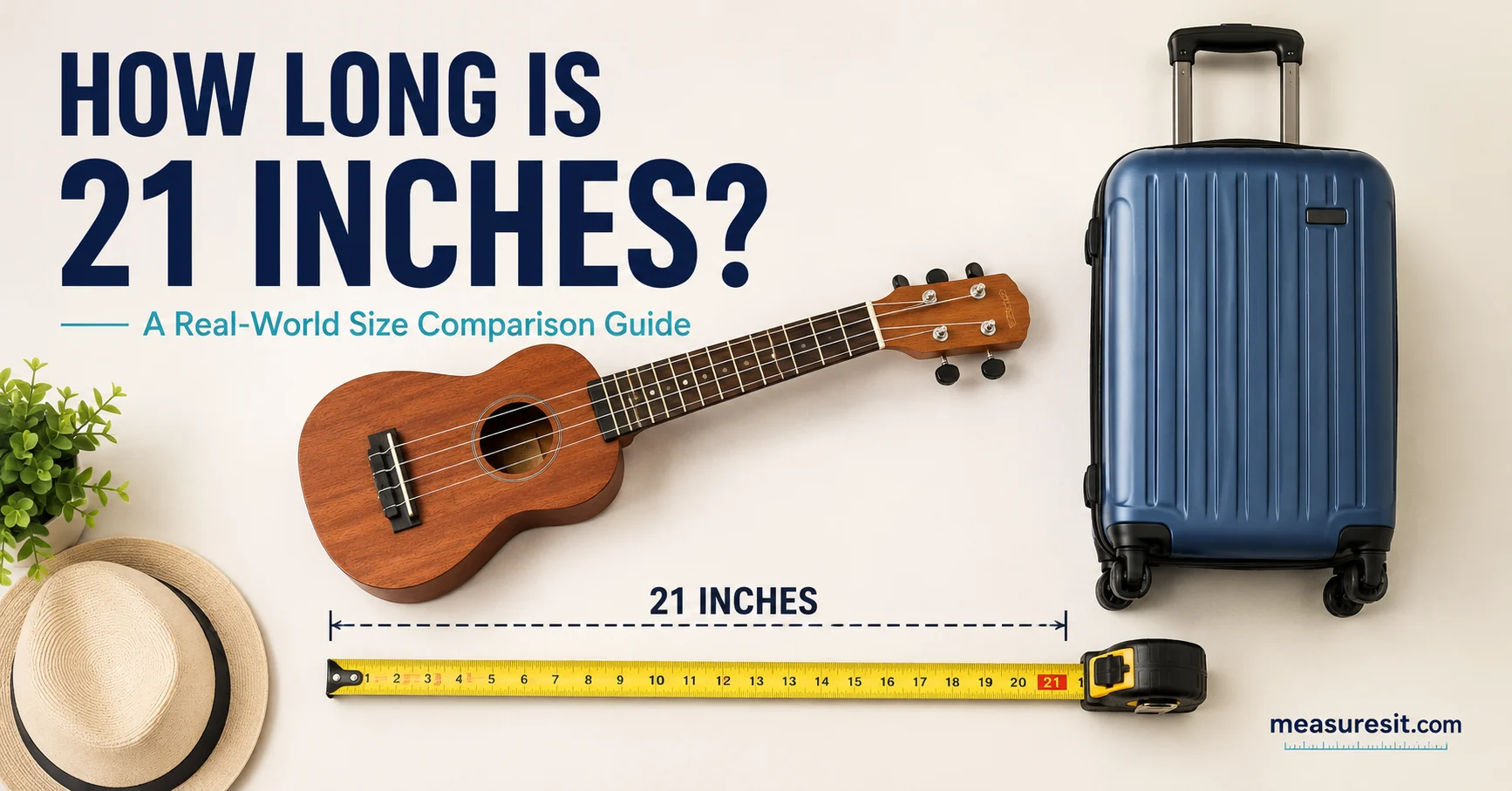
You’re staring at a product listing, or maybe standing at an airport check-in counter, and the number 21 inches just doesn’t mean much on its own. It works out to 1.75 feet, or about 53.3 centimeters: roughly the length of a soprano ukulele, and just under the optimal carry-on height that airlines actually recommend.
Once you’ve got a real object to picture, the number stops being abstract. This length turns up in more places than most people expect. It shows up at airline luggage sizers, in the hands of bakers rolling out dough, in the notes new parents compare about a baby’s length at birth, and in the tape measure of anyone sizing up a shelf, a box, or a gap between furniture. Below is a full breakdown: a conversion chart, a diagram, fifteen genuine size comparisons, and a few tricks for eyeballing this length without ever touching a tape measure.
Most how long is X guides online round every comparison to the nearest tidy number and call it a day. That approach is convenient, but it isn’t always accurate, so this one takes a slightly different route. Every object below is checked against a real, commonly cited measurement, If that’s a product spec, a medical growth reference, or an aviation industry standard, rather than a rounded-off guess. Where an object’s size naturally varies, like a teddy bear or a violin, that range is spelled out instead of forced into a false-precision number that sounds more exact than it really is.
Conversion Chart
| Unit | Converted Value |
| Inches | 21 in |
| Feet | ≈ 1.75 ft |
| Yards | ≈ 0.58 yd |
| Millimeters | ≈ 533.40 mm |
| Centimeters | ≈ 53.34 cm |
| Meters | ≈ 0.53 m |
What 21 Inches Looks Like
Stand up and imagine a length running from the floor to somewhere around your knee. That’s close to 21 inches on most adults. It’s noticeably longer than a school ruler (12 inches), but it falls well short of a yardstick (36 inches).
For a sense of scale, 18 inches, a foot and a half, is about the length of the average housecat, nose to the base of the tail. Step up to 24 inches, two full feet, and you’re at the width of a standard yoga mat. This measurement sits right in between, which is exactly why it’s easy to misjudge without something to compare it to.
That in-between quality is also why this particular length trips people up more than rounder numbers like 12, 18, or 24 inches. It doesn’t map cleanly onto a familiar object the way a foot or two feet does, so most people either round it down to about a foot and a half or up to almost two feet, both of which understate how much length is actually there. Anchoring it to a specific object, rather than a rounded fraction, closes that gap.
The Closest Matches
These eight objects land the nearest to 21 inches most within an inch or two.
| Object | Approximate Length |
| Soprano ukulele | ≈ 21 in |
| IATA optimal carry-on bag height | ≈ 21.5 in |
| Countertop microwave (width) | ≈ 21–22 in |
| 24-inch computer monitor (width) | ≈ 20.9 in |
| Wooden rolling pin | ≈ 20 in |
| Large kitchen cutting board | ≈ 20 in |
| Extra-large pizza (diameter) | ≈ 20 in |
| Newborn baby (average length) | ≈ 19.5–20 in |
More Useful Comparisons
These seven are handy references too, though a few run a little short or a little long that gap is called out honestly rather than rounded away.
| Object | Approximate Length | How Close |
| Large stuffed teddy bear | ≈ 20–24 in | Varies by brand |
| Adult forearm, elbow to fingertip | ≈ 18–20 in | Slightly short |
| Housecat, nose to base of tail | ≈ 18 in | A few inches short |
| Two 12-inch rulers, end to end | 24 in | 3 in over |
| Adult shin, knee to ankle | ≈ 17–19 in | Slightly short |
| Full-size violin (with neck) | ≈ 23–24 in | A few inches over |
| Yoga mat (width) | ≈ 24 in | 3 in over |
Soprano ukulele
The smallest, most common ukulele size measures right around 21 inches from headstock to base about as exact a match as you’ll find on this list. It’s a familiar shape even to people who’ve never played one, which makes it an easy mental anchor.
IATA optimal carry-on bag height
Most U.S. airlines cap carry-on height around 22 inches, but the International Air Transport Association’s own guideline for an optimal cabin bag is 21.5 inches tall nearly a perfect match. Travelers run into this number under real pressure, at a gate sizer, which tends to make it stick.
Countertop microwave
A typical countertop microwave runs about 21 to 22 inches wide. Since most kitchens have one, it’s a size people have brushed past without ever thinking of it as a measurement.
24-inch computer monitor
Monitors are labeled by their diagonal screen size, so a 24-inch widescreen monitor is actually about 20.9 inches wide edge to edge. Anyone who’s worked at a desk has sat in front of one.
Wooden rolling pin
A standard wooden rolling pin measures close to 20 inches end to end. Bakers handle this size often enough that it becomes second nature, even without ever measuring it on purpose.
Large kitchen cutting board
A large cutting board’s longest edge typically comes in around 20 inches. Its flat, rectangular shape also makes it easy to line up against furniture or boxes for a rough size check.
Extra-large pizza
An extra-large pizza from most chains measures close to 20 inches across. It’s a food-based reference almost everyone has ordered, which makes the size easy to recall casually.
Newborn baby
According to widely cited medical growth data, the average full-term newborn measures about 19.5 to 20 inches long at birth. It’s a number many parents remember clearly, since it’s often one of the first figures recorded after delivery.
Large stuffed teddy bear
Bears marketed as large or jumbo typically run 20 to 24 inches, so the size varies more than most items here. Still, if you’ve ever propped one on a shelf or a bed, you already have a decent feel for the range.
Adult forearm and hand
The distance from an average adult’s elbow to fingertip lands somewhere between 18 and 20 inches. It’s one of the fastest ways to estimate a length in a pinch, since it’s attached to you.
Housecat
A typical housecat measures roughly 18 inches from nose to the base of the tail a few inches short of 21, but a familiar enough shape to use as a lower bookend.
Two rulers, end to end
Two ordinary 12-inch classroom rulers laid end to end total 24 inches. Slide the second one back about 3 inches and you land almost exactly on this measurement a trick worth knowing if a ruler’s the only tool nearby.
Adult shin
Measured from knee to ankle, an adult shin usually falls between 17 and 19 inches. It’s a rougher comparison than most on this list, but a useful one when there’s nothing else to measure against.
Full-size violin
A full-size violin, from the scroll to the bottom of the body, runs about 23 to 24 inches a few inches past this length rather than an exact match. The tapered shape still makes it a decent reference for a slender, elongated object.
Yoga mat
Standard yoga mats are usually about 24 inches wide. It overshoots by a few inches, but folding one in half gets you back into range, which is a trick worth remembering.
Ways to Estimate 21 Inches Without a Tape Measure
- Use your arm. The distance from an adult’s elbow to fingertip is close to this length, and it’s always with you.
- Think carry-on. The IATA’s recommended optimal cabin bag height is almost exactly 21.5 inches.
- Picture a ukulele. A soprano ukulele lines up almost exactly with this measurement.
- Go knee-height. For most standing adults, floor to knee lands close to this mark.
- Grab two rulers. Lay two 12-inch rulers end to end, then back off by about 3 inches.
- Use a cutting board. A large one measures close to 20 inches just shy of the mark.
FAQ
Is 21 inches longer than a standard ruler?
Yes. A standard ruler measures 12 inches, so this length is 9 inches nearly twice as long.
What household item comes closest?
A soprano ukulele is about as close as it gets, at roughly 21 inches. A large cutting board or rolling pin, both around 20 inches, are close runners-up.
How many centimeters is 21 inches?
About 53.3 centimeters, or a little over half a meter.
Will a 21-inch bag fit as a carry-on?
Usually, yes. Most U.S. airlines allow carry-ons up to about 22 inches tall, and the industry’s own optimal recommendation is 21.5 inches, so a 21-inch bag comfortably fits most policies. Always confirm with your specific airline before flying, since limits vary.
Final Thoughts
21 inches breaks down to 1.75 feet, or about 53.3 centimeters and once that’s tied to something real, like a ukulele in a store window or the carry-on bag you dragged through security, it stops being just a number on a page.
That’s the real value of comparisons like these: a tool-free way to size things up, if you’re checking if a suitcase will pass the gate size, fitting a cutting board onto a cramped counter, or just satisfying a passing curiosity about a measurement you ran into online.
Read More About!
- How Long Is 30 Inches? (Feet, CM & Real Examples)
- How Long Is 15 Inches? A Real-World Size Guide
- How Long Is 19 Inches? 15 Everyday Size Comparisons

I’m Elena Cross, a content writer at MeasuresIt.com, where I turn complex measures, units, and mathematical concepts into clear, accurate, and easy-to-read articles. I’m passionate about precision in numbers and in words and I write to help readers actually understand measurements, not just memorize them.






2 thoughts on “How Long Is 21 Inches? A Real-World Size Comparison Guide”