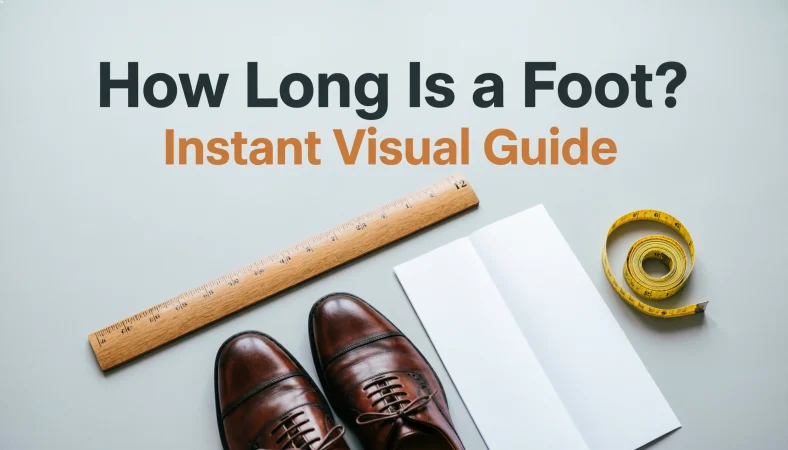
A foot is 12 inches, or about 30.48 centimeters. It’s one of the oldest units of length still in everyday use, and once you have a mental picture of it, you can size up almost anything: a shelf, a gap under a couch, a moving box without hunting for a tape measure.
You’ll run into this measurement constantly: reading furniture dimensions online, checking if a rug will fit a room, or figuring out how much closet space you’re actually working with. A foot sits right in the middle of the imperial system bigger than an inch, smaller than a yard which is exactly why it’s so useful as a mental yardstick (pun intended).
Quick Conversion Chart
| Unit | Equivalent |
| Inches | 12 in |
| Feet | 1 ft |
| Yards | ≈0.33 yd |
| Millimeters | 304.8 mm |
| Centimeters | 30.48 cm |
| Meters | ≈0.30 m |
Everyday Things That Are About a Foot Long
The fastest way to internalize a measurement isn’t memorizing a number, it’s tying it to something you already handle regularly. These are genuinely reliable references, not stretched comparisons:
| Object | Approximate Length |
| A standard 12-inch ruler | 12 in (exact) |
| A footlong sub sandwich | 12 in (by name) |
| A men’s size 11–12 shoe | ≈12 in |
| A large dinner plate | ≈11–12 in |
| A sheet of printer paper (long edge) | 11 in |
| A 13-inch laptop, closed | ≈12 in wide |
| A 2-liter soda bottle | ≈12 in tall |
| A standard subway tile or floor tile | 12 in |
Notice what these have in common: each one is a fixed, standardized object, not something that varies wildly by brand or individual. That’s what makes a comparison actually useful instead of just decorative.
Picturing a Foot Without a Ruler
A foot is easy to underestimate because it doesn’t feel dramatic, it’s not a stride, and it’s not a fingertip. It’s the middle distance: about the length of your forearm from elbow to wrist for most adults, or a bit more than one and a half hand spans.
If you’ve ever measured a room by pacing heel-to-toe, you’ve already used a rough foot-based system that’s literally where the unit’s name comes from historically. It’s a human-scale measurement, which is part of why it’s stuck around for centuries even as most of the world moved to metric.
Fast ways to estimate a foot with no tools:
- Pull out a shoe. Adult shoes, especially men’s sizes 10–12, run close to 12 inches.
- Grab a sheet of paper. Standard printer paper is 11 inches long just shy of a foot.
- Use your forearm. Elbow to wrist is a close, portable approximation for most adults.
- Picture a ruler. If you can see a 12-inch ruler in your head, you have the exact reference.
- Think of floor tiles. Standard tiles are almost always cut to 12-inch squares.
A Note on Precision
A few of the comparisons above are close but not exact shoe sizes vary by brand, and dinner plates range from 10 to 12 inches depending on the set. Treat these as fast mental estimates, not substitutes for an actual measurement when precision matters, like ordering flooring or a custom shelf. For anything you’re buying or building, measure directly.
Reading and Converting Feet-and-Inches Measurements
American measurements are rarely written as just feet or just inches. They show up as pairs, like 5’6″ or 6′ 2″, and if you have never learned to read that shorthand, product listings and height charts look like code. They are not. This section decodes the format and shows the two conversions that make it useful.
What 5’6″ actually means
The single quote mark (‘) stands for feet and the double quote mark (“) stands for inches. So 5’6″ means 5 feet and 6 inches. You will see it written with or without a space, 5’6″ or 5’ 6”, and sometimes with the words spelled out as “5 ft 6 in”. All three mean the same thing.
The inches part is always less than 12. If you ever see something like 5’14”, that is a mistake or a joke; 14 inches is a foot and 2 inches, so the correct form is 6’2″. Keeping the inches under 12 is the one rule of the format, and it is what lets you read any measurement at a glance.
This shorthand is everywhere once you notice it. Human heights, doorway widths, TV stand dimensions, lumber lengths, and sports stats all use it. A basketball player listed at 6’7″ is 6 feet 7 inches. A doorway marked 6’8″ is 6 feet 8 inches. Learning to convert these pairs is learning to read half the measurements in an American home.
Feet and inches to total inches
To get a single number, multiply the feet by 12 and add the inches. That is the whole formula: total inches = (feet × 12) + inches.
Here are the conversions you will meet most often:
| Written | Math | Total inches |
|---|---|---|
| 5’6″ | (5 × 12) + 6 | 66 in |
| 4’8″ | (4 × 12) + 8 | 56 in |
| 6’2″ | (6 × 12) + 2 | 74 in |
| 5’10” | (5 × 12) + 10 | 70 in |
| 3’4″ | (3 × 12) + 4 | 40 in |
| 6’8″ | (6 × 12) + 8 | 80 in |
Two of these are worth memorizing outright. The average American doorway is 6’8″, which is 80 inches, so “80 inches” is the clearance number behind every will-it-fit-through-the-door question. And 5’10”, or 70 inches, sits near the middle of adult heights, making it a useful anchor when a chart lists heights you need to picture.
Going the other direction is just as easy. To turn total inches back into feet and inches, divide by 12: the whole part is the feet and the remainder is the inches. Seventy inches divided by 12 is 5 with 10 left over, so 70 inches is 5’10”. Fifty inches is 4’2″, because 48 is the nearest lower multiple of 12 and 2 remains.
Inches to decimal feet
Sometimes you need feet as a single decimal number, for instance when a calculator or a flooring estimator asks for length in feet. Divide the inches by 12, or memorize the common ones:
| Inches | Decimal feet |
|---|---|
| 1 in | ≈ 0.083 ft |
| 3 in | 0.25 ft |
| 6 in | 0.5 ft |
| 9 in | 0.75 ft |
| 2 in | ≈ 0.167 ft |
| 4 in | ≈ 0.333 ft |
The quarters are the ones that matter day to day: 3 inches is a quarter foot, 6 inches is half a foot, 9 inches is three-quarters. So 2’6″ is 2.5 feet, 1’9″ is 1.75 feet, and 4’3″ is 4.25 feet. Once the quarter marks are automatic, decimal feet stop feeling foreign.
A common slip here is writing 5’6″ as 5.6 feet. It is not. Six inches is half a foot, so 5’6″ is 5.5 feet. The digit after the point is a fraction of a foot, not a count of inches, and mixing those up throws every downstream calculation off by a wide margin. When in doubt, convert to total inches first, then divide by 12: 66 ÷ 12 = 5.5, no ambiguity.
FAQ
Is a foot bigger than a ruler?
They’re the same; a standard ruler is manufactured to be exactly one foot long.
How many feet are in a yard?
Three. A yard is defined as 3 feet, or 36 inches.
What’s the easiest household item to compare to a foot?
A sheet of printer paper (11 inches) or a large dinner plate (11–12 inches) are the closest common matches.
Does every country use feet?
No. The foot belongs to the imperial system used mainly in the U.S., Liberia, and Myanmar. Most other countries measure length in centimeters and meters.
Final Thoughts
A foot 12 inches, about 30 centimeters is one of those measurements that’s more useful the more you can picture it without checking a chart.
Once an object like a ruler, a shoe, or a sheet of paper is locked in as your mental reference, sizing things up while shopping, packing, or measuring a room gets a lot faster.
Just remember: these comparisons are for quick estimates. When it actually matters cutting wood, buying a rug, fitting furniture through a doorway grab a real tape measure.
Read More!
How Long Is 30 Feet? Everyday Comparisons
How Long Is 40 Feet? 15 Real-Life Size Comparisons

I’m Marcus Kane, a measurement content specialist at MeasuresIt.com. I write clear, accurate, and practical articles about measurements, dimensions, conversions, and everyday size comparisons, making complex topics simple and easy to understand.