Try backing a moving truck into a narrow driveway, or squinting at an apartment listing that calls itself spacious, and you’ll want a real answer, fast.
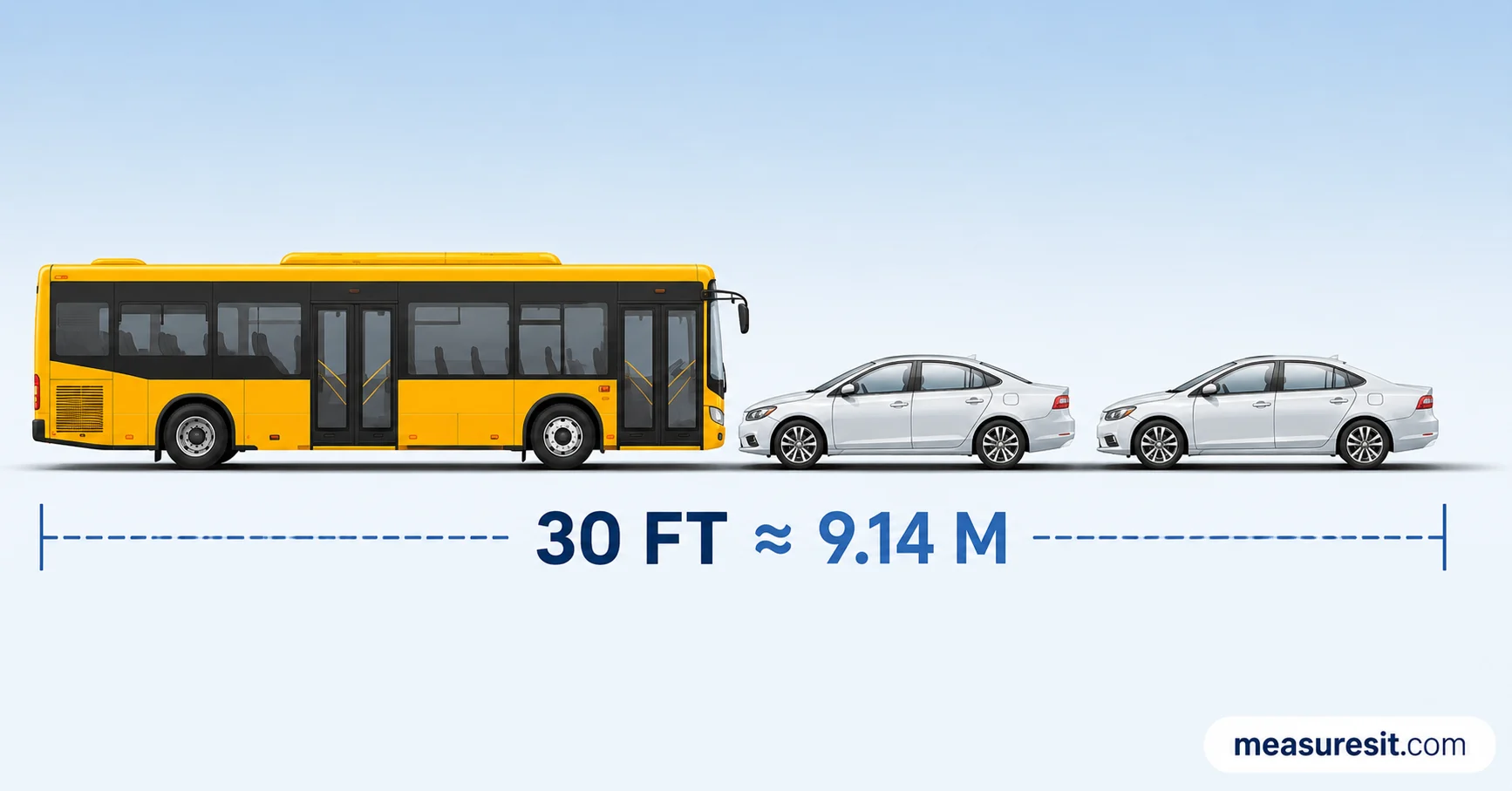
Thirty feet is 10 yards, or about 9.14 meters, close to the length of a city bus, or two ordinary sedans parked bumper to bumper. Once you can picture it, the number on the tape measure finally means something.
This is a more useful question than it looks. Renters check it before signing a lease. Homeowners check it before calling a fence contractor. Boaters check it before booking a marina slip. Below, you’ll find the exact conversions, a set of everyday objects that are roughly 30 feet long, and a few tricks for estimating the distance without ever pulling out a tape measure.
Conversion Chart: 30 Feet in Other Units
A foot is defined as exactly 0.3048 meters, so these conversions aren’t estimates. They’re the precise figures you can use for ordering materials, filling out a form, or double-checking a contractor’s measurements.
| Unit | Converted Value |
| Inches | 360 in |
| Feet | 30 ft |
| Yards | 10 yd |
| Miles | ≈ 0.0057 mi |
| Millimeters | 9,144 mm |
| Centimeters | 914.4 cm |
| Meters | ≈ 9.14 m |
Common Objects That Are About 30 Feet
Here are eight widely recognized things that land close to 30 feet, in length or in height.
| Object | Approximate Length |
| City transit bus (30-ft class) | ~28–35 ft |
| Ten yards on a football field | 30 ft |
| Telephone pole (above ground) | ~30–35 ft |
| Two mid-size sedans, end to end | ~30 ft |
| Three-story building | ~28–32 ft |
| Commercial flagpole | ~30 ft |
| Adult orca (killer whale) | ~23–32 ft |
| Small sailboat | ~30 ft |
More Everyday Items Around 30 Feet
Seven more references, all distinct from the ones above, that also fall close to 30 feet.
| Object | Approximate Length |
| 26-foot moving truck (with cab) | ~30 ft |
| Recreational vehicle (RV) | ~30 ft |
| Halfway down a bowling lane | 30 ft |
| Half of a volleyball court | ~29.5 ft |
| Rectangular backyard pool | ~30 ft |
| Modest single-family home, front width | ~28–32 ft |
| Fully extended extension ladder | ~28–32 ft |
How Long Is 30 Feet, Really?
Thirty feet sits in an in-between zone. It’s clearly longer than most rooms in a house. A typical living room runs closer to 15 or 20 feet, but it’s still modest next to something like a basketball court, which stretches 94 feet end to end. A useful shortcut: two living rooms, placed back to back, get you most of the way there.
Standing at the front of a city bus and looking toward the back door gives you almost exactly that distance, in one visual. It’s also roughly how tall a three-story building rises straight up, so the same number works if you’re measuring sideways or up.
If you don’t have a tape measure handy, these everyday tricks get you close:
- Count your strides. A typical adult walking step covers about 2.5 feet, so 12 steps in a row lands you near 30 feet.
- Borrow a car. Most mid-size sedans run about 15 feet long, so two of them nose to tail approximate the distance.
- Picture a bus. A standard 30-foot transit bus is close to a one-to-one stand-in.
- Stretch out a hose. A 25-foot garden hose fully extended, plus a couple of extra strides, gets you there.
- Use the yard lines. Football fields are marked every 5 yards, so two segments (10 yards) equal exactly 30 feet.
- Extend a ladder. A fully extended 28- to 32-foot extension ladder, the size many roofers carry for two-story homes, sits right in the same range.
So how long is 30 feet when you actually walk it out, item by item? The next section breaks down all 15 comparisons in detail, starting with the one you’ve probably ridden in already.
1. A 30-Foot Transit Bus
Transit buses aren’t built to one universal length. Manufacturers and transit agencies work from a small set of standardized size classes, and 30 feet is one of the most common, alongside 35-, 40-, and 45-foot models. Industry specifications actually allow some wiggle room within each class, so a 30-foot bus can run anywhere from roughly 28 to 35 feet bumper to bumper. Because these vehicles run fixed routes every single day, they’re one of the more reliable yardsticks you’ll find in almost any city. Next time one pulls up at a stop near you, that’s your 30 feet, parked right in front of you.
2. Ten Yards on a Football Field
Football fields double as one of the most precise rulers most people have ever stood next to, If they realize it or not. The yard lines are marked every 5 yards, so two of those segments add up to exactly 30 feet, with no rounding required. You don’t need to attend a game to picture it, either; broadcast graphics put those markings on screen constantly. Coaches and fans use that same spacing to judge how far a team needs to go for a first down, which makes it one of the more intuitive stand-ins on this list.
3. A Telephone Pole
Drive down almost any residential street and you’ll pass a telephone pole without giving it a second thought, but the portion visible above ground on many of them lands somewhere around 30 to 35 feet. Their consistency across neighborhoods makes them a dependable visual cue: one pole tends to look like the next, regardless of the city. Most people also have dozens within a short walk of home, so the reference is rarely far away. It’s especially handy for judging the height of trees or buildings that happen to sit near power lines.
4. Two Mid-Size Sedans Parked End to End
Line up two ordinary sedans nose to tail and you’ve built a fairly accurate 30-foot ruler. The average mid-size sedan runs close to 15 feet bumper to bumper, so doubling that gets you right around the mark. Parking lots make this comparison easy to test for yourself, since sedans are everywhere and simple to eyeball. It’s especially useful when you’re trying to judge If a moving truck or trailer will actually clear a driveway, because it turns an abstract number into something you can walk past on the way into any store.
5. A Three-Story Building
Architects generally plan for around 10 feet of height per story, factoring in both floor structure and ceiling clearance, which puts a three-story building close to 30 feet tall. That makes it a natural vertical counterpart to the horizontal comparisons on this list. Plenty of downtown storefronts, small apartment buildings, and modest office buildings fall into this exact range. If you’ve ever looked up at a building like that and wondered how tall it actually was, there’s a decent chance the answer was close to 30 feet.
6. A Commercial Flagpole
Commercial flagpoles outside businesses, schools, and government buildings are rarely a random height. Thirty feet is one of the most common sizes sold for that exact purpose. Their upright, isolated shape makes them easier to judge by eye than a building or a vehicle, since there’s nothing else nearby competing for scale. Because they’re meant to be visible from a distance, manufacturers keep the sizing fairly standardized, which works in your favor as a reference point. Next time you spot one flying a large flag outside a dealership or courthouse, you’re looking at roughly 30 feet of pole.
7. An Adult Orca
Few animals make as convincing a 30-foot yardstick as the orca. According to the National Oceanic and Atmospheric Administration, adult killer whales typically measure somewhere between 23 and 32 feet long, depending on sex and age, which puts a fully grown orca squarely in this range. Documentaries and aquarium visits have made these animals familiar even to people who’ve never seen one in person. As a mental reference, an orca is particularly useful for picturing 30 feet in water, say, when you’re trying to judge the length of a boat tied up at a dock.
8. A 30-Foot Sailboat
Ask anyone who’s shopped for a sailboat and thirty-footer comes up almost immediately, since it’s practically its own category in the boating world. Manufacturers build entire product lines around this length because it strikes a balance between comfortable cabin space and manageable handling for a small crew. Marina slips are frequently sized to fit boats in this range, which reinforces 30 feet as an industry standard rather than a loose estimate. Anyone shopping for their first sailboat will run into this exact measurement over and over.
9. A 26-Foot Moving Truck
Rental companies typically cap their largest consumer truck at a 26-foot cargo box, and once you factor in the cab up front, the total vehicle length lands close to 30 feet. That makes it one of the more practical entries on this list if you’re actually in the middle of planning a move, since you’ll need to know If it clears your street or driveway. Anyone who has driven one of these trucks already has a built-in feel for what 30 feet looks like from behind the wheel, a hands-on comparison rather than an abstract one.
10. A 30-Foot RV
Recreational vehicles get grouped by length almost the way suits get grouped by size, and 30 feet is one of the most common categories for a mid-range motorhome or travel trailer. Campground sites are often designed around this figure, which keeps it fairly consistent across the RV industry as a whole. Because an RV combines living space with a drivable chassis, its length has a direct, practical effect on where it can park or camp for the night. Anyone who’s browsed RV listings has almost certainly run across this exact number already.
11. Halfway Down a Bowling Lane
Bowling alleys hide a nearly exact 30-foot marker in plain sight. A regulation lane measures 60 feet from the foul line to the head pin, which means the halfway point, right around where the lane’s arrows and range finders sit, is 30 feet on the nose. It’s one of the more precise comparisons on this list, since lane dimensions are standardized rather than approximate. If you’ve ever bowled a game and watched the ball cross those arrows, you’ve watched it pass the 30-foot mark in real time.
12. Half of a Volleyball Court
Volleyball nets split the court exactly down the middle, and each half comes in just under 30 feet. A regulation court measures 18 meters end to end, so each side works out to about 9 meters, or roughly 29.5 feet, close enough to serve as a reliable reference. Gym and beach courts make this easy to visualize, since the boundary lines stay in view throughout play. It’s a good reminder that a half measurement can be just as useful as a whole one when you’re trying to estimate distance.
13. A Backyard Swimming Pool
Backyard pool builders keep coming back to one length for standard rectangular designs, and 30 feet is a common choice. It sits in a comfortable middle ground between compact plunge pools and full lap pools, which is part of why it shows up so often in suburban yards. Because in-ground pools like this are common across so many neighborhoods, plenty of people already have a personal frame of reference without realizing it. If you’ve ever swum a few laps in a home pool, there’s a good chance you covered close to 30 feet on each pass.
14. The Width of a Modest House
Stand across the street from a modest single-family home and you’re often looking at something close to 30 feet of frontage. Many older or more compact homes, especially in dense mid-century suburbs, were built on lots platted somewhere between 28 and 32 feet wide. Local zoning and lot-size rules push builders toward this range in a lot of towns, which keeps it reasonably consistent from one neighborhood to the next, even if it varies more than some of the other items here. It’s a useful gut check when a home listing mentions a lot width or frontage and you want a quick way to picture it.
15. A Fully Extended Extension Ladder
Extension ladders aren’t sold in an unlimited range of sizes. Retailers stock them in set lengths, and 28- and 32-foot models are among the most common choices for reaching two- and three-story rooflines. Fully extended, either size lands right around 30 feet, which makes this one of the more precise references on the list. Homeowners tackling gutter cleaning or roof repairs run into this exact measurement on a regular basis. It’s a practical comparison because it ties the number directly to a task most people can picture doing themselves, ladder braced against the house.
FAQ
Is 30 feet bigger than a school bus?
A full-size school bus typically runs 35 to 40 feet long, so 30 feet is actually shorter, closer to a smaller transit or shuttle-style bus.
What household item is closest to 30 feet?
Few single household items reach that length on their own, but a fully stretched-out 25- to 30-foot garden hose or extension cord gets close.
Is 30 feet enough for a moving truck to fit in a driveway?
Many single driveways can handle it, but it’s worth measuring first older homes and narrow lots sometimes have shorter driveways than that.
How many steps is 30 feet?
For an average adult with a stride of about 2.5 feet, 30 feet works out to roughly 12 walking steps.
Final Thoughts
So, how long is 30 feet? It comes down to 10 yards, about 9.14 meters, and roughly the length of a city bus or two sedans parked bumper to bumper.
Once you attach the number to something familiar, a bus, a flagpole, the halfway mark on a bowling lane it stops being abstract and starts being something you can actually use.
That’s the real payoff of comparisons like these. A moving truck rental, a fence line before a contractor shows up, a boat you’re eyeing at the marina all of it gets easier to judge once you have a mental yardstick instead of just a number. Next time 30 feet comes up, skip the tape measure first and picture the bus, the pool, or the two parked sedans instead.
Discover More!
How Long Is 40 Feet? 15 Real-Life Size Comparisons
How Long Is a Foot?

Hi, I’m Vera Lindqvist, a content writer at MeasuresIt.com, where I turn measurement standards, unit conversions, and precision tools into clear, practical guides. I care about getting the details right so you don’t have to second-guess them.










1 thought on “How Long Is 30 Feet? Everyday Comparisons”