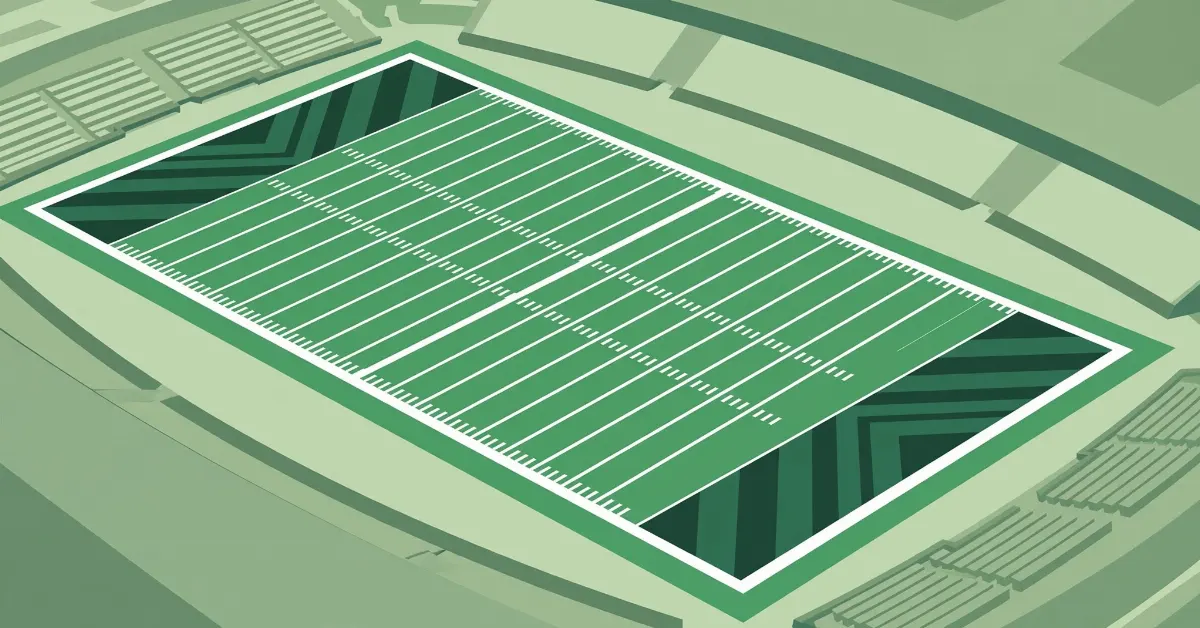
A football field is 360 feet long from the back of one end zone to the back of the other. The playing field itself measures 300 feet from goal line to goal line, with a 30-foot-deep end zone at each end accounting for the other 60 feet.
If you have ever seen one source call it a 100-yard field and another call it 120 yards, both were right. The 100-yard figure describes the playing field between the goal lines, while the 120-yard figure includes the two end zones. Once that distinction clicks, every other dimension — the 160-foot width, the roughly 1.32 acres of total area, the yard lines and hash marks — falls neatly into place.
The football field is America’s favorite unit of very large distances. Broadcasters measure everything from cruise ships to city blocks in football fields, and that shorthand only works if you know the real numbers. This guide covers the exact length with and without the end zones, the width, the acreage, a full conversion chart, and comparisons that make 360 feet easy to picture.
Football Field Dimensions: Quick Conversion Chart
Here are the official measurements converted into feet, yards, meters, and inches. This single table answers nearly every “how long” and “how wide” question about a football field.
| Measurement | Feet | Yards | Meters | Inches |
|---|---|---|---|---|
| Total length (including end zones) | 360 ft | 120 yd | 109.7 m | 4,320 in |
| Playing field (goal line to goal line) | 300 ft | 100 yd | 91.44 m | 3,600 in |
| Width (sideline to sideline) | 160 ft | 53.3 yd | 48.8 m | 1,920 in |
| End zone depth (each) | 30 ft | 10 yd | 9.14 m | 360 in |
| Total playing area | 57,600 sq ft | 6,400 sq yd | 5,351 sq m | ≈ 1.32 acres |
1. Total Length: 360 Feet Including End Zones
The number to memorize is 360. Measured from the back of one end line to the back of the other, a regulation American football field is exactly 360 feet long. In other units, that is 120 yards, about 109.7 meters, or 4,320 inches laid end to end — a genuinely long walk from one end to the other.
That total is built from three simple parts: the 300-foot playing field between the goal lines, plus one 30-foot-deep end zone at each end. Add them together — 300 + 30 + 30 — and you arrive at 360. There is nothing approximate about it at the professional level; the dimensions are fixed, which is exactly why the field works so well as a measuring stick for everything else.
Most of the confusion around football field length comes from broadcasters and casual conversation. When a commentator says a kick returner ran “the length of the field,” they usually mean the 100 yards between the goal lines, because that is where the play happened. When a stadium guide says the field is 120 yards long, it is counting the end zones too. Neither is wrong — they are simply measuring different things, and now you know which is which.
To get a genuine feel for 360 feet, break it into a distance you already know. It is exactly 3.6 times the 100-foot distance most people can picture from a city lot or a large backyard — imagine that span, then stretch it to more than three and a half times its length. Walked at a relaxed pace, 360 feet takes the average adult well over a minute to cover, and at a full sprint it is a serious distance even for trained athletes.
It also helps to think of the field in halves. From one end line to the 50-yard line at midfield is 180 feet — half of the total. Every drive that starts deep in a team’s own territory and crosses midfield has already covered more than half the full 360-foot length, which puts those long touchdown marches you see on television into real perspective.
2. Playing Field: 300 Feet From Goal Line to Goal Line
The 300-foot stretch between the two goal lines is where football actually happens. This is the “100 yards” everyone quotes: exactly 100 yards, precisely 91.44 meters, or 3,600 inches from one goal line to the other. Every snap, every run, every pass in regulation play takes place inside this rectangle, with the end zones serving as the scoring areas beyond it.
Because the playing field divides so cleanly, it is the part of the game most fans understand intuitively. Each yard is three feet — and if you want a concrete sense of that base unit, our guide to how long a foot is walks through everyday examples. Ten yards is 30 feet, the distance of a first down; fifty yards is 150 feet, half the playing field; and the full hundred is the entire 300-foot journey from one goal line to the other.
That clean divisibility is no accident. Football’s rules were built around the yard as the fundamental unit: four downs to gain ten yards, penalties measured in five- and fifteen-yard chunks, field position described entirely in yards to go. The 300-foot playing field is, in a real sense, just one hundred yard-long building blocks laid in a row, and the white yard lines painted across the turf make those blocks visible from the stands.
When someone says a quarterback threw a 40-yard pass, that ball traveled 120 feet through the air — nearly half the playing field. A 60-yard field goal attempt means the kicker is trying to send the ball 180 feet, the equivalent of 60 percent of the entire playing surface. Framing plays in feet rather than yards is a useful exercise, because feet are the unit most of us use for rooms, hallways, and driveways, and the numbers suddenly feel much more dramatic.
3. Field Width: 160 Feet Sideline to Sideline
Turn the field sideways and it measures 160 feet from sideline to sideline. That works out to 53 and one-third yards, about 48.8 meters, or 1,920 inches — comfortably wider than most people guess. The width is the dimension spectators underestimate most, because television cameras follow the ball up and down the field and compress the side-to-side scale.
The two sidelines run the entire 360-foot length of the field, end line to end line, forming the long edges of the rectangle. Everything between them — the full 160-foot width — is in bounds, and stepping on or beyond a sideline stops the play. Wide receivers make their living in the outer thirds of that width, where a few feet of separation near the sideline is the difference between a completed catch and an incompletion.
For a sense of scale, 160 feet is sixteen times the length of a typical 10-foot room dimension and well over half the 300-foot playing length. If you stood at one sideline and looked across to the other, you would be looking across a gap wider than the length of an Olympic swimming pool. It is a big, open expanse — which is exactly why team speed matters so much in the modern game.
4. End Zones: 30 Feet Deep
Each end zone is a rectangle 30 feet deep and 160 feet wide — 10 yards deep, about 9.14 meters, or 360 inches front to back. It stretches the full width of the field, giving offenses the entire 160-foot sideline-to-sideline span in which to complete a scoring play. At 4,800 square feet apiece, the two end zones are far roomier than they look on television.
Together, the pair of end zones accounts for 60 of the field’s 360 feet — one-sixth of the total length. That is the entire difference between the “100-yard field” and the “120-yard field,” and it explains why the distinction matters: a play that starts at a team’s own 1-yard line must travel 99 yards of playing field plus the depth of the far end zone to score, though only the 99 yards count as offensive progress.
The end zone is bounded by the goal line at the front and the end line at the back, with the sidelines continuing along its sides. A player scores by carrying the ball across the goal line or catching it anywhere inside this 30-by-160-foot area while maintaining possession. Because the zone is only 30 feet deep, timing and precision shrink dramatically near the goal line — there is very little room to work with, which is why so-called “red zone” offense is its own strategic specialty.
5. How Many Acres Is a Football Field?
Multiply the full footprint — 360 feet long by 160 feet wide — and you get 57,600 square feet. Since one acre equals 43,560 square feet, dividing 57,600 by 43,560 gives 1.322. So a football field, including both end zones, covers about 1.32 acres. It is one of the most quoted conversions in sports, and now you know exactly where the number comes from.
If you exclude the end zones and count only the 300-by-160-foot playing field, the area is 48,000 square feet — about 1.10 acres. That smaller figure is the one that applies to the surface where the game is actually played, while the 1.32-acre figure describes the entire marked rectangle from end line to end line. When someone uses “football fields” to describe the size of a building, a park, or a plot of land, the 1.32-acre version is almost always the intended comparison.
The perimeter tells a similar story of scale. Two 360-foot lengths plus two 160-foot widths give a total perimeter of 1,040 feet — walk the boundary of a football field and you have covered nearly a fifth of a mile without ever leaving the grass. Speaking of miles, the field’s 360-foot length is about 0.068 miles, or roughly one-fifteenth of how long a mile is. Fifteen football fields laid end to end would stretch just past a single mile.
Area conversions round out the picture: 57,600 square feet is 6,400 square yards and about 5,351 square meters. Whether you think in imperial or metric, the takeaway is the same — a football field is a genuinely large piece of ground, bigger than most city lots and roughly the size of a small neighborhood park.
6. Yard Lines, Hash Marks, and Field Markings
The white paint on the turf is a measurement system you can read at a glance. Yard lines run across the full width of the field every five yards, giving players, officials, and fans a constant visual reference for field position. Numbered markers appear every ten yards so the distance to each goal line is always obvious, and the 50-yard line at midfield splits the playing field into two equal 150-foot halves.
Between the yard lines sit the hash marks — the short lines that divide the field lengthwise and mark where each play begins. The goal lines themselves are simply the yard lines at each end of the 300-foot playing field, the end lines close off the back of each end zone, and the sidelines run the boundaries along both sides. Together, these markings turn the 360-by-160-foot rectangle into the readable, precisely measured grid that makes football possible.
Football Field Markings and Zones: Reference Table
Use this second reference table to keep every line, zone, and boundary straight — what it is, where it sits, and the measurement behind it.
| Marking or Zone | Location | Measurement |
|---|---|---|
| Total field | End line to end line | 360 ft × 160 ft |
| Playing field | Goal line to goal line | 300 ft × 160 ft |
| End zones (2) | One at each end | 30 ft deep × 160 ft wide each |
| Goal lines | Front edge of each end zone | 160 ft across the field |
| End lines | Back boundary of each end zone | 160 ft across the field |
| Sidelines (2) | Both long edges of the field | 360 ft long each |
| 50-yard line | Exact midfield | 150 ft from either goal line |
| Yard lines | Across the field every 5 yards | 15 ft apart |
| Field numbers | Painted every 10 yards | 30 ft apart |
| Hash marks | Down the middle between yard lines | Mark the start of each play |
Frequently Asked Questions
How many yards long is a football field?
A football field is 120 yards long including both end zones, and 100 yards long from goal line to goal line. The 20-yard difference is the two 10-yard-deep end zones, one at each end of the field.
How many acres is a football field?
A football field covers about 1.32 acres including the end zones (57,600 square feet). The playing field alone, without the end zones, is about 1.10 acres (48,000 square feet).
How wide is a football field in feet?
A football field is 160 feet wide from sideline to sideline — 53 and one-third yards, or about 48.8 meters. The width is the same for the playing field and the end zones.
Is a soccer field the same size as a football field?
Not exactly. An American football field has fixed dimensions — always 360 feet long including end zones and 160 feet wide — while soccer fields are allowed to vary within a range set by the laws of the game, so no two are necessarily identical. The two are roughly similar in overall scale, but only the football field’s measurements are exactly standardized.
Final Thoughts
A football field is 360 feet long including the end zones, 300 feet of playing field between the goal lines, 160 feet wide, and about 1.32 acres in total — four numbers that answer nearly every question anyone asks about it. Remembering that the two 30-foot end zones explain the gap between the 100-yard and 120-yard figures keeps the whole picture clear. Whether you are settling a debate, visualizing a news report’s distance comparison, or just curious, these are the exact dimensions to quote with confidence.

I’m Marcus Kane, a measurement content specialist at MeasuresIt.com. I write clear, accurate, and practical articles about measurements, dimensions, conversions, and everyday size comparisons, making complex topics simple and easy to understand.