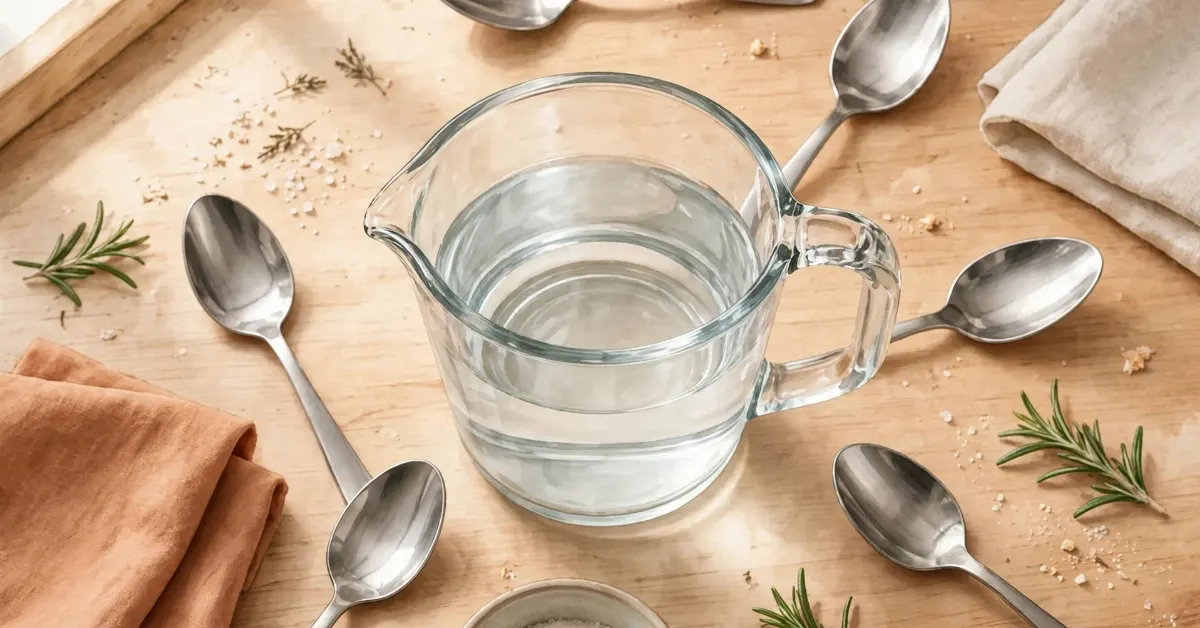
1 cup equals 16 tablespoons. That is the single most useful volume conversion in any kitchen: 1 cup = 16 tablespoons = 48 teaspoons = 8 fluid ounces. Whether you are halving a cake recipe, doubling a soup, or baking with only a spoon set and no measuring cups, this one anchor number keeps every recipe on track.
Volume conversions confuse even experienced cooks because the US customary system does not divide by ten. Instead, cups, tablespoons, and teaspoons step down in tidy factors — three teaspoons to a tablespoon, sixteen tablespoons to a cup — which makes mental math easy once you memorize the anchor numbers. This guide puts a quick conversion chart right up top for fast lookups, then walks through butter equivalents, metric conversions, international spoon sizes, and the measuring techniques that keep your results consistent.
You will also find two comparison tables covering the fifteen measurements cooks reach for most, answers to the most common questions, and practical tips for measuring accurately. By the end, converting between cups and tablespoons will feel automatic.
1. The Quick Answer: 16 Tablespoons in 1 Cup
If you remember one number from this article, make it 16. One US cup contains exactly 16 US tablespoons. This is a defined, exact conversion rather than an approximation, and it applies to every ingredient measured by volume — water, milk, flour, sugar, oil, and melted butter alike.
The relationship works in both directions. To convert cups to tablespoons, multiply by 16: 2 cups become 32 tablespoons, and half a cup becomes 8. To convert tablespoons to cups, divide by 16: 8 tablespoons make half a cup, and 4 tablespoons make a quarter cup. Keep this two-way rule handy and you will rarely need a calculator mid-recipe.
A concrete example shows why this matters. Suppose a pancake recipe makes 1 cup of batter per batch and you want to triple it, but your measuring cups are in the dishwasher. Three cups equal 48 tablespoons — and counting out 48 spoonfuls is tedious, which is exactly why the chart below also lists fluid ounces and pints. For big scaling jobs, convert up to larger units instead of counting dozens of spoonfuls.
2. Tablespoons to Cups Conversion Chart
Keep this chart within reach — on your fridge, in a kitchen notebook, or bookmarked on your phone. It covers the fractions you will meet most often, from an eighth of a cup up to four cups, with tablespoons, teaspoons, and fluid ounces for each amount.
| Cups | Tablespoons | Teaspoons | Fluid ounces |
|---|---|---|---|
| 1/8 cup | 2 tbsp | 6 tsp | 1 fl oz |
| 1/4 cup | 4 tbsp | 12 tsp | 2 fl oz |
| 1/3 cup | 5 tbsp + 1 tsp | 16 tsp | 2.7 fl oz |
| 1/2 cup | 8 tbsp | 24 tsp | 4 fl oz |
| 2/3 cup | 10 tbsp + 2 tsp | 32 tsp | 5.3 fl oz |
| 3/4 cup | 12 tbsp | 36 tsp | 6 fl oz |
| 1 cup | 16 tbsp | 48 tsp | 8 fl oz |
| 2 cups (1 pint) | 32 tbsp | 96 tsp | 16 fl oz |
| 4 cups (1 quart) | 64 tbsp | 192 tsp | 32 fl oz |
3. Why 16? The Math Behind the Conversion
The number 16 is not arbitrary — it falls out of the way US customary volume is built on doubling. Two tablespoons make one fluid ounce, and eight fluid ounces make one cup. Multiply 8 fluid ounces by 2 tablespoons each and you get exactly 16 tablespoons per cup. The fluid ounce is the bridge between the spoon scale and the cup scale.
This binary, doubling-based structure runs through the whole US customary system. It is the same logic that gives us the foot — twelve inches to the foot — and the mile — 5,280 feet to the mile — units that favor halving and doubling over neat decimal steps. Once you see the pattern, conversions stop feeling random: every step up or down is just another round of doubling or halving.
4. How Many Tablespoons in a Stick of Butter?
Butter is the ingredient that makes the cup-to-tablespoon conversion matter most in baking. One standard US stick of butter equals 8 tablespoons — exactly half a cup. American butter wrappers are even printed with tablespoon markings, so you can slice off what a recipe needs without touching a measuring cup.
The rest of the butter math follows from there: half a stick is 1/4 cup (4 tablespoons), a quarter stick is 1/8 cup (2 tablespoons), and two full sticks make 1 cup (16 tablespoons). If you bake from European recipes, note that butter there is usually sold in 250-gram blocks rather than sticks — one US stick weighs about 113 grams, so a 125-gram block is roughly half a cup plus a teaspoon.
- 1 tablespoon of butter = 1/16 cup
- 2 tablespoons = 1/8 cup (a quarter stick)
- 4 tablespoons = 1/4 cup (half a stick)
- 8 tablespoons = 1/2 cup (one full stick)
- 16 tablespoons = 1 cup (two full sticks)
5. Teaspoons, Tablespoons, and Cups: How They Relate
Teaspoons are the smallest unit in everyday use. Three teaspoons make one tablespoon, and because a cup holds 16 tablespoons, a full cup holds 48 teaspoons. Together these facts form a simple ladder: multiply teaspoons by 3 to reach tablespoons, and multiply tablespoons by 16 to reach cups.
Climbing down the ladder is just as easy: divide cups by 16 to get tablespoons, and divide tablespoons by 3 to get teaspoons. When a recipe calls for an awkward amount like 2/3 cup, the ladder rescues you — 2/3 cup equals 10 tablespoons plus 2 teaspoons, which is far easier to measure accurately than eyeballing two-thirds of a cup.
This ladder also helps when a recipe uses mixed units. “1 cup plus 2 tablespoons” is simply 18 tablespoons total — useful when you are scaling the recipe by 1.5x and need 27 tablespoons, which converts back to 1 cup plus 11 tablespoons, or more practically, 1 and 2/3 cups plus 1 tablespoon. Round numbers are your friends; convert to the largest sensible unit.
6. Metric Equivalents: Cups and Tablespoons in Milliliters
International recipes usually speak milliliters instead of cups. One US cup is approximately 236.6 milliliters, and one US tablespoon is approximately 14.8 milliliters. The word “approximately” does real work here: the legal definitions are 236.588 mL per cup and 14.787 mL per tablespoon, but rounding to one decimal place is more than precise enough for any cooking task.
| US unit | Milliliters (approx.) |
|---|---|
| 1 teaspoon | 4.9 mL |
| 1 tablespoon | 14.8 mL |
| 1 fluid ounce | 29.6 mL |
| 1/4 cup | 59.1 mL |
| 1/3 cup | 78.9 mL |
| 1/2 cup | 118.3 mL |
| 2/3 cup | 157.7 mL |
| 3/4 cup | 177.4 mL |
| 1 cup | 236.6 mL |
One caution: many measuring cup sets sold outside the United States are metric cups of exactly 250 mL, slightly larger than the US cup. For soups, stews, and marinades the difference is negligible, but for precise baking — bread, pastry, delicate cakes — pick one system and use it for the entire recipe rather than mixing metric and US measures.
When precision truly matters, consider weighing ingredients instead of converting volumes at all. A kitchen scale eliminates the cup-tablespoon-milliliter question entirely, and professional bakers rely on grams for exactly this reason. Volume conversions are convenient; weight is authoritative.
7. US vs. UK vs. Australian Tablespoons
Here is where cooks get tripped up: a tablespoon is not the same size everywhere. A US tablespoon holds 14.8 mL, a UK tablespoon holds about 17.7 mL, and an Australian tablespoon holds 20 mL — a full four teaspoons. Follow an Australian recipe with US spoons and you will under-measure every spoonful by roughly a quarter.
The practical rule is to match your spoons to your recipe’s country of origin whenever precision matters. For casual cooking, do not stress: the gap between 14.8 and 17.7 mL rarely ruins a stew, a stir-fry, or a salad dressing. When it might matter — baking, again — check whether the author lists grams or ounces alongside spoon measures; those reveal which system the recipe was written in.
Canada adds a wrinkle: older Canadian recipes sometimes use the 14.8 mL tablespoon, while newer metric-influenced ones may assume 15 mL. The difference is tiny enough to ignore in practice. What you cannot ignore is the Australian 20 mL tablespoon — if a recipe from an Australian author calls for tablespoons of baking powder or cornstarch, using US spoons will measurably change the result.
8. Comparison Table: Common Baking Measurements
Baking is chemistry, so exact volumes matter more here than anywhere else in the kitchen. This first comparison table converts the measurements that appear most often in baking recipes into tablespoons — eight essentials that let you work with a single spoon when the cup measures are buried in the dishwasher.
| Measurement | Equals in tablespoons |
|---|---|
| 1/8 cup | 2 tablespoons |
| 1/4 cup | 4 tablespoons |
| 1/3 cup | 5 tablespoons + 1 teaspoon |
| 1/2 cup | 8 tablespoons |
| 2/3 cup | 10 tablespoons + 2 teaspoons |
| 3/4 cup | 12 tablespoons |
| 1 cup | 16 tablespoons |
| 1 stick of butter | 8 tablespoons (1/2 cup) |
9. Comparison Table: Everyday Kitchen Equivalents
Beyond cups and spoons, a handful of kitchen equivalents covers almost every conversion you will meet while cooking. Memorize these seven and you can scale, halve, or double any recipe without reaching for your phone.
| If a recipe calls for | Use this instead |
|---|---|
| 1 tablespoon | 3 teaspoons |
| 1 fluid ounce | 2 tablespoons |
| 1/4 cup | 4 tablespoons |
| 1/2 cup | 8 tablespoons |
| 1 cup | 16 tablespoons |
| 1 pint | 2 cups (32 tablespoons) |
| 1 quart | 4 cups (64 tablespoons) |
10. How to Measure Tablespoons Accurately
The right conversion only helps if your technique is sound. For dry ingredients such as flour and sugar, spoon the ingredient into the tablespoon measure and level it off with the straight edge of a knife. Never scoop directly from the bag: scooping compacts flour and can pack in 20 to 30 percent more than the recipe intends, which is enough to turn a tender cake dry.
For liquids, use a clear measuring spoon or liquid measuring cup and read the level at eye level — looking down at an angle makes the meniscus lie to you. And always use real measuring spoons, not the spoons you eat with: an ordinary dinner tablespoon can hold anywhere from 10 to 20 mL, which makes “one tablespoon” meaningless. Precision starts with proper tools, just as accurate work in any craft starts with knowing how to read a measuring tape.
Sticky ingredients need their own trick. For honey, molasses, or peanut butter, lightly oil the tablespoon measure first — the ingredient will slide right out instead of clinging to the spoon and throwing off your count. When a recipe calls for many spoonfuls, count aloud or mark groups of four; losing track at tablespoon nine of twelve is a classic kitchen mishap.
Finally, when a recipe calls for a large number of tablespoons — ten, twelve, or more — switch to a cup measure instead of counting spoonfuls. Twelve individual tablespoons invite miscounts; a single 3/4-cup measure does the same job in one confident pour.
11. Common Mistakes When Converting Cups and Tablespoons
Most conversion errors come from a short list of repeat offenders. Run through this list once and you will sidestep nearly all of them:
- Mixing up teaspoons and tablespoons — the single most common error. Lock in the 3-to-1 rule (three teaspoons per tablespoon) and watch the abbreviations: “tsp” means teaspoon, while “Tbsp” or a capital “T” means tablespoon.
- Measuring with cutlery instead of measuring spoons. Dinner spoons vary wildly in size, so “one tablespoon” from the silverware drawer is a guess, not a measurement.
- Using the wrong country’s tablespoon. A US recipe assumes 14.8 mL spoons; an Australian recipe assumes 20 mL. Match the spoons to the recipe’s origin when baking.
- Scooping flour straight from the bag instead of spooning it into the measure and leveling. Scooping compacts the flour and over-measures by up to a third.
- Converting volume to weight by guessing. A cup of flour weighs about 120 grams while a cup of granulated sugar weighs about 200 grams — cups and grams are not interchangeable without an ingredient-specific conversion.
- Rounding fractional tablespoons carelessly. When 1/3 cup converts to 5 tablespoons plus 1 teaspoon, dropping that final teaspoon introduces a 6 percent error — small once, but it compounds across several scaled ingredients.
12. Frequently Asked Questions
How many tablespoons are in half a cup?
Half a cup contains 8 tablespoons. Since one cup equals 16 tablespoons, dividing by two gives 8 — which is also exactly one standard stick of butter, a handy visual reference.
How many tablespoons are in a quarter cup?
A quarter cup contains 4 tablespoons, equal to half a stick of butter. This is one of the most-used conversions in baking, worth committing to memory alongside the 16-per-cup anchor.
How many teaspoons are in a tablespoon?
There are 3 teaspoons in 1 tablespoon. That means a full cup — 16 tablespoons — contains 48 teaspoons. If you only have a teaspoon measure, 48 level teaspoons equal one cup.
Does the 16-tablespoons-per-cup rule work for UK and Australian recipes?
Not exactly. The 16-tablespoons-per-cup rule belongs to US customary measures. Because UK tablespoons (about 17.7 mL) and Australian tablespoons (20 mL) are larger than US tablespoons (14.8 mL), one US cup converts to roughly 13 to 14 of those larger spoonfuls. For recipes written outside the United States, follow the author’s measuring system — or better, use the gram weights when they are provided.
13. Final Thoughts
1 cup equals 16 tablespoons — a small fact that quietly powers better cooking. With this single conversion and its companions (48 teaspoons and 8 fluid ounces per cup, 8 tablespoons per stick of butter), you can scale recipes up or down, substitute tools when your kitchen is missing a piece, and follow recipes from any country with confidence. The charts and comparison tables above are worth bookmarking for the moments when mental math deserts you mid-recipe. And remember that technique matters as much as arithmetic: level off dry ingredients, read liquids at eye level, and reach for real measuring spoons instead of cutlery. Master the cup-to-tablespoon conversion along with these small measuring habits, and every recipe you touch becomes more reliable — from weeknight sauces to celebration cakes.

Hi, I’m Vera Lindqvist, a content writer at MeasuresIt.com, where I turn measurement standards, unit conversions, and precision tools into clear, practical guides. I care about getting the details right so you don’t have to second-guess them.