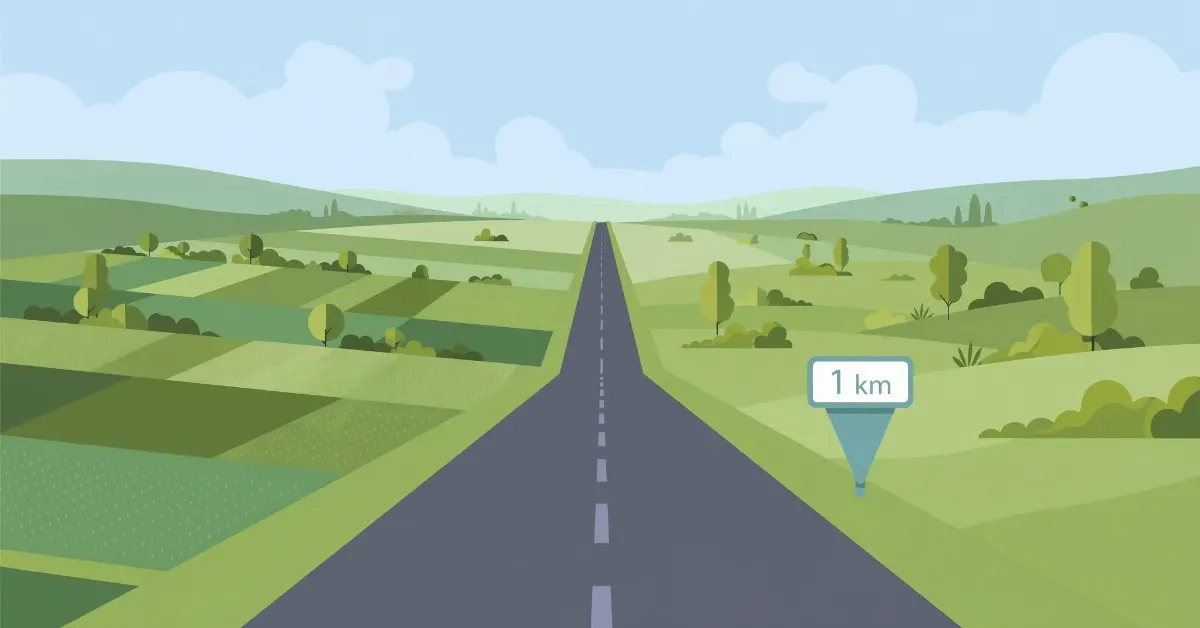
One kilometer equals exactly 0.621371 miles, or exactly 3,280.84 feet. That is the short, precise answer — and in metric terms, a kilometer is exactly 1,000 meters, the standard unit for measuring everyday travel distances across most of the world. If you are used to thinking in miles, picture a kilometer as a little under two-thirds of a mile: noticeably shorter than a mile, but still a satisfying stretch of road.
Kilometers show up everywhere once you start noticing them. Road signs in Canada, Europe, Asia, Australia, and Latin America all measure distance in kilometers. Runners train for 5K and 10K races. Car speedometers in most countries read in kilometers per hour, and GPS apps switch units the moment you cross certain borders. Whether you are planning a trip abroad, following a training plan, or simply satisfying your curiosity, knowing exactly how long a kilometer is makes the metric world feel far less mysterious — and this guide gives you the exact numbers, an easy conversion chart, walking and running time estimates, and concrete visual comparisons you can picture instantly.
1. The Exact Answer: A Kilometer in Miles, Feet, and Meters
The kilometer belongs to the metric system, where every unit relates to its neighbors by a clean factor of ten. By definition, one kilometer is exactly 1,000 meters — no approximations, no fine print. The conversion to miles comes from the international definition of the mile: since 1959, one mile has been defined as exactly 1,609.344 meters. Divide 1,000 by 1,609.344 and you arrive at the familiar figure of 0.621371.
That single conversion factor unlocks every other number you might need:
- Miles: 1 km = 0.621371 miles
- Feet: 1 km = 3,280.84 feet
- Meters: 1 km = 1,000 meters (exact)
- Yards: 1 km = 1,093.61 yards
- Inches: 1 km = 39,370.1 inches
- Centimeters: 1 km = 100,000 centimeters
For quick mental math, most people round to 0.62 miles per kilometer. The rounding error is tiny — roughly two-hundredths of a mile per kilometer — and perfectly fine for estimating travel times or race distances. When precision genuinely matters, such as in surveying, engineering, or land measurement, always use the full 0.621371 figure instead.
Going the other direction is just as simple once you know the reciprocal: one mile equals exactly 1.609344 kilometers. A handy shortcut is to multiply miles by 1.6 for a fast estimate, or use the old fraction trick — five miles is eight kilometers, so you can multiply any mile figure by 8 and divide by 5 to land on kilometers with impressive accuracy.
2. Kilometer Conversion Chart
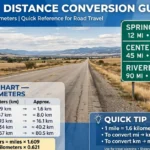
Here are the most useful kilometer conversions in one place, covering the distances people actually look up: the half kilometer, the single kilometer, the ever-popular 5K, and the 10K.
| Kilometers | Miles | Feet | Meters | Yards |
|---|---|---|---|---|
| 0.5 km | 0.3107 mi | 1,640.42 ft | 500 m | 546.81 yd |
| 1 km | 0.6214 mi | 3,280.84 ft | 1,000 m | 1,093.61 yd |
| 5 km | 3.1069 mi | 16,404.20 ft | 5,000 m | 5,468.07 yd |
| 10 km | 6.2137 mi | 32,808.40 ft | 10,000 m | 10,936.13 yd |
A quick way to read this chart: five kilometers is just over three miles, which is why a 5K race feels familiar to American runners as “about three miles.” Ten kilometers lands at roughly 6.2 miles — a distance most regular joggers can cover in under an hour of steady running. And half a kilometer, at 0.31 miles, is the sort of distance you might walk to the nearest coffee shop without thinking twice about it.
3. How Long Does It Take to Walk or Run a Kilometer?
Numbers on a page only go so far; time gives distance a human scale. Most adults walk at a comfortable pace of about 5 kilometers per hour, which means one kilometer takes roughly 12 minutes on foot. Stroll casually while window-shopping and you might take 14 or 15 minutes; walk with genuine purpose and you can cover it in about 10. That range — 10 to 15 minutes per kilometer — is the single most useful walking benchmark to carry in your head.
Running compresses the kilometer dramatically. An easy jogging pace of 10 kilometers per hour works out to a relaxed 6 minutes per kilometer, comfortable for most casual runners. Regular runners often settle around 5 to 5:30 per kilometer on everyday training runs, while competitive club runners dip under 4 minutes. Elite marathoners, for perspective, sustain paces below 3 minutes per kilometer for the entire 42.195-kilometer race distance — a level of sustained speed that redefines what a kilometer can feel like.
It helps to memorize three simple anchors: a kilometer is a 10- to 15-minute walk, a 6-minute easy jog, or about a 5-minute brisk run for a fit recreational runner. With those three anchors, you can estimate how far you can travel in any amount of time without touching a calculator. Telling a friend “it is about a kilometer away” instantly communicates “a ten-minute walk” to anyone who has internalized the scale.
These time anchors also make hiking and city exploration easier to plan. A three-kilometer loop through a park is roughly a 40-minute stroll. A kilometer-long stretch of beach boardwalk is a pleasant ten-minute wander each way. Once the kilometer has a time attached to it, it stops being an abstract figure and becomes a practical planning tool.
4. Kilometers Per Hour: What Metric Speeds Really Mean
The kilometer also governs speed across most of the planet, and the conversion is the same one you already know. A speed limit of 50 kilometers per hour — the standard urban limit in much of Europe — works out to about 31 miles per hour, essentially the same as an American 30 mph zone. Highway cruising at 100 km/h is about 62 mph, and the 120 km/h limits common on European motorways translate to roughly 75 mph.
This is why rental cars abroad can feel confusing for the first day: the speedometer reads larger numbers than you expect, and the road signs seem to describe enormous distances. In reality, the numbers are just scaled up. A quick mental trick is to halve the km/h figure and add ten percent of the original — so 100 km/h becomes 50 plus 10, or 60 mph. It is not exact, but it keeps you legal and comfortable while driving.
Runners live by a related number: pace per kilometer. A 6:00/km pace equals roughly a 9:39 mile pace, while 5:00/km equals about 8:03 per mile. Many GPS watches let you toggle between the two, and training plans from outside the United States almost always speak in minutes per kilometer. Knowing that a kilometer is 62 percent of a mile lets you translate any pace on the fly.
5. What Does a Kilometer Look Like? Everyday Visual Comparisons
Still trying to picture it? Stack familiar objects end to end until you reach 1,000 meters. A kilometer is surprisingly long when you imagine it this way — about the length of eleven American football fields laid goal line to goal line, or twenty Olympic swimming pools in a row. Few people can visualize 1,000 meters directly, but almost everyone can picture a football field, which makes these comparisons the fastest route to real intuition.
| Everyday reference | Length of one | How many make a kilometer |
|---|---|---|
| City blocks | Varies by city | About 10–20 blocks |
| American football fields (goal line to goal line) | 91.44 m | About 11 fields |
| FIFA soccer pitches | About 105 m | About 9–10 pitches |
| Olympic swimming pools | 50 m | 20 pools |
| Standard 400 m running track | 400 m per lap | 2.5 laps |
| Eiffel Tower (height) | 330 m | About 3 stacked |
| NBA basketball courts | 28.65 m | About 35 courts |
| Tennis courts | 23.77 m | About 42 courts |
The football field comparison is the classic for a reason: if you have ever stood in a stadium, you know how far the far end zone looks from your seat. Multiply that view by eleven and you are standing at one end of a kilometer. The track comparison is even more practical for runners — two and a half laps of the local high school track is exactly a kilometer, a fact coaches lean on when they send athletes out for kilometer repeats.
The vertical comparisons carry their own drama. Stacking three Eiffel Towers reaches 990 meters — just ten meters shy of a full kilometer — which means a kilometer laid upright would tower over almost every building in most cities. Only a handful of supertall skyscrapers on Earth even approach the one-kilometer mark in height, and the tallest completed buildings in the world still fall well short of it.
City blocks deserve a caveat: they vary enormously. In Portland or Manhattan, blocks run short; in sprawling suburbs and newer developments, they run long. Treat “ten to twenty blocks” as a rough feel rather than a measurement — seeing how far 100 feet stretches can help you calibrate what a single block really covers on your own street.
6. One Kilometer Compared to Other Common Distances
Another way to internalize the kilometer is to place it on a ladder of distances you already know, from a single meter all the way up to a half marathon. Each rung gives the kilometer more context.
| Distance | Length in kilometers | Relation to 1 km |
|---|---|---|
| 1 meter | 0.001 km | One-thousandth of a kilometer |
| 100 meters (Olympic sprint) | 0.1 km | One-tenth of a kilometer |
| 400 meters (one track lap) | 0.4 km | Just under half a kilometer |
| 1 mile | 1.609344 km | A kilometer is about 62% of a mile |
| 5K race | 5 km | Exactly 5 kilometers |
| 10K race | 10 km | Exactly 10 kilometers |
| Half marathon | 21.0975 km | A little over 21 kilometers |
Notice how the mile sits at 1.609344 kilometers — roughly one and three-fifths kilometers. That asymmetry is why converting in your head feels awkward at first: going from kilometers to miles you multiply by about 0.62, but going the other way you multiply by about 1.61. If you only remember one direction, remember that miles are bigger — a mile stretches more than half a kilometer farther than a kilometer does. And if you have ever run a 5K, you have covered exactly five of these units; a 10K doubles it; a half marathon stacks up more than twenty-one of them in a row.
At the small end of the ladder, the relationships are just as clean. Ten 100-meter sprints make a kilometer. Two and a half 400-meter track laps make a kilometer. These neat ratios are the quiet superpower of the metric system: everything divides evenly, with no 5,280-style surprises hiding in the arithmetic.
7. Kilometer vs. Mile: A Short History Note
The kilometer and the mile come from two completely different traditions of measuring the world. The kilometer was born in revolutionary France in the 1790s, when the French Academy of Sciences set out to replace a chaos of local measures with one rational system based on the size of the Earth itself. The meter was defined as one ten-millionth of the distance from the equator to the North Pole along the Paris meridian, and the kilometer — from the Greek khilioi, meaning “thousand” — was simply a thousand of those meters. For the first time, a unit of length was tied to the planet rather than to a king’s foot or a merchant’s arm.
The mile is far older and far messier. It began as the Roman mille passus, literally “a thousand paces,” covering roughly 1,480 meters. Over the centuries it stretched and shrank across different countries until England settled it by statute in 1593 at 5,280 feet. It took until 1959 for the English-speaking world to agree on a single exact international mile of 1,609.344 meters — the very definition that gives us today’s 0.621371 conversion factor and finally made mile-to-kilometer math exact instead of approximate.
Today the kilometer rules almost everywhere: it is the legal unit of road distance in every country except the United States, Liberia, and Myanmar, plus the United Kingdom, which still posts road distances in miles. The mile survives mainly in American and British road culture, in aviation, and in a few sporting traditions like the track mile. If you want a deeper look at the mile’s own story, our guide on what a mile actually measures walks through its definitions and everyday equivalents in detail.
The metric system’s triumph was never really about the kilometer being a better length than the mile — it was about the arithmetic. Ten millimeters make a centimeter, one hundred centimeters make a meter, one thousand meters make a kilometer. No other widely used system of length offers that kind of decimal simplicity, which is why science, medicine, and international trade all standardized on it long ago.
8. Frequently Asked Questions
Is a kilometer longer than a mile?
No. A mile is the longer unit: one mile equals 1.609344 kilometers, so a kilometer covers only about 62 percent of a mile. If you can comfortably run a mile, you can run a kilometer with distance to spare.
How many kilometers are in a mile?
Exactly 1.609344 kilometers. For everyday estimates, 1.6 is close enough — just remember that the approximation understates the mile very slightly.
How many steps are in a kilometer?
It depends on your stride, but most adults take roughly 1,300 to 1,600 steps to cover a kilometer. Taller walkers with longer strides land near the low end of that range, while shorter, quicker steps push you toward the high end. A fitness tracker or phone pedometer will calibrate the number to your own gait within a few walks.
What is 1 kilometer in feet and inches?
One kilometer is 3,280 feet and about 10 inches (3,280.84 feet, to be exact). The decimal 0.84 of a foot converts to just over 10 inches, since each foot holds 12 inches.
Why do most countries use kilometers instead of miles?
The metric system became the global standard because its decimal structure makes calculation and conversion effortless, and because international treaties in the 19th and 20th centuries encouraged a single shared system for trade and science. The United States kept its customary units largely through historical momentum, which is why Americans encounter kilometers mainly when traveling, running internationally standardized races, or reading scientific literature.
9. Final Thoughts
A kilometer is one of those measurements that feels abstract until you anchor it to your own experience. Remember the three anchors: it is 0.621371 miles or 3,280.84 feet on paper, roughly a 12-minute walk in practice, and about eleven football fields or two and a half track laps in your mind’s eye. With those pictures in place, kilometers stop being foreign numbers on road signs and start being distances you can genuinely feel. And if you ever need to measure something far shorter, a measuring tape read correctly will take you all the way from kilometers down to the millimeter.

I’m Marcus Kane, a measurement content specialist at MeasuresIt.com. I write clear, accurate, and practical articles about measurements, dimensions, conversions, and everyday size comparisons, making complex topics simple and easy to understand.