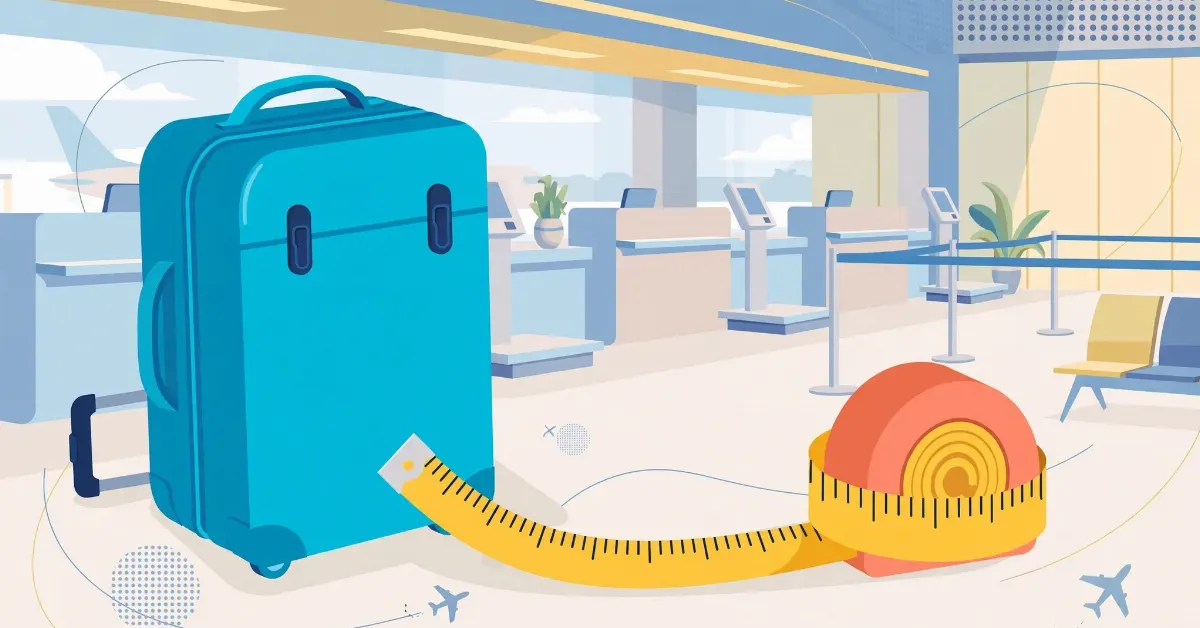
A standard carry-on bag measures about 22 × 14 × 9 inches (56 × 36 × 23 cm). That is the size most airlines design their overhead bins around, and it is the number printed on the tags of bags sold as “carry-on” in most stores. But exact limits vary from airline to airline, so always check your specific carrier’s rules before you fly — especially on budget airlines, where a few extra centimeters can mean an unexpected gate fee.
Carry-on sizing is one of those travel details that feels simple until you are standing at the gate watching an agent slide bags into a metal sizer. This guide covers the standard dimensions in inches and centimeters, shows you exactly how to measure your own bag (wheels and handles included), explains how airline limits differ, clarifies what counts as a personal item, and finishes with packing tips that help you fit a surprising amount into those 22 × 14 × 9 inches.
1. The Standard Carry-On Size: Exact Dimensions
The widely quoted carry-on standard breaks down into three measurements, always taken with the bag standing upright as you would wheel it through the terminal. Height comes first at 22 inches, measured from the floor (or the bottom of the wheels) to the top of the bag with the telescoping handle pushed fully down. Width is 14 inches across the front face, and depth is 9 inches from front to back. In metric terms, that is roughly 56 × 36 × 23 centimeters — the figures you will see on luggage tags outside the United States.
These numbers did not appear by accident. Aircraft overhead bins were designed around bags of roughly this size, so a 22-inch bag slides in wheels-first or sideways on most narrow-body jets. Add the three dimensions together and you get 45 linear inches (about 114 cm), a figure some airlines quote instead of the three separate measurements. If inches still feel abstract when you are picturing luggage, our visual guide to what an inch actually looks like can help you judge sizes at a glance in the store.
One more number worth knowing: multiply the three dimensions and you get about 2,772 cubic inches, or roughly 45 liters of packing space. That volume is the real reason the standard works so well — 45 liters comfortably holds three to five days of clothing and essentials for most travelers, which covers the large majority of trips without ever visiting a baggage carousel.
2. Carry-On Size Conversion Chart
Keep this chart handy when you are comparing bags online, especially since American retailers list inches while European and Asian brands list centimeters.
| Measurement | Inches | Centimeters |
|---|---|---|
| Height (wheels to top, handle down) | 22 in | 56 cm |
| Width (across the front) | 14 in | 36 cm |
| Depth (front to back) | 9 in | 23 cm |
| Total linear dimensions | 45 in | 114 cm |
| Packing volume (approx.) | 2,772 cu in | 45.4 L |
Notice how the centimeter figures are rounded: 22 inches is technically 55.88 cm, which the luggage industry rounds to 56. That rounding is harmless for shopping, but it is a good reminder to treat published dimensions as close approximations rather than engineering tolerances — a bag listed at 56 cm might actually measure 55 or 57 depending on the manufacturer. When you are converting between systems on the fly, our measurements overview walks through the inch–centimeter relationship in plain language.
3. How to Measure Your Carry-On Bag (Include Wheels and Handles)
Here is the mistake that catches the most travelers: measuring only the body of the suitcase. Airlines measure the bag exactly as you present it at the gate — wheels, feet, handles, and bulging front pockets all count. A bag whose shell is a perfect 22 inches can easily stretch to 23 or 24 once you include spinner wheels and a padded top handle, and that is the number the gate agent cares about.
Measuring correctly takes two minutes with a tape measure:
- Step 1: Stand the bag upright on its wheels, exactly as you would wheel it down the jet bridge, with the telescoping handle pushed all the way down.
- Step 2: Measure the height from the floor to the highest point of the bag — usually the top of the handle housing or the wheels, whichever sticks out further.
- Step 3: Measure the width straight across the front face, including any side handles or protruding zippers.
- Step 4: Measure the depth from the front of the bag to the back, including the wheels and any expanded front pocket.
- Step 5: Measure the bag packed the way you actually travel. An overstuffed bag can gain an inch of depth, and that inch is what the sizer will find.
If you are rusty with a tape measure, a quick refresher on how to read a measuring tape will make the whole process painless — the key is reading the inch marks at eye level and keeping the tape straight rather than letting it sag. Write your three numbers on a note in your phone so you have them whenever you book a flight.
Falling between sizes is common, especially with soft-sided bags that expand. When in doubt, size down: a bag that is slightly smaller than the limit always boards without argument, while a bag that is slightly over depends entirely on the mood of the gate area and how full the flight is.
4. Airline Carry-On Limits: What You Need to Know
There is no single universal carry-on standard enforced across all airlines. The 22 × 14 × 9 inch figure is a widely used industry benchmark, and many major full-service carriers accept bags of that size without question — but every airline publishes its own limits, and those limits are the only ones that matter for your flight. Before any trip, look up the carry-on rules for the specific airline (and fare type) on your booking.
Enforcement varies as much as the published numbers. On a half-empty Tuesday flight, a slightly oversized bag may roll aboard without a glance. On a packed holiday weekend, gate agents break out the metal sizers and every bag gets judged. Budget and low-cost carriers tend to be the strictest: many sell their low fares on the assumption that oversized bags will be caught and charged at the gate, so their sizers see heavy use.
Dimensions are only half the story. Many airlines also impose weight limits on carry-on bags, and these vary even more widely than size limits — some carriers weigh bags at check-in, others never do. If your airline publishes a weight limit, weigh your packed bag on a bathroom scale (weigh yourself holding it, then subtract your own weight) before leaving for the airport.
Finally, remember that the rules can change between the outbound and return legs of a single trip. Codeshare flights, partner airlines, and even different aircraft on the same route can carry different allowances. The five minutes it takes to check both airlines’ baggage pages is the cheapest travel insurance you will ever buy.
5. What Counts as a Personal Item?
Alongside your carry-on, most airlines allow one smaller personal item that must fit under the seat in front of you. Think purse, laptop bag, briefcase, or small backpack — something noticeably smaller than a carry-on, designed for the things you want within reach during the flight.
Airlines that publish personal-item dimensions generally land in the neighborhood of 18 × 14 × 8 inches, though, as with carry-ons, the exact figure is up to each carrier. The practical test is simpler than any number: if it slides easily under the seat in front of you without a fight, it qualifies. Bulky camera bags and overstuffed tote bags are the most common offenders.
Smart travelers treat the personal item as part of a system. Keep your valuables, travel documents, medications, chargers, and a change of clothes in the personal item, and let the carry-on hold everything else. That way, even in the worst case — a forced gate-check of your carry-on on a full flight — everything you truly need stays with you in the cabin.
6. How Big Is 22 × 14 × 9 Inches? Everyday Visual Comparisons
Numbers on a luggage tag are hard to picture in the aisle of a store. These everyday comparisons translate 22 × 14 × 9 inches into objects you already know, so you can judge a bag’s size before you ever touch a tape measure.
| Everyday reference | Its size | Compared to a standard carry-on |
|---|---|---|
| Standard bed pillow | 20 × 26 in | Similar footprint to the bag’s front face |
| Large pizza box | 18 × 18 in | A few inches shorter than the bag is tall |
| Typical microwave oven | About 21 in wide | Close to the bag’s 22-in height |
| Standard skateboard | About 32 in long | Roughly 1.5× the bag’s height |
| Economy airline seat width | About 17–18 in | Wider than the bag’s 14-in width |
| Nightstand / bedside table | About 24 in tall | Just a couple of inches taller than the bag |
| Two stacked shoeboxes | About 13 × 8 × 10 in combined | Close to the bag’s depth and width |
| Overhead bin on a narrow-body jet | Varies by aircraft | Designed around the 22 × 14 × 9 standard |
The pillow comparison is the most useful of the bunch: a standard bed pillow (20 × 26 inches) covers roughly the same area as the front of a carry-on. If you can picture a pillow standing on its end, you can picture your bag. The microwave comparison works the same way for height — most countertop microwaves are about 21 inches wide, just an inch shy of the carry-on’s 22-inch height.
The seat-width comparison explains why carry-ons fit the way they do. At 14 inches wide, a standard carry-on is narrower than the 17- to 18-inch economy seat you sat in on the way to the gate — which is exactly why it can roll down the aisle and slide into the bin while you could not. The whole standard is, in a sense, reverse-engineered from the airplane itself.
7. Carry-On vs. Other Luggage Sizes
Carry-on is just one rung on the luggage ladder. Seeing where it sits among personal items, checked bags, and soft-sided alternatives makes it easier to choose the right bag for each trip.
| Bag type | Typical size | Where it goes |
|---|---|---|
| Personal item | About 18 × 14 × 8 in | Under the seat in front of you |
| Standard carry-on | About 22 × 14 × 9 in | Overhead bin |
| Weekender duffel | Often around 22 in long | Overhead bin (soft sides squeeze in) |
| Travel backpack | About 18–22 in tall | Overhead bin or under the seat |
| Medium checked suitcase | About 25–27 in tall | Cargo hold (checked) |
| Large checked suitcase | About 28–30 in tall | Cargo hold (checked) |
| Garment bag (folded) | About 22 × 24 in | Overhead bin or closet on some aircraft |
The jump from carry-on to medium checked bag is the most consequential step on this ladder: those extra three to five inches of height push the bag out of the overhead bin and into the cargo hold, which means baggage fees, check-in lines, and waiting at the carousel. Soft-sided options like duffels and travel backpacks blur the line — their flexibility lets a nominally 22-inch bag compress into bins that would reject a rigid suitcase of the same listed size.
For most trips of a week or less, the carry-on plus personal item combination beats any checked bag. You skip the check-in counter, board with your belongings, and walk straight out of the airport on arrival. The travelers you see gliding past the baggage carousel while everyone else waits are almost always working this exact system.
8. Packing Tips to Make the Most of Your Carry-On
Fitting everything into 45 liters is a skill, and like any skill it improves with technique. These are the strategies frequent flyers actually use:
- Roll, don’t fold. Rolling clothes compresses them and dramatically reduces wrinkles compared to flat folding — most travelers fit noticeably more in the same space.
- Use packing cubes. Cubes turn the bag’s single compartment into organized drawers, and the light compression they provide adds up across a full bag.
- Wear your bulkiest items. Boots, heavy jackets, and thick sweaters eat enormous amounts of bag space; wearing them onto the plane frees that space for everything else.
- Stuff your shoes. Shoes are dead space unless you fill them — socks, chargers, and small accessories fit perfectly inside.
- Decant toiletries. Travel-size containers and solid alternatives (shampoo bars, solid deodorant) shrink your liquids kit to a fraction of its drugstore size.
- Remember the liquids rule. On most flights, liquids must be in containers of 3.4 ounces (100 ml) or less, all fitting in a single quart-size bag — pack this where you can reach it easily at security.
- Plan a laundry stop. For longer trips, packing for five days and doing laundry once beats packing for ten days and wrestling an overstuffed bag.
- Leave a little room. A bag packed to bursting on departure has nowhere to put souvenirs on the way home.
The liquids rule deserves emphasis because it ruins more mornings than any size limit. Keep your quart-size bag of 3.4-ounce-or-smaller containers at the very top of your carry-on or in your personal item, so the security line moves quickly and your carefully packed cubes stay undisturbed.
9. Frequently Asked Questions
Do all airlines allow 22 × 14 × 9-inch carry-ons?
No. The 22 × 14 × 9 inch size is a widely used benchmark, but every airline sets and enforces its own limits, and some — particularly budget carriers — allow less. Always check your specific airline’s baggage page before you fly.
Do wheels and handles count toward carry-on dimensions?
Yes. Airlines measure the bag as presented, including spinner wheels, feet, extended handles (measured with the handle down), and protruding pockets. Measure your bag exactly as you will roll it to the gate.
What is the difference between a carry-on and a personal item?
A carry-on is the larger bag (around 22 × 14 × 9 inches) that goes in the overhead bin. A personal item is a smaller bag — a purse, laptop bag, or small backpack — that must fit under the seat in front of you. Most airlines allow one of each.
What is 22 × 14 × 9 inches in centimeters?
About 56 × 36 × 23 centimeters. The conversion is 1 inch = 2.54 cm exactly, and luggage makers round the results to the nearest whole centimeter for tags and listings.
10. Final Thoughts
The humble 22 × 14 × 9 inch carry-on earns its status as the traveler’s best friend: it holds roughly 45 liters, fits the overhead bins it was designed for, and lets you skip the baggage carousel entirely. Memorize the three numbers, measure your bag with wheels and handles included, and always verify the limits for your specific airline before you fly. Do that, and the gate sizer becomes something that happens to other people — while you roll straight down the jet bridge with everything you need.

Hi, I’m Vera Lindqvist, a content writer at MeasuresIt.com, where I turn measurement standards, unit conversions, and precision tools into clear, practical guides. I care about getting the details right so you don’t have to second-guess them.