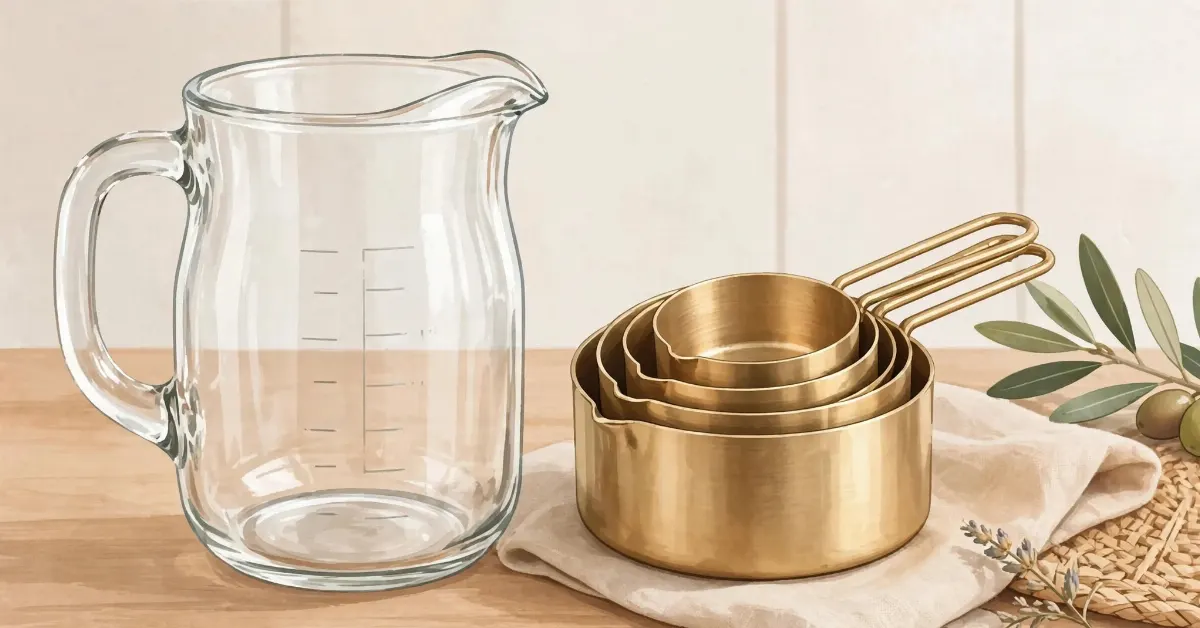
One quart equals 4 cups. A quart also equals 2 pints, or 32 fluid ounces — all in US liquid measure.
Those three numbers answer the question most cooks actually ask, but they sit inside a tidy little system: cups stack into pints, pints into quarts, and quarts into gallons, each step doubling the last. Learn the ladder once, and every recipe conversion — from a weeknight soup to a holiday punch bowl — becomes simple arithmetic.
This guide gives you the full conversion chart up front, then walks through each relationship with practical kitchen examples — broth cartons, recipe scaling, and the half-gallon math that trips people up. Everything here uses US liquid measures, the system printed on American measuring cups and milk jugs.
Kitchen Conversion Chart: Cups, Pints, Quarts & Gallons
Bookmark this table — it holds every conversion in the US liquid system on a single screen.
| Unit | Cups | Pints | Quarts | Fluid ounces |
|---|---|---|---|---|
| 1 cup | 1 | – | – | 8 |
| 1 pint | 2 | 1 | – | 16 |
| 1 quart | 4 | 2 | 1 | 32 |
| 1 gallon | 16 | 8 | 4 | 128 |
Read any row left to right to convert a unit into everything below it. The pattern is pleasingly regular: every step up the ladder doubles the volume, so once you know that a quart holds 4 cups, the rest of the chart unfolds by doubling and halving.
US Liquid Volume Equivalents
The same facts, reorganized as single-line equivalents you can scan in seconds.
| If you have | You also have |
|---|---|
| 1 cup | 8 fluid ounces |
| 2 cups | 1 pint = 16 fluid ounces |
| 1 pint | 2 cups = 16 fluid ounces |
| 4 cups | 1 quart = 2 pints |
| 1 quart | 4 cups = 2 pints = 32 fluid ounces |
| 2 quarts | 8 cups = 4 pints (a half gallon) |
| 8 pints | 1 gallon = 16 cups |
| 1 gallon | 16 cups = 8 pints = 4 quarts |
Everyday Kitchen Conversions
Conversions stick better when they are attached to real cartons and real recipes.
| Kitchen situation | The math |
|---|---|
| A 1-quart carton of broth | 4 cups — it fills a 4-cup measure exactly |
| A half-gallon jug of milk | 2 quarts = 8 cups |
| A 1-pint container of cream | 2 cups = 16 fl oz |
| A 1-gallon jug of water | 16 cups = 4 quarts |
| A recipe calling for 2 quarts of stock | 8 cups — double the quart line |
| Doubling a recipe that needs 2 cups | 4 cups = 1 quart |
| Halving a recipe that needs 1 quart | 2 cups = 1 pint |
Notice how often the quart sits at the center of the action. Recipes love the quart because it is large enough to matter and small enough to picture — four cups is a familiar quantity, and two pints is an easy split. Master the quart, and the whole system follows.
1. The Quick Answer: How Many Cups Are in a Quart?
Four. One US liquid quart contains exactly 4 cups — no rounding, no exceptions, no fine print. It is one of the cleanest conversions in the kitchen, which is why recipe writers lean on it: “add a quart of stock” is simply a friendlier way of saying “add four cups.”
The quart earns its name honestly: it is a quarter of a gallon, and since a gallon holds 16 cups, a quarter of that is 4 cups. The arithmetic checks out from every direction — divide the gallon’s 16 cups by 4, or multiply the quart’s 2 pints by 2 cups each. Every road leads to four.
In practice, the quart shows up most often on broth and stock cartons, which are commonly sold in quart containers. When a soup recipe calls for two quarts of broth and your carton says one quart, you know instantly: two cartons, eight cups, zero guesswork.
Say it plainly and it sticks: one quart, four cups. Cooks who internalize that single equivalence rarely need the rest of the chart, because the pint and gallon relationships hang off it so naturally. Two pints per quart, four quarts per gallon — the quart is the hinge the whole system swings on.
2. How Many Pints Are in a Quart?
Two. A quart contains 2 pints, and a pint contains 2 cups — so the quart-to-cup math (2 × 2 = 4) resolves through the pint as the middle step. If you remember only one bridge between units, make it this one.
Pints are the unit of the dairy case and the produce stand: cream, berries, and ice cream are sold by the pint. Knowing that two of those containers make a quart turns grocery shopping into quiet mental arithmetic — a pint of cream plus a pint of milk is a quart of dairy, ready for a recipe that calls for it.
The pint also anchors the fluid-ounce scale: one pint equals 16 fluid ounces, so a quart — two pints — equals 32. That doubling pattern, 8 to 16 to 32, is the heartbeat of the US liquid system.
Here is a handy checkout-line check: if your cart holds two pint containers of anything — cream, berries, salsa — you are carrying a quart. Recipes written in quarts and groceries sold in pints finally speak the same language.
3. Cups, Pints, Quarts, and Gallons: The Full Ladder
Zoom out and the whole system reveals itself as a doubling ladder. One cup is 8 fluid ounces. Two cups make a pint (16 fl oz). Two pints make a quart (32 fl oz). Two quarts make a half gallon (64 fl oz). And two half gallons — four quarts — make a gallon: 16 cups, 8 pints, 128 fluid ounces.
The gallon is the heavyweight most people meet at the milk jug. One gallon equals 4 quarts, which means a gallon of milk is four quart cartons’ worth — 16 cups in total. When a recipe collection calls for a gallon of punch, you now know it is asking for sixteen cups, and you can scale from there.
Working downward is just as easy: halve a gallon to get 2 quarts (a half gallon), halve again for 1 quart, again for a pint, and once more for a cup. Doubling up, halving down — the entire US liquid system runs on the number two. The same doubling logic shows up across our broader guide to converting measurements.
4. Fluid Ounces: The Base Unit
Underneath the cups and quarts sits the fluid ounce — the smallest unit in the everyday US liquid lineup. One cup equals 8 fluid ounces, and every larger unit is a multiple of eight: a pint is 16, a quart is 32, a half gallon is 64, and a gallon is 128.
Fluid ounces matter because they are the unit on the side of the measuring cup — the fine gradations between the cup lines. When a recipe calls for an odd quantity like 20 ounces, the fluid-ounce scale lets you translate: that is two and a half cups, no guesswork required.
Think of it this way: cups are for counting, fluid ounces are for precision. Together they cover every measuring situation a home kitchen produces.
Most liquid measuring cups show both scales — cups on one side, ounces on the other — precisely because recipes switch between them. Glance at the ounce scale when precision matters; read the cup scale when speed matters.
5. Half-Gallon and Two-Quart Math
The half gallon is where confident cooks sometimes stumble, because the name invites a careless answer. A half gallon equals 2 quarts — half of the gallon’s 4 — which works out to 8 cups or 4 pints. The “half” refers to the gallon, not to the quart.
Milk is the classic half-gallon citizen: the familiar jug in the dairy case holds 2 quarts, or 8 cups. So when a recipe calls for a quart of milk and you have a half-gallon jug, you know you need exactly half the jug — 4 of its 8 cups.
Two quarts also appear as a pair of quart cartons — broth, for instance. Two quart cartons equal 8 cups, 4 pints, and one half gallon: three names for the same very useful quantity.
Scaling with half gallons is equally smooth. Feeding a crowd and need 12 cups of milk? That is a half gallon (8 cups) plus a quart (4 cups). Need 24? A gallon jug plus a half-gallon jug — 16 plus 8 — and you are done.
6. Practical Kitchen Examples: Broth Cartons and Scaling Recipes
Conversions earn their keep in real kitchens. Take the standard quart carton of broth: it holds exactly 4 cups. A soup recipe calling for 6 cups of broth therefore needs one full quart carton plus 2 more cups — or, equivalently, one and a half quart cartons. The math is instant once the quart-to-cup bridge is in your head.
Scaling recipes is the other everyday workout. Doubling a sauce that needs 1 quart of tomatoes? That is 8 cups. Halving a punch recipe that calls for a gallon? That is 2 quarts, or 8 cups. Tripling a dressing built on a 2-cup (1-pint) base? Six cups — a quart and a half. Each move is just doubling or halving along the ladder.
The pint-to-quart step deserves special attention, because pints are how cream, berries, and many sauces are sold. A recipe needing a quart of strawberries is asking for 2 pint boxes; a quart of heavy cream is 2 pint containers. Shop with the ladder in mind and you will never overbuy.
7. A Quick Note on US Liquid vs. Dry and Imperial Measures
Everything in this guide uses US liquid measure — the system on American measuring cups, milk jugs, and recipe cards. Two nearby systems sound similar but differ: the US dry pint (used for produce like berries) and the Imperial pint (used in the UK) are both different volumes from the US liquid pint.
For everyday cooking with US recipes and US measuring cups, you can safely ignore the distinction — the liquid system is the one in your kitchen. Just remember the caveat when a British recipe or a produce scale enters the picture, and convert with the right system in hand.
The takeaway is reassuringly narrow: unless you are shopping for produce by the dry pint or cooking from a British cookbook, the US liquid chart in this guide is the only one you need. One system, one chart, zero ambiguity.
8. Easy Ways to Remember the Chart
Memory loves patterns, and this chart is all pattern. Start with the quart: 4 cups, 2 pints, 32 ounces. Then let doubling do the rest — a gallon is 4 quarts, so multiply everything by four: 16 cups, 8 pints, 128 ounces. Halve the quart and you get the pint: 2 cups, 16 ounces.
Another classic: draw the “Gallon Man” — a big G with four Q’s inside, each Q holding two P’s, each P holding two C’s. It looks like a children’s diagram because it is one, and it works because the system really is that regular.
Finally, teach the chart to someone else. Explaining that a gallon is four quarts of four cups each — sixteen cups in all — cements it in your own memory better than any diagram. The Gallon Man sketch plus one retelling, and the conversions are yours for good.
9. Reading Recipes That Mix Units
Real recipes rarely stay in one unit. A chili recipe might call for “1 quart of tomatoes plus 2 cups of broth” — that is 4 cups plus 2 cups, or 6 cups total. A punch recipe might ask for “a half gallon of juice and a quart of soda” — 8 cups plus 4 cups, or 12 cups, which is 3 quarts. The trick is always the same: convert everything to cups first, then add.
Going the other direction works too. Twelve cups of soup reads more cleanly as 3 quarts; 10 cups of punch is 2 quarts plus 2 cups, or two and a half quarts. Professional recipes often do this regrouping for you, but home recipes leave the arithmetic to the cook — which is exactly why the chart at the top of this guide earns its bookmark. For conversions beyond the kitchen, our measurement conversion guide has you covered.
10. Three Mistakes to Avoid
First, confusing fluid ounces with weight ounces. A cup of water weighs about 8 ounces, which is why the confusion starts — but a cup of flour weighs far less, while still measuring 8 fluid ounces of volume. In US kitchen math, “ounces” on a measuring cup always means fluid ounces.
Second, assuming pints and quarts are universal. As noted above, the US liquid pint differs from both the dry pint and the Imperial pint — a British “pint” of milk is noticeably more than an American one. When a recipe crosses the Atlantic, double-check which system it was written in before converting.
Third, eyeballing instead of measuring. “About a quart” poured freehand can easily be three cups or five. For soups and punches the difference barely matters; for baking ratios it can matter a great deal. When precision counts, use the measuring cup — that is what the gradations are for.
Frequently Asked Questions
How many cups are in 2 quarts?
Eight. Since one quart holds 4 cups, two quarts hold 8 — which is also 4 pints, 64 fluid ounces, or one half gallon.
How many cups are in a half gallon?
Eight cups. A half gallon equals 2 quarts, and at 4 cups per quart that is 8 cups — the amount in the familiar half-gallon milk jug.
Is a dry quart the same as a liquid quart?
No. This guide covers the US liquid quart (4 cups). The US dry quart, used for produce, is a different, larger volume — so keep the liquid chart for recipes and measuring cups.
How many fluid ounces are in a quart?
32. A quart is 2 pints, and at 16 fluid ounces per pint that comes to 32 fluid ounces — or four 8-ounce cups.
Final Thoughts
The quart-to-cup conversion is one of those small facts that quietly runs the kitchen. Four cups to a quart, two pints to a quart, thirty-two fluid ounces — memorize the quart and the doubling ladder builds itself: pints below, gallons above. With the chart bookmarked and a few kitchen examples under your belt — broth cartons, half-gallon jugs, doubled sauces — you will stop converting and start simply knowing. That is the real payoff: less arithmetic standing between you and dinner. And on the rare occasion a recipe mixes units or crosses measurement systems, you now know exactly where to look and what to watch for. Four cups. One quart. Dinner is served. Keep this guide handy, and every “how many cups” question answers itself.

I’m Marcus Kane, a measurement content specialist at MeasuresIt.com. I write clear, accurate, and practical articles about measurements, dimensions, conversions, and everyday size comparisons, making complex topics simple and easy to understand.