How Tall Is Mount Rushmore? Sculpture & Mountain Height
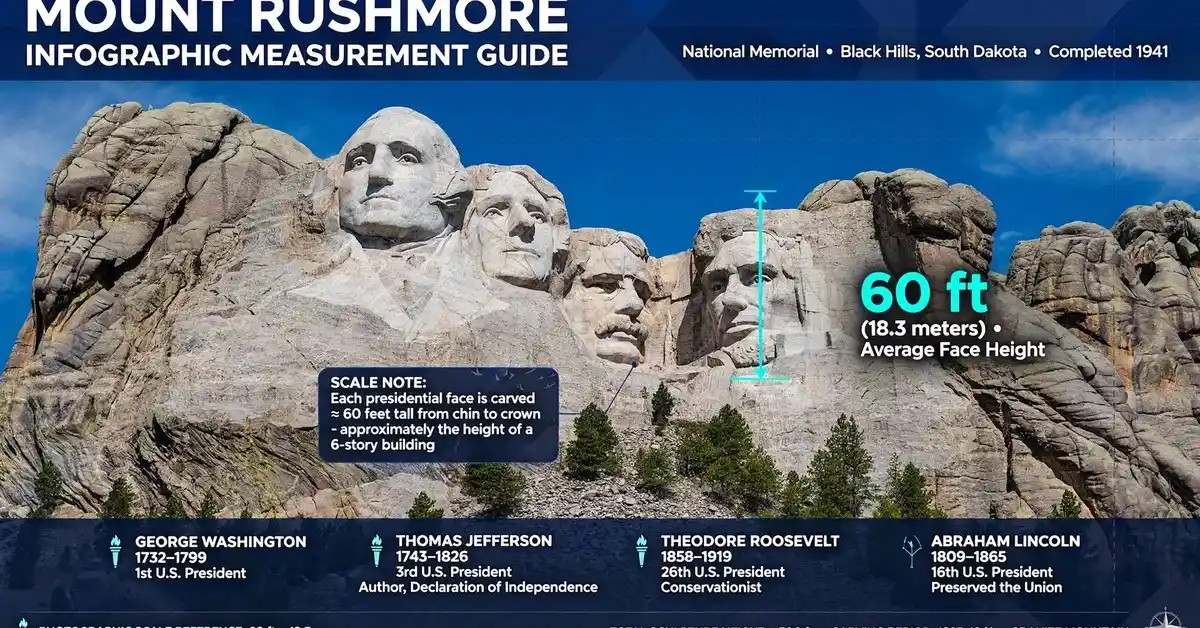
Each face carved on Mount Rushmore measures 60 feet from chin to forehead — about as tall as a six-story building. The mountain itself rises to 5,725 feet above sea level in South Dakota’s Black Hills, with the sculpture sitting roughly 450 feet above the valley floor below.
When people ask how tall Mount Rushmore is, they usually mean the carved faces. But the answer has two parts: the sculpture and the mountain it was carved into. Both numbers are impressive in their own right. The 60-foot faces are hard to appreciate in photos. Standing at the Grand View Terrace, Washington’s nose alone is 20 feet long — longer than most cars.
The mountain, at 5,725 feet of elevation, is not a particularly tall peak by western standards. The Black Hills are old and worn, and the nearby Black Elk Peak is higher at 7,244 feet. What makes Mount Rushmore extraordinary is not the mountain’s height but what Gutzon Borglum and his crew did to it between 1927 and 1941.
This guide breaks down every key measurement of the memorial, from nose lengths to the total rock removed, so you can picture the true scale of the place.
Quick Conversion Chart
| Measurement | Feet | Meters | Stories (rough) |
|---|---|---|---|
| Each face (chin to forehead) | 60 ft | 18.3 m | ~6 stories |
| Nose length | 20 ft | 6.1 m | ~2 stories |
| Eye width | 11 ft | 3.35 m | ~1 story |
| Mountain elevation | 5,725 ft | 1,745 m | — |
| Sculpture above valley floor | ~450 ft | ~137 m | ~45 stories |
Key Measurements at a Glance
| # | Feature | Measurement |
|---|---|---|
| 1 | Each face height (chin to forehead) | 60 ft |
| 2 | Nose length | 20 ft |
| 3 | Eye width | 11 ft |
| 4 | Mouth width | 18 ft |
| 5 | Mountain elevation above sea level | 5,725 ft |
| 6 | Sculpture above valley floor | ~450 ft |
| 7 | Construction span | 1927–1941 (14 years) |
| 8 | Rock removed with dynamite | ~450,000 tons |
Construction & History Facts
| # | Fact | Detail |
|---|---|---|
| 9 | Sculptor | Gutzon Borglum |
| 10 | Presidents depicted | Washington, Jefferson, Roosevelt, Lincoln |
| 11 | Original plan | Full torsos to the waist |
| 12 | Hall of Records | Chamber behind Lincoln’s head |
| 13 | Avenue of Flags | 56 flags, one per state/territory |
| 14 | Grand View Terrace | Main viewing platform |
| 15 | Statue of Liberty comparison | Her face is ~8 ft; Rushmore faces are 60 ft |
1. Face Height: 60 Feet Per President
Each of the four faces on Mount Rushmore is 60 feet tall, measured from the chin to the top of the forehead. To picture it, imagine a six-story apartment building stacked on top of itself — that is roughly the height of Washington’s forehead.
The 60-foot figure was not random. Borglum designed the faces to be legible from far away, since the memorial was meant to be viewed from the valley and surrounding roads. A smaller carving would have disappeared against the rock face.
George Washington’s face was the first completed and remains the reference for the scale of the others. Each face is slightly different in character — Washington is solemn, Jefferson contemplative, Roosevelt determined, Lincoln thoughtful — but all share the same 60-foot canvas. That uniformity is part of what makes the sculpture read so clearly from a distance.
2. Nose Length: 20 Feet
Every nose on the memorial is 20 feet long, from bridge to tip. For scale, a standard full-size pickup truck is about 19 to 20 feet long. Park one end to end and you are looking at the length of a president’s nose.
The noses are the most projecting features on the sculpture. Because they jut out from the face, workers had to carve them from solid rock that protruded from the cliff — there was no room for error. Too aggressive with the drill and a nose could have been ruined.
Photographs taken during construction show workers standing on scaffolding beside the noses. In those shots, a full-grown man barely reaches from the nostril to the bridge of the nose. It is one of the most striking visual proofs of the monument’s scale.
3. Eye Width: 11 Feet Each
Each eye is 11 feet wide. A typical bedroom door is about 6 feet 8 inches tall, so a single eye on Mount Rushmore is nearly twice as wide as your bedroom door is tall.
The eyes were among the trickiest features to carve. Unlike the noses, which project outward, the eyes are recessed and had to capture each president’s gaze. Borglum wanted the faces to look alive, and the eyes carry most of that expression.
Interestingly, the eyes are not simple ovals. Each contains a slight shadow cut that reads as a pupil from a distance. Standing up close at the base of the mountain (where visitors are not permitted to climb), the eyes would look like simple wide arcs. From the Grand View Terrace, though, they resolve into convincing gazes.
4. Mouth Width: 18 Feet
Each mouth spans about 18 feet — roughly the width of a two-car garage door. Lincoln’s mouth, set in his characteristic slight frown, is the most studied; Borglum adjusted it several times during carving to get the right solemnity.
The mouths are shallower carvings than the noses, cut into the face rather than projecting from it. That made them somewhat safer to carve, but the lips of Washington and Jefferson still required delicate finishing work with smaller drills and hand chisels.
When you look at photographs of the monument, the mouths are what give each face its distinct mood. A difference of a few inches in the corner of a mouth, scaled up to 18 feet, reads clearly from hundreds of yards away.
5. Mountain Elevation: 5,725 Feet Above Sea Level
The summit of Mount Rushmore sits at 5,725 feet above sea level. That sounds high, but it is modest by the standards of the American West — Denver’s airport sits at about 5,430 feet, for comparison.
The Black Hills are an ancient range, worn down over hundreds of millions of years. The rock the faces are carved into is granite, roughly 1.6 billion years old in places. That granite is part of why the site was chosen: it erodes extremely slowly, so the carving should survive for tens of thousands of years.
The elevation matters for visitors in one practical way: the air is thinner and the weather can change fast. Afternoon thunderstorms in summer are common, and the memorial closes the terrace during lightning. Plan accordingly if you visit.
6. Sculpture Above the Valley Floor: ~450 Feet
The carved faces sit about 450 feet above the valley floor below. That is roughly the height of a 45-story skyscraper. The memorial feels imposing partly because the faces hang high above the viewer at the terrace.
This vertical gap is why the sculpture photographs so well. From the Grand View Terrace, you look up at the faces against the sky, with nothing but air and rock between you and them. Borglum understood this sightline and composed the faces for it.
The 450-foot drop also explains the construction logistics. Everything — drills, dynamite, scaffolding, the workers themselves — had to be hauled up the cliff face. Workers climbed over 700 steps to reach the top of the carving each day.
7. Construction Years: 1927 to 1941
Work on Mount Rushmore began in October 1927 and finished in October 1941 — a 14-year project. The Great Depression hit right in the middle, and federal funding kept the work alive when private donations dried up.
The timeline was not continuous carving. Weather shut the site down each winter, and funding gaps paused work more than once. Actual carving time was closer to six and a half years spread across those fourteen calendar years.
Gutzon Borglum died in March 1941, seven months before the project was declared complete. His son, Lincoln Borglum, supervised the final months. The Hall of Records chamber was left unfinished, and the planned full torsos were never attempted.
8. Rock Removed: About 450,000 Tons
Carving Mount Rushmore required removing approximately 450,000 tons of rock — most of it blasted away with dynamite. That is roughly the weight of 90,000 adult elephants, if you want a mental image.
Dynamite did about 90 percent of the carving work. Workers drilled holes, packed them with dynamite, and blasted the rock down to within a few inches of the final surface. Then came the “honeycombing” — drilling a tight pattern of shallow holes so the last layer of rock could be chipped away cleanly.
The precision was remarkable. Not a single worker died during the entire 14-year project, despite the dynamite, the heights, and the Depression-era equipment. Borglum credited careful engineering and, frankly, good luck.
9. The Sculptor: Gutzon Borglum
Gutzon Borglum was 60 years old when he started Mount Rushmore. He was already a prominent American sculptor, known for large-scale work including a colossal (later destroyed) Confederate memorial project at Stone Mountain, Georgia.
Borglum was a demanding, theatrical figure who fought constantly with the National Park Service and his own engineers over money and methods. But his artistic judgment on the mountain was vindicated: the faces have the simplified, bold planes that read perfectly at a distance.
He never saw the finished work. Borglum died of a heart attack in Chicago in March 1941. The memorial was completed under his son Lincoln’s direction, with Borglum’s plaster models as the guide.
10. The Four Presidents Depicted
The four faces are George Washington, Thomas Jefferson, Theodore Roosevelt, and Abraham Lincoln. Borglum chose them to represent the first 150 years of American history: the nation’s birth, its growth, its development, and its preservation.
The order on the mountain, left to right, is Washington, Jefferson, Roosevelt, Lincoln. Washington was chosen first and carved first. Jefferson was originally placed to Washington’s right but the rock there was cracked, so his face was moved to Washington’s left.
Theodore Roosevelt was the most controversial pick — he was still a recent president, and some critics thought it was too soon. Borglum insisted: Roosevelt represented American expansion and the conservation of public lands, including the Black Hills themselves.
11. The Original Plan: Full Torsos
Borglum’s original vision was far grander than four heads. He wanted to carve the presidents down to their waists, with an entablature — a carved inscription panel — describing American history beside them.
The full-torso plan was abandoned for two reasons: money and rock. Funding ran short during the Depression, and the granite below the faces turned out to be fractured and unsuitable for carving. By 1941, the heads alone were the achievable monument.
Some visitors are surprised the sculpture “ends” at the chins. What survives is essentially the project’s Phase One — and, arguably, the part that worked best. The heads against raw rock have a starkness the busier original plan might have lacked.
12. The Hall of Records
Behind Lincoln’s head, inside the mountain, sits the Hall of Records — a chamber Borglum intended as a repository of American history. He imagined future generations finding bronze and enamel panels explaining the nation’s story.
The chamber was never finished. Borglum died before its entrance could be carved into the grand doorway he planned. What exists is a rough tunnel leading to a small room containing a titanium vault with porcelain panels of the Declaration of Independence, the Constitution, and the Bill of Rights.
The vault was sealed in 1998. It is not open to visitors, and the chamber entrance is barely visible from the terrace. It remains one of the memorial’s best-kept secrets hiding in plain sight.
13. The Avenue of Flags
The Avenue of Flags is a walkway at the memorial lined with 56 flags — one for each of the 50 states, plus the District of Columbia, Guam, Puerto Rico, the U.S. Virgin Islands, American Samoa, and the Northern Mariana Islands.
The flags run from the entrance toward the Grand View Terrace, and the plaques beneath them list each state’s admission date to the Union. It is a popular photo spot, especially when the wind fills the flags against the mountain backdrop.
Walking the avenue takes a few minutes and is fully wheelchair accessible. Many visitors say the flag-lined approach builds anticipation before the first full view of the faces.
14. The Grand View Terrace
The Grand View Terrace is the main viewing platform directly below the sculpture. This is the spot in nearly every postcard photograph of Mount Rushmore — the wide terrace with the four faces rising above it.
The terrace sits roughly at the valley floor level, so the full 450-foot vertical rise of the sculpture is on display. Benches, telescopes, and ranger programs are all available here. Evening lighting ceremonies are held from late May through September.
If you visit, arrive early. The terrace faces southeast, so the faces are lit best in morning light. Afternoon sun puts the sculpture partly in shadow, and tour buses peak between 11 a.m. and 3 p.m.
15. Comparison: The Statue of Liberty’s Face
For a final sense of scale, compare Mount Rushmore to the Statue of Liberty. Lady Liberty’s face is about 8 feet tall — already huge by human standards. Each Rushmore face, at 60 feet, is roughly seven and a half times taller.
The Statue of Liberty as a whole stands about 305 feet from ground to torch tip. A single Rushmore face would reach nearly a fifth of that height. And the mountain carrying those faces rises thousands of feet above the surrounding landscape.
It is worth remembering that both monuments were built in the same spirit — colossal public art meant to be read from far away. Borglum just had the advantage of a mountain-sized canvas. If you want to practice reading measurements on a tape before a trip, our guide on how to read a measuring tape walks through the basics.
Frequently Asked Questions
How tall is each face on Mount Rushmore?
Each face is 60 feet tall, measured from the chin to the top of the forehead. The noses are 20 feet long and the eyes are 11 feet wide. The uniformity of the 60-foot scale is what lets all four faces read clearly from the viewing terrace hundreds of yards away.
How tall is the mountain Mount Rushmore is carved into?
The mountain’s summit is 5,725 feet above sea level. The carved faces themselves sit about 450 feet above the valley floor where visitors stand. The Black Hills are an ancient, worn-down range, so this is modest by western mountain standards — the nearby Black Elk Peak is higher at 7,244 feet.
How long did it take to carve Mount Rushmore?
Construction ran from October 1927 to October 1941 — 14 calendar years, though actual carving time was closer to six and a half years once you subtract winters and funding gaps. Gutzon Borglum died in March 1941, seven months before the project was declared complete.
How much rock was removed to carve Mount Rushmore?
Approximately 450,000 tons of granite were removed, mostly with dynamite. Blasting did about 90 percent of the work; workers then finished the surfaces with drills and chisels. Remarkably, no workers died during the entire project.
Final Thoughts
Mount Rushmore’s numbers tell a story of scale that photos rarely capture: 60-foot faces, 20-foot noses, and 450,000 tons of blasted granite, all perched 450 feet above the valley floor on a 5,725-foot mountain. The 14-year effort, finished in 1941 without a single worker fatality, remains one of America’s great engineering feats. If you go, stand at the Grand View Terrace in the morning light and pick out the 11-foot eyes — that is when the sheer size of Borglum’s vision truly lands. The mountain will still be there long after the scaffolding stories fade, granite wearing down at a pace measured in millennia.

I’m Marcus Kane, a measurement content specialist at MeasuresIt.com. I write clear, accurate, and practical articles about measurements, dimensions, conversions, and everyday size comparisons, making complex topics simple and easy to understand.