How Tall Is the Hoover Dam? Height, Width & Key Facts
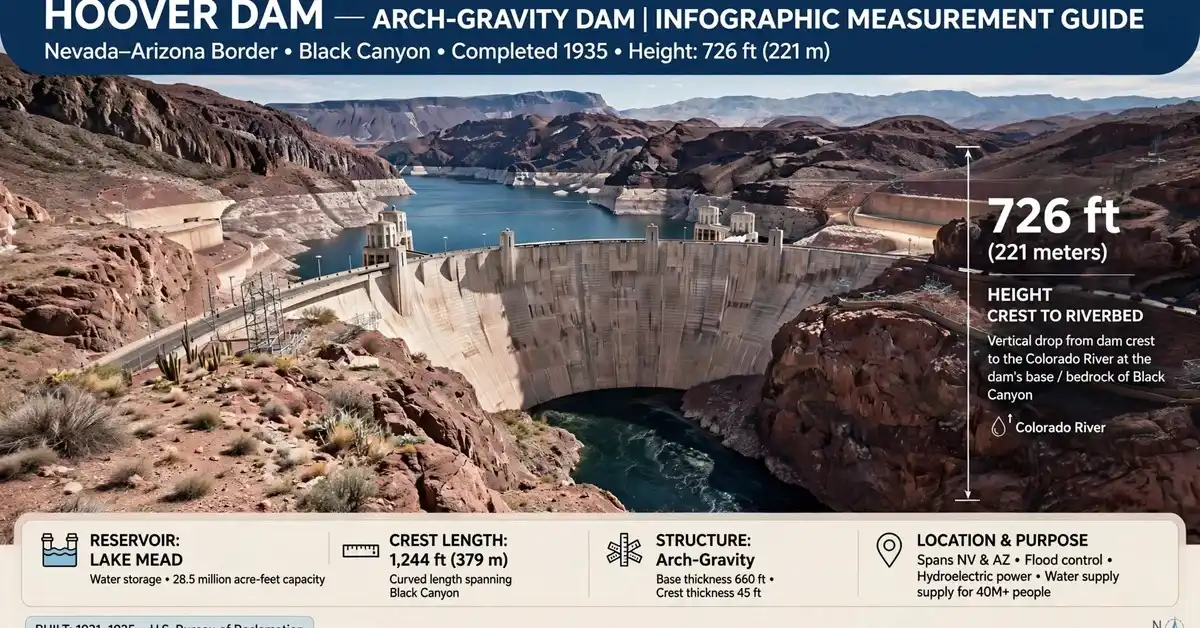
The Hoover Dam stands 726 feet tall from its foundation to its crest, making it one of the tallest concrete dams ever built. Its crest stretches 1,244 feet across the Black Canyon, and at its base the dam is a staggering 660 feet thick. Completed in 1935, it holds back Lake Mead — the largest reservoir in the United States — and still generates hydroelectric power for nearly a century later.
The dam’s numbers are worth savoring because every one of them was achieved in the early 1930s, with the construction technology of the Great Depression. To feel the scale, it helps to measure it against familiar things — the same instinct behind checking how to read a measuring tape before a project, applied to one of the biggest concrete structures on Earth. Here are 15 measurements that capture just how massive it is.
Key Dimensions Conversion Chart
| Measurement | Feet | Meters | Comparison |
|---|---|---|---|
| Height (foundation to crest) | 726 | 221 | ~60-story building |
| Crest length | 1,244 | 379 | ~4 football fields |
| Base thickness | 660 | 201 | ~2 football fields |
| Crest thickness | 45 | 14 | Two-lane road |
| Lake Mead max depth | 532 | 162 | — |
| Intake tower height | ~395 | ~120 | — |
| Powerhouse length | ~650 | ~198 | — |
Hoover Dam Measurements at a Glance
| # | Feature | Measurement |
|---|---|---|
| 1 | Height (foundation to crest) | 726 ft (221 m) |
| 2 | Crest length | 1,244 ft |
| 3 | Base thickness | 660 ft |
| 4 | Crest thickness | 45 ft |
| 5 | Concrete volume | 3.25 million cu yd |
| 6 | Weight | ~6.6 million tons |
| 7 | Construction period | 1931–1935 |
| 8 | Official construction deaths | 96 |
More Dam Scale Facts
| # | Feature | Measurement |
|---|---|---|
| 9 | Lake Mead capacity | ~28.9 million acre-feet |
| 10 | Powerhouse length | ~650 ft |
| 11 | Generators | 17 |
| 12 | Intake tower height | ~395 ft |
| 13 | Spillway capacity (each) | ~200,000 cu ft/sec |
| 14 | Washington Monument comparison | 555 ft (dam is taller) |
| 15 | 60-story building comparison | ~726 ft equivalent |
1. Height: 726 Feet
The headline number: 726 feet from the lowest point of the foundation to the top of the crest. That is taller than a 60-story building and, when it was finished, made Hoover Dam the tallest dam in the world — a title it held for decades.
The height is measured from the foundation because so much of the dam is buried: the structure extends deep into the canyon floor and walls. What you see from the roadway on top is only part of the story. The 726-foot figure represents the full structural height, and it is the number engineers use when they talk about the dam holding back the immense pressure of Lake Mead — pressure that grows with every foot of water depth behind that curved wall.
2. Crest Length: 1,244 Feet
The top of the dam — the crest — runs 1,244 feet from the Nevada side to the Arizona side, carrying a two-lane road across the Black Canyon. Walking it takes about five minutes, with Lake Mead on one side and a 700-foot drop to the Colorado River on the other.
The crest’s gentle curve is not decorative. The dam is an arch-gravity structure, meaning its curved shape transfers the water’s pressure into the canyon walls on either side. That 1,244-foot arc is precisely engineered: too straight and the dam would rely on mass alone; too curved and the stresses would concentrate. Standing on the crest, you can feel the curve under your feet as the roadway bends across the canyon.
3. Base Thickness: 660 Feet
At its foundation, the dam is 660 feet thick — roughly the length of two football fields of solid concrete between the lake and the downstream face. This is the dimension that stops visitors cold: the dam is nearly as thick at its base as it is tall.
The thickness tapers as the dam rises, following the physics of water pressure, which increases with depth. At the bottom, the water pushes hardest, so the concrete is deepest there. The 660-foot base is what makes the dam a “gravity” dam as well as an arch dam: its sheer mass alone would resist the lake’s pressure even without the canyon walls helping.
4. Crest Thickness: 45 Feet
At the top, the dam narrows to just 45 feet thick — wide enough for the two-lane roadway, sidewalks, and the railings, with room to spare. The contrast with the 660-foot base is the whole story of the dam’s cross-section in one pair of numbers.
Forty-five feet is about the width of a generous residential street, and it is easy to forget while driving across that you are on top of a structure that widens to nearly fifteen times that thickness below you. The taper is visible if you look at the dam from the downstream side: the face slopes outward as it descends, like the hull of a great ship.
5. Concrete Volume: 3.25 Million Cubic Yards
The dam contains about 3.25 million cubic yards of concrete — enough, as the old guides like to say, to build a two-lane highway from San Francisco to New York, or to pave a sidewalk four feet wide around the equator. It was the largest concrete pour in history at the time.
Pouring that much concrete created its own engineering problem: concrete generates heat as it cures, and 3.25 million cubic yards would have taken more than a century to cool naturally. The builders embedded a network of cooling pipes carrying cold river water through the dam as it rose, then filled the pipes with grout — a technique invented for this project and still used in massive concrete structures today.
6. Weight: About 6.6 Million Tons
The finished dam weighs roughly 6.6 million tons. That figure includes the concrete of the dam itself plus the powerhouse and related structures, and it is the reason the dam barely notices the lake pushing against it.
Weight is the quiet hero of dam engineering. Every second, Lake Mead presses against the dam with millions of pounds of force, and the dam answers with millions of tons of mass. The 6.6-million-ton figure also explains the dam’s legendary durability: there is simply so much material that minor cracking, seepage, or earthquake shaking cannot threaten the whole.
7. Built 1931–1935
Construction ran from 1931 to 1935, with the dam completed two years ahead of schedule — a remarkable feat during the Great Depression, when the project employed more than 21,000 workers at its peak. The dedication ceremony took place in September 1935.
The timeline is part of the legend. The Colorado River was diverted through tunnels blasted into the canyon walls, the foundation was excavated down to bedrock, and the dam rose in interlocking concrete blocks — all in about four years, using 1930s equipment. Workers lived in Boulder City, a town built from scratch for the project, and the dam’s early completion saved the government millions during the hardest economic years in American history.
8. Official Construction Deaths: 96
The official death toll of the dam’s construction is 96 workers. It is a sobering number, and it reflects the genuine dangers of the work: falls, blasting accidents, heat, carbon monoxide in the diversion tunnels, and drowning in the river.
The figure comes with context worth knowing. The official count excluded deaths from heat-related illness that were sometimes recorded as pneumonia, so some historians believe the true toll was higher. What is not disputed is that the project pioneered safety measures for its era, including hard hats — reportedly required on the site — and that the human cost was enormous. The memorial at the dam honors the workers who died building it.
9. Lake Mead Capacity: About 28.9 Million Acre-Feet
Lake Mead, the reservoir the dam created, holds about 28.9 million acre-feet of water at full capacity — the largest reservoir in the United States. An acre-foot is the amount of water that covers an acre one foot deep, so the lake at full pool holds enough water to cover the entire state of New York about a foot deep.
The scale of the lake is what makes the dam matter. Lake Mead stores Colorado River water for millions of people and vast farmland across Nevada, Arizona, and California. In recent drought years the lake has fallen far below full pool, exposing a pale “bathtub ring” on the canyon walls — a visible measure, in feet of elevation, of the region’s water crisis.
10. Powerhouse Length: About 650 Feet
The powerhouse at the base of the dam stretches roughly 650 feet along the river — longer than two football fields — and houses the generators that turn the river’s flow into electricity. Its Art Deco styling, with Native American-inspired motifs, makes it one of the most beautiful industrial buildings in America.
Six hundred fifty feet of powerhouse is easy to miss from the top of the dam, since it sits at the downstream base, but it is where the dam does its daily work. Water drops from the lake through the penstocks, spins the turbines, and exits back into the river — a continuous conversion of the Colorado’s power into electricity for the Southwest.
11. Seventeen Generators
The powerhouse contains 17 main generators, which together can produce just over 2,000 megawatts of electricity — enough to power roughly 1.3 million homes. When the dam opened, it was the largest hydroelectric installation in the world.
The number 17 reflects decades of upgrades: the original installation had fewer, larger units, and the plant has been modernized repeatedly since 1935. Each generator is driven by water falling hundreds of feet from the lake, and the plant can ramp output up and down to meet peak demand. Nearly a century after construction, the dam remains a workhorse of the Western power grid.
12. Intake Towers: About 395 Feet Tall
Four intake towers rise from the lake bed near the dam, each roughly 395 feet tall — taller than the Statue of Liberty — controlling the water that flows into the powerplant and the river below. Their cylindrical concrete forms, topped with small pavilions, are among the dam’s most photographed features.
The towers draw water from different depths of the lake, which lets operators manage water temperature and quality downstream. At 395 feet, each tower is a substantial structure on its own; from the dam’s crest they look modest only because the dam itself dwarfs them. When Lake Mead’s level drops, more of the towers’ height is exposed above the waterline.
13. Spillway Capacity: About 200,000 Cubic Feet Per Second Each
Each of the dam’s two spillways can discharge roughly 200,000 cubic feet of water per second — enough to drain an Olympic swimming pool in a fraction of a second. The spillways are the dam’s safety valves, used only when the lake rises dangerously high.
The spillways have been used rarely, most notably during the floods of 1983, when the lake threatened to overtop the dam. Each spillway is a massive concrete channel carved into the canyon wall on either side of the dam, and the roar of water through them at full flow is said to shake the ground. Their enormous capacity is a measure of the engineers’ caution: they were sized for floods far beyond anything then recorded.
14. Taller Than the Washington Monument
The Washington Monument stands 555 feet tall. The Hoover Dam, at 726 feet, is nearly 200 feet taller — a comparison that helps because the monument is one of the most familiar vertical landmarks in America. If you set the monument at the dam’s base, its tip would fall well short of the crest.
The comparison also marks a changing of the guard in American engineering ambition. The monument, completed in 1884, was the tallest structure in the world in its day; the dam, finished fifty years later, exceeded it as a matter of routine. Both are stone-and-concrete statements of national purpose, but the dam’s height serves a working function — holding back a sea in the desert.
15. As Tall as a 60-Story Building
At 726 feet, the dam stands about as tall as a 60-story skyscraper. Picture a downtown office tower laid on its side across the canyon — that is the vertical scale of the concrete wall. A standard door is 80 inches tall; you would need to stack about 109 of them to reach from the dam’s foundation to its crest.
The skyscraper comparison lands because most people have stood at the base of a tall building and craned their necks upward. Now fill that view with solid concrete curving across a canyon, with a lake the size of a small sea behind it. It is a useful final image: the Hoover Dam is not just tall for a dam — it is tall, period, by any measure we use for the built world.
Frequently Asked Questions
How tall is the Hoover Dam?
The dam is 726 feet (221 meters) tall from its foundation to its crest. It is 1,244 feet long across the top, 660 feet thick at its base, and narrows to 45 feet thick at the crest.
When was the Hoover Dam built?
Construction ran from 1931 to 1935, and the dam was dedicated in September 1935 — two years ahead of schedule. It was built during the Great Depression and at its peak employed more than 21,000 workers.
How much concrete is in the Hoover Dam?
About 3.25 million cubic yards, which was the largest concrete pour in history at the time. The dam weighs roughly 6.6 million tons in total.
Does the Hoover Dam still generate electricity?
Yes. Its 17 generators produce just over 2,000 megawatts, enough for roughly 1.3 million homes. The dam remains a major source of hydroelectric power for Nevada, Arizona, and California.
Final Thoughts
The Hoover Dam is one of those places where the numbers do the talking: 726 feet tall, 660 feet thick at the base, 3.25 million cubic yards of concrete, all raised in four Depression-era years. But the statistics only partly explain why it moves people. It is also beautiful — the curved crest, the Art Deco towers, the white-on-black terrazzo floors — proof that infrastructure can be art. If you visit, walk the crest, tour the powerhouse, and stand at the base looking up at the curved wall rising above you. Remember the 96 workers who did not come home, and the millions downstream whose water and power still depend on it. Few human achievements reward looking up as richly as this one.

I’m Elena Cross, a content writer at MeasuresIt.com, where I turn complex measures, units, and mathematical concepts into clear, accurate, and easy-to-read articles. I’m passionate about precision in numbers and in words and I write to help readers actually understand measurements, not just memorize them.