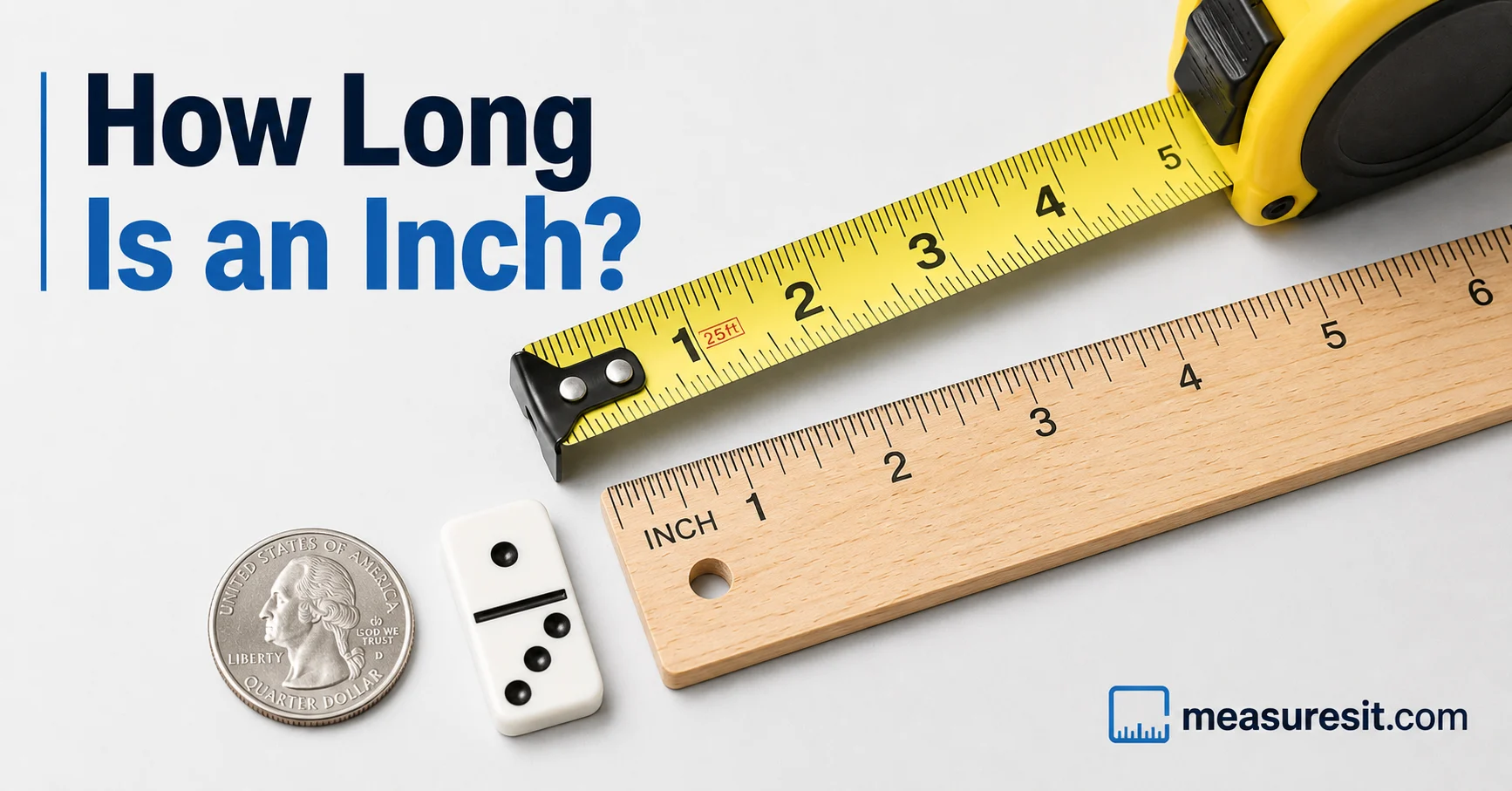
Grab a tape measure and look at the first mark after zero that’s an inch, and it’s smaller than most people picture it in their head.
An inch equals 2.54 centimeters, or about the width of an adult thumb at the knuckle. It’s the small, everyday building block behind bigger units like feet and yards, and it shows up constantly: on phone screens, clothing tags, rainfall totals, and the ruler in your kid’s pencil case.
If you’ve ever tried to guess If a package would fit in a mailbox slot, or squinted at a tape measure trying to read the little lines between the numbers, you already know inches are one of those units you think you understand until you actually need to use one precisely.
This guide covers the conversions people search for most, how to read fractions of an inch on a real ruler, and a handful of everyday objects worth keeping in your mental back pocket.
What Is an Inch, Exactly?
An inch is a unit of length used mainly in the United States, and to a lesser extent in the UK and Canada, as part of the imperial and US customary measurement systems. Almost everywhere else, the metric system took over decades ago, which is why you’ll often see both units printed side by side on packaging and tools.
The inch itself isn’t some arbitrary historical guess. Since 1959, the US, UK, and several other countries have defined it under an international agreement as exactly 2.54 centimeters a fixed, unchanging figure, not an approximation. Before that agreement, slightly different versions of the inch existed in different countries, which is part of why standardizing it mattered.
You’ll run into inches most often in three places: home projects (measuring a shelf or a doorway), shopping (screen sizes, waist measurements, shoe widths), and anything involving a standard ruler or tape measure, which in the US is still marked in inches rather than centimeters.
Inch Conversion Chart
| Unit | Equivalent |
| 1 inch | 2.54 centimeters |
| 1 inch | 25.4 millimeters |
| 1 inch | 0.0254 meters |
| 1 inch | 1/12 foot (≈0.083 ft) |
| 1 inch | 1/36 yard (≈0.028 yd) |
| 12 inches | 1 foot |
| 36 inches | 1 yard |
| 63,360 inches | 1 mile |
These figures come from the standardized 1959 definition, so unlike some measurement comparisons later in this guide, they’re exact not rounded estimates.
Reading Fractions of an Inch
This is the part most people actually get stuck on. A ruler doesn’t just show whole inches; it’s broken into halves, quarters, eighths, and sixteenths, and those tiny unlabeled lines trip up plenty of adults, not just kids in shop class.
| Fraction | Decimal Equivalent |
| 1/16 inch | 0.0625 |
| 1/8 inch | 0.125 |
| 1/4 inch | 0.25 |
| 3/8 inch | 0.375 |
| 1/2 inch | 0.5 |
| 5/8 inch | 0.625 |
| 3/4 inch | 0.75 |
| 7/8 inch | 0.875 |
A quick trick for reading a ruler fast: find the nearest half-inch mark first (it’s usually the longest line between whole numbers), then count smaller lines from there instead of starting from zero every time. It’s faster and it’s how most carpenters and tailors actually read a tape measure in practice.
How Big Is an Inch, Really?
Compared to a centimeter, an inch is noticeably longer than double, in fact, which is why metric rulers look like they have so many more lines packed into the same space. Compared to a foot, it’s on the small side: twelve inches make up just one foot, so a single inch is a modest sliver of a standard ruler.
Where people usually misjudge inches is in photos and product listings. A 27-inch monitor sounds enormous until you remember that measurement is the diagonal, not the width the actual screen is narrower than the number suggests. The same goes for suitcases, TVs, and picture frames: inches described in marketing material often refer to diagonal or combined dimensions, not the straightforward length you’re picturing.
Objects That Are About an Inch (and a Few That Aren’t)
Rulers aren’t always within reach, so it helps to have a few real-world objects memorized. These aren’t lab-precise, but they’re consistent enough to trust for a quick gut check.
A US quarter is the most reliable one it measures just under an inch across (0.955 inches, to be exact, since US coins are minted to strict federal specifications). If you need a fast reference and you’ve got change in your pocket, this is the one to use.
Your own thumb comes in a close second. Measured from the tip to the first knuckle, an adult thumb lands close to an inch for most people which is exactly why tailors and woodworkers have leaned on it for generations before tape measures were common.
A standard domino tile is about an inch wide, and a AA battery is just over half an inch across, so two side by side get you close to a full inch. Both are manufactured to fixed dimensions, which makes them more dependable than produce-based comparisons.
Speaking of produce, a large grape or strawberry is often cited as about an inch, but treat that one loosely. Fruit size varies enough by variety and ripeness that it’s a rough visual cue at best, not something to measure a woodworking cut against.
For something clearly larger than an inch, a credit card’s short edge runs a little over two inches, and a standard No. 2 pencil, unsharpened, is close to seven and a half inches both useful upper-bound references when an inch alone feels too small to picture.
How to Estimate an Inch Without a Ruler
- Check your thumb the width from the tip to the first knuckle is close enough for casual use.
- Use a quarter laid flat, it’s just under an inch across and easy to carry.
- Fold a dollar bill a US bill is about 2.6 inches wide, so folding it roughly in half gets you close to an inch.
- Line up two AA batteries whose combined width lands right around an inch.
- Compared to a domino its width is one of the more accurate quick references available.
None of these replace an actual tape measure for anything that needs to be precise: hanging shelving, cutting wood, or ordering furniture but they’re solid enough for will this fit in my bag or how big is that, roughly.
FAQ
How many inches are in a foot?
There are 12 inches in a foot, and 36 inches in a yard.
Is an inch bigger than a centimeter?
Yes. One inch equals 2.54 centimeters, so it’s more than twice the length of a centimeter.
What’s the easiest household item to use as a 1-inch reference?
A US quarter is the most consistent, since coins are minted to exact federal specifications rather than varying by manufacturer.
Why does the US still measure in inches instead of centimeters?
The US never fully converted to the metric system, largely due to the cost and disruption of switching existing infrastructure, tools, and standards. According to the National Institute of Standards and Technology, the US customary system including the inch remains the primary system used in American commerce and everyday life.
Final Thoughts
An inch is a small unit, but it’s one you run into constantly, If you’re reading a ruler, checking a screen size, or figuring out if something will fit through a doorway.
The conversions are fixed and easy to look up 2.54 centimeters, 12 to a foot but the harder skill is being able to picture an inch without pulling out a tape measure every time.
That’s really what the comparisons in this guide are for. A quarter, a thumb, a domino, none of them are perfect substitutes for a real measurement, but they’re accurate enough to settle the everyday question of is that about an inch? without digging through a junk drawer first.
Read More About!
- How Long Is 8 Inches? 15 Everyday Comparisons
- How Long Is 5 Inches? Real-Life Size Comparisons
- How Long Is 14 Inches? Real-World Comparisons

I’m Elena Cross, a content writer at MeasuresIt.com, where I turn complex measures, units, and mathematical concepts into clear, accurate, and easy-to-read articles. I’m passionate about precision in numbers and in words and I write to help readers actually understand measurements, not just memorize them.


4 thoughts on “How Long Is an Inch? Sizes, Conversions & Comparisons”