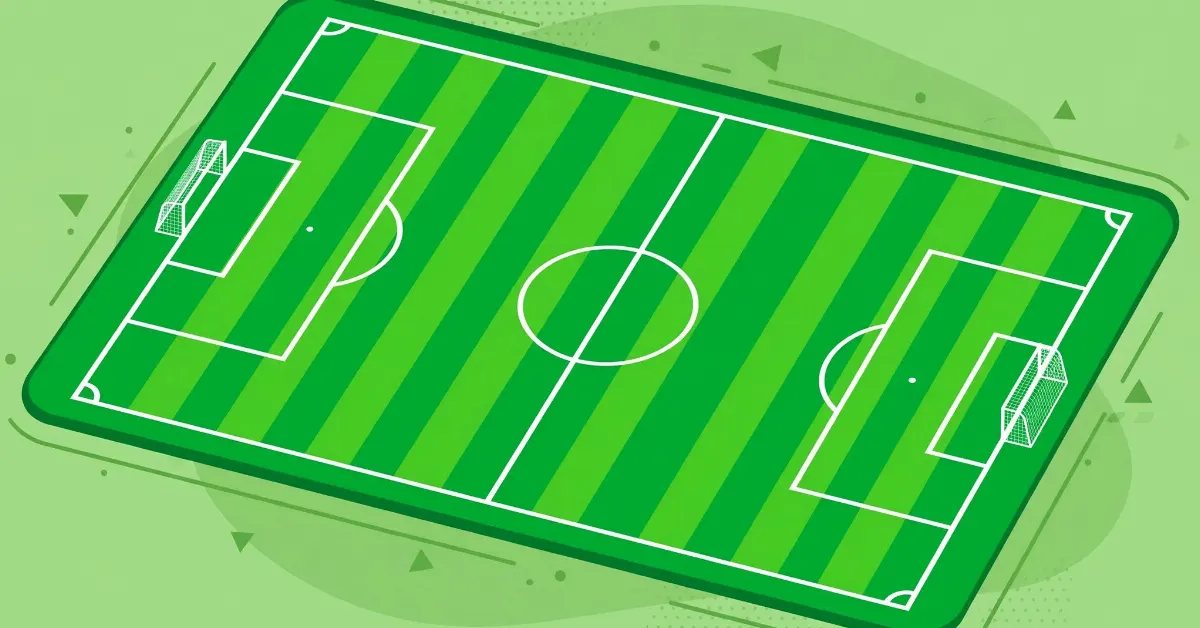
An official FIFA soccer field measures 105 × 68 meters, which works out to 115 × 74 yards. In feet, that is about 345 feet long by 223 feet wide, and the goals measure 24 feet wide by 8 feet high.
Whether you call it soccer or football, the pitch is one of the most carefully regulated playing surfaces in all of sport. FIFA, the world governing body of the game, publishes the official standard used for World Cup matches and top-flight professional leagues: a rectangle 105 meters long and 68 meters wide. Those two numbers have become the universal reference point for stadium builders, groundskeepers, coaches, and anyone who has ever wondered just how big the field really is when it fills a television screen.
Yet not every pitch you see is identical. FIFA’s Laws of the Game allow some variation in field size, which is why a historic stadium shoehorned into a city block can play slightly smaller than a brand-new arena built without constraints. The 105 × 68 meter figure is the recommended international match standard, and it is the number that most professional venues target when they lay out their grass.
The metric numbers are the official ones — FIFA writes its Laws of the Game in meters — while the yard and foot figures are the conversions most fans in the United States and the United Kingdom reach for first. The conversions are not perfectly round (105 meters is really 114.83 yards), which is why you will occasionally see slightly different figures quoted in older books and broadcasts. The 115 × 74 yard form is the accepted rounded version used across the sport, and it is the one worth memorizing.
This guide breaks down the official dimensions in meters, yards, and feet, explains every line and marking on the pitch, covers goal sizes, youth and high school variations, and shows how a soccer field stacks up against an American football field.
1. Official FIFA Soccer Field Dimensions
The headline numbers are simple: length 105 meters, width 68 meters. In the imperial units most familiar to American readers, that translates to 115 yards long and 74 yards wide. In feet — the unit that makes the scale of the field hit home — the pitch stretches about 345 feet from goal line to goal line and spans roughly 223 feet from touchline to touchline.
Here is the full set of official measurements in every unit, so you never have to convert on the fly:
| Measurement | Meters | Feet | Yards |
|---|---|---|---|
| Field length (touchline to touchline) | 105 m | 344.5 ft | 115 yd |
| Field width (goal line to goal line) | 68 m | 223.1 ft | 74 yd |
| Goal width | 7.32 m | 24 ft | 8 yd |
| Goal height | 2.44 m | 8 ft | 2.67 yd |
| Penalty spot distance (from goal line) | 10.97 m | 36 ft | 12 yd |
| Center circle radius | 9.14 m | 30 ft | 10 yd |
A quick sense of scale: the total playing area is 7,140 square meters — just over 1.75 acres of grass to cover, mow, water, and maintain. Put another way, you could fit about a dozen full-size tennis courts inside the boundary lines and still have room to spare. No wonder professional grounds crews treat their pitches like prized gardens, and no wonder players describe the walk from one penalty area to the other as one of the longer strolls in sports.
One detail worth knowing is which dimension is which. The length of the field is measured along the touchlines — the long sides where throw-ins are taken. The width runs along the goal lines — the short ends where the goals stand. By the Laws of the Game, the touchlines must always be longer than the goal lines, which is why the field is a true rectangle and never a square. When someone quotes a single pair of numbers like 105 × 68, the length always comes first.
Because the metric figures are exact and the imperial ones are rounded, anyone building, buying, or lining a field should work from meters wherever possible. A contractor ordering turf, a school district approving a new stadium, or a coach painting lines for a tournament will all find that the meter-based numbers eliminate the small rounding errors that creep in when you chain conversions together.
2. Pitch Markings Explained
A soccer field looks simple from the stands — some white lines on green grass — but every marking has a job, and players read them the way drivers read road signs. The markings define where the ball is in play, where restarts happen, and where goalkeepers are allowed to use their hands.
The boundary of the field is formed by the two touchlines and the two goal lines. When the whole of the ball crosses a touchline, the game restarts with a throw-in; when it crosses a goal line without a goal being scored, play restarts with a goal kick or a corner kick depending on who touched it last. Inside that frame sits the halfway line, which splits the pitch into two equal halves, and the center mark at its midpoint, where every kickoff begins each half and after every goal.
Around the center mark is the center circle with its 10-yard radius. At kickoff, every player except the one taking the kick must be in their own half, and opponents must stay outside the circle until the ball is in play. It is a small patch of geometry with an outsized role: it guarantees the kicking team a clean first touch and a moment of order before the chaos of open play resumes.
In front of each goal you will find the penalty spot, a small mark 12 yards from the middle of the goal line. Fouls committed by defenders inside the penalty area result in a penalty kick taken from this spot — twelve yards of grass that have decided World Cups. The goals themselves frame the target: two posts standing 24 feet apart, joined by a crossbar 8 feet off the ground, with a net behind to catch the ball and confirm the score.
| Marking | What it is | Official size |
|---|---|---|
| Touchlines | The two long boundary lines; throw-ins are taken from here | 105 m / 115 yd long |
| Goal lines | The two short boundary lines behind each goal | 68 m / 74 yd wide |
| Halfway line | Divides the pitch into two equal halves | Spans the full 68 m width |
| Center mark | Midpoint of the halfway line; kickoffs start here | A single spot at midfield |
| Center circle | Keeps opponents back at kickoff | 10 yd radius |
| Penalty spot | Where penalty kicks are taken | 12 yd from the goal line |
| Goalposts | The two vertical posts of each goal | 24 ft apart |
| Crossbar | The horizontal bar joining the posts | 8 ft above the ground |
Notice how much of the game is defined by just two distances — 12 yards and 10 yards. Once you know the penalty spot and the center circle, you already understand the geometry behind kickoffs and the tensest moments of a penalty shootout. Grounds crews typically repaint or rechalk these lines before every professional match, because a crisp marking is easier for players, officials, and video review to read at speed.
3. Soccer Goal Size: 24 × 8 Feet
The goal is 24 feet wide and 8 feet high, measured from the inside of one post to the inside of the other, and from the ground to the underside of the crossbar. In metric terms that is 7.32 meters by 2.44 meters — proportions that have been essentially unchanged for well over a century, a rare constant in a sport that has otherwise modernized enormously.
Posts and crossbars must be white, and they share the same width and depth so the frame presents a uniform target from every angle. That slim profile matters: the frame is deliberately narrow so it interferes as little as possible with play while still giving the goal its unmistakable shape. Behind the frame hangs the net, which catches the ball and — just as importantly — makes it obvious to players, officials, and fans when a goal has been scored. Before nets became standard, disputes about whether the ball had crossed the line were a regular feature of the game.
For a goal to be used in official competition, it must be anchored securely so it cannot tip over. Portable goals used in training or youth matches should match the 24 × 8 foot proportions wherever possible and must always be anchored or weighted. An unsecured goal is a serious safety hazard, and every major soccer authority emphasizes proper anchoring as a non-negotiable part of setting up a field.
It is worth pausing on how big that target really is. A 24-foot-wide goal is wider than most living rooms, and at 8 feet high it towers a full two feet over a six-foot goalkeeper standing flat-footed. Even with arms outstretched, a keeper cannot cover the whole frame — which is precisely why finishing, the art of placing the ball where the keeper cannot reach, is one of the most celebrated skills in the sport. Every great striker in history has made a career out of eight feet of height and twenty-four feet of width.
4. Youth and High School Field Sizes
Not everyone plays on a full 105 × 68 meter pitch. Young players develop on smaller fields matched to their age and physical size, and the game they play is adjusted to fit: fewer players per side, shorter halves, smaller goals, and a pitch where every child stays close to the action.
In the United States, youth soccer follows a small-sided progression. The youngest age groups play short-sided games — often 4-versus-4 or 7-versus-7 — on compact fields where players touch the ball constantly and no one gets lost in vast empty space. As players grow, the field grows with them: more players are added to each team, the pitch is lengthened and widened, and the goals get bigger. By the mid-teen years, the game looks very much like the adult version, played on pitches approaching full size with regulation-style markings.
High school soccer in the U.S. is played on fields that closely resemble the adult game. School programs typically lay out full-size or near-full-size pitches that follow the same FIFA-based proportions — long touchlines, full-width goal lines, regulation 24 × 8 foot goals, a 12-yard penalty spot, and a 10-yard center circle. Walk onto a well-kept high school field on a Friday night and you are, for all practical purposes, standing on a regulation soccer field.
The guiding principle at every level is proportion. Shrink the field for small legs, keep the markings consistent, and the game teaches itself: players learn spacing, angles, and timing on a canvas that fits their stride. If you coach or organize youth matches, check your league’s field charts before lining a pitch — but expect the same familiar geometry, simply scaled down to meet the players where they are.
5. Soccer Field vs. American Football Field
Soccer and American football invite comparison because both are played on big grass rectangles by eleven players a side — yet the two fields feel completely different underfoot. The soccer pitch is the wider, more open canvas; the football field is the longer, more segmented one, and each shape reflects the sport it serves.
The most visible difference is in the markings. A soccer pitch carries only a handful of lines: boundaries, a halfway line, a center circle, and the penalty spots and goals at each end. An American football field is striped with yard lines every five yards, numbered every ten, with hash marks, sidelines, and end zones boxing in every play. Where soccer’s lines define open space, football’s lines measure progress in precise increments — a visual reminder that one game flows continuously while the other advances in discrete downs.
The goals tell a similar story of contrast. Soccer’s 24 × 8 foot frame sits on the ground at each end, guarding a net; putting the ball through it is the entire objective of the game. Football’s goalposts rise high above the end line as a narrow upright target used mainly for field goals and extra points. Both are called goals, and they share almost nothing else — different shapes, different heights, different roles, different skills required to use them.
| Feature | Soccer pitch | American football field |
|---|---|---|
| Overall shape | Wide, open rectangle | Long, narrow rectangle |
| Length | 115 yards, goal line to goal line | Slightly longer end to end once the end zones are included |
| Width | 74 yards — much wider | Noticeably narrower |
| Goals | 24 × 8 ft frame on the ground with a net | Tall uprights above the end line; no net |
| Markings | A few simple lines and spots | Yard lines, numbers, and hash marks throughout |
| Surface | Natural grass or artificial turf | Natural grass or artificial turf |
| Players per side | 11 | 11 |
Standing on a soccer pitch for the first time surprises most people: the goals look enormous up close, the center circle feels like a long walk from anywhere, and 105 meters suddenly seems much farther than it sounds on television. That sense of scale is exactly what makes the official dimensions worth knowing — they turn an abstract rectangle on a screen into a physical space you can feel.
6. How to Measure a Soccer Field Yourself
Lining a field — for a school, a club, or a weekend tournament — starts with two straight reference lines and a trustworthy tape. If you are new to long measuring tapes, read our guide on how to read a measuring tape before you head out to the grass; misreading the small marks is the most common source of a crooked pitch, and a few minutes of practice saves hours of rework.
Work from one corner: measure 105 meters (or 115 yards) down the touchline, then 68 meters (74 yards) across the goal line, and square the corners with the 3-4-5 triangle method — measure 30 feet along one line and 40 feet along the other, then adjust until the diagonal reads exactly 50 feet. Mark the center of the pitch, sweep your 10-yard center circle with a string or a can of field paint tied to a stake, step off 12 yards from the middle of each goal line for the penalty spots, and set your 24 × 8 foot goals last so each frame sits square to its line.
A 300-foot tape makes the job far easier than a standard 25-footer, and two people beat one: have a partner hold the zero end while you walk the line, and call out measurements rather than guessing. Chalk, spray paint, or removable field paint all work for temporary lines — just be sure whatever you use is approved for the surface you are marking, and anchor or weight portable goals before anyone takes a shot.
Frequently Asked Questions
How big is a soccer field in feet?
An official FIFA soccer field is about 345 feet long and 223 feet wide (105 × 68 meters). The goals are 24 feet wide and 8 feet high, the penalty spot sits 36 feet (12 yards) from the goal line, and the center circle has a 30-foot (10-yard) radius.
How wide is a regulation soccer goal?
A regulation goal is 24 feet wide, measured from the inside of one post to the inside of the other, and 8 feet high from the ground to the underside of the crossbar. In metric terms, that is 7.32 × 2.44 meters.
Are all professional soccer fields the same size?
Not exactly. FIFA recommends 105 × 68 meters for international matches, and most modern professional stadiums follow that standard, but the Laws of the Game allow some variation — which is why older or space-constrained venues can play slightly smaller or larger while remaining fully within the rules.
How far is the penalty spot from the goal?
The penalty spot is marked 12 yards (36 feet, or about 11 meters) from the midpoint of the goal line. Penalty kicks are taken from this spot, and it is one of the most famous distances in all of sports.
Final Thoughts
Soccer field dimensions are a rare thing in sports: a global standard that fits on an index card yet shapes every match played on the planet. Commit the core numbers to memory — 105 × 68 meters, 115 × 74 yards, goals 24 × 8 feet, the penalty spot 12 yards out, and a center circle with a 10-yard radius — and you can picture any professional pitch in the world without ever seeing it. Whether you are lining a youth field, settling a halftime debate, or simply appreciating how much ground 22 players cover over 90 minutes, those measurements are the foundation everything else is built on. For more everyday measurement guides, from tape measures to room sizes, browse our Measure-ments library.

Hi, I’m Vera Lindqvist, a content writer at MeasuresIt.com, where I turn measurement standards, unit conversions, and precision tools into clear, practical guides. I care about getting the details right so you don’t have to second-guess them.