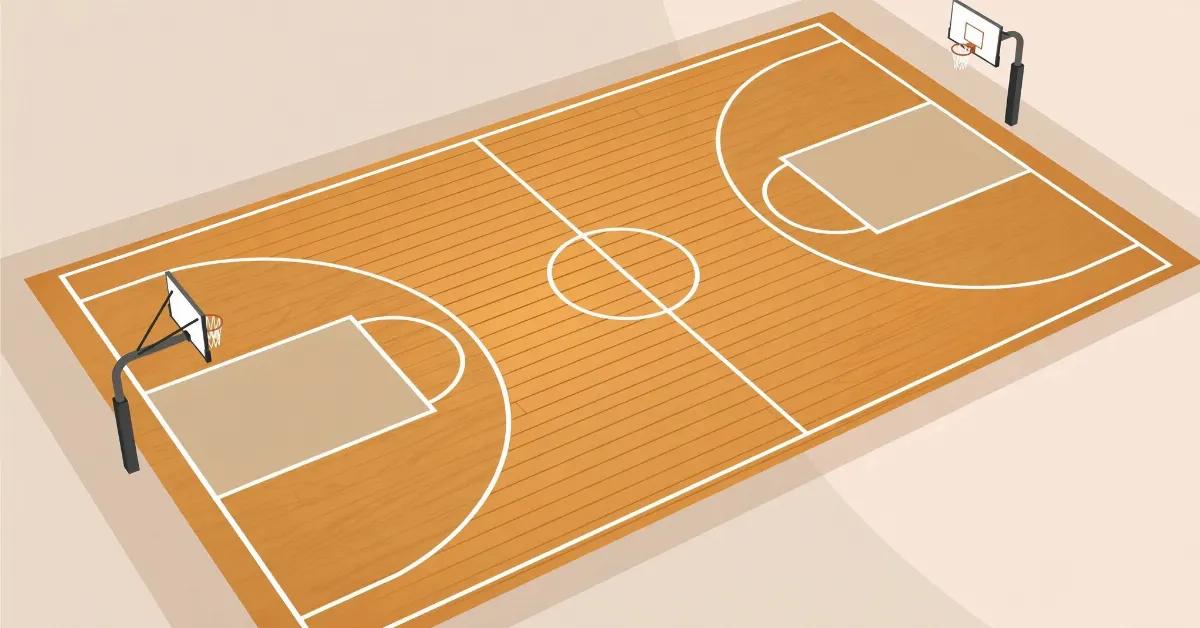
An official NBA basketball court measures 94 feet long by 50 feet wide, with the hoop hanging exactly 10 feet above the playing surface. The three-point line sits 23.75 feet from the basket at the top of the arc and 22 feet in the corners, the free-throw line is 15 feet from the backboard, and the painted key is 16 feet wide. These are not rounded numbers made up for television. Every NBA arena floor is built to this exact specification, and the distances are checked with tape measures and laser tools before the season begins, so a game played in one city feels identical to a game played in another.
Basketball is a game of precise geometry. Every stripe on the hardwood — the half-court line, the arcs around each basket, the rectangle of paint under the hoop — sits at a measured distance that quietly shapes how the sport is played. Shooters build their range around fixed distances, coaches design entire defenses around the width of the key, and the players themselves develop an instinctive feel for exactly how far 23.75 feet is. Once you know the official numbers, you start seeing the game differently: every cut, every closeout, and every shot happens inside a rectangle that never changes.
In this guide, we will walk through every official NBA court measurement, explain what each marking actually does, convert the key distances into metric units, compare a full court with a half court, and finish by showing how college and high-school courts differ from the professional standard. Here is the quick version up front.
| Measurement | Official NBA dimension |
|---|---|
| Overall court length | 94 feet |
| Overall court width | 50 feet |
| Total playing area | 4,700 square feet |
| Hoop height | 10 feet above the floor |
| Three-point line (top of the arc) | 23.75 feet from the basket |
| Three-point line (corners) | 22 feet from the basket |
| Free-throw line | 15 feet from the backboard |
| Key (paint) width | 16 feet |
1. The Official NBA Court: 94 Feet Long, 50 Feet Wide
Picture the court from above, the way it looks on a broadcast when the camera pulls back. You are looking at a perfect rectangle, 94 feet from baseline to baseline and 50 feet from sideline to sideline. The two long edges are the sidelines, and the two short edges behind each basket are the baselines. A stripe across the exact middle — the half-court line, also called the midcourt line — divides the rectangle into two identical 47-foot halves, and a circle painted at the very center of the floor marks the spot where every game begins with the opening tip.
The total playing surface works out to 4,700 square feet (94 multiplied by 50), and the perimeter of the court measures 288 feet all the way around. In metric terms, which international fans and FIBA-influenced programs often use, the court is about 28.65 meters long and 15.24 meters wide — the 50-foot width converts to a clean 15.24 meters, while the 94-foot length lands on 28.65 meters. If you ever decide to mark out a court yourself on a driveway or a gym floor, a 100-foot tape measure is the right tool for the job, and our guide on how to read a measuring tape will help you read the foot and inch markings accurately before you paint a single line.
The boundary lines themselves matter more than most fans realize. Step on or over a sideline or baseline while holding the ball and you are out of bounds — the whistle blows and possession changes. That is why the 94-by-50 dimensions are measured to the inside of the boundary lines: the playing area is the space within them, and every arena keeps its lines crisp and exactly placed so there is never any doubt about where the court ends and the out-of-bounds area begins.
| Official measurement | Feet | Meters |
|---|---|---|
| Court length | 94 ft | 28.65 m |
| Court width | 50 ft | 15.24 m |
| Half-court length | 47 ft | 14.33 m |
| Three-point line (top of arc) | 23.75 ft | 7.24 m |
| Three-point line (corners) | 22 ft | 6.71 m |
| Key width | 16 ft | 4.88 m |
| Free-throw line | 15 ft | 4.57 m |
| Hoop height | 10 ft | 3.05 m |
2. The Hoop: 10 Feet Above the Floor
The single most famous measurement in basketball is the height of the rim: 10 feet above the playing surface, in every NBA arena, with no exceptions. The number is so deeply woven into the sport that players describe their jumping ability relative to it — touching the top of the backboard or getting your head near rim level only means something because the rim itself never moves. Ten feet is high enough that dunking requires genuine athleticism, yet low enough that a well-placed layup or a soft jump shot drops through cleanly.
The backboard stands just in front of the baseline, and the rim extends out over the court from the bottom of the board. This geometry is what makes the free-throw line meaningful: the stripe is painted 15 feet from the backboard, so when a shooter steps up for free throws, the basket itself sits a touch beyond that mark. It is a fixed, repeatable distance — the same in every arena — which is exactly why free-throw shooting is considered a pure skill. Nothing about the setup changes from night to night; only the shooter does.
Ten feet also defines the physical scale of everything around it. A regulation rim looks surprisingly small when you stand under it and look straight up, and the 10-foot height is why even tall players have to jump to dunk — very few people can reach that high flat-footed. During a game, players sprint the 94-foot length of the floor over and over again, and coaches often track that conditioning work in miles rather than court lengths. If you want to convert those running distances, our breakdown of what a mile is covers the exact feet and meters involved.
3. The Three-Point Line: 23.75 Feet (22 Feet in the Corners)
The three-point line is the most strategically important marking on the floor, and its shape surprises people who see it up close for the first time. Measured from the center of the basket, the arc reaches its maximum distance of 23.75 feet at the top, directly in front of the hoop. But as the arc sweeps toward the sidelines, it runs out of room — the court is only 50 feet wide — so the line straightens out and runs parallel to each sideline, where the distance from the basket drops to 22 feet in the corners.
That 1.75-foot difference between the top of the arc and the corners shapes modern offense. The corner three is the shortest three-point shot in the game, which is why you constantly see shooters camped in the corners while the ball swings around the perimeter. Defenses, in turn, have to stretch all the way out to 23.75 feet to contest shots at the top, which opens driving lanes and passing angles underneath. The entire geometry of spacing in today’s game flows from those two numbers.
For players, 23.75 feet is a distance learned by repetition rather than measurement. Nobody paces it off during a game; thousands of practice shots build an instinct for where the line is. But the line has to be painted with total precision, because a toe on the line turns a three-pointer into a two-pointer. Arena crews measure the arc from the exact center of the rim — not from the front of the rim or the backboard — so the 23.75-foot and 22-foot distances hold true from every angle around the basket.
| Measurement | Full court | Half court |
|---|---|---|
| Length | 94 feet | 47 feet |
| Width | 50 feet | 50 feet |
| Playing area | 4,700 square feet | 2,350 square feet |
| Baskets | 2 | 1 |
| Three-point arcs | 2 | 1 |
| Painted keys | 2 | 1 |
| Free-throw lines | 2 | 1 |
4. The Key and Free-Throw Line: 16 Feet Wide, 15 Feet Out
The key — the painted rectangle under each basket, usually called “the paint” — is 16 feet wide in the NBA, stretching from the baseline out to the free-throw line. The free-throw line itself is painted 15 feet from the backboard, forming the top edge of the rectangle. Together, the 16-foot width and the 15-foot depth define the most crowded real estate in basketball: the area where centers battle for rebounds, guards cut for layups, and games are so often decided.
The free-throw line at 15 feet is the great equalizer of the sport. Every free throw in every NBA game is shot from the identical distance, with no defender allowed to interfere. It is close enough that professional players are expected to make them at a high rate, yet far enough — and mentally demanding enough — that misses happen at the worst possible moments. When commentators call them “free” throws, they mean the shot is undefended, not that it is easy.
The 16-foot width of the paint matters most on defense and on the glass. It is wide enough for post players to establish position on either block, and wide enough that help defenders have real ground to cover when rotating. Youth and amateur courts sometimes paint narrower keys, which changes the geometry of the game more than you might expect — post moves, entry passes, and rebounding angles all shift when the rectangle shrinks. The NBA’s 16-foot version is the roomiest in common use, built for the biggest and most athletic players in the world.
5. How College and High-School Courts Differ
The headline numbers in this guide — 94 feet by 50 feet, a 10-foot rim, a 15-foot free-throw line — describe the NBA standard, but the college and high-school games are played on floors with their own specifications. The overall shape is familiar, and many of the core distances carry over, but the two areas where the levels diverge most are the width of the painted key and the distance of the three-point arc. The NBA uses the widest key of the three at 16 feet, along with the deepest three-point arc at 23.75 feet (22 feet in the corners).
College and high-school courts use narrower lanes and shorter three-point arcs, which subtly changes how the game plays. A narrower key compresses post play and rebounding battles into tighter quarters, while a shorter arc brings long-range shooting within reach of younger, still-developing players. None of this is accidental — each level’s dimensions are tuned to the size, strength, and skill of the athletes playing on them, the same way youth soccer fields and little-league diamonds are scaled down from the professional versions.
One more difference worth knowing is that not every court you play on follows any of these standards exactly. Driveway hoops, schoolyard blacktops, and church-gym floors are often squeezed into whatever space was available, so the three-point arc might be a little short or the key might be narrower than 16 feet. That is completely fine for a pickup game, but it is also why shooting can feel so different from one gym to the next. When players say a court feels “small” or “tight,” they are usually sensing small deviations from the official 94-by-50 template without quite realizing it.
If you are marking out a court at home, at a school, or for a community league, it is worth deciding which standard you are building to before you paint. Most casual builders copy the NBA dimensions because they are the most widely recognized: 94 by 50, 10-foot rims, the full 23.75-foot arc. Whatever you choose, measure twice — a court that is a foot short at one end will feel wrong to anyone who has played on a regulation floor, even if they cannot quite say why.
Frequently Asked Questions
How long is an NBA basketball court in feet?
An NBA court is 94 feet long from baseline to baseline and 50 feet wide from sideline to sideline. The half-court line divides it into two 47-foot halves, and the total playing area is 4,700 square feet.
How high is the hoop in the NBA?
The rim sits exactly 10 feet above the playing surface in every NBA arena. The backboard is mounted just in front of the baseline, with the rim extending out over the court.
How far is the three-point line in the NBA?
The NBA three-point line is 23.75 feet from the center of the basket at the top of the arc. In the corners, where the court is only 50 feet wide, the line straightens out and the distance drops to 22 feet.
How wide is the key on an NBA court?
The painted key is 16 feet wide, running from the baseline out to the free-throw line, which is painted 15 feet from the backboard. It is the widest lane used at any major level of the game.
Is a high-school court smaller than an NBA court?
An NBA court is 94 feet long and 50 feet wide, which is the largest standard in common use. High-school and college courts share many of the same markings, but their painted keys are narrower and their three-point arcs sit closer to the basket than the NBA’s 23.75-foot arc. If you grew up playing on a school court and then step onto an NBA-sized floor, the extra space is the first thing you notice.
Final Thoughts
The beauty of the NBA court is that nothing about it is arbitrary. The 94-by-50 rectangle, the 10-foot rim, the 23.75-foot arc that tightens to 22 feet in the corners, the 15-foot free-throw line, and the 16-foot-wide key all work together as a single designed space. Every measurement earns its place: the width creates corner threes, the depth creates fast breaks, and the fixed distances let skill — not guesswork — decide games. The next time you watch a game, notice how rarely anyone thinks about the lines. That invisibility is the point. When the measurements are exactly right, in every arena, the court disappears and only the basketball remains.

Hi, I’m Vera Lindqvist, a content writer at MeasuresIt.com, where I turn measurement standards, unit conversions, and precision tools into clear, practical guides. I care about getting the details right so you don’t have to second-guess them.