Standard Bathtub Dimensions: Alcove, Freestanding & Corner
Introduction
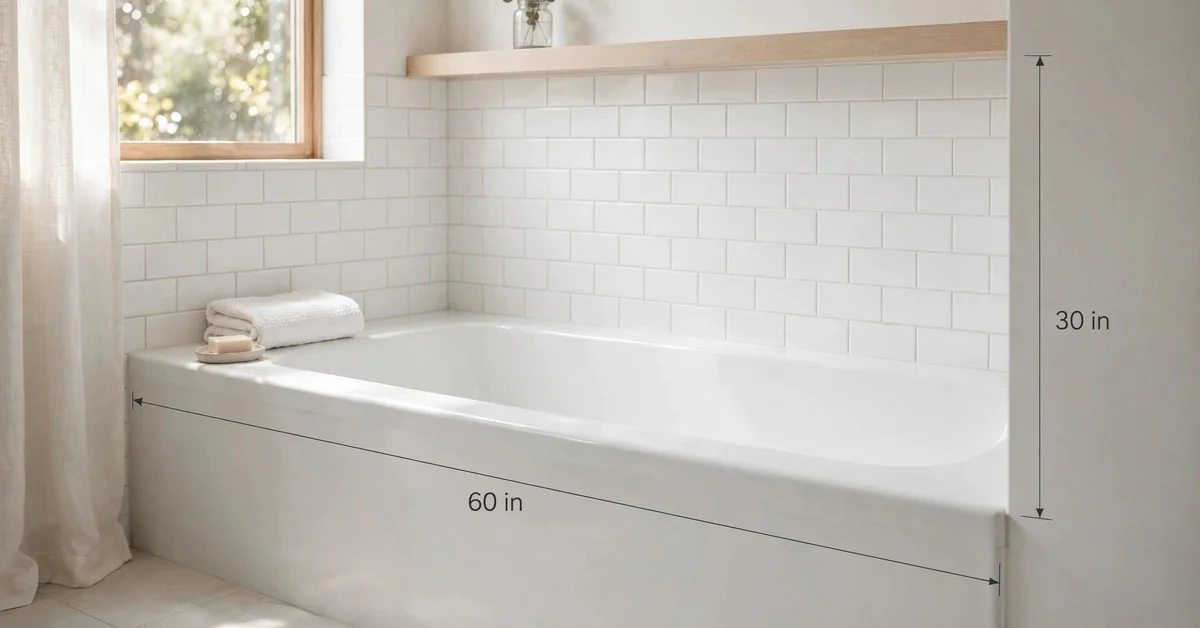
Few bathroom projects go wrong as fast as one where the tub does not fit. A bathtub that is two inches too wide can mean tearing out a wall, and one that is too short leaves an awkward gap along the tile. A standard alcove bathtub is 60 inches long, 30 inches wide, and about 14 inches deep. Those three numbers cover the most common tub sold in North America and fit the classic 60-inch alcove framed into most bathrooms.
Remodelers measure the rough-in before they order tile, and homeowners buying freestanding or corner models need to know the floor space each style demands. The 60-inch length converts to exactly 5 feet, or about 152 centimeters, which is why the standard tub is often called the “5-foot tub.” This guide walks through every common style, from alcove and drop-in tubs to freestanding soaking models, with real measurements you can plan around.
Bathtub Dimension Conversion Chart
| Unit | Standard Alcove Tub |
|---|---|
| Length | 60 in ≈ 5 ft ≈ 152.4 cm |
| Width | 30 in ≈ 2.5 ft ≈ 76.2 cm |
| Depth | 14–16 in ≈ 1.2–1.3 ft ≈ 35.6–40.6 cm |
Common Objects That Are About 60 Inches
| Object | Approximate Length |
|---|---|
| 5-foot Christmas tree | 60 in tall |
| Queen-size mattress width | 60 in wide |
| 60-inch TV screen | 60 in diagonal |
| Tall office filing cabinet | 60 in tall |
| Standard writing desk | 60 in long |
| A five-foot-tall adult | 60 in tall |
| Standard loveseat | 60 in wide |
| 63-inch curtain panel | 63 in long |
More Everyday Items Around 60 Inches
| Item | Approximate Size |
|---|---|
| Soaking tub | 66–72 in long |
| Standard refrigerator | 67 in tall |
| Tall standing mirror | 60 in tall |
| Freestanding bathtub | 67 in long |
| Tall bookshelf | 60 in tall |
| 60-inch double door opening | 60 in wide |
| Corner bathtub | 48 × 48 in |
How Big Is a Standard Bathtub?
A standard bathtub is 60 inches long, which is exactly 5 feet. That is about the height of a short adult woman, or roughly the width of a queen-size mattress. Most adults can stretch out in a standard tub with their knees slightly bent, though taller bathers may wish for a 66-inch soaking model.
The tub feels roomy because it is also 30 inches wide, giving about 2.5 feet of side-to-side space. Compare that with a corner tub at 48 inches square: shorter in length but noticeably wider, with more floor space swallowed up. A freestanding tub at roughly 67 inches sits a little larger than the standard, closer in feel to a tall refrigerator laid on its side.
Easy Ways to Estimate 60 Inches in Everyday Life
- Lie flat against the floor — 60 inches is the length of a standard tub, and roughly the height of a five-foot-tall adult lying down.
- Picture a loveseat — most two-seat loveseats run about 60 inches wide, nearly the same as a standard tub is long.
- Look at a tall filing cabinet — the standard five-drawer cabinet stands about 60 inches, end to end with a 5-foot tub.
- Measure your desk — many home office desks are 60 inches long, matching a standard tub almost exactly. Learning how to read a measuring tape makes these quick checks easy.
- Think of a 60-inch TV — the diagonal of a 60-inch screen equals the length of a standard bathtub, inch for inch.
- Use a doorway as a guide — standard double-door openings are 60 inches wide, the same footprint a standard tub occupies along a wall.
1. Alcove Bathtub: The 60 × 30 × 14-Inch Standard
The alcove tub is the workhorse of American bathrooms, framed on three sides and finished with a shower surround on top. At 60 inches long and 30 inches wide, it drops neatly into the standard 60-inch alcove that builders frame into most full bathrooms. The depth usually runs 14 to 16 inches, measured from the rim down to the drain, which holds enough water for a comfortable soak without splashing over the sides. Most manufacturers also make compact 54-inch and apartment 48-inch versions, but the 60-inch model dominates new construction. Its outside length of exactly 5 feet makes it the easiest tub to plan tile, backer board, and plumbing around.
2. Freestanding Bathtub: About 67 × 32 Inches
Freestanding tubs stand alone in the middle of a bathroom or against a single wall, finished on all sides. They typically run about 67 inches long and 32 inches wide, a bit roomier than the standard alcove tub. That extra length suits taller bathers who want to stretch out, and the deeper basins, often 18 inches or more, hold more water. The trade-off is floor space: a freestanding tub needs clearance on every side for cleaning and access, so it works best in bathrooms at least 7 feet across. The tub faucet usually stands on the floor beside it, which adds to the plumbing plan.
3. Drop-In Bathtub: 60 × 32 Inches
A drop-in tub sits into a framed deck or platform, with only its rim and interior visible. Most drop-in models measure about 60 inches long and 32 inches wide, a couple of inches wider than the alcove standard. The deck around it gives a handy shelf for soap and candles, and the tub itself tends to run 14 to 18 inches deep. Because the deck hides the tub’s sides, drop-ins work well in larger bathrooms where the platform becomes a design feature. Builders usually frame the deck opening a hair larger than the tub’s rim, so measure the rim, not the basin, when you plan the cutout.
4. Corner Bathtub: 48 × 48 Inches
Corner tubs nest into a 90-degree corner, forming a triangle or rounded square that fills the corner of a bathroom. The typical model measures about 48 by 48 inches, so it is a full foot shorter than a standard tub but nearly twice as wide. That square footprint eats a chunk of floor space, which is why corner tubs show up mostly in larger master bathrooms. The depth is generous, often 18 to 22 inches, making them deep soakers despite the shorter length. Two bathers can share many corner models comfortably, though the faucet placement in the corner takes some planning.
5. Soaking Tub: 66 to 72 Inches Long
Soaking tubs trade length for depth, running 66 to 72 inches long with basins 18 inches or deeper. The most common sizes are 66 inches, about the height of a tall refrigerator, and 72 inches, a full 6 feet. These tubs suit taller bathers who find a standard 60-inch tub cramped, and the extra depth covers the body better. A soaking tub holds significantly more water, so check the floor’s weight rating and the water heater’s capacity before installing one upstairs. Freestanding soaking models need the same all-around clearance as any freestanding tub, while alcove-style soaking tubs drop into a slightly longer framed opening.
6. Door Opening Minimum: 60 Inches
The smallest doorway a standard tub can pass through is 60 inches wide for a tub moved straight in lengthwise, which is why tubs ship before interior doors go up in new construction. Most bathroom doors are only 30 to 32 inches wide, so a full-size tub cannot pass through them after the fact. When replacing a tub in a finished bathroom, installers often bring the new tub in through a removed wall or order a sectional tub. If you are planning a remodel, confirm the largest object that fits through every hallway and doorway on the path, or you may find your new tub stuck in the living room. Standard double door openings run 60 inches wide, the same length as a classic tub. For help comparing common openings, see the guide to standard door size.
7. 5-Foot Christmas Tree: 60 Inches Tall
A five-foot Christmas tree stands exactly 60 inches tall, the same as a standard bathtub is long. That makes it a surprisingly handy visual reference when you are sizing up a bathroom. If you have a 5-foot tree from the holidays, lay it along the wall where the tub will go and you can see the footprint at a glance. The tree’s width spreads wider than a tub, so picture only the trunk line for the comparison. Artificial 5-foot trees are one of the most common holiday sizes, and most real farm-grown trees cut for apartments run close to the same height.
8. Queen-Size Mattress Width: 60 Inches Wide
A queen-size mattress measures 60 inches across, matching a standard bathtub’s length inch for inch. Anyone who has wrestled a queen mattress up a staircase knows what 60 inches feels like, and that muscle memory helps when you judge whether a tub will fit a space. The mattress is 80 inches long, so it stretches well past a tub’s length, but its width alone tells the story. Memory foam, innerspring, and hybrid queens all share the same 60-inch width by industry standard. Next time you make the bed, picture the mattress standing on end along the bathroom wall to size up the tub footprint. Queen, king, and twin measurements are covered in detail in the bed sizes in inches guide.
9. 60-Inch TV Screen: 60 Inches Diagonal
A 60-inch television measures 60 inches diagonally from corner to corner, exactly the length of a standard bathtub. The actual cabinet runs wider than 60 inches, but the screen diagonal itself is the match. This reference is handy because so many people have a large flat-screen mounted on a wall; hold your arm across that diagonal and you have the tub’s length. Bigger 65- and 70-inch screens run a few inches longer, which is close to the 67-inch length of a typical freestanding tub. Since TVs are measured on the diagonal, remember that a tub’s 60 inches runs straight along its length, not at an angle.
10. Tall Office Filing Cabinet: 60 Inches Tall
The classic five-drawer lateral filing cabinet stands about 60 inches tall, matching a standard tub end to end. Offices have used this 60-inch height for decades because it fits under most dropped ceilings while holding five full drawers of letter-size files. If you have one in a home office, run your eye from its top to the floor to feel what 60 inches looks like in a room. The cabinet’s narrow footprint, usually about 18 inches deep, is much slimmer than a tub’s 30-inch width, so it only matches the length. Shorter four-drawer cabinets run about 52 inches, noticeably shy of tub length.
11. Standard Writing Desk: 60 Inches Long
Many home office desks run 60 inches long, the same as a standard bathtub. That length comfortably holds a monitor, keyboard, and lamp with room left over, and it also happens to be one of the most popular desk sizes sold online. If your desk is the standard 60-by-30-inch model, its 30-inch depth matches a tub’s width too, giving you a full tub outline on the floor. Measure your desk to confirm; desks also come in 48-, 55-, and 72-inch lengths, and a quick check with a tape keeps the comparison honest. This is one of the easiest references for anyone working from home.
12. A Five-Foot-Tall Adult: 60 Inches Tall
An adult who is 5 feet tall measures exactly 60 inches, the length of a standard bathtub. Standing such a person at the head of the tub gives an instant visual of the tub’s full length, head to toe. About one in ten adult women in the United States stands around 5 feet, so this reference is not hard to find. The comparison also explains why taller bathers feel cramped in a standard tub: anyone over 5 feet long has to bend their knees. A 6-foot adult would need the 72-inch soaking model for a straight-leg soak, which is why soaking tubs exist.
13. Standard Loveseat: 60 Inches Wide
Most two-seat loveseats measure about 60 inches wide, nearly identical to a standard bathtub’s length. That width seats two people shoulder to shoulder, which is why furniture makers settled on it. If your living room has a loveseat, pace off its width and you have felt the tub’s length without lifting a finger. Loveseats also run about 30 to 36 inches deep, close to a tub’s 30-inch width, so the seat cushion alone hints at the tub’s footprint. Sectional sofas run longer, but the humble loveseat stays near that 60-inch mark across most brands.
14. 63-Inch Curtain Panel: Close to 60 Inches
Standard curtain panels sold in 63-inch lengths hang just 3 inches past the 60-inch mark, making them a close everyday reference. The 63-inch length is designed for windows in rooms with 8-foot ceilings, and nearly every home goods store stocks it. Hold a 63-inch panel against a wall and imagine trimming a hand’s width off the bottom to reach tub length. Because curtains flex and drape, they are less precise than a desk or filing cabinet, but they still beat guessing. The next common sizes, 84 and 96 inches, run far longer than any standard tub.
15. Tall Standing Mirror: 60 Inches Tall
A tall leaning or standing floor mirror typically runs about 60 inches high, matching a standard tub’s length. These mirrors show most adults from head to toe when leaned against a wall, which is why the 60-inch height is so common. If you have one in a bedroom, walk up to it and note where the 60-inch mark falls on your own height. Leaning mirrors are usually about 20 inches wide, slimmer than a tub, so they match length only. Full-length cheval mirrors on stands can run a few inches taller, closer to the 67-inch freestanding tub length.
Frequently Asked Questions
What is the most common bathtub size?
The most common bathtub is the standard alcove tub at 60 inches long, 30 inches wide, and about 14 inches deep. It fits the 60-inch alcove framed into most bathrooms and suits the average bather.
How much water does a standard bathtub hold?
A standard 60-by-30-inch tub holds roughly 40 to 60 gallons of water, depending on depth and how full you run it. Larger soaking and freestanding models can hold 60 to 80 gallons or more. Water volume varies a lot between models, so check the tub’s spec sheet for the exact figure.
Will a standard tub fit through my bathroom door?
Usually not once the bathroom is finished. A 60-inch tub cannot pass through a standard 30-to-32-inch interior door, so installers bring tubs in before walls close or remove a wall section. Measure every doorway on the delivery path before ordering.
How deep should a bathtub be?
Standard alcove tubs run 14 to 16 inches deep, which suits most bathers. Soaking and corner tubs run 18 to 22 inches for a deeper bath. Deeper tubs hold more water and take longer to fill, so match the depth to your water heater’s capacity.
Final Thoughts
Bathtub dimensions come down to one familiar number: 60 inches. The standard alcove tub runs 60 inches long and 30 inches wide, with freestanding, drop-in, corner, and soaking models each shifting those numbers to suit different bathrooms and bathers. Whether you are replacing an old tub, planning a remodel, or just curious how big a 5-foot tub really is, picturing a loveseat, a tall filing cabinet, or a five-foot Christmas tree gives you the length in a glance. Measure the space, check the doorway path, and confirm the depth against your water heater before you buy. With the right numbers in hand, the tub you order is the tub that fits, and your bathroom project stays on track from rough framing to the first soak.

Hi, I’m Vera Lindqvist, a content writer at MeasuresIt.com, where I turn measurement standards, unit conversions, and precision tools into clear, practical guides. I care about getting the details right so you don’t have to second-guess them.